
Contents
Introduction & Spiritual Essence: The Waters of Lord Shiva
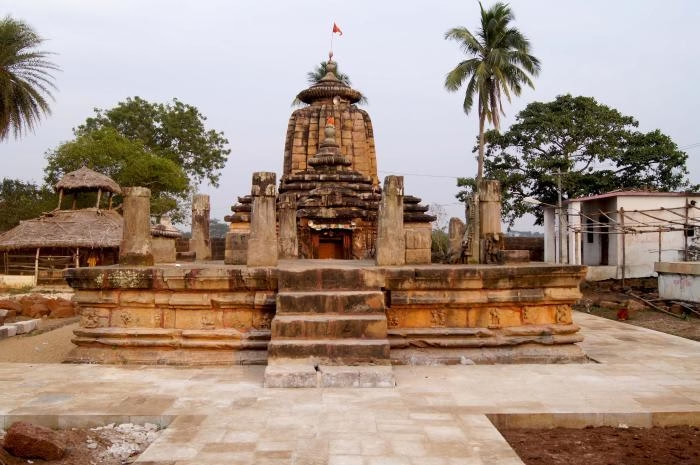
In the heart of Bhubaneswar, the temple city of India, lies a sanctuary that echoes the ancient rituals of the Swayambhu (self-manifested) form of Lord Shiva. The Jaleswar Siva Temple is not merely a structure of stone; it is a spiritual abode where the divine resides as Jalasayi—the Lord resting upon the waters. Located near the village of Kalarahanga, this 12th-century temple precinct is a testament to the unwavering devotion of the Eastern Ganga dynasty.
Phalaśruti: The Benefits of Darshan
Why do devotees flock to this secluded precinct? According to local lore and scriptural belief, the Jaleswar Shiva is the granter of wishes and the remover of sins. The primary spiritual significance lies in the Phalaśruti (benefits of worship):
- Ancestral Liberation: Devotees believe that offering prayers here cleanses ancestral karma, aiding in the Pitra Dosh Nivaran for departed souls.
- Protection from Water Elements: As the presiding deity is situated near a sacred pond, worship here is believed to ward off ailments related to water and ensure harmony with nature.
- Mental Equanimity: The serene ambiance, juxtaposed against the bustling city, offers a unique spiritual energy for meditation and inner peace.
Historical Origins & Scriptural Legend
The Jaleswar Siva Temple precinct dates back to the 12th Century A.D. Built during the zenith of the Eastern Ganga dynasty, the temple exemplifies the transitional phase of Odishan temple architecture. While the Lingaraja Temple dominates the city center, Jaleswar offers a more intimate, contemplative historical narrative.
The Legend of Chudangagada
Tradition holds a captivating local legend (Sthala Purana) regarding the temple’s origin. The King of Chudangagada was a devout devotee of Lord Lingaraja. However, the heavy monsoons made the daily commute to the main city arduous.
According to temple records and oral history, the Lord appeared in the King’s dreams, instructing him not to despair. Shiva revealed that he dwelt as a Jalasayi (a form resting on water) in a neighboring lotus pond. He commanded the King to construct a temple there so that the daily rituals would not be interrupted. The King obeyed, building the present temple on the western embankment of the Jalesvara pond. To sustain the temple’s rituals, land grants were issued to the Brahmins of Rahanga Sasan, leading to the area being named Kalarahanga.
Architectural Marvels: Kalinga Style
The temple is a masterpiece of Kalinga architecture, characterized by its towering spire and intricate carvings. The precinct comprises several structures, each serving a specific ritualistic purpose.
The Vimana (Sanctum Sanctorum)
The central shrine (Rekha order) stands tall at approximately 12.35 meters. It follows the traditional Kalinga Pancha Ratha plan:
- Bada: The vertical base stands 2.87 meters high, divided into five sections (Pabhaga, Tala Jangha, Bandhana, Upara Jangha, and Baranda).
- Gandi: The curvilinear spire rises 6.48 meters, adorned with a central Raha niche flanked by Anuratha and Kanika pagas.
- Mastaka: The crowning element (3.00 meters) features the Bekhi, Amlaka, and Kalasa.
Parsva Devatas (Guardian Deities)
The sanctum’s outer walls feature niches with carved deities, a hallmark of 10th–11th-century temples:
- South Niche: Lord Ganesha stands in a tribhanga pose, holding an axe, rosary, and modak (sweet offering). The mouse mount is visible on the pedestal.
- East Niche: Kartikeya (Murugan) is depicted with four arms, holding a rooster and spear.
- North Niche: Mahisasuramardini (Durga) is the guardian of this side. The 10-armed goddess is shown slaying the buffalo demon, with attendant demons Sumbha and Nisumbha at the base.
Jagamohana and Nata Mandira
The Jagamohana (assembly hall) is a later addition, built in the Pidha style (pyramidal roof), similar to the Parsuramesvara temple. At a short distance lies the Nata Mandira (dance hall), used for ritualistic performances and offering flowers to the deity.
Darshan & Ritual Logistics
The Jaleswar Temple follows a strict traditional schedule. While it is less crowded than Lingaraja, the atmosphere is deeply meditative during specific Abhishekam times.
Daily Darshan Timings (2026 Schedule)
| Session | Time Slot | Description |
|---|---|---|
| Morning | 06:00 AM – 12:00 PM | Mangala Alati, Abhishekam, and Morning Puja. |
| Afternoon | 12:00 PM – 04:00 PM | Sandhya Alati (Intermittent) and Temple Cleaning. |
| Evening | 04:00 PM – 08:00 PM | Evening Arati and Bhoga offering. |
Key Sevas & Booking
Devotees can perform specific Sevas (rituals) which require prior arrangement:
- Abhishekam: Ritual bathing of the Shiva Lingam with water, milk, and honey.
- Archana: Recitation of the 108 names of Lord Shiva.
- Mahabishekam: Performed during festivals (see below).
Note on Online Seva: While the local temple trust manages daily rituals, major festivals utilize the state-level Odisha Temple Management System (OTMS) for bookings.
Major Festivals in 2026
- Shivaratri (Feb 26, 2026): The most significant event. The temple remains open all night, with special lighting and Rudra Homam.
- Ratha Yatra (July 13, 2026): While primarily associated with Jagannath, the chariot procession passes near the precinct area.
- Diwali/Kartik Purnima (Nov 5, 2026): Deep lighting and Khichdi Prasad offering.
Practical Visitor Guidance
Visiting the Jaleswar Siva Temple requires respect for local customs and an awareness of the environment.
Rules & Etiquette
- Dress Code: Traditional Indian attire is preferred. Men should wear dhoti or trousers with a shirt; women should wear saree, salwar kameez, or long skirts. Avoid shorts and sleeveless tops.
- Photography: Photography is restricted inside the sanctum and the inner Jagamohana. You may photograph the exterior architecture and the Nata Mandira.
- Mobile Phones: Electronic devices are generally allowed but must be switched to silent mode. Lockers are not available on-site, so travel light.
Crowd Management & Seasonal Advice
- Best Time to Visit: Early mornings (6:00 AM – 8:00 AM) offer the most peaceful Darshan.
- Summer (April – June): Bhubaneswar gets extremely hot. Carry a water bottle, umbrella, and cotton handkerchief. Seek shade in the Nata Mandira complex.
- Monsoon (July – September): The temple area is near a pond; waterlogging can occur. Wear waterproof sandals.
Pilgrimage Connectivity
The temple is located on the southern outskirts of Bhubaneswar, making it accessible via the airport corridor.
How to Reach
- Nearest Airport: Biju Patnaik International Airport (BBI) is approximately 12 km away (20–25 mins by taxi via NH16).
- Nearest Railway Station: Bhubaneswar Railway Station (BBS) is roughly 9 km away.
- By Road: Located near Patia and Kalarahanga. The temple is accessible via the service lanes of NH 16 (formerly NH 5). Public buses heading towards Patia/Chudangagada stop at the nearest junction.
Nearby Sacred Sites (Pilgrimage Circuit)
- Lingaraja Temple (6 km): The primary deity of Bhubaneswar and the architectural pinnacle of Kalinga style.
- Mukteswar Temple (5 km): Famous for its ornate torana (archway) and detailed carvings.
- Udayagiri & Khandagiri Caves (8 km): Ancient Jain rock-cut caves that predate the temple era, offering a historical contrast.
Frequently Asked Questions (FAQ)
Is there a VIP darshan entry at Jaleswar Temple?
No, the Jaleswar Siva Temple does not have a designated VIP entry lane. Darshan is general and open to all devotees. However, visiting during early morning hours ensures a quick and peaceful Darshan.
What is the entry fee for Darshan?
General Darshan is free of cost. However, specific Sevas like Abhishekam or Archana may have a nominal fee (ranging from ₹50 to ₹500 depending on the ritual), which is paid at the temple office counter.
Is the temple accessible for differently-abled visitors?
The outer complex and Nata Mandira are relatively flat, but the main sanctum involves steps. There is no ramp facility currently, so assistance may be required for wheelchair users.
Are non-Hindus allowed inside?
Traditionally, entry to the sanctum of Shiva temples in Odisha is restricted to Hindus. Non-Hindu visitors can admire the exterior architecture and the precincts but should respect the rules regarding the inner sanctum.
Where can I park my vehicle?
There is a small designated parking area near the temple entrance. During festivals, parking fills up quickly; it is advisable to use ride-sharing services or public transport.
Recent Posts

Shri Kaamkoteeshwar Mandir, Varanasi – History & Significance
In the heart of Kashi, the eternal city of Lord Shiva, where the Ganges flows with celestial grace, stands the Shri Kaamkoteeshwar Mandir. This sacred Sannidhi is not merely a temple but a profound spiritual bridge between the Northern…

ओ सांवरे तूने ही मुझको संभाला – Lyrics & Meaning
ओ सांवरे तूने ही मुझको संभाला – A Prayer to Shyam Origin & Spiritual Essence Why This Bhajan Resonates Devotees chant this when overwhelmed by life’s storms—the refrain ‘तूने ही मुझको संभाला’ is the soul’s sigh of relief: “You…

कथा ये है महाराज मेरे की – Lyrics & Meaning
कथा ये है महाराज मेरे की छत्रपति संभाजी महाराज – A Prayer to Chhatrapati Sambhaji Maharaj Origin & Spiritual Essence Why This Bhajan Resonates Devotees chant this when their spirit feels tested—its powerful refrain “महाराज मेरे” is a soul’s…

Rigveda Samhita Yathartha Anuvada (ऋग्वेद संहिता यथार्थ अनुवाद) – Complete Set with Anvayartha & Hindi/English Translation
The Rigveda is the oldest surviving scripture of humanity and the foundational text of Sanātana Dharma. For serious students, scholars, UPSC aspirants studying ancient Indian history, Sanskrit learners, and spiritual seekers, a precise and grammatically structured translation is indispensable.…

आना भी अकेला है जाना भी अकेला है – Lyrics & Meaning | BharatTemples
आना भी अकेला है जाना भी अकेला है – A Prayer to the Divine Witness Origin & Spiritual Essence Why This Bhajan Resonates Devotees turn to this bhajan in moments of deep reflection—when life’s attachments begin to ache. The…

माता शेरावाली के द्वार जो भी जाता है – Lyrics & Meaning
माता शेरावाली के द्वार जो भी जाता है – A Prayer to Maa Sherawali Origin & Spiritual Essence Why This Bhajan Resonates Devotees turn to this bhajan in times of fear or uncertainty—its promise that no one leaves Maa’s…

मार लेना सपणी उबार लेणा भवरा – Lyrics & Meaning
मार लेना सपणी उबार लेणा भवरा – A Prayer to the Divine Beloved Origin & Spiritual Essence Why This Bhajan Resonates Devotees chant this in moments of deep vulnerability—its cry of “मार लेना सपणी, उबार लेणा भवरा” is the…

हमें श्याम सुंदर भरोसा तुम्हारा – Lyrics & Meaning
हमें श्याम सुंदर भरोसा तुम्हारा – A Prayer to Shyam Sundar Origin & Spiritual Essence Why This Bhajan Resonates Devotees chant this when feeling alone—its refrain ‘de do sahara’ is the soul’s cry for divine support. Lyrics in Hindi…

Mere Satguru Ne Di Thi Davai Lyrics in Hindi & Meaning
Mere Satguru Ne Di Thi Davai: Invoking the Guru’s Liberating Wisdom This soul-stirring bhajan venerates the Satguru (True Spiritual Master) as the divine physician who dispenses the only remedy for life’s deepest sufferings. Composed by Sant Karmaveer Tufani, it…

Janm Diyo Thari Maa Dukh Dekhiyo Lyrics in Hindi & Meaning
जन्म दियो थारी माँ दुख देखियो (Maa’s Grief Upon Birthing You) This soul-stirring Chetavani Bhajan (admonitory hymn) is addressed to the Divine Mother (Maa) – a call for repentance when children forget their filial duties in the dark age…