
Contents
Introduction & Spiritual Essence
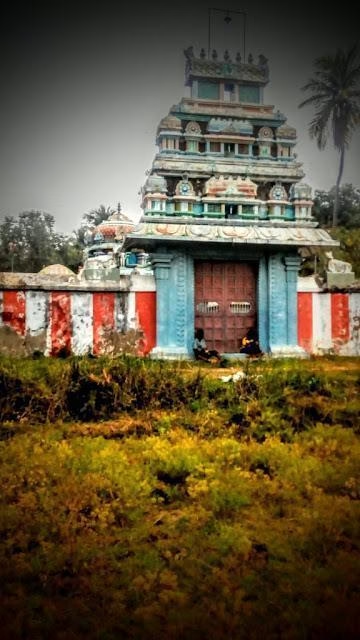
The Jambukeswarar Temple, nestled in the serene village of Nallicheri (also known as Nandi Mangai) near Thanjavur, stands as a profound testament to the mystical geography of Tamil Nadu. Dedicated to Lord Shiva in the form of Jambukeswarar (or Jambunathar), the presiding deity is revered alongside his consort, Akilandeswari.
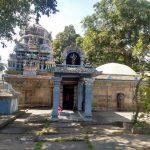
What sets this temple apart in the spiritual landscape is its orientation. Unlike traditional Shiva shrines where the deity faces East, the sanctum here faces West. According to the Sthala Purana, this unique alignment is symbolic of the Lord’s gaze upon the cremation grounds nearby, signifying the transient nature of the physical body and the eternal reality of the soul. It is believed that a visit here cleanses ancestral karma and offers the spiritual merit equivalent to a pilgrimage to Kashi (Varanasi).
Phalaśruti: The Fruits of Devotion
Devotees flock to Nallicheri to seek specific blessings from Lord Jambukeswarar:
- Mukthi (Liberation): As the temple is classified as a Mukthi Kshetram (liberation site), it aids in breaking the cycle of birth and death.
- Resolution of Pitru Dosha: The westward orientation makes it a powerful site for performing rites for ancestors.
- Removal of Sankata (Obstacles): Special prayers to Nandikeswara (the Nandi bull) are believed to remove life’s hurdles.
Historical Origins & Scriptural Legend
While specific dynastic records of construction are often obscured in the mists of rural antiquity, the temple is deeply rooted in the traditions of the Saptha Matrikas (seven divine mothers) associated with the Pasupathi Koil region of Thanjavur.
The Saptha Matrika Connection
According to temple records, this shrine is one of the seven sacred Sthalams surrounding Ayyampettai, each representing a different mother goddess. Jambukeswarar Temple is associated specifically with Mother Vaishnavi. The name Nandi Mangai suggests an ancient connection where the consort of Nandi (the gatekeeper) was worshipped here.
Local Legends
- The Nandi’s Penance: Tradition holds that Nandikeswara performed rigorous penance here to attain Panchakshara Siddhi (mastery over the five-letter mantra Na-Si-Va-Ya), a boon he sought after brushing against Shiva’s ankle ornament.
- Vaishnavi’s Origin: This temple highlights the harmonious convergence of Vaishnavism and Shaivism, as Mother Vaishnavi—born from the energies of Lord Vishnu—is enshrined here alongside the Shiva Lingam.
- Nandhi’s Ecstasy: A fascinating folklore recounts how Nandi, ecstatic merely by touching Shiva’s ankle ornament, yearned for the touch of the Lord’s lotus feet. Pleased by 1,008 Pradosha Poojas, Lord Shiva is said to have placed his foot on Nandi, a moment immortalized in sculptural art within the temple.
Architectural Marvels
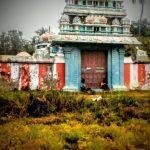
The temple is a quintessential example of Dravidian Temple Architecture, evolving through centuries of contribution from local artisans.
Dravidian Vastu Elements
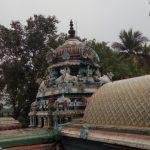
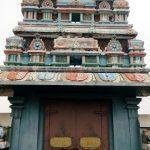
The temple is oriented strictly West, a rare architectural choice dictated by the mythological narrative. The Shikhara (tower) over the sanctum is modest but rich in symbolism, while the Mandapas (halls) feature intricate carvings.
- Irattai Vinayagar: Located at the southern entrance, this twin Ganesha shrine guards the temple gates.
- The Vowvaal Mandapam: The ceiling of this hall is adorned with vibrant paintings depicting the Pallipadai (resting place) motifs and owl iconography, representing the vehicle of Goddess Lakshmi.
- Sculptural Narratives: Sudhai work (stucco molding) vividly depicts the story of Nandi performing Pradosha Pooja.
- Organic Architecture: The Sthala Vriksham (sacred tree) is the Naval tree (Indian Jujube/Jambu), which directly inspires the name Jambukeswarar.
Photo Gallery

Darshan & Ritual Logistics
To ensure a seamless spiritual journey in 2026, refer to the daily schedule and seva bookings below.
Daily Temple Timings
| Session | Timing | Notes |
|---|---|---|
| Morning | 07:00 AM – 12:00 PM | Best time for Abhishekam |
| Evening | 04:00 PM – 07:00 PM | Ideal for peaceful Darshan |
Key Sevas & Online Booking
While this temple retains a traditional, non-commercial atmosphere, pilgrims can participate in standard daily rituals. Major offerings include:
- Morning Abhishekam: Performed with water, milk, and honey.
- Archana: Chanting of names accompanied by the Tamil Thevaram.
- Deepa Aradhana: Evening lamp offering.
Note: As of 2026, specific online bookings for smaller shrines in Nallicheri are often managed locally. For major festivals, coordinate with the Temple Trust Office in Pasupathikoil or Ayyampettai.
2026 Festival Calendar (Tentative)
- Maha Shivaratri: February 26, 2026
- Navarathri (Chaturthi): October 4, 2026 (Special Abhishekam for Vaishnavi)
- Aipasi Annabishekam: November 14, 2026
- Margazhi Tiruvadhirai: December 25, 2026
- Saptha Sthanam Festival: April (Panguni) – Grand procession with Kannadi Pallakku (mirror palanquin).
Practical Visitor Guidance
Visiting Nallicheri offers a rustic, authentic temple experience compared to the bustling crowds of major metros.
Visitor Etiquette
- Dress Code: Traditional attire is mandatory. Men should wear dhotis or trousers with shirts; women should wear sarees, salwar kameez, or long skirts.
- Photography: Strictly prohibited inside the sanctum sanctorum. Allowed in the outer praharams (corridors) for non-commercial purposes.
- Electronics: Mobile lockers may not be available on-site. It is advisable to carry minimal valuables.
- Accessibility: The temple features traditional stone steps and uneven flooring. It is moderately accessible for seniors with assistance.
Crowd Management & Seasonal Tips
- Best Hours: 8:00 AM to 10:00 AM or 5:00 PM to 6:30 PM to avoid the midday heat and ensure the sanctum is open.
- Seasonal Advice:
- Summer (April–June): Temperatures in Thanjavur can exceed 35°C. Carry a water bottle and an umbrella.
- Monsoon (Oct–Dec): Light rains occur; pack a raincoat.
Pilgrimage Connectivity
How to Reach
The temple is strategically located on the Thanjavur – Kumbakonam Road (SH 21 / SH 69).
- By Air: The nearest airport is Trichy International Airport (Tiruchirappalli), approximately 75 km away (1.5 hours by car).
- By Rail:
- Pasupathikoil Railway Station: 3 km (Branch line connected to Thanjavur).
- Ayyampet Railway Station: 6 km.
- Thanjavur Junction: 13 km (Major hub with frequent trains from Chennai and Trichy).
- By Road: Buses are frequent from Thanjavur and Ayyampettai. Private taxis and auto-rickshaws are available from Mathur (2 km) and Pasupathikoil.
Nearby Sacred Sites (The Spiritual Circuit)
Enhance your pilgrimage by visiting these nearby locations:
- Pasupathikoil Temple (Vayu Linga): Just 3 km away. One of the 9 Nava Lingas of Thanjavur district.
- Ayyampettai Karumarthanda Perumal Temple: The hub for the Saptha Matrika consort shrines.
- Thiruvaiyaru Panchanadeeswarar Temple: 12 km away. Famous for the Aathikesava Stalam and the Samadhi of Saint Thyagaraja.
Frequently Asked Questions (FAQs)
Is there a VIP darshan entry?
The Jambukeswarar Temple in Nallicheri is a community-centric shrine and generally does not have a commercialized VIP ticket system. Darshan is open to all devotees equally. However, if you are participating in a specific seva (like Abhishekam), you may enter the inner sanctum during the ritual.
What is the significance of Lord Shiva facing West?
In this temple, the west-facing orientation symbolizes the Lord overseeing the transition of souls. It is believed that this direction aligns with the path of Yama (the lord of death) and Shani (Saturn), thereby offering relief from ancestral sufferings and granting Mukthi.
Are there food facilities available?
While the temple does not have a large commercial canteen, basic Prasadam (offerings) like Pongal or Puliyodarai is often distributed during festivals. For meals, small eateries are available in Ayyampettai (3 km) and Pasupathikoil.
What is the connection to Saptha Matrikas?
This temple is one of seven shrines in the Thanjavur region dedicated to the seven mothers (Matrikas). Here, the focus is on Vaishnavi, representing the energy of Lord Vishnu, alongside the primary Shiva Lingam.
How old is the temple?
While exact construction dates are not etched, the architectural style and references to the Saptha Matrika circuit suggest the core structure dates back several centuries, with subsequent renovations carried out by local dynasties and devotees over time.
Recent Posts

ओ सांवरे तूने ही मुझको संभाला – Lyrics & Meaning
ओ सांवरे तूने ही मुझको संभाला – A Prayer to Shyam Origin & Spiritual Essence Why This Bhajan Resonates Devotees chant this when overwhelmed by life’s storms—the refrain ‘तूने ही मुझको संभाला’ is the soul’s sigh of relief: “You…

कथा ये है महाराज मेरे की – Lyrics & Meaning
कथा ये है महाराज मेरे की छत्रपति संभाजी महाराज – A Prayer to Chhatrapati Sambhaji Maharaj Origin & Spiritual Essence Why This Bhajan Resonates Devotees chant this when their spirit feels tested—its powerful refrain “महाराज मेरे” is a soul’s…

Rigveda Samhita Yathartha Anuvada (ऋग्वेद संहिता यथार्थ अनुवाद) – Complete Set with Anvayartha & Hindi/English Translation
The Rigveda is the oldest surviving scripture of humanity and the foundational text of Sanātana Dharma. For serious students, scholars, UPSC aspirants studying ancient Indian history, Sanskrit learners, and spiritual seekers, a precise and grammatically structured translation is indispensable.…

आना भी अकेला है जाना भी अकेला है – Lyrics & Meaning | BharatTemples
आना भी अकेला है जाना भी अकेला है – A Prayer to the Divine Witness Origin & Spiritual Essence Why This Bhajan Resonates Devotees turn to this bhajan in moments of deep reflection—when life’s attachments begin to ache. The…

माता शेरावाली के द्वार जो भी जाता है – Lyrics & Meaning
माता शेरावाली के द्वार जो भी जाता है – A Prayer to Maa Sherawali Origin & Spiritual Essence Why This Bhajan Resonates Devotees turn to this bhajan in times of fear or uncertainty—its promise that no one leaves Maa’s…

मार लेना सपणी उबार लेणा भवरा – Lyrics & Meaning
मार लेना सपणी उबार लेणा भवरा – A Prayer to the Divine Beloved Origin & Spiritual Essence Why This Bhajan Resonates Devotees chant this in moments of deep vulnerability—its cry of “मार लेना सपणी, उबार लेणा भवरा” is the…

हमें श्याम सुंदर भरोसा तुम्हारा – Lyrics & Meaning
हमें श्याम सुंदर भरोसा तुम्हारा – A Prayer to Shyam Sundar Origin & Spiritual Essence Why This Bhajan Resonates Devotees chant this when feeling alone—its refrain ‘de do sahara’ is the soul’s cry for divine support. Lyrics in Hindi…

Mere Satguru Ne Di Thi Davai Lyrics in Hindi & Meaning
Mere Satguru Ne Di Thi Davai: Invoking the Guru’s Liberating Wisdom This soul-stirring bhajan venerates the Satguru (True Spiritual Master) as the divine physician who dispenses the only remedy for life’s deepest sufferings. Composed by Sant Karmaveer Tufani, it…

Janm Diyo Thari Maa Dukh Dekhiyo Lyrics in Hindi & Meaning
जन्म दियो थारी माँ दुख देखियो (Maa’s Grief Upon Birthing You) This soul-stirring Chetavani Bhajan (admonitory hymn) is addressed to the Divine Mother (Maa) – a call for repentance when children forget their filial duties in the dark age…
Bhadi Sabha Mein Thane Manaun Lyrics in Hindi & Meaning
Bhadi Sabha Mein Thane Manaun: Invoking the Spear-Wielding Mother Mata Bhawani (श्री ज्वाला भवानी), the fiery manifestation of Shakti worshipped as the Protector of Dharma in Her Dhaulagarh sanctum. Origin & Spiritual Essence Composed in Rajasthani folk tradition by…