
Contents
Introduction & Spiritual Essence: The Adobe of Kailasanatha
While Palani is globally revered as the sacred abode of Lord Murugan, the Kailasha Nathar Temple offers a distinct, profound spiritual energy dedicated to Lord Shiva. Located in the heart of the temple town of Palani in the Dindigul district of Tamil Nadu, this ancient shrine stands as a testament to the region’s deep Shaivite roots.
The primary deity here is Kailash Nathar (an aspect of Lord Shiva), worshipped as a Swayambhu Linga (self-manifested) in the sanctum sanctorum. Facing East, the Lord is enshrined within a traditional granite structure that echoes the Dravidian architectural ethos, offering a serene counterpoint to the bustling devotion found elsewhere in the town.
Phalaśruti (The Fruit of Devotion):
Devotees visit the Kailasha Nathar Temple seeking relief from planetary afflictions, particularly those governed by Saturn (Shani) and the shadow planet Rahu. It is widely believed that offering sincere prayers here helps in cleansing ancestral karma (Pitra Dosha) and bestows mental peace, longevity, and stability in professional endeavors. The temple is particularly potent for devotees looking to overcome stagnation in life.
Historical Origins & Scriptural Legend
Dating and Construction:
According to temple records and epigraphic evidence found in the surrounding regions, the Kailasha Nathar Temple is believed to have been constructed during the Pandya dynasty era, likely between the 9th and 11th centuries. While the massive Palani Murugan Temple (Dhandayuthapani Swamy) underwent major expansions under the Nayak rulers (17th century), the Kailasha Nathar shrine retains older architectural elements, suggesting a foundational history that predates the Nayak era.
Scriptural References & Sthala Purana:
Local legends, often referred to as the Sthala Purana, narrate a fascinating story involving the divine trinity. Tradition holds that Sage Narada once visited Mount Kailash during the celestial wedding of Lord Shiva and Parvati. A dispute arose between Lord Brahma and Lord Vishnu regarding supremacy. Witnessing this, Lord Shiva pierced the three worlds with a fiery pillar (Jyotirlinga).
It is said that a fragment of this divine energy settled in the soil of Palani, manifesting as the Kailasha Nathar Linga. Furthermore, as per the Skanda Purana, the Devi (Goddess Parvati) performed intense penance in the Vilvaranya (forest of Tulsi/Basil) located here to attain Lord Shiva as her consort. Pleased by her devotion, the Lord gave darshan as Kailash Nathar.
Architectural Marvels
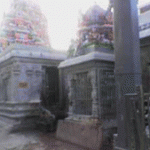
The temple exemplifies the classic Dravidian style of architecture, characterized by its stepped pyramidal towers and concentric enclosures. Unlike the towering gopurams of later Nayak temples, this shrine focuses on sanctity and proportion.
Key Structural Elements
- Garbhagriha (Sanctum): The main deity, Kailash Nathar, is enshrined here in a small, dark chamber that amplifies the spiritual vibration. The Linga is east-facing.
- Mandapa System: The temple features a distinct Maha Mandapa and an Ardha Mandapa (half hall). The structure extends significantly toward the Devi’s shrine, showcasing a seamless integration of spaces.
- Inner Sanctum Layout: Within the Arda Mandapa, there is a unique shrine facing North dedicated to Dandayudapani (Lord Murugan). This is rare; usually, Murugan temples are separate structures. Here, he is enshrined within a niche, signifying the unity of Shiva and Murugan.
- Sculpture & Vastu: The temple follows Vastu Shastra principles, with the entrance aligned to the East to welcome the rising sun (Surya), channeling positive energy. The stone carvings, though weathered by time, depict scenes from the Shiva Puranas and celestial nymphs (Apsaras).
ASI Status: While the temple is a heritage site of immense value, it is primarily managed by the Hindu Religious and Charitable Endowments (HR&CE) Department of Tamil Nadu. It is not currently listed as a UNESCO site but remains a protected monument of state heritage.
Darshan & Ritual Logistics
Visiting Kailasha Nathar Temple requires adherence to specific timings. While the temple follows a standard schedule, rituals may vary during festival days.
Daily Temple Timings (2026 Schedule)
| Session | Timings | Activity |
|---|---|---|
| Morning | 06:00 AM – 12:00 PM | Opening, Goshala cleaning, Abhishekam slots |
| Midday | 12:00 PM – 04:30 PM | Temple closed for rest (Goshta Puja) |
| Evening | 04:30 PM – 08:30 PM | Darshan, Pooja, and Lighting rituals |
| Night | 08:30 PM onwards | Closure |
*Note: Timings may vary slightly on Pournami (Full Moon) and Pradosham days. Please verify at the temple counter upon arrival.
Key Sevas & Online Booking
Devotees can perform several sevas to please Lord Kailash Nathar:
- Abhishekam: Performed with milk, honey, and sandalwood paste. Best performed on Mondays.
- Archana: Recitation of hymns. Devotees can offer 1008 Shiva Gayatri Archana.
- Deepa Aradhana: Offering ghee lamps.
Online Booking: While the Kailasha Nathar Temple offers some on-the-spot bookings, the larger Palani temple complex (administered by the same board) utilizes the “Palani Temple” official app or the HR&CE website for online seva booking. You can book special Abhishekam tickets online and collect the prasadam at the counter.
Major Festivals in 2026
- Thai Poosam (January): A grand celebration dedicated to Lord Murugan, with special alankarams for Kailash Nathar.
- Maha Shivaratri (February 26, 2026): The most significant event for this temple. Night-long vigils, special Abhishekam, and chanting of the Rudram.
- Panguni Uthiram (March/April): Celebrated with a celestial procession.
- Kartikai Deepam (November): Lighting of the sacred flame.
Practical Visitor Guidance
To ensure a spiritually fulfilling visit, please adhere to the following guidelines:
- Dress Code: Traditional attire is mandatory. Men should wear dhotis or pants with shirts (no shorts). Women should wear sarees, salwar kameez, or long skirts.
- Photography: Strictly prohibited inside the sanctum sanctorum and the Ardha Mandapa. Photography is permitted in the outer corridors, but without flash.
- Mobile Lockers: The temple provides free cloakrooms (mobile storage) near the entrance. It is advisable not to carry expensive items inside the sanctum.
- Accessibility: The temple is accessible via stairs. For differently-abled devotees, assistance is usually available upon request, though wheelchair access is limited due to the heritage nature of the structure.
Crowd Management & Seasonal Tips
Best Hours: The ideal time for darshan is between 06:30 AM and 08:00 AM, or between 05:00 PM and 06:30 PM to avoid peak crowds.
Seasonal Advice:
Palani experiences a hot and dry climate from March to June. It is highly recommended to carry water bottles and wear a cap during summer visits. The monsoon season (October–November) brings a pleasant atmosphere, making it a preferred time for many pilgrims.
Pilgrimage Connectivity
How to Reach
- By Air: The nearest airport is Coimbatore International Airport (CJB), located approximately 100 km away. It connects to major metros like Chennai, Bangalore, Mumbai, and Delhi.
- By Train: The Palani Railway Station (PGA) is a terminus connected to Chennai (Palani Express), Madurai, and Coimbatore. The line runs through Pollachi and Madurai.
- By Road: Palani is well-connected via NH 85 (Coimbatore – Theni route) and State Highway 38 (connecting to Madurai). Frequent buses operate from Coimbatore, Madurai, Trichy, and Dindigul.
Nearby Sacred Sites (Pilgrimage Circuit)
After seeking blessings at Kailasha Nathar, devotees often visit:
- Palani Murugan Temple (Dhandayuthapani Swamy): The primary hilltop temple of Palani, just a few minutes’ walk from Kailasha Nathar.
- Kulithalai (Arunachaleswarar Temple): Located about 50 km away, this is another ancient Shiva temple on the banks of the Kaveri.
- Perur Pateeswarar Temple: Located near Coimbatore (70 km), famous for its celestial sculptures and Nataraja shrine.
Photo Gallery
Frequently Asked Questions (FAQ)
1. Is there a VIP darshan entry at Kailasha Nathar Temple?
While the temple is smaller than the main Murugan shrine, special entry tickets are available for faster darshan. However, during major festivals, all devotees are generally required to stand in the common queue.
2. Can we carry our own Prasadam (food offering)?
Yes, you can carry simple vegetarian items like fruits, coconuts, or sweets. However, outside cooked food is discouraged. The temple also sells standard prasadam like Panchamritam and laddoos.
3. What is the history of the Dandayudapani shrine inside the temple?
According to local legend, Lord Murugan (Dandayudapani) is placed in a north-facing niche within the Ardha Mandapa. This signifies that while the main deity is Shiva, Murugan is eternally present as the guardian and devotee within the premises.
4. Is there accommodation available near the temple?
Yes, Palani has numerous choultries and guest houses run by the HR&CE department and private trusts. The main accommodations are located near the temple streets and are affordable for pilgrims.
5. What are the parking facilities?
There are designated paid parking lots at the base of the town. During peak seasons, it is advisable to use public transport to reach the temple entrance directly as the inner streets are narrow.
Recent Posts

ओ सांवरे तूने ही मुझको संभाला – Lyrics & Meaning
ओ सांवरे तूने ही मुझको संभाला – A Prayer to Shyam Origin & Spiritual Essence Why This Bhajan Resonates Devotees chant this when overwhelmed by life’s storms—the refrain ‘तूने ही मुझको संभाला’ is the soul’s sigh of relief: “You…

कथा ये है महाराज मेरे की – Lyrics & Meaning
कथा ये है महाराज मेरे की छत्रपति संभाजी महाराज – A Prayer to Chhatrapati Sambhaji Maharaj Origin & Spiritual Essence Why This Bhajan Resonates Devotees chant this when their spirit feels tested—its powerful refrain “महाराज मेरे” is a soul’s…

Rigveda Samhita Yathartha Anuvada (ऋग्वेद संहिता यथार्थ अनुवाद) – Complete Set with Anvayartha & Hindi/English Translation
The Rigveda is the oldest surviving scripture of humanity and the foundational text of Sanātana Dharma. For serious students, scholars, UPSC aspirants studying ancient Indian history, Sanskrit learners, and spiritual seekers, a precise and grammatically structured translation is indispensable.…

आना भी अकेला है जाना भी अकेला है – Lyrics & Meaning | BharatTemples
आना भी अकेला है जाना भी अकेला है – A Prayer to the Divine Witness Origin & Spiritual Essence Why This Bhajan Resonates Devotees turn to this bhajan in moments of deep reflection—when life’s attachments begin to ache. The…

माता शेरावाली के द्वार जो भी जाता है – Lyrics & Meaning
माता शेरावाली के द्वार जो भी जाता है – A Prayer to Maa Sherawali Origin & Spiritual Essence Why This Bhajan Resonates Devotees turn to this bhajan in times of fear or uncertainty—its promise that no one leaves Maa’s…

मार लेना सपणी उबार लेणा भवरा – Lyrics & Meaning
मार लेना सपणी उबार लेणा भवरा – A Prayer to the Divine Beloved Origin & Spiritual Essence Why This Bhajan Resonates Devotees chant this in moments of deep vulnerability—its cry of “मार लेना सपणी, उबार लेणा भवरा” is the…

हमें श्याम सुंदर भरोसा तुम्हारा – Lyrics & Meaning
हमें श्याम सुंदर भरोसा तुम्हारा – A Prayer to Shyam Sundar Origin & Spiritual Essence Why This Bhajan Resonates Devotees chant this when feeling alone—its refrain ‘de do sahara’ is the soul’s cry for divine support. Lyrics in Hindi…

Mere Satguru Ne Di Thi Davai Lyrics in Hindi & Meaning
Mere Satguru Ne Di Thi Davai: Invoking the Guru’s Liberating Wisdom This soul-stirring bhajan venerates the Satguru (True Spiritual Master) as the divine physician who dispenses the only remedy for life’s deepest sufferings. Composed by Sant Karmaveer Tufani, it…

Janm Diyo Thari Maa Dukh Dekhiyo Lyrics in Hindi & Meaning
जन्म दियो थारी माँ दुख देखियो (Maa’s Grief Upon Birthing You) This soul-stirring Chetavani Bhajan (admonitory hymn) is addressed to the Divine Mother (Maa) – a call for repentance when children forget their filial duties in the dark age…
Bhadi Sabha Mein Thane Manaun Lyrics in Hindi & Meaning
Bhadi Sabha Mein Thane Manaun: Invoking the Spear-Wielding Mother Mata Bhawani (श्री ज्वाला भवानी), the fiery manifestation of Shakti worshipped as the Protector of Dharma in Her Dhaulagarh sanctum. Origin & Spiritual Essence Composed in Rajasthani folk tradition by…