
Contents
- 1 Kali Bari, New Delhi: A Definitive Pilgrimage Guide
- 1.1 1. Introduction & Spiritual Essence
- 1.2 2. Historical Origins & Scriptural Legend
- 1.3 3. Architectural Marvels
- 1.4 4. Darshan & Ritual Logistics
- 1.5 5. Practical Visitor Guidance
- 1.6 6. Pilgrimage Connectivity
- 1.7 7. Frequently Asked Questions (FAQs)
- 1.8 Legend / Local stories
- 1.9 Photo Gallery
- 1.10 How to Reach:
- 1.11 Contact Details
Kali Bari, New Delhi: A Definitive Pilgrimage Guide
Anchoring the soul of Bengali heritage in the heart of the capital.
1. Introduction & Spiritual Essence
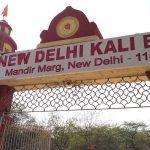
Nestled on Mandir Marg, west of Connaught Place, the Kali Bari of New Delhi is more than a place of worship; it is a cultural lifeline. Dedicated to Devi Kali, the fierce yet benevolent mother form of Shakti, this temple mirrors the architectural and spiritual ethos of the famous Kalighat Kali Temple in Kolkata.
Phalaśruti: The Divine Benefits
According to the temple’s oral tradition and the beliefs of the devotees, visiting the Kali Bari offers specific spiritual benefits:
- Removal of Obstacles: Devotees believe that worshipping Maa Kali here destroys negative energies and removes life’s hurdles.
- Cleansing Ancestral Karma: Rituals performed at this shrine are believed to pacify ancestors (Pitru Dosha) and bring peace to the departed souls.
- Granting of Moksha: The primary deity, often a Shmashana Kali form (associated with transcendence over death), helps devotees break the cycle of rebirth.
2. Historical Origins & Scriptural Legend
The genesis of the Kali Bari is deeply intertwined with the migration of Bengali families to the capital after World War I.
Subhas Chandra Bose and the Mandir Committee
Tradition holds that the burgeoning Bengali population in Delhi initially gathered for worship on Baird Road (now Bangla Sahib Road). As the community grew, a need for a permanent structure arose. In the early 1930s, one acre of land was allotted on the newly developed Mandir Marg.
The temple authority was formally established in 1935, and the first President was none other than Netaji Subhas Chandra Bose. The inaugural building was inaugurated by Sir Justice Manmatha Nath Mukherjee. This lineage gives the temple a unique place in India’s political and spiritual history.
The Durga Puja Legacy
While the current structure solidified the community’s presence, the roots of worship go deeper. The first Durga Puja at the original location began in 1925. When the temple moved to Mandir Marg in 1931, the tradition shifted with it. Today, it remains the nodal point for hundreds of Puja committees in Delhi, rivaled only by the older committees at Kashmere Gate (1910) and Timarpur (1914).
3. Architectural Marvels
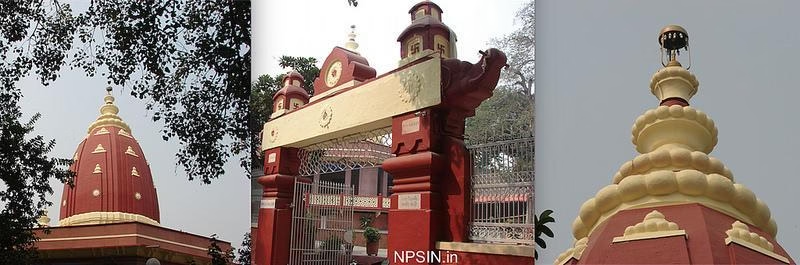
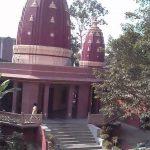
Unlike the towering stone temples of South India, the Kali Bari exhibits a distinct Bengali Terracotta style and traditional North Indian architecture.
Deity & Sanctum
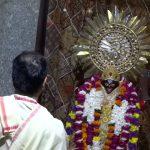
The central Murti (idol) of Goddess Kali is crafted in the likeness of the Kalighat deity. She is depicted with four arms, holding a sword and a severed head (symbolizing the destruction of ego), while her other two hands offer blessings and protection. The idol is installed on a marble platform, flanked by other deities including Ganesha and Hanuman, who guard the temple premises.
Construction Style
- Materials: The temple utilizes a mix of traditional brick and mortar with extensive use of white marble for flooring and altar areas.
- Facilities: Over the decades, the committee has expanded the complex to include a guest house for visitors and a library housing ancient Bengali scriptures and literature.

4. Darshan & Ritual Logistics
The rituals at Kali Bari adhere strictly to the Shakta traditions. The atmosphere shifts dynamically from the serene morning prayers to the energetic Aarti in the evening.
Daily Timings
| Time Slot | Activity |
|---|---|
| 06:00 AM – 12:00 PM | Morning Darshan & Midday Puja |
| 12:00 PM – 4:00 PM | Temple closed for Rest (Typical) |
| 4:00 PM – 10:30 PM | Evening Darshan, Aarti & Puja |
Key Sevas (Rituals) & Online Booking
While many rituals are performed on-site, the temple has modernized to accommodate the global Bengali diaspora.
- Weekly Kali Puja: Every Tuesday and Saturday are considered highly auspicious for Maa Kali.
- Annual Durga Puja: This is the pinnacle event. The Sholar Kaaj (artwork made of Eri silk cotton) is a signature element brought by artisans from Kolkata.
- Online Seva: The temple facilitates Prasad delivery and Abhishekam bookings through their official website. Devotees can sponsor the Puja and receive sanctified items via courier.
2026 Festival Calendar (Major Dates)
- Chaitra Navratri: March 30 – April 7, 2026
- Durga Puja: October 1 – October 5, 2026 (Durga Ashtami to Dashami)
- Kali Puja: October 16, 2026 (Deepavali Amavasya)
- Bengali New Year (Poila Boishakh): April 14, 2026
5. Practical Visitor Guidance
To ensure a harmonious darshan experience, visitors are requested to adhere to the following guidelines.
Code of Conduct
- Dress Code: Traditional Indian attire is recommended (Kurtas, Sarees, or Dhotis). Avoid shorts and sleeveless tops as a mark of respect.
- Photography: Photography of the main deity is generally discouraged inside the sanctum. However, the outer complex and architectural details are photogenic and permitted.
- Mobile Lockers: A cloakroom is available near the entrance for depositing shoes and electronic items. Large bags may be subject to security checks.
Crowd Management
Peak Hours: Evenings (6:00 PM – 8:00 PM) and weekends see heavy footfall.
Best Time to Visit: Early mornings (6:30 AM – 9:00 AM) offer the most peaceful darshan. During the monsoon (July-August) and summer (May-June), the city experiences high humidity; carrying a water bottle is advised. Water coolers are available inside the complex.
6. Pilgrimage Connectivity
Located centrally, the temple is easily accessible via public transport.
How to Reach
- Nearest Metro: R.K. Ashram Marg (Blue Line) is the closest, approximately 2 km away (5-minute auto-rickshaw ride). Mandir Marg station is also accessible on the Pink Line.
- Bus Routes: Multiple DTC buses halt at Mandir Marg or near Laxminarayan Temple.
- By Road: The temple is situated off the main Inner Ring Road, connecting easily to NH-8 (Delhi-Gurgaon Expressway) and NH-9.
- Airport: Indira Gandhi International Airport (T3) is roughly 20 km away (45-60 mins by taxi).
Nearby Sacred Sites
- Laxminarayan Temple (Birla Mandir): Located just minutes away, this is a sprawling complex dedicated to Vishnu and Lakshmi.
- Gurudwara Bangla Sahib: One of the most prominent Sikh shrines, known for its healing waters, located within a 1 km radius.
- Sri Digambar Jain Lal Mandir: The oldest Jain temple in Delhi, famous for its bird hospital, situated in Chandni Chowk (approx. 4 km).
7. Frequently Asked Questions (FAQs)
Is there a VIP Darshan entry available?
No, Kali Bari does not have a specific VIP entry. All devotees are treated equally. However, during major festivals like Durga Puja, the temple releases special passes for crowd management, which can be collected from the office.
Can non-Hindus visit the temple?
While the temple is a Hindu place of worship, visitors of all faiths are welcome in the outer complex and courtyard. However, entry into the inner sanctum (Garbhagriha) for prayer is restricted to those who follow the Hindu faith.
Is there parking available?
Limited parking space is available on Mandir Marg. During weekdays, it is often occupied quickly. Using public transport or ride-sharing services is highly recommended.
What is the significance of the library?
The temple library houses a rich collection of Bengali literature, including works by Tagore, Bankim Chandra Chattopadhyay, and religious scriptures like the Chandi Path. It serves as a vital resource for researchers and students.
Where can I stay near the temple?
The Kali Bari Trust operates a guest house (Yatri Niwas) on the premises with limited rooms. Advance booking is mandatory. Alternatively, numerous hotels are available in Connaught Place and Paharganj.
| Date built: | – |
|---|---|
| Deity: | – |
| Architectural style: | – |
| Major festivals | Durga Poja |
| Locale: | New Delhi |
| District:: | New Delhi |
| Address: | – |
| Phone | – |
Legend / Local stories
The Durga puja celebrated at the Kalibari, is one of the oldest Durga Pujas in the city. It first started in 1925. The original temple of Kali Bari was situated on Baird Road (today’s Bangla Sahib Road), where the local Bengali community gathered for the annual Durga Puja. After the present temple came up after 1931, it shifted here. Till today, it continues to be the nodal point for the hundreds of puja committees in Delhi, and is widely revered among Delhi Bengalis. Only older pujas in Delhi are at Kashmere Gate, organized by Delhi Durga Puja Samiti, which started in 1910, and the Timarpur puja organised by the Timarpur and Civil Lines puja samiti, estd. 1914 .
The puja celebration at Kali Bari continued to follow the traditional style, with traditional ekchalar thakur (single frame for idols) and sholar kaaj. Even puja rituals have remained unchanged since 1936 and traditional competitions in Rabindra sangeet and recitation are still organised. Mr Swapan Kumar Chakraborty is the current President of Delhi Kalibari. Artisans are brought in from Kolkata to build the puja pandal.
Photo Gallery
How to Reach:
The temple is located on the Mandir Marg, situated west of Connaught Place in New Delhi. The temple is easily accessible from the city by local buses, taxis and auto-rickshaws. Nearest Delhi Metro station is R.K.Ashram Marg, located about 2 km away.
Contact Details
Official Address
Recent Posts

ओ सांवरे तूने ही मुझको संभाला – Lyrics & Meaning
ओ सांवरे तूने ही मुझको संभाला – A Prayer to Shyam Origin & Spiritual Essence Why This Bhajan Resonates Devotees chant this when overwhelmed by life’s storms—the refrain ‘तूने ही मुझको संभाला’ is the soul’s sigh of relief: “You…

कथा ये है महाराज मेरे की – Lyrics & Meaning
कथा ये है महाराज मेरे की छत्रपति संभाजी महाराज – A Prayer to Chhatrapati Sambhaji Maharaj Origin & Spiritual Essence Why This Bhajan Resonates Devotees chant this when their spirit feels tested—its powerful refrain “महाराज मेरे” is a soul’s…

Rigveda Samhita Yathartha Anuvada (ऋग्वेद संहिता यथार्थ अनुवाद) – Complete Set with Anvayartha & Hindi/English Translation
The Rigveda is the oldest surviving scripture of humanity and the foundational text of Sanātana Dharma. For serious students, scholars, UPSC aspirants studying ancient Indian history, Sanskrit learners, and spiritual seekers, a precise and grammatically structured translation is indispensable.…

आना भी अकेला है जाना भी अकेला है – Lyrics & Meaning | BharatTemples
आना भी अकेला है जाना भी अकेला है – A Prayer to the Divine Witness Origin & Spiritual Essence Why This Bhajan Resonates Devotees turn to this bhajan in moments of deep reflection—when life’s attachments begin to ache. The…

माता शेरावाली के द्वार जो भी जाता है – Lyrics & Meaning
माता शेरावाली के द्वार जो भी जाता है – A Prayer to Maa Sherawali Origin & Spiritual Essence Why This Bhajan Resonates Devotees turn to this bhajan in times of fear or uncertainty—its promise that no one leaves Maa’s…

मार लेना सपणी उबार लेणा भवरा – Lyrics & Meaning
मार लेना सपणी उबार लेणा भवरा – A Prayer to the Divine Beloved Origin & Spiritual Essence Why This Bhajan Resonates Devotees chant this in moments of deep vulnerability—its cry of “मार लेना सपणी, उबार लेणा भवरा” is the…

हमें श्याम सुंदर भरोसा तुम्हारा – Lyrics & Meaning
हमें श्याम सुंदर भरोसा तुम्हारा – A Prayer to Shyam Sundar Origin & Spiritual Essence Why This Bhajan Resonates Devotees chant this when feeling alone—its refrain ‘de do sahara’ is the soul’s cry for divine support. Lyrics in Hindi…

Mere Satguru Ne Di Thi Davai Lyrics in Hindi & Meaning
Mere Satguru Ne Di Thi Davai: Invoking the Guru’s Liberating Wisdom This soul-stirring bhajan venerates the Satguru (True Spiritual Master) as the divine physician who dispenses the only remedy for life’s deepest sufferings. Composed by Sant Karmaveer Tufani, it…

Janm Diyo Thari Maa Dukh Dekhiyo Lyrics in Hindi & Meaning
जन्म दियो थारी माँ दुख देखियो (Maa’s Grief Upon Birthing You) This soul-stirring Chetavani Bhajan (admonitory hymn) is addressed to the Divine Mother (Maa) – a call for repentance when children forget their filial duties in the dark age…
Bhadi Sabha Mein Thane Manaun Lyrics in Hindi & Meaning
Bhadi Sabha Mein Thane Manaun: Invoking the Spear-Wielding Mother Mata Bhawani (श्री ज्वाला भवानी), the fiery manifestation of Shakti worshipped as the Protector of Dharma in Her Dhaulagarh sanctum. Origin & Spiritual Essence Composed in Rajasthani folk tradition by…