
Contents
Introduction & Spiritual Essence: The Primal Abode of Maa Kali
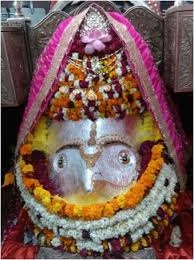
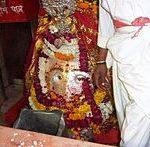
Kalkaji Mandir, also revered as Kalka Mandir, South, stands as a timeless beacon of Shakti in the heart of New Delhi. Dedicated to Goddess Kali, the fierce incarnation of Adi Shakti, this temple is not merely a structure of stone but a living spiritual ecosystem. The deity here is believed to be Swayambhu (self-manifested), radiating an energy that predates recorded history.
Phalaśruti: The Benefits of Visiting
Devotees flock to Kalkaji for specific spiritual purposes, often citing the Phalaśruti (scriptural promise of merit) associated with this Manokamna Siddha Peetha:
- Ancestral Liberation: Rituals performed here are believed to cleanse Pitra Dosha and grant peace to ancestors.
- Protection from Negative Forces: As the slayer of Raktabija, Maa Kalka is invoked to destroy internal demons and external negativity.
- Wish Fulfillment: As the “Manokamna Siddha Peetha,” it is famed for granting the sincere wishes of devotees, particularly those facing legal or health obstacles.
Historical Origins & Scriptural Legend
The Satya Yuga Connection
According to Hindu tradition and temple records, the origins of Kalkaji Mandir trace back to the Satya Yuga. The local Sthala Purana narrates a celestial battle where Maa Parvati created Goddess Kaushiki to battle giants. When the giants’ blood created new life, Maa Kali emerged from Kaushiki’s eyebrows to drink the blood and save the gods. She chose this earthy patch as her eternal abode.
Architectural History & Renovations
While the spiritual energy is ancient, the current architectural footprint reveals a storied past.
1764 AD: The oldest portions of the masonry structure were established by the Marathas.
1816 AD: Significant additions and renovations were undertaken by Mirza Raja Kidar Nath, the Peshkar (revenue officer) of Emperor Akbar II.
The land is historically managed by the Thok Brahmins and Thok Jogians, classified into Gharbari Jogi and Kanphada Jog (Nath sect), who remain the primary pujaris.
Architectural Marvels
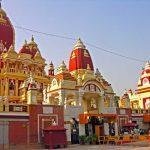
The temple complex is a fascinating blend of Mughal and indigenous North Indian styles, constructed primarily of brick masonry finished with plaster and marble.
The Sanctum & Layout
The central chamber is a unique 12-sided polygon (dodecagonal), measuring 24 feet across. It is paved with marble and encircled by an 8’9″ wide verandah featuring 36 arched openings. This geometric precision is a hallmark of the era’s architectural experimentation.
Notable Sculptures
At the heart of the arcade, opposite the eastern doorway, stands a pedestal with two red sandstone tigers. Between them lies the stone image of Kali Devi, holding a trident. The inscriptions on the marble railings are in Nastaʿlīq script, a testament to the Mughal influence during the 1816 renovation.
Heritage Status
While the temple predates the ASI (Archaeological Survey of India) era, the site is culturally monumental. In the east of Kailash Colony, mere meters from the temple complex, lies an Edict of Ashoka dating to the 3rd century BC, confirming the sanctity of this land since ancient times.
Darshan & Ritual Logistics (2026 Season)
The temple remains a hub of continuous worship. Below are the general operating hours. Note: Timings are subject to change during festivals.
Daily Timings
| Session | Timing |
|---|---|
| Morning Darshan | 5:00 AM – 12:00 PM |
| Evening Darshan | 4:00 PM – 10:30 PM |
Key Sevas & Online Booking
Devotees can book Abhishekam (ritual bathing of the deity) and Archana (offering of names) in advance. While the official online portal is managed by the Delhi Tourism and Transportation Development Corporation (DTTDC), it is advisable to verify slots via the temple’s administrative contact on arrival.
2026 Major Festival Calendar
- Navratri (Shardiya): September 22 – October 1, 2026. Special Aarti and Bhog arrangements will be in place.
- Kali Puja: October 21, 2026 (Kartik Amavasya). The temple is illuminated and remains open late night.
- Chaitra Navratri: March 30 – April 7, 2026 (Spring festival).
Practical Visitor Guidance
Rules & Etiquette
- Dress Code: Traditional attire is recommended. Men should wear dhoti/kurta or full-length trousers; women should wear saree/salwar kameez. Avoid shorts/t-shirts.
- Photography: Strictly prohibited inside the inner sanctum (Garbhagriha). Allowed in the outer courtyards with discretion.
- Mobile Phones: Electronic devices must be switched off or kept in silent mode. Check for lockers at the entrance provided by security.
Crowd Management Strategy
Best Time to Visit: Mornings (5:00 AM – 7:00 AM) are quietest. Evenings are chaotic, especially on Tuesdays and Fridays.
Seasonal Tip: Delhi summers (May–June) are harsh. Carry a water bottle and a handheld fan. During the monsoon (July–August), humidity is high; light cottons are essential.
Pilgrimage Connectivity
How to Reach
Metro: Take the Delhi Metro Violet Line to Kalkaji Mandir Station (Gate 2) or the Pink Line to Nehru Enclave Station. The temple is a 5-minute walk from both.
Rail: The nearest railway station is Okhla (approx. 2 km), though New Delhi Railway Station is better connected via Metro.
Road: Located on Maha Vir Marg, easily accessible from the Moolchand Flyover on Outer Ring Road (NH-24).
Nearby Sacred Sites
- Lotus Temple (Bahá’í House of Worship): Located directly opposite, an architectural marvel of silence and prayer.
- ISKCON Temple, East of Kailash: A vibrant center of Vaishnavism, just 10 minutes away.
- Sri Kalka Ji Temple (Palika Bazaar): Often confused, this is a smaller temple dedicated to Kalka Mata inside Palika Bazaar, New Delhi.
Frequently Asked Questions
1. Is there a VIP Darshan entry?
Yes, the temple administration often facilitates a priority queue for senior citizens, differently-abled devotees, and donors of specific Sevas. However, during peak Navratri, VIP entry is suspended to ensure fair crowd management.
2. What is the history of the Pujaris here?
The temple priests belong to the Thok Brahmins and Thok Jogians. Historically, they are classified as Gharbari Jogi (householders) and Kanphada Jog (ascetics who pierce their ears). They have been the custodians since the Maratha era (18th Century).
3. Is non-vegetarian food allowed?
No. The temple premises are strictly vegetarian. No meat, alcohol, or tobacco products are permitted inside the complex. Devotees are advised to eat at vegetarian restaurants in Nehru Place before arrival.
4. Where can I park my vehicle?
There is no dedicated parking for the temple itself. Pilgrims usually park at the NSIC Estate parking lots or the commercial complexes in Nehru Place (about 500m walk).
5. What is the significance of the Ashoka Pillar nearby?
The Edict of Ashoka (3rd Century BC) is located on a hillock near the Kailash Colony area. It is one of the few remaining rock edicts of Emperor Ashoka in Delhi, predating the temple by millennia and indicating the region’s spiritual importance.
Recent Posts

Shri Kaamkoteeshwar Mandir, Varanasi – History & Significance
In the heart of Kashi, the eternal city of Lord Shiva, where the Ganges flows with celestial grace, stands the Shri Kaamkoteeshwar Mandir. This sacred Sannidhi is not merely a temple but a profound spiritual bridge between the Northern…

ओ सांवरे तूने ही मुझको संभाला – Lyrics & Meaning
ओ सांवरे तूने ही मुझको संभाला – A Prayer to Shyam Origin & Spiritual Essence Why This Bhajan Resonates Devotees chant this when overwhelmed by life’s storms—the refrain ‘तूने ही मुझको संभाला’ is the soul’s sigh of relief: “You…

कथा ये है महाराज मेरे की – Lyrics & Meaning
कथा ये है महाराज मेरे की छत्रपति संभाजी महाराज – A Prayer to Chhatrapati Sambhaji Maharaj Origin & Spiritual Essence Why This Bhajan Resonates Devotees chant this when their spirit feels tested—its powerful refrain “महाराज मेरे” is a soul’s…

Rigveda Samhita Yathartha Anuvada (ऋग्वेद संहिता यथार्थ अनुवाद) – Complete Set with Anvayartha & Hindi/English Translation
The Rigveda is the oldest surviving scripture of humanity and the foundational text of Sanātana Dharma. For serious students, scholars, UPSC aspirants studying ancient Indian history, Sanskrit learners, and spiritual seekers, a precise and grammatically structured translation is indispensable.…

आना भी अकेला है जाना भी अकेला है – Lyrics & Meaning | BharatTemples
आना भी अकेला है जाना भी अकेला है – A Prayer to the Divine Witness Origin & Spiritual Essence Why This Bhajan Resonates Devotees turn to this bhajan in moments of deep reflection—when life’s attachments begin to ache. The…

माता शेरावाली के द्वार जो भी जाता है – Lyrics & Meaning
माता शेरावाली के द्वार जो भी जाता है – A Prayer to Maa Sherawali Origin & Spiritual Essence Why This Bhajan Resonates Devotees turn to this bhajan in times of fear or uncertainty—its promise that no one leaves Maa’s…

मार लेना सपणी उबार लेणा भवरा – Lyrics & Meaning
मार लेना सपणी उबार लेणा भवरा – A Prayer to the Divine Beloved Origin & Spiritual Essence Why This Bhajan Resonates Devotees chant this in moments of deep vulnerability—its cry of “मार लेना सपणी, उबार लेणा भवरा” is the…

हमें श्याम सुंदर भरोसा तुम्हारा – Lyrics & Meaning
हमें श्याम सुंदर भरोसा तुम्हारा – A Prayer to Shyam Sundar Origin & Spiritual Essence Why This Bhajan Resonates Devotees chant this when feeling alone—its refrain ‘de do sahara’ is the soul’s cry for divine support. Lyrics in Hindi…

Mere Satguru Ne Di Thi Davai Lyrics in Hindi & Meaning
Mere Satguru Ne Di Thi Davai: Invoking the Guru’s Liberating Wisdom This soul-stirring bhajan venerates the Satguru (True Spiritual Master) as the divine physician who dispenses the only remedy for life’s deepest sufferings. Composed by Sant Karmaveer Tufani, it…

Janm Diyo Thari Maa Dukh Dekhiyo Lyrics in Hindi & Meaning
जन्म दियो थारी माँ दुख देखियो (Maa’s Grief Upon Birthing You) This soul-stirring Chetavani Bhajan (admonitory hymn) is addressed to the Divine Mother (Maa) – a call for repentance when children forget their filial duties in the dark age…