
Contents
- 1 The Sacred Sangam: A Definitive Pilgrimage Guide to Karnaprayag Temple
The Sacred Sangam: A Definitive Pilgrimage Guide to Karnaprayag Temple
By Lead Heritage Architect, bharattemples.com | Estimated Reading Time: 7 Minutes
1. Introduction & Spiritual Essence
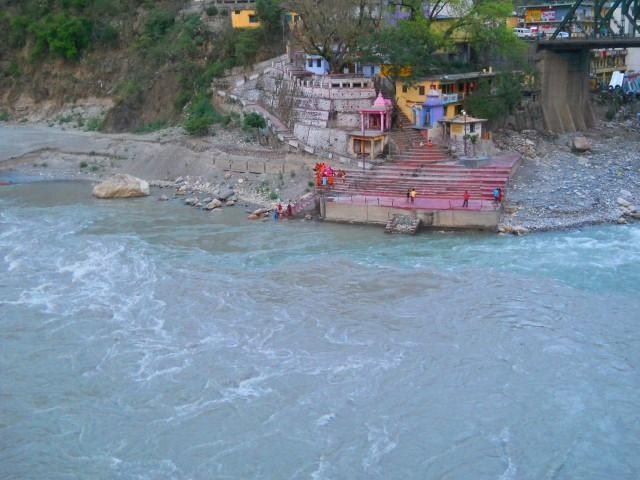
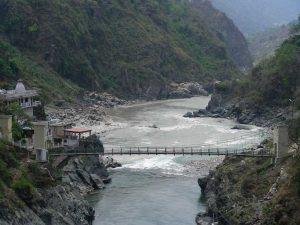
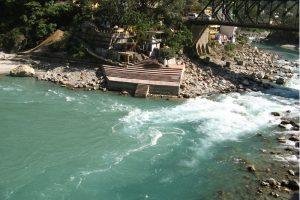
Karnaprayag, nestled in the Chamoli district of Uttarakhand, is not merely a geographical intersection but a spiritual convergence. As one of the Panch Prayag (five confluences), it marks the holy meeting of the Alaknanda and Pindar Rivers. While the city itself is a bustling hub for travelers heading to Badrinath, the specific temple complex here is dedicated to the legendary Karna and the divine mother Uma Devi.
Why do devotees visit?
The primary deity is Karna (son of the Sun God, Surya) and Uma Devi (a form of Goddess Parvati). This temple is unique in its Swayambhu (self-manifested) spiritual energy. According to the Phalaśruti (scriptural promise of benefits) associated with this site, devotees believe that offering Pind Daan (ritual offering to ancestors) at Karnaprayag cleanses ancestral karma and liberates the soul from the cycle of rebirth. It is widely believed that Lord Krishna himself performed the last rites of Karna here, making it a potent site for Shraddha rituals.
2. Historical Origins & Scriptural Legend
The history of Karnaprayag is woven from two distinct threads: the epic Mahabharata and the local folklore of the Himalayas.
The Legend of Karna
According to local tradition and the Sthala Purana, this is the site where Karna performed severe austerities to please Lord Shiva and Surya (the Sun God). Pleased by his devotion, Surya bestowed upon him the Kavach (armor) and Kundal (earrings) that made him invincible in battle. The name “Karnaprayag” is derived from Karna himself. It is also the legendary site where Lord Krishna performed Karna’s cremation on a rock known as Karnashila after the Kurukshetra war.
The Uma Devi Connection
A second legend tells of Goddess Parvati’s self-immolation (Sati) and her rebirth as Uma, daughter of the Himalayas. It is believed that she performed intense penance at this very confluence to win Lord Shiva as her husband. An ancient temple dedicated to Uma Devi stands here as a testament to her devotion.
Historical Note: While the original structure dates back to mythological times, the current edifice was largely re-established by Adi Shankaracharya in the 8th century. The temple complex suffered significant damage during the devastating floods of 1803 (following the breach of the Birahi dam) but was subsequently rebuilt by local devotees.
3. Architectural Marvels
The temple architecture at Karnaprayag is a distinct blend of the Nagara style, adapted to the rugged terrain of the Garhwal Himalayas.
Design and Layout
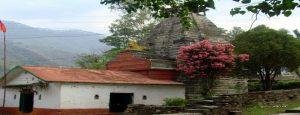
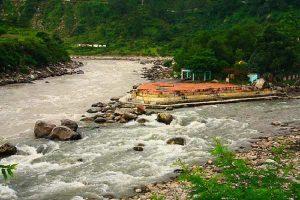
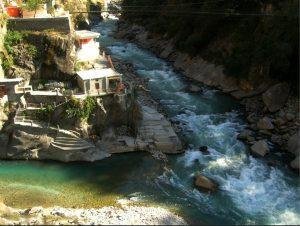
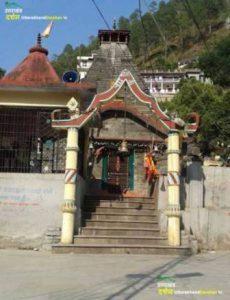
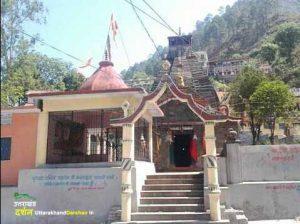
Unlike the towering spires found in the plains, the Karnaprayag temples feature a low-profile, pyramidal Shikhara (spire) constructed using locally quarried stone. The complex is situated precariously on the edge of the riverbank, offering a panoramic view of the Sangam.
Sculptural Details
The exterior walls are adorned with intricate carvings depicting scenes from the Mahabharata, specifically Karna’s charitable nature. Inside the sanctum, the idols of Karna and Krishna are larger than life-sized. The inner sanctum also houses smaller shrines dedicated to:
- Bhoomia Devta (Guardian of the Land)
- Lord Shiva and Parvati
- Ram, Sita, and Lakshman
The temple complex does not currently hold a UNESCO designation, but it is preserved under the Archaeological Survey of India (ASI) guidelines for heritage sites in Uttarakhand.
4. Darshan & Ritual Logistics
Planning your visit requires attention to specific timings and ritual offerings. Below are the standard operating hours, though they may vary slightly during peak winter months.
Daily Temple Timings (2026)
| Session | Timing | Activity |
|---|---|---|
| Morning | 06:00 AM – 12:00 PM | Mangala Aarti & General Darshan |
| Afternoon | 12:00 PM – 02:00 PM | Temple Cleaning (Closed) |
| Evening | 02:00 PM – 07:30 PM | Evening Aarti & Darshan |
Key Sevas & Online Booking
Devotees can perform Pind Daan (ancestral offering) and Rudrabhishek at the temple. While online booking is primarily managed through the Badrinath Kedarnath Temple Committee (BKTC) portal, some specific rituals at Karnaprayag are managed locally.
- Abhishekam: Performed daily between 7:00 AM and 9:00 AM.
- Special Archana: Offering flowers and sweets to Karna and Uma Devi.
- Online Portal: Visit bkctc.gov.in for authorized Seva bookings.
Major 2026 Festival Dates
- Basant Panchami: February 2, 2026 (Special Puja for Goddess Uma).
- Maha Shivaratri: February 26, 2026 (Night-long vigil and Rudra Abhishek).
- Nanda Devi Raj Jat Yatra: (Bi-annual event; check local dates as this is a major regional festival originating nearby).
- Deepawali: October 18, 2026.
5. Practical Visitor Guidance
Karnaprayag acts as a transit point, but treating the temple visit with respect ensures a fulfilling spiritual experience.
Dress Code and Etiquette
As with most Himalayan shrines, modest attire is mandatory. Men should opt for trousers and shirts (avoid shorts), and women should wear sarees, salwar kameez, or covered skirts. The temple premise is strictly vegetarian; alcohol and non-vegetarian food are prohibited.
Crowd Management & Best Hours
Karnaprayag is a major stop for Badrinath pilgrims. The rush peaks between 10:00 AM and 4:00 PM.
Best Time to Visit: Arrive for the morning darshan (6:00 AM – 8:00 AM) when the Alaknanda waters sparkle in the dawn light and crowds are minimal.
Accessibility & Amenities
- Mobile Lockers: Available near the temple entrance for a nominal fee (approx. ₹20) to store phones and electronics, as photography inside the sanctum is prohibited.
- Footwear: A paid shoe-keeping facility is available outside the main gate.
- Seasonal Advice: In summer (May-June), carry reusable water bottles and sun protection. In winter (Nov-Feb), layers are essential as temperatures drop rapidly near the river confluence.
6. Pilgrimage Connectivity
Karnaprayag is strategically located on National Highway 7 (formerly NH 58), making it one of the most accessible Prayags.
How to Reach
- By Air: The nearest airport is Jolly Grant Airport, Dehradun (approx. 135 km / 5-6 hours drive).
- By Rail: The nearest major railway station is Rishikesh (approx. 110 km). Taxi and bus services are readily available from Rishikesh.
- By Road: Located on NH 7. Regular buses ply from Rishikesh and Dehradun to Chamoli/Karnaprayag.
Nearby Sacred Sites (Pilgrimage Circuit)
Extend your journey by visiting these nearby spiritual centers:
- Badrinath Dham (75 km North): One of the Char Dhams, dedicated to Lord Vishnu.
- Kedarnath (120 km): One of the twelve Jyotirlingas of Lord Shiva (requires a trek or helicopter ride).
- Nandaprayag (18 km South): The confluence of Alaknanda and Nandakini rivers, featuring the Nanda Devi Temple.
7. Frequently Asked Questions (FAQ)
1. Is there a VIP Darshan entry at Karnaprayag Temple?
Unlike large commercial temples, Karnaprayag does not have a formal VIP ticketing system. Darshan is open to all. However, making a prior donation for a specific Puja (Seva) often allows for closer access to the deity during the ritual time.
2. Can I take photos inside the temple?
Photography is strictly prohibited inside the sanctum (Garbhagriha) and near the idols. You may take photos of the exterior architecture and the river confluence from the courtyard.
3. Is Karnaprayag safe for solo female travelers?
Yes, Uttarakhand is generally considered safe for pilgrims and solo travelers. However, as a transit town, it is advisable to avoid wandering near the riverbanks late at night due to the strong currents.
4. What is the significance of the Pindar River?
The Pindar River originates from the Pindari Glacier. Its confluence with the Alaknanda is believed to be spiritually charged, and water from this point is often used for rituals in nearby villages.
5. Are there hotels near the temple?
Karnaprayag is a commercial hub with numerous hotels, lodges, and GMVN (Garhwal Mandal Vikas Nigam) guest houses catering to all budgets.
Contact Details
Official Address:
Karnaprayag Temple Trust / Administrative Office
Karnaprayag, District Chamoli,
Uttarakhand, India – 246444
Recent Posts

ओ सांवरे तूने ही मुझको संभाला – Lyrics & Meaning
ओ सांवरे तूने ही मुझको संभाला – A Prayer to Shyam Origin & Spiritual Essence Why This Bhajan Resonates Devotees chant this when overwhelmed by life’s storms—the refrain ‘तूने ही मुझको संभाला’ is the soul’s sigh of relief: “You…

कथा ये है महाराज मेरे की – Lyrics & Meaning
कथा ये है महाराज मेरे की छत्रपति संभाजी महाराज – A Prayer to Chhatrapati Sambhaji Maharaj Origin & Spiritual Essence Why This Bhajan Resonates Devotees chant this when their spirit feels tested—its powerful refrain “महाराज मेरे” is a soul’s…

Rigveda Samhita Yathartha Anuvada (ऋग्वेद संहिता यथार्थ अनुवाद) – Complete Set with Anvayartha & Hindi/English Translation
The Rigveda is the oldest surviving scripture of humanity and the foundational text of Sanātana Dharma. For serious students, scholars, UPSC aspirants studying ancient Indian history, Sanskrit learners, and spiritual seekers, a precise and grammatically structured translation is indispensable.…

आना भी अकेला है जाना भी अकेला है – Lyrics & Meaning | BharatTemples
आना भी अकेला है जाना भी अकेला है – A Prayer to the Divine Witness Origin & Spiritual Essence Why This Bhajan Resonates Devotees turn to this bhajan in moments of deep reflection—when life’s attachments begin to ache. The…

माता शेरावाली के द्वार जो भी जाता है – Lyrics & Meaning
माता शेरावाली के द्वार जो भी जाता है – A Prayer to Maa Sherawali Origin & Spiritual Essence Why This Bhajan Resonates Devotees turn to this bhajan in times of fear or uncertainty—its promise that no one leaves Maa’s…

मार लेना सपणी उबार लेणा भवरा – Lyrics & Meaning
मार लेना सपणी उबार लेणा भवरा – A Prayer to the Divine Beloved Origin & Spiritual Essence Why This Bhajan Resonates Devotees chant this in moments of deep vulnerability—its cry of “मार लेना सपणी, उबार लेणा भवरा” is the…

हमें श्याम सुंदर भरोसा तुम्हारा – Lyrics & Meaning
हमें श्याम सुंदर भरोसा तुम्हारा – A Prayer to Shyam Sundar Origin & Spiritual Essence Why This Bhajan Resonates Devotees chant this when feeling alone—its refrain ‘de do sahara’ is the soul’s cry for divine support. Lyrics in Hindi…

Mere Satguru Ne Di Thi Davai Lyrics in Hindi & Meaning
Mere Satguru Ne Di Thi Davai: Invoking the Guru’s Liberating Wisdom This soul-stirring bhajan venerates the Satguru (True Spiritual Master) as the divine physician who dispenses the only remedy for life’s deepest sufferings. Composed by Sant Karmaveer Tufani, it…

Janm Diyo Thari Maa Dukh Dekhiyo Lyrics in Hindi & Meaning
जन्म दियो थारी माँ दुख देखियो (Maa’s Grief Upon Birthing You) This soul-stirring Chetavani Bhajan (admonitory hymn) is addressed to the Divine Mother (Maa) – a call for repentance when children forget their filial duties in the dark age…
Bhadi Sabha Mein Thane Manaun Lyrics in Hindi & Meaning
Bhadi Sabha Mein Thane Manaun: Invoking the Spear-Wielding Mother Mata Bhawani (श्री ज्वाला भवानी), the fiery manifestation of Shakti worshipped as the Protector of Dharma in Her Dhaulagarh sanctum. Origin & Spiritual Essence Composed in Rajasthani folk tradition by…