
Contents
- 1 Introduction & Spiritual Essence of Kedarnath
- 2 Historical Origins & Scriptural Legend
- 3 Architectural Marvels
- 4 Darshan & Ritual Logistics
- 5 Practical Visitor Guidance
- 6 Pilgrimage Connectivity
- 7 Frequently Asked Questions (FAQs)
- 7.1 1. Is there a VIP or VIP darshan entry available?
- 7.2 2. What is the significance of the “Bhairon Temple”?
- 7.3 3. Is it safe to visit Kedarnath after the 2013 floods?
- 7.4 4. Can I stay overnight at Kedarnath?
- 7.5 5. Is helicopter service available for disabled pilgrims?
- 7.6 6. What is the connection between Kedarnath and Badrinath?
Introduction & Spiritual Essence of Kedarnath
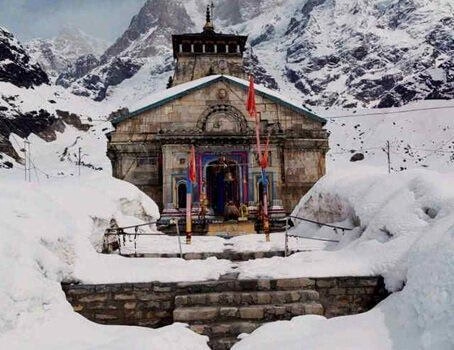
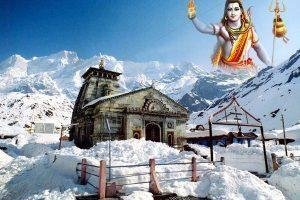
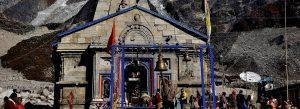
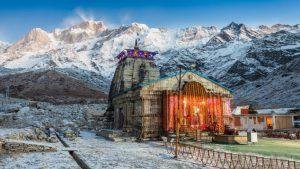
Perched at an elevation of 3,583 meters (11,755 ft) in the Garhwal Himalayas, Kedarnath Temple stands as a sentinel of devotion and resilience. Dedicated to Lord Shiva, this ancient shrine is revered as one of the twelve Jyotirlingas, representing the cosmic pillar of light. Unlike other shrines where the deity is carved, the Shiva Lingam here is a natural rock formation resembling a hump (the back of a bull), making it a Swayambhu (self-manifested) form.
Why Devotees Visit (Phalaśruti):
Pilgrims undertake this arduous journey to wash away the sins of a lifetime and cleanse ancestral karma. As the highest among the Jyotirlingas, it is believed that visiting Kedarnath liberates the soul from the cycle of rebirth. The temple is also a vital part of the Chota Char Dham circuit, fulfilling a spiritual duty for devout Hindus.
Historical Origins & Scriptural Legend
The origins of Kedarnath are shrouded in the mists of mythology and geological time.
The Pandavas & The Panch Kedar:
According to the Sthala Purana, after the Kurukshetra War, the Pandava brothers sought Lord Shiva’s blessings to atone for the sin of killing their kin. Shiva, unwilling to forgive them directly, transformed into a bull and vanished into the ground. When Bheem (one of the brothers) caught the bull’s tail, Shiva reappeared at five different locations. The hump of the bull remained at Kedarnath, while the other body parts manifested at Tungnath (arms), Madhyamaheshwar (stomach), Rudranath (face), and Kalpeshwar (hair). Thus, the five temples form the Panch Kedar circuit.
Architectural Origins & Adi Shankara:
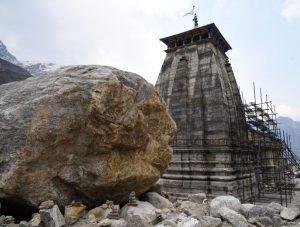
Tradition holds that the current stone edifice was likely restored by Adi Shankara in the 8th century, following the devastating floods of the Mandakini river. While geological surveys suggest the temple structure dates back over a millennium (possibly the 6th-7th century CE), the exact date of construction remains a mystery of the Himalayas. The temple was rediscovered by the Garhwal Kingdom after the 2013 floods, reinforcing its legendary resilience against nature’s fury.
Architectural Marvels
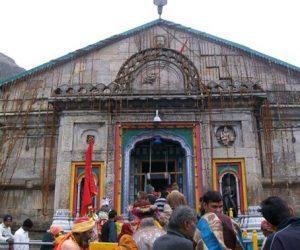
Kedarnath is a masterpiece of Nagara-style architecture, utilizing massive grey stone slabs stacked together with tight joints—built without any mortar. This unique construction technique has allowed it to withstand glacial winds and heavy snowfalls for centuries.
Key Features:
- The Mandapa: The pillared hall welcomes pilgrims with intricate carvings on the ceiling and pillars.
- The Garbhagriha: The inner sanctum houses the conical Shivling (the hump of the bull). The space is dark, lit only by lamps, creating a profound, meditative atmosphere.
- The Nandi Statue: A life-sized statue of Nandi, the divine bull vehicle of Shiva, stands guard outside the temple, facing the entrance.
- Material: The temple is constructed from extremely hard, interlocking gray stone blocks, quarried from the surrounding hills.
Darshan & Ritual Logistics
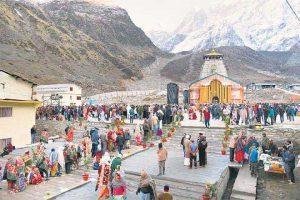
Due to the extreme weather conditions of the Himalayas, the temple remains open only for six months (April/May to November). The closing date is traditionally observed on Bhaiya Duj (two days after Diwali).
Daily Darshan Timings (2026 Season)
Note: Timings may vary slightly based on sunrise and sunset in the Himalayas.
| Session | Timing | Activity |
|---|---|---|
| Morning | 04:00 AM – 03:00 PM | General Darshan (with breaks for rituals) |
| Evening | 05:00 PM – 09:00 PM | Aarti & Special Darshan |
| Closing | 3:00 PM – 5:00 PM | Temple closed for afternoon break |
Key Sevas & Online Booking
To perform seva, devotees must book in advance through the official Badrinath Kedarnath Temple Committee (BKTC) portal. Key rituals include:
- Maha Abhishekam: Ritual bathing of the Jyotirlinga with milk, honey, and ghee (performed before general darshan).
- Rudrabhishek: A powerful Vedic ritual invoking Shiva.
- Laghu Puja/Archana: Personal prayers and name chanting.
Booking Link: https://bkct.uk.gov.in/ (Official BKTC Website)
2026 Festival Calendar
- Akshaya Tritiya (Opening): April 30, 2026
- Kedar Gauri Vrat: August 2026 (Specific date as per Hindu calendar)
- Maha Shivaratri: February 26, 2026 (Celebrated at Ukhimath during winter closure)
- Kartik Purnima (Closing): November 15, 2026 (Tentative)
Practical Visitor Guidance
Dress Code: As this is a high-altitude temple, modesty and warmth are key. Men should wear dhoti or trousers (no shorts). Women should wear sarees, salwar kameez, or full-length dresses. Traditional attire is highly recommended.
Photography & Mobiles:
- Photography is strictly prohibited inside the sanctum sanctorum.
- Mobile phones should be kept in silent mode. Lockers are available at the base camp (Bhimbuli) or near the temple entrance for storing electronics and shoes.
Accessibility & Crowd Management:
- Trek Difficulty: The 18km trek from Gaurikund is steep and narrow. For senior citizens or those with health issues, helicopter services or palanquins (Doli/Palki) are recommended.
- Best Time to Visit: May to June (pleasant weather) and September to October (clear skies, post-monsoon). Avoid July-August due to heavy monsoon and landslide risks.
- Essentials: Carry woolens regardless of the season, a raincoat, sturdy trekking shoes, and basic medicines.
Pilgrimage Connectivity
How to Reach:
- Nearest Airport: Jolly Grant Airport, Dehradun (approx. 250 km from Gaurikund).
- Nearest Railway: Rishikesh Railway Station (approx. 230 km from Gaurikund).
- By Road: Drive to Gaurikund via NH 7 (National Highway 7) and State Highway 11. Gaurikund is the last motorable point.
- Final Leg: 18 km trek from Gaurikund to Kedarnath. Alternatively, helicopter services operate from Sirsi, Phata, and Guptakashi.
Nearby Sacred Sites:
- Vishwanath Temple (Ukhimath): The winter abode of Lord Kedarnath (20 km away).
- Tungnath: The third temple in the Panch Kedar series, located at Chandrashila peak.
- Triyuginarayan: Known as the “Wedding Capital” of India, where Shiva and Parvati were married.


Frequently Asked Questions (FAQs)
1. Is there a VIP or VIP darshan entry available?
While there is no dedicated VIP entry gate, purchasing a specific Seva ticket (like Maha Abhishekam) allows for a privileged entry before general darshan lines open. Additionally, Helicopter package tourists are often given priority slots for a faster darshan.
2. What is the significance of the “Bhairon Temple”?
Located about 500 meters behind the main Kedarnath Temple, the Bhairon Temple is dedicated to Bhairon Baba (Bhairava). It is believed that Bhairon protects the temple from the west when Kedarnath is closed during winter. Pilgrims are encouraged to visit this temple for complete blessings.
3. Is it safe to visit Kedarnath after the 2013 floods?
Yes. Following the 2013 tragedy, significant infrastructure improvements have been made by the government and the Garhwal Mandal Vikas Nigam (GMVN). The trek route has been widened, accommodation has been upgraded, and an early warning system for floods has been installed. However, always check the latest weather advisory before traveling.
4. Can I stay overnight at Kedarnath?
Yes, basic accommodation options are available at Kedarnath, including GMVN guest houses and private tents. However, due to the high altitude (over 11,000 ft), those not accustomed to mountain conditions should consult a doctor before acclimatizing overnight.
5. Is helicopter service available for disabled pilgrims?
Yes, wheelchair-accessible helicopter services are available, particularly from Phata and Guptakashi. It is advisable to book in advance and notify the service provider of any special mobility requirements.
6. What is the connection between Kedarnath and Badrinath?
Together, they form the Kedar-Badri spiritual circuit. They are often visited together by pilgrims as they represent the dual divinity of Shiva (Kedarnath) and Vishnu (Badrinath), located roughly 220 km apart.
Recent Posts

Shri Kaamkoteeshwar Mandir, Varanasi – History & Significance
In the heart of Kashi, the eternal city of Lord Shiva, where the Ganges flows with celestial grace, stands the Shri Kaamkoteeshwar Mandir. This sacred Sannidhi is not merely a temple but a profound spiritual bridge between the Northern…

ओ सांवरे तूने ही मुझको संभाला – Lyrics & Meaning
ओ सांवरे तूने ही मुझको संभाला – A Prayer to Shyam Origin & Spiritual Essence Why This Bhajan Resonates Devotees chant this when overwhelmed by life’s storms—the refrain ‘तूने ही मुझको संभाला’ is the soul’s sigh of relief: “You…

कथा ये है महाराज मेरे की – Lyrics & Meaning
कथा ये है महाराज मेरे की छत्रपति संभाजी महाराज – A Prayer to Chhatrapati Sambhaji Maharaj Origin & Spiritual Essence Why This Bhajan Resonates Devotees chant this when their spirit feels tested—its powerful refrain “महाराज मेरे” is a soul’s…

Rigveda Samhita Yathartha Anuvada (ऋग्वेद संहिता यथार्थ अनुवाद) – Complete Set with Anvayartha & Hindi/English Translation
The Rigveda is the oldest surviving scripture of humanity and the foundational text of Sanātana Dharma. For serious students, scholars, UPSC aspirants studying ancient Indian history, Sanskrit learners, and spiritual seekers, a precise and grammatically structured translation is indispensable.…

आना भी अकेला है जाना भी अकेला है – Lyrics & Meaning | BharatTemples
आना भी अकेला है जाना भी अकेला है – A Prayer to the Divine Witness Origin & Spiritual Essence Why This Bhajan Resonates Devotees turn to this bhajan in moments of deep reflection—when life’s attachments begin to ache. The…

माता शेरावाली के द्वार जो भी जाता है – Lyrics & Meaning
माता शेरावाली के द्वार जो भी जाता है – A Prayer to Maa Sherawali Origin & Spiritual Essence Why This Bhajan Resonates Devotees turn to this bhajan in times of fear or uncertainty—its promise that no one leaves Maa’s…

मार लेना सपणी उबार लेणा भवरा – Lyrics & Meaning
मार लेना सपणी उबार लेणा भवरा – A Prayer to the Divine Beloved Origin & Spiritual Essence Why This Bhajan Resonates Devotees chant this in moments of deep vulnerability—its cry of “मार लेना सपणी, उबार लेणा भवरा” is the…

हमें श्याम सुंदर भरोसा तुम्हारा – Lyrics & Meaning
हमें श्याम सुंदर भरोसा तुम्हारा – A Prayer to Shyam Sundar Origin & Spiritual Essence Why This Bhajan Resonates Devotees chant this when feeling alone—its refrain ‘de do sahara’ is the soul’s cry for divine support. Lyrics in Hindi…

Mere Satguru Ne Di Thi Davai Lyrics in Hindi & Meaning
Mere Satguru Ne Di Thi Davai: Invoking the Guru’s Liberating Wisdom This soul-stirring bhajan venerates the Satguru (True Spiritual Master) as the divine physician who dispenses the only remedy for life’s deepest sufferings. Composed by Sant Karmaveer Tufani, it…

Janm Diyo Thari Maa Dukh Dekhiyo Lyrics in Hindi & Meaning
जन्म दियो थारी माँ दुख देखियो (Maa’s Grief Upon Birthing You) This soul-stirring Chetavani Bhajan (admonitory hymn) is addressed to the Divine Mother (Maa) – a call for repentance when children forget their filial duties in the dark age…