Kirateshwar Mahadev Temple: History, Darshan Timings & Sikkim Guide
Receive daily temple updates, divine darshan, and morning bhajans directly on WhatsApp.
Contents
- 1 Introduction & Spiritual Essence: The Throne of the Kirata Lord
- 2 Historical Origins & Scriptural Legend
- 3 Architectural Marvels
- 4 Darshan & Ritual Logistics
- 5 Practical Visitor Guidance
- 6 Pilgrimage Connectivity
- 7 Frequently Asked Questions (FAQ)
Introduction & Spiritual Essence: The Throne of the Kirata Lord
Perched on the serene banks of the roaring Rangit River in Legship, West Sikkim, stands the Kirateshwar Mahadev Temple, a sanctum revered as the “Thaan” (throne) of the Kirata people. Dedicated to Lord Shiva in his formidable aspect as Kirateshwar, this temple is not merely a structure of stone but a living testament to the divine intersection of mythology, history, and nature.
Unlike conventional murti worship, the presiding deity here is a Swayambhu (self-manifested) Shiva Linga. The very atmosphere vibrates with the energy of the Mahabharata, as the temple grounds are believed to be where Arjuna, the valiant Pandava, performed severe penance to acquire the Pashupatastra from Lord Shiva.
Phalaśruti (Spiritual Benefits): Devotees undertake this arduous journey to cleanse ancestral karma and seek the blessings of Lord Shiva for spiritual liberation (Moksha). It is particularly renowned among childless couples seeking blessings for progeny and for those wishing to harmonize discord in their lives.
Historical Origins & Scriptural Legend
The Mahabharata Connection
According to ancient Puranic scriptures and the Sthala Purana of West Sikkim, the temple’s roots are deeply embedded in the epic Mahabharata. Tradition holds that the Pandava prince Arjuna traveled through these Himalayan ranges to please Lord Shiva. Pleased by Arjuna’s devotion, Shiva manifested not as a celestial god but as a Kirateshwar—a hunter (Kirata) of the indigenous Kirati community—and gifted him the divine weapon required to win the war. This synthesis of Vedic tradition and indigenous Kirati culture makes this site unique in the annals of Himalayan spirituality.
📖 Related: Ayya Vaikundar Temple, Saandhupathi: History, Darshan Timings & Guide
Architectural Evolution
While specific dynastic inscriptions regarding the foundational date are sparse due to the temple’s ancient roots and subsequent renovations, the structure reflects a blend of traditional Hindu architecture adapted to the rugged Himalayan terrain. The stone masonry respects the local aesthetics of Sikkim, featuring a distinctive Dravida-inspired Shikhara (tower) capped with a gold kalasha. The temple complex is bounded by a stone wall, and ASI (Archaeological Survey of India) guidelines are followed to preserve the sanctity of the site.
Architectural Marvels
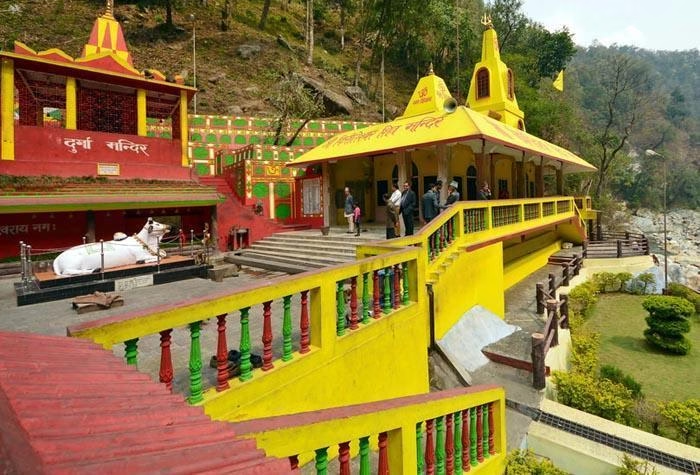
Set against the dramatic backdrop of the misty hills, the temple is a masterpiece of mountain architecture.
- The Sanctum (Garbhagriha): The inner sanctum houses the primeval Shiva Linga. The inner walls are adorned with intricate wood carvings depicting scenes from Hindu mythology, including the Dance of Shiva (Nataraja) and the Panchabhutas.
- The Mandapa: A spacious pillared hall allows devotees to gather for Aarti and prayer. The wooden beams are etched with traditional motifs, showcasing the craftsmanship of local artisans.
- Surroundings: The temple overlooks the confluence of the Rangit River and the Rammam stream, creating a natural Vastu Shastra alignment that channels the flow of positive energy.
hanuman-statue-kirateshwar-mahadev-temple-legship-west-sikkim-india-avatar-lord-shiva-hindu-63499066

18195338563_af8d1ae6d6, Kirateshwar Mahadev Temple, West Sikkim, Sikkim

kirateshwar-mahadev-temple (1), Kirateshwar Mahadev Temple, West Sikkim, Sikkim

kirateshwar-mahadev-temple-banner, Kirateshwar Mahadev Temple, West Sikkim, Sikkim

kirateshwar-mahadev-temple, Kirateshwar Mahadev Temple, West Sikkim, Sikkim

Legship_shiva_temple, Kirateshwar Mahadev Temple, West Sikkim, Sikkim

kirateshwar-mahadev-mandir1, Kirateshwar Mahadev Temple, West Sikkim, Sikkim
Darshan & Ritual Logistics
The temple follows a strict Vedic schedule, opening at dawn for the first Aarti and closing after the evening rituals. Devotees are encouraged to arrive early to offer Bilva leaves, a favorite of Lord Shiva.
Daily Darshan Timings
| Time Slot | Opening Time | Closing Time | Rituals |
|---|---|---|---|
| Morning | 07:00 AM | 12:00 PM | Abhishekam, Morning Aarti |
| Afternoon | 12:00 PM | 02:00 PM | Rest period (Closed to public) |
| Evening | 02:00 PM | 06:00 PM | Evening Aarti, Darshan |
📖 Related: Shri Bhuteshwar Mahadev Temple Mathura: History, Timings & Complete Guide
Key Sevas & Online Booking
Popular Sevas include the Shiva Abhishekam and the Mrityunjaya Jaap. While online booking is currently limited and primarily handled through the Sikkim Tourism portal for major festivals, devotees can book specific Sevas upon arrival at the temple counter.
2026 Festival Calendar
- Maha Shivaratri: February 26, 2026 (Expect high footfall; booking recommended months in advance).
- Bala Chaturdasi: November 30, 2025 – December 1, 2026 (A unique festival celebrated with a night-long vigil and the scattering of rice grains).
- Shravan Month (Mondays): July – August 2026 (Monsoon pilgrimage peak).
Practical Visitor Guidance
Respecting the sanctity of the site is paramount. The atmosphere is contemplative, and silence is encouraged inside the sanctum.
- Dress Code: Modest clothing is mandatory. Men should remove footwear and wear trousers/t-shirts; women should wear sarees, salwar kameez, or skirts/dupattas.
- Photography: Photography is strictly prohibited inside the main sanctum (Garbhagriha). However, photography is permitted in the outer courtyard and for scenic views of the Rangit River.
- Mobile Lockers: A cloakroom facility is available at the entrance for mobile phones and leather goods, as electronic devices are restricted in the temple premises.
- Crowd Management: The temple sees a surge of pilgrims during Shivaratri. Best Time to Visit: Early mornings (7 AM – 9 AM) or late evenings (4 PM – 5 PM) on weekdays. Avoid weekends if you prefer a quieter darshan.
- Seasonal Advice: Sikkim winters (Dec-Feb) are freezing; carry heavy woolens. Monsoons (June-Sept) bring heavy rainfall; waterproof footwear is essential.
Pilgrimage Connectivity
How to Reach
The temple is located in Legship, roughly 4 km from the main Geyzing-Pelling route.
- By Air: The nearest airport is Pakyong Airport (PYG) in Sikkim (approx. 35 km) or Bagdogra Airport (IXB) in West Bengal (approx. 140 km).
- By Rail: The nearest major railway station is New Jalpaiguri (NJP) (approx. 135 km).
- By Road: Legship is well-connected via National Highway (NH) 10 (now NH 710). From Siliguri, take the route via Melli to Geyzing, then proceed to Legship.
📖 Related: Rudranath Temple: History, Panch Kedar Darshan Timings & Guide
Nearby Sacred Sites
Complete your spiritual circuit by visiting these nearby locations:
- Pemayangtse Monastery: One of the oldest monasteries in Sikkim (12th century), located just 8 km away.
- Rabdentse Ruins: The second capital of the former Kingdom of Sikkim, a UNESCO-protected archaeological site.
- Siddheshwar Dham (Char Dham): Located in Namchi (South Sikkim), approximately 40 km away.
Frequently Asked Questions (FAQ)
1. Is there a VIP darshan entry at Kirateshwar Mahadev?
While there is no formal VIP entry system like in larger South Indian temples, priority is given to elderly devotees and those with special Seva bookings. During peak festivals, a separate queue is managed by volunteers.
2. What is the significance of the “Bala Chaturdasi” festival here?
Bala Chaturdasi is celebrated the night before Amavasya (new moon) in late November or December. Devotees stay awake all night chanting hymns and scattering rice grains (Bala) in the surrounding forest to pacify spirits and ancestors.
3. Are there accommodation facilities near the temple?
Yes, there are budget hotels and guest houses available in Legship and Geyzing. A guest house managed by the temple trust is also available for pilgrims, though prior reservation via local contacts is advised.
4. Is the temple accessible for wheelchairs?
The terrain around Legship is hilly and the temple involves steps. Accessibility for wheelchairs is limited due to the traditional architecture and gradient of the location.
5. Can we carry our own Prasad?
Yes, dry fruits, sweets, and milk can be carried for personal offering. However, for the main Abhishekam, it is recommended to purchase the official Puja kit available at the temple counter to ensure purity.