
Contents
Introduction & Spiritual Essence
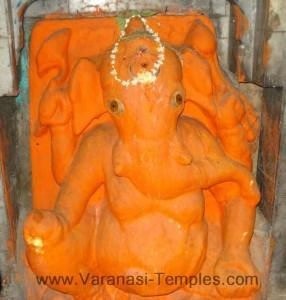
Nestled deep within the labyrinthine lanes of the Lakshmi Kund locality in Varanasi (Kashi) lies the ancient and powerful Koonitaksh Vinayak Temple. This sacred shrine is dedicated to Lord Ganesha, revered here as Koonitaksh Vinayak (also spelled Koonitaksh Ganpati). The name “Koonitaksh” is derived from “Koon” (dim or hidden) and “Aksh” (eyes), signifying a deity with piercing, hidden vision who sees through the darkest intentions.
According to local folklore, Lord Ganesha guards the holy city of Kashi from the “evil designs of bad persons.” Devotees visit this temple not only for the fulfillment of wishes but specifically for cleansing ancestral karma and removing the unseen obstacles (Vighna) that block their spiritual and material paths. As a Swayambhu (self-manifested) form, the energy here is considered raw and potent, making it a vital stop for those completing the Kashi Vishwanath pilgrimage circuit.
Phalaśruti: Why Visit Koonitaksh Vinayak?
Tradition holds that offering prayers at this specific Ganesha shrine yields distinct spiritual benefits:
- Removal of Hidden Enemies: As the guardian of Kashi, devotees believe the deity protects them from covert threats and bad intentions of adversaries.
- Karmic Cleansing: It is highly recommended for those undergoing difficult Shani (Saturn) or Rahu periods to visit and perform Ganesh Chalisa recitation.
- Resolution of Legal Disputes: Many devotees visit here before court hearings, seeking the Lord’s intervention in complex matters.
Historical Origins & Scriptural Legend
While the specific construction date of the current structure is not documented in public ASI archives, the temple is steeped in the ancient Puranic history of Varanasi. The Kashi Khand of the Skanda Purana extensively details the placement of Ganesha shrines around the periphery of the Kashi Vishwanath Jyotirlinga, serving as the first line of defense and blessing for pilgrims.
The Legend of Koonitaksh
Tradition holds that this shrine dates back to the era when the physical structure of Kashi was being established as a fortress of spirituality against negative cosmic forces. Local legends narrate that the earth here has a natural vibration that manifests the energy of Lord Ganesha. Sthala Purana (local oral history) suggests that the eyes of the deity here are so intense that they are often kept covered or are located in a darker corner of the sanctum (hence the name “Koonitaksh”), signifying the Lord’s ability to see through the darkness of ignorance and evil.
Architectural Marvels
The temple exhibits a traditional Nagara style of temple architecture, though adapted to the tight urban constraints of old Varanasi. Unlike sprawling temple complexes, the architecture here focuses on verticality and a sanctified inner space.
Key Architectural Elements
The Shikhara (spire) is modest yet distinctly Hindu in its tiered structure. The entrance leads directly into a compact Mandapa (hall) which opens into the Garbhagriha (sanctum sanctorum). The walls, though simple, carry the ancient vibration characteristic of the stone temples of the Kashi region. While not a designated ASI monument, the temple follows traditional Vastu Shastra principles, with the idol facing the East, allowing the morning sun to illuminate the deity during certain times of the year.
Photo Gallery
Darshan & Ritual Logistics (2026 Update)
Given the location deep inside the old city, timings can be seasonal. As of our 2026 guide, the following schedule is observed. Note: It is advisable to call the temple administrator (contact details below) 24 hours prior during peak festival seasons.
Daily Timings
| Session | Timings | Notes |
|---|---|---|
| Morning Darshan | 05:00 AM – 12:00 PM | Best time: 6:00 AM for quiet prayer. |
| Midday Closure | 12:00 PM – 3:00 PM | Rest period for the deity. |
| Evening Darshan | 3:00 PM – 10:00 PM | Includes Aarti time (approx 6:30 PM). |
Key Sevas & Online Booking
Devotees can perform specific Sevas to deepen their connection with Koonitaksh Vinayak:
- Abhishekam: Ritual bathing of the idol with milk, honey, and curd. Recommended for clearing mental impurities.
- Ganesh Chalisa & Sahasranama Archana: Recitation of 108 names for specific life goals.
- Modak Offering: The favorite sweet of Lord Ganesha is offered daily.
Online Booking: While Koonitaksh Vinayak has a local administration, many standard Pujas in Varanasi can be booked via the official Kashi Vishwanath Temple portal or trusted third-party platforms like “Vedic Vidyaa” for general Ganesha offerings.
2026 Major Festival Dates
| Festival | Date (2026) | Special Significance |
|---|---|---|
| Sankashti Chaturthi | Feb 3 (Kaphala) & Oct 13 (Kartik) | Full Moon fasting for obstacles removal. |
| Ganesh Chaturthi | August 26, 2026 | The main birthday of Lord Ganesha. High crowd expected. |
| Diwali (Lakshmi Puja) | October 18, 2026 | Special Aarti at midnight. Temple illuminated. |
Practical Visitor Guidance
Visiting Koonitaksh Vinayak requires navigating the historic but narrow lanes of Varanasi.
Rules & Etiquette
- Dress Code: Traditional attire is recommended. Men should wear dhoti/pants and shirts; women should wear sarees or salwar kameez. Avoid shorts and sleeveless tops.
- Photography: Strictly prohibited inside the sanctum sanctorum. Photography in the outer Mandapa is generally allowed but seek permission from the priest.
- Mobile Lockers: There are no high-tech lockers at this specific shrine. Devotees are advised to carry minimal luggage. Use the cloakrooms at the nearby Kashi Vishwanath Temple entry gates (Vishwanath Gali).
- Accessibility: The temple is located in the pedestrian-only zone. The approach involves walking through narrow alleys, making it difficult for those with mobility issues. Wheelchair access is not feasible.
Crowd Management
- Best Hours: Early morning (5:00 AM – 7:00 AM) or late evening (8:00 PM – 10:00 PM) to avoid the rush of market shoppers.
- Seasonal Advice: Summers (April-June) in Varanasi can be harsh; carry a water bottle and a head covering. Monsoons (July-Sept) make the lanes slippery; wear rubber-soled footwear.
Pilgrimage Connectivity
How to Reach Koonitaksh Vinayak
The temple is located at D-52/38, inside Old Lakshmi Temple premises, near Mahalakshmi Gauri Temple, Lakshmi Kund, Varanasi, Uttar Pradesh 221001.
- By Air: Lal Bahadur Shastri International Airport (VNS) is approximately 25 km away. Taxis and Auto-rickshaws are available directly to the Godaulia or Varanasi Cantt Railway Station area.
- By Rail: Varanasi Junction (BSB) is about 5-6 km from Lakshmi Kund. From the station, take an auto to Luxa Road or Godaulia. From there, the temple is accessible via e-rickshaw or a 10-minute walk.
- By Road: NH 19 (formerly NH 2) connects Varanasi to major cities. Once in Varanasi, approach via Luxa Road towards the old city. Local vehicles stop at the periphery of the pedestrian zone.
Nearby Sacred Sites (Pilgrimage Circuit)
Enhance your spiritual journey by visiting these nearby shrines:
- Shri Kashi Vishwanath Temple (Jyotirlinga): Just a 15-minute walk through the Vishwanath Gali. The primary destination of Kashi.
- Shri Sankat Mochan Hanuman Temple: Located approx 3 km away near the Assi Ghat. Famous for the removal of troubles and diseases.
- Maa Annapurna Temple: Situated adjacent to the Kashi Vishwanath temple, revered as the Goddess of food and nourishment.
Frequently Asked Questions (FAQ)
Is there a VIP Darshan entry at Koonitaksh Vinayak?
Unlike the major Kashi Vishwanath Corridor, there is no official VIP entry system at Koonitaksh Vinayak. Darshan is general and based on a first-come, first-served basis. However, visiting early in the morning usually ensures a quick and peaceful Darshan.
What is the best time to visit this temple to avoid crowds?
The best time is during weekdays in the early mornings (5:30 AM to 7:00 AM). Weekends and festival days see a significant influx of devotees, especially during the month of Shravan (July-August).
Are there accommodation facilities nearby?
While there are no hotels directly at Lakshmi Kund, the areas of Godaulia and Dashashwamedh offer numerous hotels and Dharamshalas ranging from budget to mid-range. For luxury accommodations, the cantonment area is the best option.
Can we offer Modak inside the sanctum?
Generally, the offering is handed to the priest who places it before the deity. Direct offering by devotees inside the sanctum is usually restricted to maintain order and purity.
What is the phone number for inquiries?
Specific direct contact numbers for Koonitaksh Vinayak are not widely publicized. For general information regarding temples in Varanasi, one may contact the Kashi Vishwanath Temple Administration or the local tourism office.
Recent Posts

ओ सांवरे तूने ही मुझको संभाला – Lyrics & Meaning
ओ सांवरे तूने ही मुझको संभाला – A Prayer to Shyam Origin & Spiritual Essence Why This Bhajan Resonates Devotees chant this when overwhelmed by life’s storms—the refrain ‘तूने ही मुझको संभाला’ is the soul’s sigh of relief: “You…

कथा ये है महाराज मेरे की – Lyrics & Meaning
कथा ये है महाराज मेरे की छत्रपति संभाजी महाराज – A Prayer to Chhatrapati Sambhaji Maharaj Origin & Spiritual Essence Why This Bhajan Resonates Devotees chant this when their spirit feels tested—its powerful refrain “महाराज मेरे” is a soul’s…

Rigveda Samhita Yathartha Anuvada (ऋग्वेद संहिता यथार्थ अनुवाद) – Complete Set with Anvayartha & Hindi/English Translation
The Rigveda is the oldest surviving scripture of humanity and the foundational text of Sanātana Dharma. For serious students, scholars, UPSC aspirants studying ancient Indian history, Sanskrit learners, and spiritual seekers, a precise and grammatically structured translation is indispensable.…

आना भी अकेला है जाना भी अकेला है – Lyrics & Meaning | BharatTemples
आना भी अकेला है जाना भी अकेला है – A Prayer to the Divine Witness Origin & Spiritual Essence Why This Bhajan Resonates Devotees turn to this bhajan in moments of deep reflection—when life’s attachments begin to ache. The…

माता शेरावाली के द्वार जो भी जाता है – Lyrics & Meaning
माता शेरावाली के द्वार जो भी जाता है – A Prayer to Maa Sherawali Origin & Spiritual Essence Why This Bhajan Resonates Devotees turn to this bhajan in times of fear or uncertainty—its promise that no one leaves Maa’s…

मार लेना सपणी उबार लेणा भवरा – Lyrics & Meaning
मार लेना सपणी उबार लेणा भवरा – A Prayer to the Divine Beloved Origin & Spiritual Essence Why This Bhajan Resonates Devotees chant this in moments of deep vulnerability—its cry of “मार लेना सपणी, उबार लेणा भवरा” is the…

हमें श्याम सुंदर भरोसा तुम्हारा – Lyrics & Meaning
हमें श्याम सुंदर भरोसा तुम्हारा – A Prayer to Shyam Sundar Origin & Spiritual Essence Why This Bhajan Resonates Devotees chant this when feeling alone—its refrain ‘de do sahara’ is the soul’s cry for divine support. Lyrics in Hindi…

Mere Satguru Ne Di Thi Davai Lyrics in Hindi & Meaning
Mere Satguru Ne Di Thi Davai: Invoking the Guru’s Liberating Wisdom This soul-stirring bhajan venerates the Satguru (True Spiritual Master) as the divine physician who dispenses the only remedy for life’s deepest sufferings. Composed by Sant Karmaveer Tufani, it…

Janm Diyo Thari Maa Dukh Dekhiyo Lyrics in Hindi & Meaning
जन्म दियो थारी माँ दुख देखियो (Maa’s Grief Upon Birthing You) This soul-stirring Chetavani Bhajan (admonitory hymn) is addressed to the Divine Mother (Maa) – a call for repentance when children forget their filial duties in the dark age…
Bhadi Sabha Mein Thane Manaun Lyrics in Hindi & Meaning
Bhadi Sabha Mein Thane Manaun: Invoking the Spear-Wielding Mother Mata Bhawani (श्री ज्वाला भवानी), the fiery manifestation of Shakti worshipped as the Protector of Dharma in Her Dhaulagarh sanctum. Origin & Spiritual Essence Composed in Rajasthani folk tradition by…