Macheswarar Temple, Kanchipuram: History, Darshan Timings & Guide
Receive daily temple updates, divine darshan, and morning bhajans directly on WhatsApp.
Contents
- 1 1. Introduction & Spiritual Essence
- 2 2. Historical Origins & Scriptural Legend
- 3 3. Architectural Marvels
- 4 4. Darshan & Ritual Logistics (2026 Update)
- 5 5. Practical Visitor Guidance
- 6 6. Pilgrimage Connectivity
- 7 7. Frequently Asked Questions
- 8 Contact Details
1. Introduction & Spiritual Essence
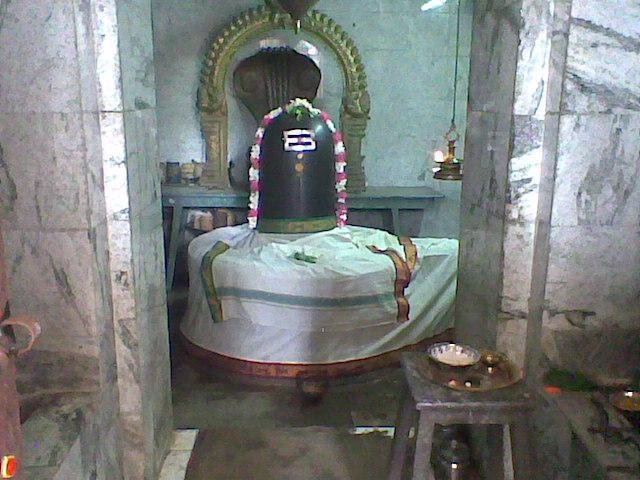
In the holy city of Kanchipuram, often revered as the “City of Temples,” stands the ancient Macheswarar Temple. Dedicated to Lord Shiva, this shrine holds a unique distinction in Hindu mythology. The presiding deity, Macheswarar (a form of Lord Shiva), is believed to have been worshipped by Matsya, the first avatar of Lord Vishnu.
Unlike typical Shiva temples, the Swayambhu (self-manifested) lingam here is directly associated with the cosmic rescue performed by Vishnu. According to legend, after slaying the demon Hayagriva and freeing the Vedas, Matsya washed away the accumulated “Pavam” (negative karmic influence or poison) in this very location and offered prayers to Shiva. Thus, the temple is a powerful spiritual center for cleansing ancestral karma and seeking liberation from past sins. Devotees visit to witness the rare depiction of Vishnu’s rescue mission and to receive the blessings of Lord Shiva, who grants Moksha (liberation).
2. Historical Origins & Scriptural Legend
The Legend of Matsya
According to the Sthala Purana, the demon Hayagriva stole the Vedas and hid them in a cosmic ocean. Lord Vishnu incarnated as the giant fish, Matsya, to retrieve them. Upon recovering the Vedas, Matsya needed to purify himself of the battle’s residual darkness (or Pavam). He descended at this spot in Kanchipuram, worshipped the self-manifested Shiva lingam, and attained purity. Hence, the deity is named Macheswarar—the Lord worshipped by Matsya (Matsya + Eswarar).
📖 Related: Chenganmaaleeswarar Temple, Chenganmaal: History, Darshan Timings & Guide
Archaeological History
While exact construction dates for smaller shrines in Kanchipuram are often obscured by millennia of reconstruction, this temple is structurally rooted in the Pallava Dynasty (6th–9th century CE), with subsequent enhancements by the Cholas and Vijayanagara rulers. Temple records indicate renovations during the Vijayanagara era, evident in the vibrant Mandapas (pillared halls). Unlike major Kanchipuram temples which strictly follow Agamic rules, this shrine retains a distinct, rustic sanctity typical of ancient folk traditions.
3. Architectural Marvels
The Macheswarar Temple is a classic example of Dravidian Temple Architecture. It follows the Pancha Sthana (five-shrine) layout common in Kanchipuram, where the central sanctum is surrounded by smaller shrines.
Key Features:
- Sanctum Sanctorum (Garbhagriha): Houses the Swayambhu lingam facing east. The lingam is roughly oval-shaped, natural in form, symbolizing the unmanifested nature of Shiva.
- Vimana (Shikhara): The tower over the sanctum is a modest, barrel-shaped Dravida Vimana, typical of early Pallava architecture, lacking the ornate later gopurams.
- Niche Sculptures: The outer walls feature carvings of Dwarapalakas (guardians) and minor deities. The most notable sculpture depicts Matsya holding the Vedas, a rare iconography not found in most Shiva temples.
- Prakaram (Circumambulatory Path): A narrow corridor surrounds the main shrine, allowing for Pradakshina. The flooring consists of ancient granite slabs.
Note: This temple is a protected heritage site under the Tamil Nadu Hindu Religious and Charitable Endowments (HR&CE) Department.
4. Darshan & Ritual Logistics (2026 Update)
To ensure a peaceful darshan, it is advisable to check the local Panchangam before visiting, as festival timings may vary slightly.
Daily Temple Timings
| Session | Timings | Details |
|---|---|---|
| Morning Session | 6:00 AM – 12:00 PM | Opens with Kalasanthi (Sunrise Puja). Best time: 8:00 AM – 9:30 AM. |
| Afternoon Break | 12:00 PM – 4:00 PM | Temple remains closed for midday rituals. |
| Evening Session | 4:00 PM – 8:00 PM | Reopens for Saaya Rajjam Puja. Closes after the last Arathi. |
Key Sevas & Online Booking
While this is a smaller shrine compared to Ekambareswarar or Kamakshi Amman, standard Shiva Sevas are available. Booking is typically done at the temple counter, but for 2026, the Tamil Nadu HR&CE app (Arulmigu) allows online booking for major pujas.
- Abhishekam: Daily 8:00 AM & 6:00 PM. Offered with milk, honey, and sandalwood paste.
- Archana: Recitation of Shiva Sahasranamam.
- Rudra Abhishekam: Performed on Mondays and Pradosham.
📖 Related: Bhadra Kali Amman Temple Vattavilai: History, Darshan Timings & Guide
2026 Major Festivals
- Arudra Darshanam: January 15, 2026 (Celebrating Lord Nataraja).
- Maha Shivaratri: February 26, 2026 (Night-long vigil and special abhishekam).
- Pradosham: Bi-monthly (13th day after New Moon/Full Moon). Key dates: May 10 and November 4, 2026.
- Karthigai Deepam: December 4, 2026 (Festival of Lights).
5. Practical Visitor Guidance
Code of Conduct & Dress Code
Maintaining the sanctity of the temple is paramount.
- Attire: Traditional Indian wear is recommended (Dhoti/Saree). Western clothing should be modest (avoid shorts/tank tops).
- Photography: Strictly prohibited inside the Garbhagriha (inner sanctum). Photography of the outer architecture is permitted with discretion.
- Mobile Phones: Please switch to silent mode. Lockers are generally available at the temple office for electronic devices, though for smaller temples, it is advised to travel light.
- Accessibility: The temple has a single-level entrance. Elderly devotees can park wheelchairs near the Mandapa, though the sanctum threshold has a high step.
Crowd Management
Unlike the crowded Varadharaja Perumal Temple, Macheswarar Temple is relatively quiet.
- Best Hours: 7:00 AM – 9:00 AM (Morning calm) or 5:00 PM – 6:30 PM (Evening puja).
- Seasonal Advice: Kanchipuram is hot in May. Carry a water bottle and wear cotton fabrics. Monsoons (October-November) are pleasant, but the temple floors can be slippery.
6. Pilgrimage Connectivity
How to Reach
- By Air: Chennai International Airport (MAA) is the nearest airport, approximately 75 km away. From there, taxis and buses are available to Kanchipuram.
- By Rail: Kanchipuram Railway Station (KCGM) is the closest railhead (5 km from the temple). Alternatively, Chengalpattu Junction (30 km) is a major rail hub.
- By Road: Kanchipuram is well-connected via NH 48 (connecting Chennai to Bangalore). The temple is located near the central bus stand, easily accessible by auto-rickshaws or local share autos.
📖 Related: Venugopala Temple Anaikuppam: History, Darshan Timings & Complete Pilgrimage Guide
Nearby Sacred Sites (The Kanchipuram Circuit)
- Ekambareswarar Temple: Located 2 km away. Dedicated to Shiva as the Lord of the Mango Tree.
- Kamakshi Amman Temple: Located 1.5 km away. The focal Shakti shrine for the region.
- Varadharaja Perumal Temple: Located 3 km away. A premier Vishnu temple housing the golden lizard.
7. Frequently Asked Questions
What is the significance of the name Macheswarar?
The name is derived from Matsya (the fish avatar of Vishnu) and Eswarar (Lord Shiva). It signifies the spot where Lord Vishnu, after his incarnation as Matsya, worshipped Shiva to cleanse the poison (Pavam) encountered during the battle to save the Vedas.
Is there a VIP darshan entry available?
As this is a smaller, historic temple managed by the HR&CE, there is no formal VIP ticket system like in Tirupati. However, purchasing a special Archana ticket allows for closer access to the deity during the ritual.
What is the best time to visit Kanchipuram for this temple?
The ideal months are November to February when the weather is cool and pleasant. If visiting for Maha Shivaratri (February 2026), expect larger crowds and special night-long rituals.
Are non-Hindus allowed inside the temple?
Traditionally, access to the inner sanctum of many Shiva temples in Kanchipuram is restricted to Hindus. However, the outer architecture and mandapas are often viewable. It is respectful to ask the temple priest or security personnel at the entrance.
Where can I park my vehicle?
Since the temple is located near the bus stand and market area, on-street parking is limited. There are designated paid parking lots near the Kanchipuram bus stand complex, a short 5-minute walk from the temple.
Contact Details
Official Address:
Macheswarar Temple,
near Central Bus Stand, Kanchipuram Town,
Tamil Nadu 631501, India.
Temple Authority: Tamil Nadu Hindu Religious and Charitable Endowments (HR&CE) Department.
Note: Specific phone numbers for smaller shrines are often not publicly listed. For general inquiries, contact the Kanchipuram District Temple Administration Office.