
Contents
Introduction & Spiritual Essence
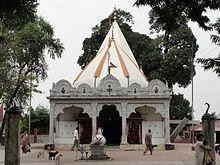
Nestled atop a serene hillock on the northern fringes of Tezpur town in Assam, the Mahabhairav Temple stands as a monumental guardian of faith and history. Dedicated to Lord Shiva in his fierce yet benevolent form of Mahabhairav, this ancient shrine is one of the holiest abodes of the Mahadeva in Northeast India. The presiding deity is a Swayambhu (self-manifested) Lingam, radiating a potent spiritual energy that has drawn devotees for millennia.
Also revered as the Bhairav Temple Tezpur, this site is unique for its syncretic rituals. It represents the harmonious blend of mainstream Shaivism and indigenous Tai-Ahom traditions. The primary Phalaśruti (benefit of pilgrimage) cited by devotees is the cleansing of ancestral karma and the removal of obstacles caused by malevolent planetary alignments. It is believed that offering prayers here liberates the spirits of ancestors, symbolized by the ritualistic freeing of pigeons, and grants the devotee protection from untimely death.
Historical Origins & Scriptural Legend
Myths of King Bana and the Salasthamba Dynasty
According to local legend and tradition, the temple traces its origins to the pre-historic era, credited to the demon-king Bana, a devout devotee of Lord Shiva. Historical evidence, however, suggests the temple’s foundational stones were laid by the Salasthamba dynasty rulers between the 8th and 10th century A.D. Archaeological remnants, including massive stone pillars scattered around the sanctum, attest to this era.
Temple records narrate a turbulent history of resilience. During the medieval Islamic invasions, the original stone structure was heavily damaged. It was later resurrected by successive dynasties, including the Ahom rulers. Specifically, the Tungkhungiya dynasty contributed significantly, donating vast tracts of Devotee land (Deori land) and appointing Paiks (guards) and Borthakurs (managers) to maintain the shrine.
Despite these efforts, a catastrophic earthquake in 1897 leveled much of the structure. The present-day temple complex was miraculously rebuilt in the early 20th century by Sri Swayambar Bharati, popularly known as Naga Baba, an ascetic who dedicated his life to the restoration of the Shiva Lingam.
Architectural Marvels
The architecture of Mahabhairav Temple is a hybrid of Nagara (North Indian) and indigenous Assamese styles, evolved over centuries of reconstruction.
Vastu Shastra & Structural Elements
The temple is situated on a high hillock, aligning with the Vastu principle of placement on elevated ground to channel cosmic energy. The sanctum sanctorum houses the massive Shiva Lingam, but unlike typical stone structures, the current edifice is built of durable concrete, ensuring longevity against the humid climate of Assam.
Flanking the main entrance are towering idols of Lord Ganesha and Lord Hanuman acting as Dwarpaals (gatekeepers). The Nat Mandir (dance hall), constructed later by Sri Mahadeo Bharati, features intricate carving spaces for classical dance performances dedicated to the deity. While the temple holds immense historical value, it currently does not have a UNESCO tag, though it is protected and maintained by the State Archaeology Department.
Darshan & Ritual Logistics
Visiting Mahabhairav Temple offers a glimpse into unique Shaivite rituals. A distinctive offering here is Laddu laced with Bhang (an edible preparation of cannabis mixed with milk and spices), offered to Lord Shiva as Prasad. This ritual is deeply rooted in the tantric traditions of the region and is consumed by devotees during Maha Shivaratri.
Daily Temple Timings
Assuming the current year is 2026, the following schedule applies. Note that timings may vary slightly during festivals.
| Session | Timing | Activity |
|---|---|---|
| Morning Darshan | 6:00 AM – 1:00 PM | Mangala Aarti, Abhishekam |
| Afternoon Break | 1:00 PM – 3:00 PM | Sanctum Cleaning |
| Evening Darshan | 3:00 PM – 8:00 PM | Sandhya Aarti, Shringar |
Sevas & Online Booking
Devotees can book specific sevas (rituals) such as Abhishekam (ritual bathing of the Lingam) and Archana (recitation of names). While traditional offline booking is available at the temple counter, the Government of Assam has digitized several processes.
- Online Seva Portal: Visit the official Deori Temple Management portal (managed by the Sonitpur Deputy Commissioner’s office).
- 2026 Festival Dates: Maha Shivaratri falls on February 26, 2026. Special sevas require booking 30 days in advance due to high footfall.
Practical Visitor Guidance
Rules & Etiquette
- Dress Code: Traditional attire is recommended. Men should wear dhotis or trousers (no shorts); women should wear sarees or salwar kameez.
- Photography: Strictly prohibited inside the sanctum sanctorum. Photography is allowed in the outer courtyard.
- Mobile & Lockers: Electronic items, including mobile phones and cameras, are restricted near the inner sanctum. Locker facilities are available near the entrance for a nominal fee.
- Accessibility: The temple is situated on a hillock. There are steps leading to the entrance. Currently, wheelchair access is limited due to the historical terrain, though a paved path has been constructed.
Crowd Management & Seasonal Advice
- Best Hours: Early morning (6:00 AM – 7:30 AM) or late evening (after 7:00 PM) to avoid long queues.
- Seasonal Tip: Assam summers (April–May) are humid. Carry a water bottle (refill stations are available). Winters (November–February) are ideal for visitation.
Pilgrimage Connectivity
How to Reach
The temple is located on the outskirts of Tezpur town, easily accessible from Guwahati.
- Nearest Airport: Tezpur Airport (Salonibari) – 8 km. Alternatively, Guwahati International Airport (GAU) – 180 km (approx. 4 hours drive).
- Nearest Railway: Tezpur Railway Station (Link to Guwahati/Dibrugarh lines).
- By Road: The temple connects via NH 715. From Tezpur town center, take the route towards the hillock (Bhairab Kund area).
Nearby Sacred Sites
Enhance your pilgrimage circuit by visiting:
- Kolkiateshwari Temple (Koliabor): Another powerful Shakti Peetha located 30 km from Tezpur.
- Nagshankar Temple: Famous for the ancient serpent (naga) shrine, located 45 km away.
- Bhalukpong (Arunachal Border): A scenic gateway to Arunachal Pradesh with riverine spirituality.
Architectural Highlights

Ancient stone pillars surrounding the temple complex.
How to Reach
For detailed navigation, you can view the location on Google Maps.
Contact Details
Official Address:
Mahabhairav Temple, Tezpur, Sonitpur District,
Assam, India – 784001
Frequently Asked Questions (FAQs)
1. Is there a VIP or special entry darshan facility?
Yes, the temple administration offers a special darshan pass for elderly citizens and differently-abled visitors. This can be obtained from the temple manager’s office upon presentation of valid ID. VIP entry is generally restricted for groups during peak festivals like Maha Shivaratri.
2. What is the significance of offering Bhang Laddu?
The offering of Bhang Laddu is a unique ritual specific to this region, believed to be favored by Lord Shiva. It represents a form of offering that induces a state of spiritual ecstasy, symbolizing the transcendence of worldly consciousness. It is strictly regulated and served only as Prasad by authorized temple cooks.
3. Are there accommodation facilities near the temple?
While there are no guesthouses directly within the temple complex, Tezpur town offers a wide range of government lodges (e.g., PWD inspection bungalow) and private hotels ranging from budget to luxury. It is advisable to book in advance during winter and festival seasons.
4. Is non-Hindu entry allowed?
The temple follows traditional Shaivite customs. While the inner sanctum is generally reserved for Hindus, the outer courtyard and architecture are accessible to visitors of all faiths who wish to appreciate the history and peaceful environment. It is best to maintain silence and respect local sentiments.
5. What is the history of the stone pillars surrounding the temple?
Archaeologists believe these massive stone pillars belong to the original structural temple built by the Salasthamba dynasty (8th–10th century A.D.). These pillars serve as the only standing evidence of the ancient stone architecture before the temple was rebuilt in concrete after the 1897 earthquake.
Recent Posts

ओ सांवरे तूने ही मुझको संभाला – Lyrics & Meaning
ओ सांवरे तूने ही मुझको संभाला – A Prayer to Shyam Origin & Spiritual Essence Why This Bhajan Resonates Devotees chant this when overwhelmed by life’s storms—the refrain ‘तूने ही मुझको संभाला’ is the soul’s sigh of relief: “You…

कथा ये है महाराज मेरे की – Lyrics & Meaning
कथा ये है महाराज मेरे की छत्रपति संभाजी महाराज – A Prayer to Chhatrapati Sambhaji Maharaj Origin & Spiritual Essence Why This Bhajan Resonates Devotees chant this when their spirit feels tested—its powerful refrain “महाराज मेरे” is a soul’s…

Rigveda Samhita Yathartha Anuvada (ऋग्वेद संहिता यथार्थ अनुवाद) – Complete Set with Anvayartha & Hindi/English Translation
The Rigveda is the oldest surviving scripture of humanity and the foundational text of Sanātana Dharma. For serious students, scholars, UPSC aspirants studying ancient Indian history, Sanskrit learners, and spiritual seekers, a precise and grammatically structured translation is indispensable.…

आना भी अकेला है जाना भी अकेला है – Lyrics & Meaning | BharatTemples
आना भी अकेला है जाना भी अकेला है – A Prayer to the Divine Witness Origin & Spiritual Essence Why This Bhajan Resonates Devotees turn to this bhajan in moments of deep reflection—when life’s attachments begin to ache. The…

माता शेरावाली के द्वार जो भी जाता है – Lyrics & Meaning
माता शेरावाली के द्वार जो भी जाता है – A Prayer to Maa Sherawali Origin & Spiritual Essence Why This Bhajan Resonates Devotees turn to this bhajan in times of fear or uncertainty—its promise that no one leaves Maa’s…

मार लेना सपणी उबार लेणा भवरा – Lyrics & Meaning
मार लेना सपणी उबार लेणा भवरा – A Prayer to the Divine Beloved Origin & Spiritual Essence Why This Bhajan Resonates Devotees chant this in moments of deep vulnerability—its cry of “मार लेना सपणी, उबार लेणा भवरा” is the…

हमें श्याम सुंदर भरोसा तुम्हारा – Lyrics & Meaning
हमें श्याम सुंदर भरोसा तुम्हारा – A Prayer to Shyam Sundar Origin & Spiritual Essence Why This Bhajan Resonates Devotees chant this when feeling alone—its refrain ‘de do sahara’ is the soul’s cry for divine support. Lyrics in Hindi…

Mere Satguru Ne Di Thi Davai Lyrics in Hindi & Meaning
Mere Satguru Ne Di Thi Davai: Invoking the Guru’s Liberating Wisdom This soul-stirring bhajan venerates the Satguru (True Spiritual Master) as the divine physician who dispenses the only remedy for life’s deepest sufferings. Composed by Sant Karmaveer Tufani, it…

Janm Diyo Thari Maa Dukh Dekhiyo Lyrics in Hindi & Meaning
जन्म दियो थारी माँ दुख देखियो (Maa’s Grief Upon Birthing You) This soul-stirring Chetavani Bhajan (admonitory hymn) is addressed to the Divine Mother (Maa) – a call for repentance when children forget their filial duties in the dark age…
Bhadi Sabha Mein Thane Manaun Lyrics in Hindi & Meaning
Bhadi Sabha Mein Thane Manaun: Invoking the Spear-Wielding Mother Mata Bhawani (श्री ज्वाला भवानी), the fiery manifestation of Shakti worshipped as the Protector of Dharma in Her Dhaulagarh sanctum. Origin & Spiritual Essence Composed in Rajasthani folk tradition by…