
Contents
- 1 The Definitive Pilgrimage Guide to Mandodari Temple, Betki
The Definitive Pilgrimage Guide to Mandodari Temple, Betki
Nestled amidst the lush greenery of Ponda, Goa, far removed from the coastal tourist bustle, lies a spiritual sanctuary steeped in ancient folklore and elemental reverence: the Shri Mandodari Temple in Betki. As the Lead Heritage Architect for BharatTemples.com, I invite you to step beyond the surface and explore this unique Gramadevata (Village Deity) shrine. This guide is engineered for the modern pilgrim of 2026, blending scriptural tradition with practical logistics.
1. Introduction & Spiritual Essence
The Mandodari Temple of Betki is not a shrine to the wife of the epic demon-king Ravana, as is a common misconception. Instead, the name Mandodari is a linguistic evolution rooted in Goan geography and elemental worship.
The Primary Deity and Form
Deity: Gramadevata (Village Deity) & Water Goddess.
Form: Swayambhu (Self-manifested) elemental representation, revered as the guardian of the village (Betki) and the keeper of the water streams.
Phalaśruti: Why Devotees Visit
According to oral tradition, the Phalaśruti (benefits of visiting) of the Mandodari Temple is intimately tied to the welfare of the village’s children and the flow of water.
- Protection of Children: Devotees, particularly parents, visit to offer prayers for the health and safety of their children, a legacy of historical rituals involving sacrifices for the village’s prosperity.
- Water Abundance: As the presiding deity is the Goddess of Water, prayers here are believed to ensure a continuous, unobstructed flow of fresh water, essential for Goa’s agrarian communities.
- Cleansing Ancestral Karma: Rituals performed here are believed to cleanse the ancestral line of misfortunes tied to elemental imbalances.
2. Historical Origins & Scriptural Legend
While specific stone inscriptions dating the foundation are rare in many village shrines, the architecture and oral history provide a timeline of devotion.
The Etymology: Mand + Udar
The term Mandodari is deconstructed in local folklore as Mand (Water) and Udar (Stomach/Womb). Therefore, the deity represents the “Water Womb”—a deity born of water or residing within water, symbolizing the source of life.
The Legend of Betki
Tradition holds that the deity protects the village of Betki from water scarcity and disease. Historically, before modern irrigation, the survival of the village depended entirely on local streams. The Gramadevata was invoked to guard these sources. The temple structure itself reflects the community’s gratitude for this protection, built by local chieftains and villagers over centuries, rather than a single imperial dynasty.
3. Architectural Marvels
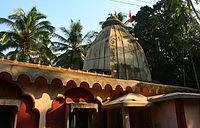
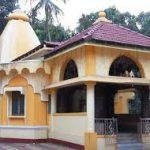
The Mandodari Temple is a quintessential example of the Goan Temple Style—a unique fusion of indigenous Konkani design and later Portuguese influences.
Architectural Style & Vastu
- Temple Tank (Talav): Like most Goan Gramadevata temples, water plays a central Vastu role. A temple tank is usually adjacent or nearby, essential for the Snana (ritual bath) of the idol.
- The Garbhagriha (Sanctum Sanctorum): The inner sanctum is designed to house the Swayambhu deity. The layout typically follows a square plan, oriented East-West, maximizing the flow of solar energy during rituals.
- Facade: Unlike the towering Nagara or Dravida gopurams of North and South India, Goan temples often feature a simpler, sloping roof structure covered in traditional tiles, though the inner sanctum retains the sacred geometry.
Status
While not a UNESCO World Heritage Site, the temple is a protected heritage structure under local Goan heritage laws, maintaining the Sthala Vriksha (sacred tree) and the traditional water body.
4. Darshan & Ritual Logistics
For the 2026 pilgrim, planning is key. Below are the standard timings and major sevas. Please note: Times are subject to change during festivals; calling ahead is recommended.
Daily Timings
| Session | Timing | Activity |
|---|---|---|
| Morning | 06:00 AM – 12:00 PM | Mangala Arti, Abhishekam, General Darshan |
| Afternoon | 12:00 PM – 04:00 PM | Sanctum Closure (Rest period for Deity) |
| Evening | 04:30 PM – 08:30 PM | Sayankala Arti, Darshan, Closing Rites |
Key Sevas (Services)
- Abhishekam: Ritual bathing of the deity with water, milk, and herbal extracts. Best performed in the morning.
- Archana: Individual chanting of the Goddess’s names.
- Naivedya: Offering of food (Rice, Coconuts, Fruits).
Online Seva Booking
To facilitate devotees across the globe, the temple trust is increasingly digitizing offerings. While specific portals vary for Gramadevata shrines compared to major state-run temples, devotees can typically book sevas by contacting the Temple Panchayat Office in Betki or through the Goa Tourism Department portal which lists major religious itineraries.
2026 Festival Calendar
The most significant event is the Annual Zatra (Temple Festival). Based on the lunar calendar (Konkani/Panchang), the dates are projected as follows:
- Maha Shivaratri: February 26, 2026 (Special night vigils).
- Gudi Padwa: March 30, 2026 (Marathi New Year, marked by special Rangoli and prayers).
- Navaratri: September 22 – October 1, 2026 (Nine nights of Jagna and cultural performances).
- Deepavali: October 21, 2026 (Lighting of lamps, distinct in Goan folk style).
5. Practical Visitor Guidance
Visiting a rural Goan temple requires adherence to specific cultural and environmental norms.
Dress Code & Etiquette
- Attire: Traditional Indian wear (Dhoti/Kurta for men, Saree/Salwar for women) is preferred. Western clothing (shorts/tank tops) is generally discouraged in the inner sanctum.
- Footwear: Must be removed at the designated stand outside the temple premises.
- Photography: Strictly prohibited inside the Garbhagriha (Sanctum Sanctorum). Photography of the outer architecture may be permitted, but always seek permission from the priest.
Crowd Management & Seasons
- Best Hours: Early mornings (6:00 AM – 8:00 AM) offer the most peaceful darshan.
- Peak Seasons: Avoid weekends during the monsoon (June–September) if you dislike crowds; however, the lush greenery is at its peak.
- Hydration: Carry water. Goa temperatures can rise to 35°C+ in May.
- Lockers: Mobile phones are usually allowed but must be kept on silent. There are no electronic lockers, so valuables should be kept in vehicles or securely in bags.
6. Pilgrimage Connectivity
How to Reach
The temple is located in Betki, near Khandola, Marcel, Ponda.
- By Air: The nearest airport is Manohar International Airport (GOX) in Mopa (approx. 40 km) or Dabolim Airport (approx. 45 km).
- By Rail: The nearest major railway station is Karmali (KRMI) (approx. 25 km). The Madgaon (MAO) junction is further south (approx. 45 km).
- By Road (NH/State Highway): From Panjim, take NH 748 towards Ponda. Upon reaching the Marcel/Ponda bypass, follow local signage for Betki/Khandola. The roads are well-paved but narrow in village stretches.
Nearby Sacred Sites (Pilgrimage Circuit)
Ponda is known as the “Temple District” of Goa. Combine your visit with:
- Mahalakshmi Temple (Farmagudi): Located on the way from Ponda, this is a prominent Sri Vaishnava temple.
- Mangueshi Temple: One of Goa’s most famous temples, dedicated to Lord Shiva (Manguesh), located just 15-20 minutes from Betki.
- Shanta Durga Temple (Kavlem): A unique architectural marvel showcasing the fusion of Indo-Portuguese styles, dedicated to the Goddess of Peace.
7. Frequently Asked Questions (FAQ)
Is there a VIP Darshan entry at Mandodari Temple?
No, the Mandodari Temple in Betki functions as a community Gramadevata shrine. There is no formal VIP entry. All devotees are treated equally, and darshan is based on the queue system.
Can we carry Prasad from home?
Yes, home-cooked vegetarian Prasad (fruits, sweets) is permitted and often offered to the deity before distribution. However, avoid plastic wrappers; use banana leaves or cloth.
Is the temple wheelchair accessible?
The temple is an older structure. While the outer area is accessible, the inner sanctum involves steps. Assistance may be required for wheelchair users.
What is the exact address and contact number?
Address: Betki, Khandola, Marcel, Goa 403401.
Contact: For inquiries, it is best to contact the local Betki Panchayat office, as direct temple landlines are not commonly listed for small rural shrines.
Why is the deity associated with water?
The name Mandodari itself originates from Mand (Water) and Udar. Historically, the deity ensured the survival of the village through reliable water sources, making water the primary element of worship here.
Photo Gallery
Official Address
Betki , Khandola , Goa, Goa 403401
Recent Posts

ओ सांवरे तूने ही मुझको संभाला – Lyrics & Meaning
ओ सांवरे तूने ही मुझको संभाला – A Prayer to Shyam Origin & Spiritual Essence Why This Bhajan Resonates Devotees chant this when overwhelmed by life’s storms—the refrain ‘तूने ही मुझको संभाला’ is the soul’s sigh of relief: “You…

कथा ये है महाराज मेरे की – Lyrics & Meaning
कथा ये है महाराज मेरे की छत्रपति संभाजी महाराज – A Prayer to Chhatrapati Sambhaji Maharaj Origin & Spiritual Essence Why This Bhajan Resonates Devotees chant this when their spirit feels tested—its powerful refrain “महाराज मेरे” is a soul’s…

Rigveda Samhita Yathartha Anuvada (ऋग्वेद संहिता यथार्थ अनुवाद) – Complete Set with Anvayartha & Hindi/English Translation
The Rigveda is the oldest surviving scripture of humanity and the foundational text of Sanātana Dharma. For serious students, scholars, UPSC aspirants studying ancient Indian history, Sanskrit learners, and spiritual seekers, a precise and grammatically structured translation is indispensable.…

आना भी अकेला है जाना भी अकेला है – Lyrics & Meaning | BharatTemples
आना भी अकेला है जाना भी अकेला है – A Prayer to the Divine Witness Origin & Spiritual Essence Why This Bhajan Resonates Devotees turn to this bhajan in moments of deep reflection—when life’s attachments begin to ache. The…

माता शेरावाली के द्वार जो भी जाता है – Lyrics & Meaning
माता शेरावाली के द्वार जो भी जाता है – A Prayer to Maa Sherawali Origin & Spiritual Essence Why This Bhajan Resonates Devotees turn to this bhajan in times of fear or uncertainty—its promise that no one leaves Maa’s…

मार लेना सपणी उबार लेणा भवरा – Lyrics & Meaning
मार लेना सपणी उबार लेणा भवरा – A Prayer to the Divine Beloved Origin & Spiritual Essence Why This Bhajan Resonates Devotees chant this in moments of deep vulnerability—its cry of “मार लेना सपणी, उबार लेणा भवरा” is the…

हमें श्याम सुंदर भरोसा तुम्हारा – Lyrics & Meaning
हमें श्याम सुंदर भरोसा तुम्हारा – A Prayer to Shyam Sundar Origin & Spiritual Essence Why This Bhajan Resonates Devotees chant this when feeling alone—its refrain ‘de do sahara’ is the soul’s cry for divine support. Lyrics in Hindi…

Mere Satguru Ne Di Thi Davai Lyrics in Hindi & Meaning
Mere Satguru Ne Di Thi Davai: Invoking the Guru’s Liberating Wisdom This soul-stirring bhajan venerates the Satguru (True Spiritual Master) as the divine physician who dispenses the only remedy for life’s deepest sufferings. Composed by Sant Karmaveer Tufani, it…

Janm Diyo Thari Maa Dukh Dekhiyo Lyrics in Hindi & Meaning
जन्म दियो थारी माँ दुख देखियो (Maa’s Grief Upon Birthing You) This soul-stirring Chetavani Bhajan (admonitory hymn) is addressed to the Divine Mother (Maa) – a call for repentance when children forget their filial duties in the dark age…

Bhadi Sabha Mein Thane Manaun Lyrics in Hindi & Meaning
Bhadi Sabha Mein Thane Manaun: Invoking the Spear-Wielding Mother Mata Bhawani (श्री ज्वाला भवानी), the fiery manifestation of Shakti worshipped as the Protector of Dharma in Her Dhaulagarh sanctum. Origin & Spiritual Essence Composed in Rajasthani folk tradition by…