
Contents
- 1 Manibhadresvara Temple – II: The Forgotten Rekha Deul of Ekamra Kshetra
- 1.1 1. Introduction & Spiritual Essence
- 1.2 2. Historical Origins & Scriptural Legend
- 1.3 3. Architectural Marvels
- 1.4 4. Darshan & Ritual Logistics
- 1.5 5. Practical Visitor Guidance
- 1.6 6. Pilgrimage Connectivity
- 1.7 Photo Gallery
- 1.8 Frequently Asked Questions (FAQ)
- 1.8.1 1. Is there a VIP darshan entry for Manibhadresvara Temple II?
- 1.8.2 2. What is the significance of the Kalingan style seen here?
- 1.8.3 3. Is there a temple priest available for rituals?
- 1.8.4 4. What is the best time to visit this specific site?
- 1.8.5 5. Can I contact the authorities for a private heritage tour?
- 1.8.6 6. Why is the temple called “Manibhadresvara”?
Manibhadresvara Temple – II: The Forgotten Rekha Deul of Ekamra Kshetra
As the Lead Heritage Architect for BharatTemples.com, I invite you to explore the silent corridors of Manibhadresvara Temple – II. While many temples in Bhubaneswar (ancient Ekamra Kshetra) are bustling with devotees, this site remains a profound testament to time, standing quietly amidst private residential lands. This definitive guide explores the temple’s spiritual essence, architectural geometry, and practical access for the heritage pilgrim.
1. Introduction & Spiritual Essence
The Manibhadresvara Temple – II is a designated heritage structure in the heart of Bhubaneswar. Unlike its active counterparts, this temple is an archaeological treasure preserved in a state of “arrested ruin.” While the primary deity is currently absent or enshrined in a simplified form due to abandonment, the sanctity of the structure invokes the memory of the Guardian Deity, Manibhadra (a Jain/Yaksha deity revered in Odisha’s syncretic history, often equated with Lord Shiva in later Hindu traditions).
Phalaśruti: The Spiritual Resonance
Visiting Manibhadresvara Temple – II is not merely an act of viewing ruins; it is a meditation on impermanence and endurance. Devotees and heritage enthusiasts visit to:
- Connect with the Ancestral: The temple, dating back to the 8th century, serves as a spiritual anchor for those seeking to ground themselves in the ancient lineage of Odisha.
- Architectural Darshan: Experiencing the Rekha Deul form allows for a visual meditation on sacred geometry, believed to align the earth and celestial planes.
- Preservation Merit: Engaging with these protected monuments supports the broader mission of preserving the Kalingan heritage, an act of cultural seva.
2. Historical Origins & Scriptural Legend
The history of this temple is a blend of architectural dating and local oral traditions.
Chronology & Construction
According to architectural analysis and historical records, the temple likely originated in the 8th Century A.D. However, the inscription table provided in historical datasets indicates a construction date of the 12th-13th century A.D.. This discrepancy often indicates a reconstruction phase or a typological dating based on the “Rekha Deul” style, which flourished during that era. It is built using dry masonry with grey sandstone, a hallmark of the region.
Local Legends & The Sthala Purana
Tradition holds that the temple was once part of a larger complex of shrines dedicated to Manibhadra, a deity of merchants and caravans. The current structure is privately owned by Rabindra Kumar Paramaguru, whose family has acted as a custodian for this heritage site. The temple stands on private land, necessitating respectful permission for close inspection. Legend suggests that the original sanctum housed a powerful Bhairava aspect, protecting the Rath Road branching from Mausima (Ramesvara) temple.
3. Architectural Marvels
As an abandoned site, the temple offers an unobstructed view of the structural engineering of ancient Odisha.
The Rekha Deul Style
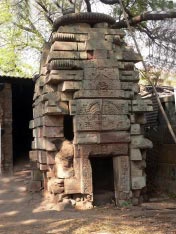
The temple follows the Kalingan Style of temple architecture, specifically the Rekha Deul typology. This is the quintessential Odia temple form, featuring a curvilinear tower (shikhara) that rises to a single point.
Structural Elevation & Measurements
- Plan: The Vimana (sanctum) is square, measuring approximately 2.20 square meters.
- Height: The total height is roughly 23 meters (74 feet).
- Proportions (The Triratha System): The elevation is defined as a Triratha (three-facet projection), which measures 4.20 m in height. The distinct segments include:
- Pabhaga: The basement (currently buried).
- Jangha: The vertical wall (1.00 m).
- Gandi: The spire (3.00 m).
- Mastaka: The crowning member (0.20 m).
- Ornamentation: The Amalaka (the ribbed disk at the spire’s apex) is noted as broken, a poignant symbol of the passage of time. The door jambs stand at 1.20 m in height and 0.90 m in width, featuring a plain lintel that directs the eye toward the sanctum.
4. Darshan & Ritual Logistics
Because Manibhadresvara Temple – II is a protected archaeological site rather than an active temple of worship, standard daily rituals (like Abhishekam) are not performed here. However, devotees and researchers may seek permission to offer simple prayers.
Site Access & Timing
As this is a privately owned heritage structure within residential quarters, there are no official public temple timings. Access is generally granted during daylight hours upon request from the owner, Mr. Rabindra Kumar Paramaguru.
| Category | Details |
|---|---|
| Primary Status | Protected Heritage Site (ASI) |
| Best Access Window | 10:00 AM – 4:00 PM (Subject to owner permission) |
| Online Seva | Not Applicable (Archaeological Site) |
| 2026 Festival Dates | While the temple doesn’t host festivals, nearby Ramesvara Temple celebrates Shivaratri (Feb 26, 2026) and Chandan Yatra (May 2026). |
Respecting the Site
Visitors are encouraged to treat this site with the reverence of a living temple. Although there may not be a priest present, the sanctity of the ground remains.
5. Practical Visitor Guidance
Visiting an abandoned structure requires different preparation than a major temple. Here is what you need to know:
- Dress Code: As a sign of respect for the heritage and surrounding religious context, modest attire is recommended (covering shoulders and knees).
- Photography: Photography is allowed. This is an excellent subject for architectural photography, but please do not touch the sandstone reliefs, as they are fragile.
- Accessibility: The temple is located on the left side of the Rath Road branching from Mausima (Ramesvara) temple to Badheibanka Chowk. The terrain is uneven due to the buried Pabhaga. Wear sturdy footwear.
- Mobile Lockers: There are no formal lockers or cloaks. Carry minimal essentials.
- Crowd Management: This is a low-crowd site. It is an ideal location for those seeking solitude and introspection.
6. Pilgrimage Connectivity
The temple is situated in the dense heritage zone of Old Bhubaneswar, making connectivity relatively easy.
How to Reach
- Air: The nearest airport is Biju Patnaik International Airport (BBI), approximately 6 km away (15-20 mins by taxi).
- Rail: Bhubaneswar Railway Station (BBS) is the closest major railhead, about 3 km from the site.
- Road: The temple is located off the main arterial roads of Bhubaneswar. It is accessible via the Mausima Temple route. The specific highway connectivity is via NH-16 (connecting to the city ring road).
Nearby Sacred Sites
Build a pilgrimage circuit by visiting these nearby structures:
- Ramesvara Temple: Located just a short walk away, this is an active and historically significant Shiva temple.
- Muktesvara Temple: A masterpiece of Kalingan architecture, known as the “Gem of Odisha,” located approximately 1 km away.
- Parasuramesvara Temple: The best-preserved ancient temple in Bhubaneswar, dating back to the 7th century.
Photo Gallery

Frequently Asked Questions (FAQ)
1. Is there a VIP darshan entry for Manibhadresvara Temple II?
No, as this is an abandoned archaeological site rather than an active place of worship, there are no VIP darshan tickets or queues. Access is open to all heritage enthusiasts via the entry path.
2. What is the significance of the Kalingan style seen here?
The Kalingan style is characterized by the Rekha Deul (curvilinear tower). Its significance lies in the mathematical precision of its measurement system (The Tri-Bhangas) which creates a visual illusion of the tower reaching for the heavens.
3. Is there a temple priest available for rituals?
Currently, there is no resident priest for daily rituals. However, local devotees occasionally offer flowers or lighting (diya) at the base of the temple. For formal rituals, visit the adjacent Ramesvara Temple.
4. What is the best time to visit this specific site?
Visit between October and February for the best weather. The sandstone can become very hot in peak summer (May). Early morning (10 AM) is best for photography due to the soft light.
Yes. Since the temple is situated on private property owned by the Paramaguru family, it is courteous to inform them of your visit. For general tourism information, the Bhubaneswar Development Authority (BDA) or the Odisha Tourism department can provide guidance.
6. Why is the temple called “Manibhadresvara”?
The name is derived from Mani (Jewel) and Bhadra (Auspicious). It is associated with Manibhadra, a Yaksha in Jain tradition and a protective deity in Hindu folklore, often worshipped by traders and warriors.
Recent Posts

ओ सांवरे तूने ही मुझको संभाला – Lyrics & Meaning
ओ सांवरे तूने ही मुझको संभाला – A Prayer to Shyam Origin & Spiritual Essence Why This Bhajan Resonates Devotees chant this when overwhelmed by life’s storms—the refrain ‘तूने ही मुझको संभाला’ is the soul’s sigh of relief: “You…

कथा ये है महाराज मेरे की – Lyrics & Meaning
कथा ये है महाराज मेरे की छत्रपति संभाजी महाराज – A Prayer to Chhatrapati Sambhaji Maharaj Origin & Spiritual Essence Why This Bhajan Resonates Devotees chant this when their spirit feels tested—its powerful refrain “महाराज मेरे” is a soul’s…

Rigveda Samhita Yathartha Anuvada (ऋग्वेद संहिता यथार्थ अनुवाद) – Complete Set with Anvayartha & Hindi/English Translation
The Rigveda is the oldest surviving scripture of humanity and the foundational text of Sanātana Dharma. For serious students, scholars, UPSC aspirants studying ancient Indian history, Sanskrit learners, and spiritual seekers, a precise and grammatically structured translation is indispensable.…

आना भी अकेला है जाना भी अकेला है – Lyrics & Meaning | BharatTemples
आना भी अकेला है जाना भी अकेला है – A Prayer to the Divine Witness Origin & Spiritual Essence Why This Bhajan Resonates Devotees turn to this bhajan in moments of deep reflection—when life’s attachments begin to ache. The…

माता शेरावाली के द्वार जो भी जाता है – Lyrics & Meaning
माता शेरावाली के द्वार जो भी जाता है – A Prayer to Maa Sherawali Origin & Spiritual Essence Why This Bhajan Resonates Devotees turn to this bhajan in times of fear or uncertainty—its promise that no one leaves Maa’s…

मार लेना सपणी उबार लेणा भवरा – Lyrics & Meaning
मार लेना सपणी उबार लेणा भवरा – A Prayer to the Divine Beloved Origin & Spiritual Essence Why This Bhajan Resonates Devotees chant this in moments of deep vulnerability—its cry of “मार लेना सपणी, उबार लेणा भवरा” is the…

हमें श्याम सुंदर भरोसा तुम्हारा – Lyrics & Meaning
हमें श्याम सुंदर भरोसा तुम्हारा – A Prayer to Shyam Sundar Origin & Spiritual Essence Why This Bhajan Resonates Devotees chant this when feeling alone—its refrain ‘de do sahara’ is the soul’s cry for divine support. Lyrics in Hindi…

Mere Satguru Ne Di Thi Davai Lyrics in Hindi & Meaning
Mere Satguru Ne Di Thi Davai: Invoking the Guru’s Liberating Wisdom This soul-stirring bhajan venerates the Satguru (True Spiritual Master) as the divine physician who dispenses the only remedy for life’s deepest sufferings. Composed by Sant Karmaveer Tufani, it…

Janm Diyo Thari Maa Dukh Dekhiyo Lyrics in Hindi & Meaning
जन्म दियो थारी माँ दुख देखियो (Maa’s Grief Upon Birthing You) This soul-stirring Chetavani Bhajan (admonitory hymn) is addressed to the Divine Mother (Maa) – a call for repentance when children forget their filial duties in the dark age…
Bhadi Sabha Mein Thane Manaun Lyrics in Hindi & Meaning
Bhadi Sabha Mein Thane Manaun: Invoking the Spear-Wielding Mother Mata Bhawani (श्री ज्वाला भवानी), the fiery manifestation of Shakti worshipped as the Protector of Dharma in Her Dhaulagarh sanctum. Origin & Spiritual Essence Composed in Rajasthani folk tradition by…