
Contents
- 1 Murdeshwar Temple: A Complete Guide to the Land of Lord Shiva
| Date built: | – |
|---|---|
| Deity: | – |
| Architectural style: | – |
| Major festivals | – |
| Locale: | – |
| District:: | Uttara Kannada |
| Address: | – |
| Phone | – |
Murdeshwar Temple: A Complete Guide to the Land of Lord Shiva
1. Introduction & Spiritual Essence
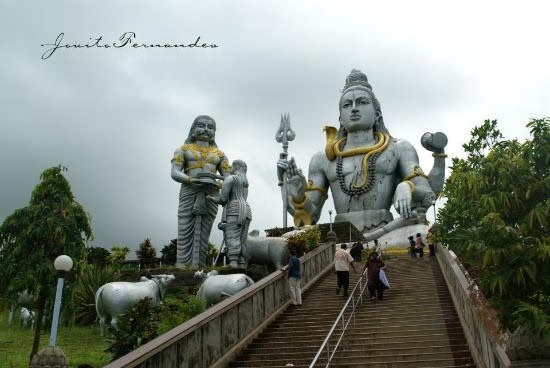
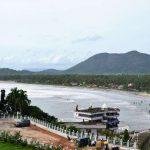
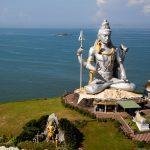
The Murdeshwar Temple, perched on the Kanduka Hill overlooking the Arabian Sea, is a sanctuary of divine energy and architectural grandeur in Uttara Kannada, Karnataka. While the modern complex is renowned for the world’s second-tallest Shiva statue, the spiritual heart of the temple lies in the ancient Sri Mridesa Linga enshrined within.
Primary Deity & Form: The temple is dedicated to Lord Shiva, worshipped here as Mridesha (also spelled Murdeshwar). The Shivalinga is a Swayambhu (self-manifested) rock believed to be a fragment of the original Atma Linga. It rests in a hollowed depression about two feet below ground level, emanating a primal spiritual vibration.
Phalaśruti: The Benefits of Pilgrimage
Devotees undertake the journey to Murdeshwar with profound faith, seeking:
- Removal of Malefic Karma: It is believed that prayer before the Mridesa Linga cleanses Karmic debt (Rina) inherited from ancestors.
- Overcoming Fear: As Murdeshwar is the abode of the Destroyer, devotees offer prayers to dissolve fears and illusions (Maya).
- Divine Blessings for Prosperity: The Raja Gopura and the towering Shiva statue act as a beacon, drawing cosmic energy to bless devotees with stability and strength.
2. Historical Origins & Scriptural Legend
The history of Murdeshwar is a blend of ancient mythology and 20th-century philanthropy.
The Legend of the Atma Linga
According to the Sthala Purana, the demon king Ravana performed intense penance to Lord Shiva to obtain the Atma Linga, which would grant him immortality and supreme power. Lord Shiva granted his wish on the condition that the Linga must never be placed on the ground until he reached Lanka.
Intelligence and Ganesha tricked Ravana at a spot near present-day Gokarna by making him believe it was already dusk. Ravana placed the Linga on the ground to perform his evening rituals. The Linga became permanently rooted to the earth. As Ravana attempted to remove it, pieces of the Linga shattered and scattered. Tradition holds that a fragment of this sacred rock formed the Mridesa Linga at Murdeshwar.
Modern Renovation
While the sanctum has existed for centuries, the sprawling complex and the Raja Gopura were constructed in the modern era by the renowned philanthropist R. N. Shetty. The project, completed in the early 21st century, transformed the temple into a monumental site while preserving the original sanctity of the inner shrine.
3. Architectural Marvels
The temple is a stunning fusion of traditional Dravidian architecture and modern engineering, designed to withstand the coastal saline environment.
The Raja Gopura & The Shiva Statue
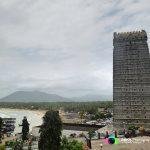
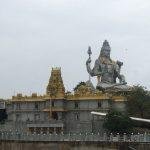
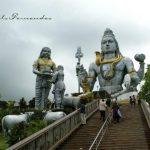
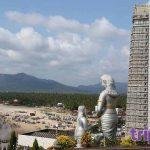
The towering 20-storeyed Raja Gopura stands at an impressive 237.5 feet. A lift installed within provides devotees a breathtaking panoramic view of the Arabian Sea and the surrounding landscape. Standing adjacent to the Gopura is the 123-foot statue of Lord Shiva, the second tallest in the world. The statue is oriented to catch direct sunlight, appearing as though it is radiating light.
The Sanctum & Complex
Despite the modern scale of the complex, the inner sanctum (Garbhagriha) remains dark and retains its ancient composure. The architecture features:
- Pillared Mandapas: Hallways adorned with sculptures depicting scenes from the Puranas.
- Rameshwara Linga: Located at the base of the hill, allowing devotees to perform seva personally.
- Shaneswar Temple: A dedicated shrine to Lord Shani.
- Artistic Depictions: Concrete elephants guard the steps, and sculptures around the hill depict Arjuna receiving Geetopadesham, the deceit of Ravana by Ganesha, and the descent of the Ganga.
Photo Gallery


4. Darshan & Ritual Logistics
To ensure a seamless spiritual experience, here are the updated timings and ritual schedules. Note: Timings may vary slightly during festivals.
Daily Temple Timings
| Session | Activity | Timing |
|---|---|---|
| Morning | Opening, Morning Pooja, Rudrabhisheka | 6:00 AM – 1:00 PM |
| Mid-Day | Cleaning & Break (Sanctum closed) | 1:00 PM – 3:00 PM |
| Evening | Temple Reopens, Nisha Pooja, Close | 3:00 PM – 8:30 PM |
Seva Details & Online Booking
Devotees can book the following rituals in advance. The temple trust has digitized many services.
- Rudrabhisheka: The most powerful ritual for purification (Approx. ₹500).
- Abhishekam: Pouring water/milk over the Linga (Approx. ₹100).
- Rathotsava: The temple chariot festival (Seasonal).
- Kumkum Archana: Offering Kumkum to the deity (Approx. ₹50).
How to Book: Visit the official temple trust website (usually murdeshwartempletrust.org) or use authorized payment gateways. Select the date and Seva type to receive a booking ID.
Festival Dates for 2026
- Maha Shivaratri: February 26, 2026 (Grand celebrations, night-long darshan).
- Kartika Purnima: November 15, 2026 (Deepotsava and lighting of lamps).
- Sravana Mondays (Shravan Maas): July – August 2026 (Heavy influx of devotees).
- Ganesh Chaturthi: August 23, 2026.
5. Practical Visitor Guidance
Being a coastal temple, the climate can be humid, and the crowds can be significant during peak seasons.
Dress Code & Etiquette
- Modest traditional attire is recommended. Men should avoid shorts; women should cover shoulders and legs.
- Footwear must be removed at the designated paid counters outside the main entrance.
- Leather items (belts, wallets) are traditionally prohibited in Shiva temples.
Photography & Lockers
Photography is generally allowed in the outer complex but strictly prohibited inside the Garbhagriha. Mobile lockers are available near the entrance for small bags and electronic devices, as cameras may be restricted by security.
Crowd Management & Seasonal Tips
- Best Time to Visit: Early mornings (6:00 AM – 8:00 AM) or late evenings (6:00 PM – 8:00 PM) offer the shortest wait times.
- Summer (March–May): Carry a water bottle and head covering. The stone floors can be hot.
- Monsoon (June–September): The sea view may be obscured, but the temple looks majestic in mist. Carry an umbrella.
6. Pilgrimage Connectivity
Murdeshwar is well-connected by road and rail along the scenic Konkan coast.
How to Reach
- By Air: The nearest airport is Mangalore International Airport (IXE), approximately 120 km away.
- By Train: Murdeshwar Railway Station is located on the Konkan Railway line, just 1 km from the temple. Most trains on the Mumbai-Mangalore route stop here.
- By Road: Located on NH-66 (formerly NH-17). It is a 4-hour drive from Mangalore and a 2-hour drive from Karwar.
Nearby Sacred Sites (Pilgrimage Circuit)
- Mallikarjuna Temple (Bhatkal): An ancient temple dedicated to Lord Shiva located just 20 km away.
- Devbagh Beach: A serene beach where the river meets the sea, ideal for spiritual contemplation.
- Maha Ganapati Temple (Murdeshwar): Located within the complex or nearby, dedicated to Lord Ganesha.
7. Frequently Asked Questions (FAQ)
Is there a VIP darshan entry available?
Yes, the temple trust offers a special darshan queue for senior citizens and differently-abled visitors. VIP tickets are usually available at the counter for a nominal fee, subject to availability.
Can I take a dip in the sea near the temple?
While the temple is surrounded by the Arabian Sea, there is no direct bathing facility at the temple ghat. However, nearby Bhatkal beach (approx. 20 mins drive) offers safe swimming areas. Exercise caution during high tide.
Is there a facility for vehicle parking?
Yes, a large parking area is available at the base of the hill. Cars and buses are allowed to park for a fee. During peak season, parking fills up quickly by 10:00 AM.
What makes the Murdeshwar Linga unique?
The Linga is unique because it is not a carved stone but a natural rock formation (Swayambhu). It is believed to be a fragment of the original Atma Linga, making it potent for those seeking salvation and relief from past sins.
Is the temple wheelchair accessible?
The outer complex is largely flat, but the inner sanctum has steps. The temple authorities have installed ramps in many areas, but accessing the very innermost shrine may require assistance.
Contact Details
Official Address
Recent Posts

ओ सांवरे तूने ही मुझको संभाला – Lyrics & Meaning
ओ सांवरे तूने ही मुझको संभाला – A Prayer to Shyam Origin & Spiritual Essence Why This Bhajan Resonates Devotees chant this when overwhelmed by life’s storms—the refrain ‘तूने ही मुझको संभाला’ is the soul’s sigh of relief: “You…

कथा ये है महाराज मेरे की – Lyrics & Meaning
कथा ये है महाराज मेरे की छत्रपति संभाजी महाराज – A Prayer to Chhatrapati Sambhaji Maharaj Origin & Spiritual Essence Why This Bhajan Resonates Devotees chant this when their spirit feels tested—its powerful refrain “महाराज मेरे” is a soul’s…

Rigveda Samhita Yathartha Anuvada (ऋग्वेद संहिता यथार्थ अनुवाद) – Complete Set with Anvayartha & Hindi/English Translation
The Rigveda is the oldest surviving scripture of humanity and the foundational text of Sanātana Dharma. For serious students, scholars, UPSC aspirants studying ancient Indian history, Sanskrit learners, and spiritual seekers, a precise and grammatically structured translation is indispensable.…

आना भी अकेला है जाना भी अकेला है – Lyrics & Meaning | BharatTemples
आना भी अकेला है जाना भी अकेला है – A Prayer to the Divine Witness Origin & Spiritual Essence Why This Bhajan Resonates Devotees turn to this bhajan in moments of deep reflection—when life’s attachments begin to ache. The…

माता शेरावाली के द्वार जो भी जाता है – Lyrics & Meaning
माता शेरावाली के द्वार जो भी जाता है – A Prayer to Maa Sherawali Origin & Spiritual Essence Why This Bhajan Resonates Devotees turn to this bhajan in times of fear or uncertainty—its promise that no one leaves Maa’s…

मार लेना सपणी उबार लेणा भवरा – Lyrics & Meaning
मार लेना सपणी उबार लेणा भवरा – A Prayer to the Divine Beloved Origin & Spiritual Essence Why This Bhajan Resonates Devotees chant this in moments of deep vulnerability—its cry of “मार लेना सपणी, उबार लेणा भवरा” is the…

हमें श्याम सुंदर भरोसा तुम्हारा – Lyrics & Meaning
हमें श्याम सुंदर भरोसा तुम्हारा – A Prayer to Shyam Sundar Origin & Spiritual Essence Why This Bhajan Resonates Devotees chant this when feeling alone—its refrain ‘de do sahara’ is the soul’s cry for divine support. Lyrics in Hindi…

Mere Satguru Ne Di Thi Davai Lyrics in Hindi & Meaning
Mere Satguru Ne Di Thi Davai: Invoking the Guru’s Liberating Wisdom This soul-stirring bhajan venerates the Satguru (True Spiritual Master) as the divine physician who dispenses the only remedy for life’s deepest sufferings. Composed by Sant Karmaveer Tufani, it…

Janm Diyo Thari Maa Dukh Dekhiyo Lyrics in Hindi & Meaning
जन्म दियो थारी माँ दुख देखियो (Maa’s Grief Upon Birthing You) This soul-stirring Chetavani Bhajan (admonitory hymn) is addressed to the Divine Mother (Maa) – a call for repentance when children forget their filial duties in the dark age…
Bhadi Sabha Mein Thane Manaun Lyrics in Hindi & Meaning
Bhadi Sabha Mein Thane Manaun: Invoking the Spear-Wielding Mother Mata Bhawani (श्री ज्वाला भवानी), the fiery manifestation of Shakti worshipped as the Protector of Dharma in Her Dhaulagarh sanctum. Origin & Spiritual Essence Composed in Rajasthani folk tradition by…