
Contents
Introduction & Spiritual Essence
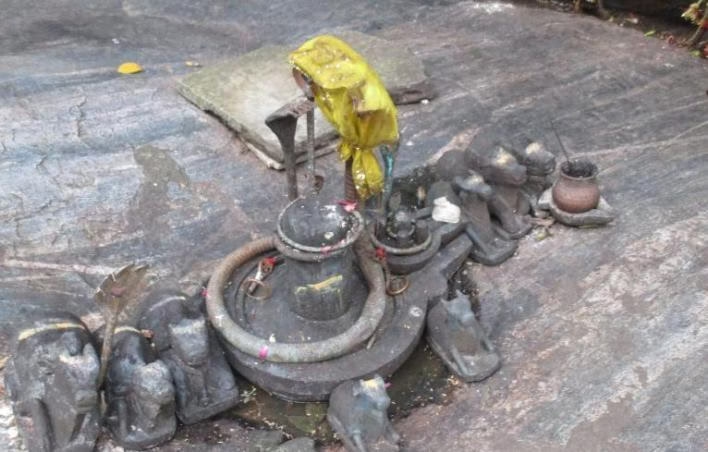
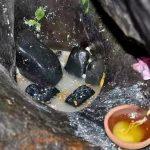
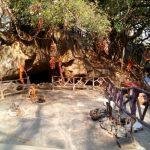
Nestled amidst the rolling hillocks of the Nilagiri range in Balasore, the Panchalingeshwar Temple stands as a unique testament to devotion where nature itself performs the abhishekam. Dedicated to Lord Shiva, the temple derives its name from the “Pancha” (five) “Lingas” (phallic forms of Shiva) enshrined within. Unlike conventional temples where the deity is placed in a sanctum, these Swayambhu (self-manifested) lingas are situated beneath a perennial stream, constantly bathed by flowing water.
Phalaśruti (Spiritual Benefits): Devotees believe that offering prayers here washes away sins and cleanses ancestral karma. The unique act of lying flat on the rock to touch the lingas submerged in water is believed to grant Mukti (liberation) and remove planetary afflictions, particularly those related to Rahu and Ketu in one’s astrological chart.
Historical Origins & Scriptural Legend
The history of Panchalingeshwar is a blend of ancient mythology and regional folklore.
Scriptural Legend: According to the Sthala Purana, the five lingas were originally enshrined by King Banasura, a devout follower of Lord Shiva and the demon-king of the region. Legend holds that Banasura, captivated by the natural beauty and serenity of the Nilagiri hills, performed intense penance here. Pleased with his devotion, Lord Shiva manifested as five lingas to bless him.
Another popular tradition links the site to the Ramayana. It is said that Sita, the consort of Lord Rama, enshrined these lingas during their exile period in the forests of this region.
Architectural Heritage: While the current structure has been renovated over centuries, the site remains an ancient center of worship. The temple complex has undergone several renovations to preserve the natural stream flow and the sanctity of the shrine, maintaining its rustic, natural charm rather than a polished stone facade common in later Kalinga architecture.
Architectural Marvels
The architecture of Panchalingeshwar is defined by its harmony with nature rather than soaring verticality.
Style & Vastu: While the temple structure itself is relatively simple with a sloping roof typical of Odishan village temples, the focal point is the natural rock formation. The layout follows the Vastu principle of integrating the Mandala with the landscape.
The Shikhara & Sanctum: The temple features a modest Rekha Deul style spire (Shikhara), but the true sanctum is the open-air rock face where the lingas reside.
Notable Features: The perennial stream is the architectural element of interest. It flows continuously over the five lingas, creating a natural Abhishekam. The water then disappears into a crevice, maintaining a cycle of purity. The surrounding hillocks of the Nilagiri range provide a natural bastion, creating a serene atmosphere conducive to meditation.


Darshan & Ritual Logistics (2026 Update)
To ensure a smooth pilgrimage, devotees should note the following schedule and rituals. Note: Temple timings are subject to change based on seasonal variations and specific festivals.
Daily Temple Timings
| Session | Timing |
|---|---|
| Morning Darshan | 5:00 AM – 1:00 PM |
| Evening Darshan | 4:00 PM – 9:00 PM |
| Aarti / Puja Breaks | 1:00 PM – 4:00 PM (Temple remains closed) |
Key Sevas & Booking
Visitors can perform specific rituals. Since the lingas are underwater, Abhishekam is performed by the temple priests using the natural stream water, milk, and honey.
Online Seva Booking: Currently, most sevas are performed upon arrival. However, for special Maha Rudra Yagna or Shivratri events, check the official Odisha Tourism portal or the temple administration desk upon arrival.
2026 Festival Dates
- Maha Shivaratri: February 26, 2026
- Nabanna (Harvest Festival): April 14, 2026
- Raja Parba: June 14–17, 2026 (Major local festival in Odisha)
Practical Visitor Guidance
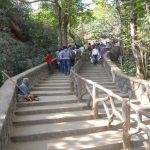
Dress Code: Traditional attire is recommended. Men should wear dhoti or pants with a shirt; women should wear saree or salwar kameez. Crucial Note: You must remove footwear before climbing the hillock where the temple is located.
Physical Requirement (Darshan Method): To worship the Panchalingas, one must lie flat on the wet rock surface and reach into the stream to touch the lingas. This requires physical flexibility. Elderly visitors or those with mobility issues can offer prayers from the top of the rock.
Crowd Management:
- Best Hours: Early morning (5:30 AM – 7:00 AM) or late evening to avoid crowds.
- Weekends: Expect higher footfall; weekdays are preferable.
- Seasonal Advice: Monsoon (July-Sept) sees higher water flow, making the rock slippery; exercise caution. Summers (May) are hot; carry water and a cap.
Facilities: There is no formal mobile locker system at the entrance, but a luggage counter is available. Public restrooms are located at the base of the hillock.
Pilgrimage Connectivity
How to Reach:
- Nearest Airport: Biju Patnaik International Airport, Bhubaneswar (Approx. 150 km / 3.5 hours drive).
- Nearest Railway Station: Balasore Railway Station (Approx. 28 km). Taxis and buses are easily available.
- By Road: Located 27.7 km southwest of Balasore via Nilagiri. The route connects to NH-16 (formerly NH-5). The final approach is a hilly road.
Nearby Sacred Sites (Pilgrimage Circuit):
- Chandaneswar Temple: Located nearby, famous for its unique Ratha Yatra (chariot festival) during the Bengali New Year.
- Nilagiri Ramachandi: A scenic temple dedicated to Goddess Ramachandi situated on the banks of the Kharasrotra river.
- Baladevjew Temple (Kulada): An ancient temple dedicated to Lord Krishna’s elder brother, Balarama, located in Balasore.
Frequently Asked Questions (FAQ)
Is there a VIP darshan entry available?
No, there is no formal VIP entry. Darshan is on a first-come, first-served basis. However, visiting during early morning hours is the most effective way to avoid long queues.
Are there accommodations available nearby?
Basic guest houses are available in the nearby town of Nilagiri. For better amenities, hotels and lodges are available in Balasore city (28 km away).
Can we take a camera inside?
Photography of the inner sanctum (the lingas inside the stream) is generally discouraged or prohibited to maintain sanctity. Professional equipment may require permission from the temple committee.
Why is the temple called Panchalingeshwar?
The name comes from the five (Pancha) self-manifested Shivalingas (Lingas) worshipped here simultaneously.
Recent Posts

Shri Kaamkoteeshwar Mandir, Varanasi – History & Significance
In the heart of Kashi, the eternal city of Lord Shiva, where the Ganges flows with celestial grace, stands the Shri Kaamkoteeshwar Mandir. This sacred Sannidhi is not merely a temple but a profound spiritual bridge between the Northern…

ओ सांवरे तूने ही मुझको संभाला – Lyrics & Meaning
ओ सांवरे तूने ही मुझको संभाला – A Prayer to Shyam Origin & Spiritual Essence Why This Bhajan Resonates Devotees chant this when overwhelmed by life’s storms—the refrain ‘तूने ही मुझको संभाला’ is the soul’s sigh of relief: “You…

कथा ये है महाराज मेरे की – Lyrics & Meaning
कथा ये है महाराज मेरे की छत्रपति संभाजी महाराज – A Prayer to Chhatrapati Sambhaji Maharaj Origin & Spiritual Essence Why This Bhajan Resonates Devotees chant this when their spirit feels tested—its powerful refrain “महाराज मेरे” is a soul’s…

Rigveda Samhita Yathartha Anuvada (ऋग्वेद संहिता यथार्थ अनुवाद) – Complete Set with Anvayartha & Hindi/English Translation
The Rigveda is the oldest surviving scripture of humanity and the foundational text of Sanātana Dharma. For serious students, scholars, UPSC aspirants studying ancient Indian history, Sanskrit learners, and spiritual seekers, a precise and grammatically structured translation is indispensable.…

आना भी अकेला है जाना भी अकेला है – Lyrics & Meaning | BharatTemples
आना भी अकेला है जाना भी अकेला है – A Prayer to the Divine Witness Origin & Spiritual Essence Why This Bhajan Resonates Devotees turn to this bhajan in moments of deep reflection—when life’s attachments begin to ache. The…

माता शेरावाली के द्वार जो भी जाता है – Lyrics & Meaning
माता शेरावाली के द्वार जो भी जाता है – A Prayer to Maa Sherawali Origin & Spiritual Essence Why This Bhajan Resonates Devotees turn to this bhajan in times of fear or uncertainty—its promise that no one leaves Maa’s…

मार लेना सपणी उबार लेणा भवरा – Lyrics & Meaning
मार लेना सपणी उबार लेणा भवरा – A Prayer to the Divine Beloved Origin & Spiritual Essence Why This Bhajan Resonates Devotees chant this in moments of deep vulnerability—its cry of “मार लेना सपणी, उबार लेणा भवरा” is the…

हमें श्याम सुंदर भरोसा तुम्हारा – Lyrics & Meaning
हमें श्याम सुंदर भरोसा तुम्हारा – A Prayer to Shyam Sundar Origin & Spiritual Essence Why This Bhajan Resonates Devotees chant this when feeling alone—its refrain ‘de do sahara’ is the soul’s cry for divine support. Lyrics in Hindi…

Mere Satguru Ne Di Thi Davai Lyrics in Hindi & Meaning
Mere Satguru Ne Di Thi Davai: Invoking the Guru’s Liberating Wisdom This soul-stirring bhajan venerates the Satguru (True Spiritual Master) as the divine physician who dispenses the only remedy for life’s deepest sufferings. Composed by Sant Karmaveer Tufani, it…

Janm Diyo Thari Maa Dukh Dekhiyo Lyrics in Hindi & Meaning
जन्म दियो थारी माँ दुख देखियो (Maa’s Grief Upon Birthing You) This soul-stirring Chetavani Bhajan (admonitory hymn) is addressed to the Divine Mother (Maa) – a call for repentance when children forget their filial duties in the dark age…