
Contents
Introduction & Spiritual Essence
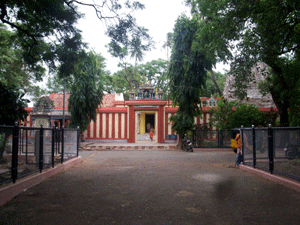
The Peru Udayar Temple, often revered locally as the Periya Avudayar Kovil, stands as a profound spiritual beacon near Palani in the Dindigul district of Tamil Nadu. Unlike the bustling crowds of the main Palani Murugan Temple, this shrine offers a serene, sylvan atmosphere dedicated to Lord Brihadeesvarar (a form of Shiva).
The deity here is a Swayambhu Linga—a naturally formed limestone lingam that emerged from the earth, bypassing human craftsmanship. Local belief holds that this lingam existed long before the legendary sage Bhogar (who fashioned the Palani Murugan idol) discovered the area. The temple is strictly consecrated to male deities, creating a unique masculine energy field within the peaceful natural setting.
Phalaśruti: Why Visit Peru Udayar Temple?
Devotees visit this sacred site for specific spiritual benefits:
- Cleansing Ancestral Karma: The temple is believed to possess immense power to alleviate Pitru Dosha (ancestral curses), helping devotees break cycles of stagnation.
- Inner Peace & Clarity: Located on the banks of the Shanmuga Nadi, the unpolluted air and bird songs create an environment conducive to meditation and mental clarity.
- Removal of Ignorance: As the presiding deity is Brihadeesvarar (The Great Lord), worship here is associated with gaining wisdom and removing the darkness of ignorance.
Historical Origins & Scriptural Legend
According to temple records and local tradition, the Peru Udayar Temple dates back approximately one thousand years. The structure and inscriptions suggest origins during the Later Pandya or early Chola periods, an era when temple construction in the region flourished.
Consecration History
While the original construction is ancient, the temple underwent significant renovations and reconsecration ceremonies in modern times:
- First Kumbhabhishekam: 1915
- Second Kumbhabhishekam: 1962
Scriptural & Oral Legends
The Sthala Purana (local legend) refers to the surrounding forest as ‘Kannikara Vanam’ (Forest of Maidens). Legend holds that the Sapta Kannis (Seven Virgins) and Karuppanna Swami (a guardian deity) protect this sacred territory. The temple is mentioned in oral traditions as a site where the Sapta Rishis worshipped the Swayambhu Lingam to attain salvation.
Architectural Marvels
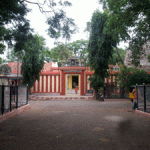
The Peru Udayar Temple is a classic example of Dravidian Architecture, characterized by its massive enclosure walls, progressive mandapas (halls), and intricate sculptural work. The temple faces south, a directional choice that follows specific Vastu Shastra principles distinct from many other Shiva temples.
Notable Features
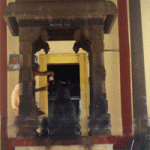
- Sanctum Sanctorum (Garbhagriha): The inner sanctum houses the Swayambhu Linga. Uniquely, the deity faces west (towards the setting sun), while the main entrance faces south.
- The Niche Cells (Koshtas): The temple walls feature rare niche placements. The Chandisa cell is located in the northeast corner, contrasting with the standard south/southwest placement. Adjacent to it are cells dedicated to Vishnu (Tirumal) and others.
- Dakshinamurthi: A majestic stone sculpture of Dakshinamurthi (Shiva as the Adi Guru) is located in the northern corridor. The northern walls also house Brahma and Navagraha (planetary deities) shrines.
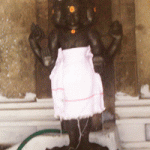
- Bhairava Shrine: Located in the eastern circuit, this fierce form of Shiva acts as a guardian to the temple premises.
- 16 Ancient Inscriptions: The temple walls preserve 16 inscriptions from the medieval period, offering valuable epigraphic evidence regarding land grants, temple administration, and donor history.
Darshan & Ritual Logistics
The administration of the Peru Udayar Temple is managed by the Hindu Religious and Charitable Endowments (HR&CE) Department of Tamil Nadu. The priests perform daily rituals with deep devotion.
Daily Timings (Standard Schedule)
| Session | Timings |
|---|---|
| Morning Opening | 6:00 AM |
| Ushankalam (Early Morning Pooja) | 6:30 AM – 7:00 AM |
| Midday Closing | 12:00 PM – 4:00 PM |
| Evening Opening | 4:00 PM |
| Arthajama Pooja (Night Closing) | 7:30 PM |
Key Sevas (Rituals)
While daily Abhishekam (ritual bathing of the deity) and Archana (reciting names) are performed, specialized Sevas are conducted during festivals.
Online Seva Booking
For devotees wishing to book rituals or contribute, most Tamil Nadu HR&CE temples offer online services. Pro Tip: Visit the official Tamil Nadu Temple Portal or use the Arulmigu Palani Murugan Temple app, which often lists surrounding temples like Peru Udayar.
2026 Festival Dates (Tentative)
- Maha Shivaratri: February 26, 2026
- Ardra Darshan: June 24, 2026
- Skanda Shashti: October 27 – November 2, 2026
- Arudra Darshan: Late December 2026
Practical Visitor Guidance
Visiting Peru Udayar Temple is a journey into nature. The temple is surrounded by greenery and the sounds of birds, often compared to a tape-recording of nature.
- Dress Code: Traditional attire is mandatory. Men should wear Veshti (dhoti) or formal trousers with a shirt. Women should wear sarees or salwar kameez.
- Photography: Generally allowed in the outer corridors but prohibited inside the inner sanctum (Garbhagriha).
- Mobile Phones: Lockers are typically not available at this smaller temple. It is advisable to leave electronic devices in your vehicle.
- Accessibility: The temple is accessible via a 1 km walk from the arch on the Old Dharapuram road. The path is relatively flat but not wheelchair friendly due to natural terrain.
Crowd Management & Best Time to Visit
Unlike the main Palani temple, crowds here are manageable. However, for the most peaceful darshan:
- Best Hours: Early morning (6:30 AM – 8:00 AM) or late evening (6:00 PM – 7:30 PM).
- Seasonal Advice: Carry a water bottle, especially during May when temperatures rise. The natural breeze is refreshing, but sun protection is necessary.
Pilgrimage Connectivity
How to Reach
Located approximately 4 km from the Palani Bus Stand.
- By Road: Take the Old Dharapuram Road. Travel 3 km by bus/taxi, then walk 1 km through the arch.
- Nearest Railway Station: Palani Railway Station (Palani – PNI) is the closest, approximately 5 km away.
- Nearest Airport: Coimbatore International Airport (CBE) is roughly 100 km away (approx. 2.5 hours by car).
Nearby Sacred Sites (The Palani Circuit)
Extend your pilgrimage by visiting these nearby temples:
- Palani Murugan Temple (Murugan Kovil): The primary destination of Palani, located on the hill.
- Thiru Avinankudi Temple: Located at the foothills, this is the 1st Padai Veedu (Battle Camp) of Lord Murugan.
- Sri Idumban Temple: Situated on the path leading up to the main temple, dedicated to the sage Idumban.
Frequently Asked Questions (FAQ)
1. What is the significance of the Swayambhu Linga here?
The Swayambhu Linga at Peru Udayar Temple is considered self-manifested, meaning it was not carved by human hands. Devotees believe this form of Shiva possesses higher vibrational energy and fulfills wishes for those who pray with a pure heart.
2. Is there a VIP darshan entry available?
Unlike larger commercial temples, Peru Udayar Temple focuses on spiritual equality. There is no specific VIP entry. However, purchasing a special Archana ticket at the counter allows you to perform a quick ritual near the sanctum.
3. How old is the Peru Udayar Temple?
While the current structure and inscriptions suggest a history of over 1,000 years, the temple was reconsecrated in 1915 and again in 1962 after major renovations. The Swayambhu Linga is believed to be significantly older than the surrounding masonry.
4. Are there accommodation facilities nearby?
The temple does not have its own guest house. However, the Devasthanam (Temple Administration) has built a Kalyana Mandapam (Marriage Hall) behind the temple. For lodging, it is best to stay in Palani town, which offers numerous choultries, lodges, and hotels.
5. Can non-Hindus visit the temple?
As with most ancient Shiva temples in Tamil Nadu, entry is generally restricted to followers of Hinduism. Please check with the local temple authorities for any specific guidelines.
Photo Gallery
How to Reach
From Palani Bus Stand: Proceed towards Old Dharapuram Road. Take a bus or auto for 3 km. Get down at the arch and walk 1 km south along the river bank.
Address:
Peru Udayar Temple,
Palani, Dindigul District,
Tamil Nadu – 624601
Contact Details
Executive Officer
Peru Udayar Temple, Palani
HR&CE Department, Tamil Nadu
Contact: 04545 – [Insert Official Phone Number if available]
Official Address
Peru Udayar Kovil,
Near Shanmuga Nadi,
Old Dharapuram Road,
Palani, Dindigul District,
Tamil Nadu, India.
Recent Posts

ओ सांवरे तूने ही मुझको संभाला – Lyrics & Meaning
ओ सांवरे तूने ही मुझको संभाला – A Prayer to Shyam Origin & Spiritual Essence Why This Bhajan Resonates Devotees chant this when overwhelmed by life’s storms—the refrain ‘तूने ही मुझको संभाला’ is the soul’s sigh of relief: “You…

कथा ये है महाराज मेरे की – Lyrics & Meaning
कथा ये है महाराज मेरे की छत्रपति संभाजी महाराज – A Prayer to Chhatrapati Sambhaji Maharaj Origin & Spiritual Essence Why This Bhajan Resonates Devotees chant this when their spirit feels tested—its powerful refrain “महाराज मेरे” is a soul’s…

Rigveda Samhita Yathartha Anuvada (ऋग्वेद संहिता यथार्थ अनुवाद) – Complete Set with Anvayartha & Hindi/English Translation
The Rigveda is the oldest surviving scripture of humanity and the foundational text of Sanātana Dharma. For serious students, scholars, UPSC aspirants studying ancient Indian history, Sanskrit learners, and spiritual seekers, a precise and grammatically structured translation is indispensable.…

आना भी अकेला है जाना भी अकेला है – Lyrics & Meaning | BharatTemples
आना भी अकेला है जाना भी अकेला है – A Prayer to the Divine Witness Origin & Spiritual Essence Why This Bhajan Resonates Devotees turn to this bhajan in moments of deep reflection—when life’s attachments begin to ache. The…

माता शेरावाली के द्वार जो भी जाता है – Lyrics & Meaning
माता शेरावाली के द्वार जो भी जाता है – A Prayer to Maa Sherawali Origin & Spiritual Essence Why This Bhajan Resonates Devotees turn to this bhajan in times of fear or uncertainty—its promise that no one leaves Maa’s…

मार लेना सपणी उबार लेणा भवरा – Lyrics & Meaning
मार लेना सपणी उबार लेणा भवरा – A Prayer to the Divine Beloved Origin & Spiritual Essence Why This Bhajan Resonates Devotees chant this in moments of deep vulnerability—its cry of “मार लेना सपणी, उबार लेणा भवरा” is the…

हमें श्याम सुंदर भरोसा तुम्हारा – Lyrics & Meaning
हमें श्याम सुंदर भरोसा तुम्हारा – A Prayer to Shyam Sundar Origin & Spiritual Essence Why This Bhajan Resonates Devotees chant this when feeling alone—its refrain ‘de do sahara’ is the soul’s cry for divine support. Lyrics in Hindi…

Mere Satguru Ne Di Thi Davai Lyrics in Hindi & Meaning
Mere Satguru Ne Di Thi Davai: Invoking the Guru’s Liberating Wisdom This soul-stirring bhajan venerates the Satguru (True Spiritual Master) as the divine physician who dispenses the only remedy for life’s deepest sufferings. Composed by Sant Karmaveer Tufani, it…

Janm Diyo Thari Maa Dukh Dekhiyo Lyrics in Hindi & Meaning
जन्म दियो थारी माँ दुख देखियो (Maa’s Grief Upon Birthing You) This soul-stirring Chetavani Bhajan (admonitory hymn) is addressed to the Divine Mother (Maa) – a call for repentance when children forget their filial duties in the dark age…
Bhadi Sabha Mein Thane Manaun Lyrics in Hindi & Meaning
Bhadi Sabha Mein Thane Manaun: Invoking the Spear-Wielding Mother Mata Bhawani (श्री ज्वाला भवानी), the fiery manifestation of Shakti worshipped as the Protector of Dharma in Her Dhaulagarh sanctum. Origin & Spiritual Essence Composed in Rajasthani folk tradition by…