
Contents
- 1 Sahasraksheshwar Shiva Temple: The Divine Epitome of Kashi
- 1.1 1. Introduction & Spiritual Essence
- 1.2 2. Historical Origins & Scriptural Legend
- 1.3 3. Architectural Marvels
- 1.4 4. Darshan & Ritual Logistics (2026 Guide)
- 1.5 5. Practical Visitor Guidance
- 1.6 6. Pilgrimage Connectivity
- 1.7 7. Frequently Asked Questions (FAQs)
- 1.8 Photo Gallery
- 1.9 How to Reach
- 1.10 Contact Details
Sahasraksheshwar Shiva Temple: The Divine Epitome of Kashi
As the Lead Heritage Architect and SEO Strategist for Bharat Temples, I present this definitive guide to the Sahasraksheshwar Shiva Temple. Located in the spiritual heartland of Varanasi (Kashi), this temple is not merely a structure of stone but a living chronicle of devotion, steeped in the ancient texts of the Kashi Khand.
1. Introduction & Spiritual Essence
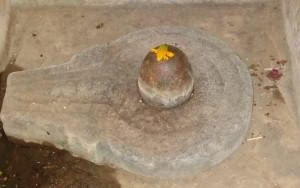
The Sahasraksheshwar Shiva Temple is a sanctuary dedicated to Lord Shiva in his form as Sahasraksheshwar—the Lord with a Thousand Eyes. It is a profound center of energy within the holy city of Varanasi. In the spiritual lexicon of Kashi, this Shiva Lingam is revered as a Swayambhu (self-manifested) idol, appearing from the sacred Suvarna Teertham.
Phalaśruti: The Benefits of Darshan
According to the sacred Kashi Khand of the Skanda Purana, the spiritual potency of this temple is unmatched. Tradition holds that devotees who offer sincere worship here attain liberation from the cycle of karma.
Why do devotees visit?
- Cleansing Ancestral Karma: It is believed that worshipping Sahasraksheshwar washes away sins accumulated over hundreds of thousands of past births.
- Protection: As the Lord who vanquished the demon Gajasura, wearing his skin, devotees seek protection from evil forces and planetary afflictions.
- Spiritual Awakening: The location is said to activate the Ajna Chakra (third eye), enhancing intuition and spiritual clarity.
2. Historical Origins & Scriptural Legend
The history of the Sahasraksheshwar Temple is deeply interwoven with the mythology of Kashi.
Scriptural Foundations
According to Kashi Khand, Chapter 69: The land where Lord Shiva wore the skin of Gajasur after slaying the demon is called Rudra Vasam. This temple commemorates that specific form of the Lord (distinctly related to the Krithi Vaseshwar manifestation).
The Legend of the Lingam
Tradition holds: Once, Lord Shiva, in his form as Krithi Vaseshwar, sat alongside Goddess Uma Devi. Nandi, the divine bull, offered prayers and stated that there are 68 places of worship dedicated to Shiva in this holy land. From the Suvarna Teertham, a Lingam named Sahasraksheshwar appeared in Kashi. This Lingam was established to the south of another significant shrine, Shaileshwar.
While specific dynastic construction records for the original structure are lost to time—typical of many ancient Kashi shrines—the architecture suggests a Dravidian influence, possibly renovated by South Indian dynasties like the Cholas or Nayakas who patronized Shiva worship in the North.
3. Architectural Marvels
Dravidian Style in the Ganges Plains
Unlike the predominantly Nagara-style temples of North India, the Sahasraksheshwar Temple showcases a distinct Dravidian architectural style. This indicates a historical cultural exchange where Southern artisans influenced the temple landscape of Varanasi.
- The Shikhara (Tower): The temple features a pyramid-like Shikhara, typical of Dravidian designs, culminating in a Kalasham (pot-finial).
- Vastu Shastra: The temple is oriented according to Vastu principles, facing East to capture the first rays of the sun, symbolizing the dispelling of ignorance.
- Sculpture and Sanctum: The sanctum sanctorum (Garbhagriha) houses the Sahasraksheshwar Lingam. The surrounding walls bear intricate carvings depicting scenes from the Shiva Purana.
While the temple is revered for its antiquity, it stands as a testament to the layered history of Varanasi, where centuries of devotion have been carved into its stone.
4. Darshan & Ritual Logistics (2026 Guide)
Planning your visit requires attention to the daily rituals and annual festivals. The atmosphere transforms during the Brahma Muhurta (pre-dawn) and the evening Aarti.
Daily Darshan Timings
Please note that temple timings may vary slightly during festivals or local holidays.
| Session | Timing | Activity |
|---|---|---|
| Morning | 05:00 AM – 12:00 PM | Morning Aarti, Abhishekam, General Darshan |
| Afternoon | 12:00 PM – 04:00 PM | Temple Closed (Rest period for the Deity) |
| Evening | 04:00 PM – 09:00 PM | Evening Aarti, Shayan Darshan |
Key Sevas & Online Booking
Devotees can book specific rituals to enhance their spiritual experience.
- Abhishekam: Ritual bathing of the Lingam with water, milk, honey, and bilva leaves.
- Rudra Archana: Chanting of the Sri Rudram (Namakam and Chamakam).
- Maha Aarti: The grand lamp offering performed at dusk.
Online Booking: While specific online portals for smaller shrines in Varanasi are often consolidated, bookings for major Sevas in Kashi are generally handled through the Kashi Vishwanath Temple administration or local priest networks. Visitors are advised to contact the temple office directly or inquire at the Shailputri counter for Sahasraksheshwar-specific Seva availability.
2026 Festival Calendar
Major festivals observed at the temple:
- Mahashivratri (February 26, 2026): The most significant event. The temple remains open through the night with special Abhishekams and chanting.
- Pradosh Vrat: Observed on the 13th day of every lunar fortnight (trayodashi).
- Monthly Shivratri: Observed every month during the Krishna Paksha.
5. Practical Visitor Guidance
Dress Code and Etiquette
- Attire: Traditional Indian wear is recommended (dhoti/kurta for men, saree/salwar kameez for women). Avoid shorts or sleeveless tops.
- Footwear: Shoes must be removed at the designated area outside the temple premises.
- Photography: Photography is generally restricted inside the sanctum. Please respect the sanctity of the space.
Facilities & Accessibility
- Mobile Lockers: Small lockers are available for mobile phones and bags, as electronic devices are often prohibited in the inner sanctum.
- Accessibility: The temple is located on the ghats of Varanasi, which involves steps. While the main sanctum is accessible via a ramp, navigating the ghats can be challenging for those with mobility issues.
- Crowd Management: Best hours to visit: Early morning (5:30 AM – 7:00 AM) or late evening (after 7:30 PM) to avoid crowds. Seasonal advice: Varanasi summers (April-June) are extremely hot; carry a water bottle and umbrella. Winters (Dec-Jan) are foggy but pleasant.
6. Pilgrimage Connectivity
How to Reach Sahasraksheshwar Temple
The temple is located at A-40/11, Marhia Ghat, Shailputri, Varanasi.
- By Rail: The nearest major junction is Varanasi Junction (BSB). From the station, take an auto-rickshaw or e-rickshaw.
- By Air: Lal Bahadur Shastri International Airport (VNS) is approximately 25-30 km away.
- By Road: If traveling from Varanasi Junction via GT Road, take a left turn just before Varanasi City Station. Cross the level crossing and proceed for about 2 km to reach Shailputri.
- Local Transport: Most auto-rickshaw drivers are familiar with the Shailputri temple area, which serves as the landmark for this shrine.
Nearby Sacred Sites (Pilgrimage Circuit)
Enhance your spiritual journey by visiting these nearby temples in the Shailputri/Ghats area:
- Shailputri Temple: The temple dedicated to the first form of Goddess Durga, located very close to Sahasraksheshwar.
- Krithi Vaseshwar Temple: Associated with the legend of Lord Shiva wearing the elephant skin (Gajasura), mentioned in the same Kashi Khand chapter.
- Manikarnika Ghat: One of the oldest and most sacred ghats of Varanasi, located a short distance away, where the cycle of life and death is witnessed.
7. Frequently Asked Questions (FAQs)
Is there a VIP darshan entry?
Unlike larger temple complexes, Sahasraksheshwar Temple typically does not have a separate VIP entry gate. However, devotees booking specific Sevas (like Abhishekam) are given priority access during the ritual time.
What is the significance of the name “Sahasraksheshwar”?
The name translates to “Lord of a Thousand Eyes” (Sahasra = Thousand, Aksha = Eye/Eye of Shiva, Ishwar = Lord). It signifies the all-seeing, all-knowing nature of Lord Shiva.
Can I perform the Abhishekam myself?
Generally, the Abhishekam is performed by the resident priests. However, you can book the Seva and be present to witness it. You may be permitted to offer items like milk or bilva leaves under the guidance of the priest.
Is there parking available?
Due to the narrow lanes of the old city (Shailputri area), parking is limited. It is best to park vehicles on the outer perimeter near GT Road or take a shared auto-rickshaw to the temple entrance.
What is the best time of year to visit?
The ideal time is between October and March when the weather in Varanasi is cool and pleasant, making the walk through the ghats comfortable.
Photo Gallery
How to Reach
Sahasraksheshwar is located at A-40/11, Marhia Ghat, Shailputri. If one travels from Varanasi Railway station through G.T. Road, just before Varanasi City Station, a small road takes a left turn where he will encounter a level crossing. After crossing the road, he will have to travel for about 2 Kms. to reach this place. People can travel up to this place by rickshaw/auto rickshaw and most of the drivers know the place where Shailputri temple is located.
Contact Details
Official Address: A-40/11, Marhia Ghat, Shailputri, Varanasi, Uttar Pradesh.
Recent Posts

ओ सांवरे तूने ही मुझको संभाला – Lyrics & Meaning
ओ सांवरे तूने ही मुझको संभाला – A Prayer to Shyam Origin & Spiritual Essence Why This Bhajan Resonates Devotees chant this when overwhelmed by life’s storms—the refrain ‘तूने ही मुझको संभाला’ is the soul’s sigh of relief: “You…

कथा ये है महाराज मेरे की – Lyrics & Meaning
कथा ये है महाराज मेरे की छत्रपति संभाजी महाराज – A Prayer to Chhatrapati Sambhaji Maharaj Origin & Spiritual Essence Why This Bhajan Resonates Devotees chant this when their spirit feels tested—its powerful refrain “महाराज मेरे” is a soul’s…

Rigveda Samhita Yathartha Anuvada (ऋग्वेद संहिता यथार्थ अनुवाद) – Complete Set with Anvayartha & Hindi/English Translation
The Rigveda is the oldest surviving scripture of humanity and the foundational text of Sanātana Dharma. For serious students, scholars, UPSC aspirants studying ancient Indian history, Sanskrit learners, and spiritual seekers, a precise and grammatically structured translation is indispensable.…

आना भी अकेला है जाना भी अकेला है – Lyrics & Meaning | BharatTemples
आना भी अकेला है जाना भी अकेला है – A Prayer to the Divine Witness Origin & Spiritual Essence Why This Bhajan Resonates Devotees turn to this bhajan in moments of deep reflection—when life’s attachments begin to ache. The…

माता शेरावाली के द्वार जो भी जाता है – Lyrics & Meaning
माता शेरावाली के द्वार जो भी जाता है – A Prayer to Maa Sherawali Origin & Spiritual Essence Why This Bhajan Resonates Devotees turn to this bhajan in times of fear or uncertainty—its promise that no one leaves Maa’s…

मार लेना सपणी उबार लेणा भवरा – Lyrics & Meaning
मार लेना सपणी उबार लेणा भवरा – A Prayer to the Divine Beloved Origin & Spiritual Essence Why This Bhajan Resonates Devotees chant this in moments of deep vulnerability—its cry of “मार लेना सपणी, उबार लेणा भवरा” is the…

हमें श्याम सुंदर भरोसा तुम्हारा – Lyrics & Meaning
हमें श्याम सुंदर भरोसा तुम्हारा – A Prayer to Shyam Sundar Origin & Spiritual Essence Why This Bhajan Resonates Devotees chant this when feeling alone—its refrain ‘de do sahara’ is the soul’s cry for divine support. Lyrics in Hindi…

Mere Satguru Ne Di Thi Davai Lyrics in Hindi & Meaning
Mere Satguru Ne Di Thi Davai: Invoking the Guru’s Liberating Wisdom This soul-stirring bhajan venerates the Satguru (True Spiritual Master) as the divine physician who dispenses the only remedy for life’s deepest sufferings. Composed by Sant Karmaveer Tufani, it…

Janm Diyo Thari Maa Dukh Dekhiyo Lyrics in Hindi & Meaning
जन्म दियो थारी माँ दुख देखियो (Maa’s Grief Upon Birthing You) This soul-stirring Chetavani Bhajan (admonitory hymn) is addressed to the Divine Mother (Maa) – a call for repentance when children forget their filial duties in the dark age…
Bhadi Sabha Mein Thane Manaun Lyrics in Hindi & Meaning
Bhadi Sabha Mein Thane Manaun: Invoking the Spear-Wielding Mother Mata Bhawani (श्री ज्वाला भवानी), the fiery manifestation of Shakti worshipped as the Protector of Dharma in Her Dhaulagarh sanctum. Origin & Spiritual Essence Composed in Rajasthani folk tradition by…