
Contents
- 1 Saravana Polgai Temple, Palani: A Guide to the Sacred Bath
Saravana Polgai Temple, Palani: A Guide to the Sacred Bath
As the Lead Heritage Architect for bharattemples.com, I welcome you to one of the most unique spiritual experiences in South India. Located at the foothills of the Palani Malai, the Saravana Polgai (also known as Saravana Poigai) is not merely a temple tank; it is a living tradition where the legend of Lord Murugan intersects with the daily devotion of thousands of pilgrims.
1. Introduction & Spiritual Essence
The Saravana Polgai Temple is dedicated to Lord Kartikeya (Murugan), revered in his form as Dhandapani (the one holding the staff of asceticism). Unlike the presiding deity of the Palani Murugan Temple atop the hill (Arulmigu Dhandayuthapani Swamy), the deity here represents the ascetic form learned from his father, Lord Shiva.
Phalaśruti (Spiritual Benefits):
Visiting this sacred tank and performing the ritual bathing is believed to cleanse ancestral karma. According to local devotees, bathing in the waters where the six Karthikai maidens tended to the infant Murugan washes away sins and grants the blessing of family harmony. The water here is considered Teertham (holy water) of the highest order.
2. Historical Origins & Scriptural Legend
Scriptural Legend:
The Sthala Purana (local legend) is deeply rooted in the mythology of Lord Murugan’s childhood. It is said that Lord Murugan was looked after by the Six Karthikai Sisters (the deities associated with the star Karthigai) in a forest of Saravana reeds. Hence, the sacred pond is named Saravana Polgai (The Pond of the Saravana Reeds).
Historical Context:
While exact records of the initial construction date are elusive in standard historical archives, the structure is ancient, having been maintained and renovated over centuries by local chieftains and devotees. The temple and tank are situated in Adivaram Road, Palani, within the Dindigul district of Tamil Nadu. Tradition holds that the tank was originally a large, full-body immersion tank, though modern renovations have adjusted its structure for accessibility.
3. Architectural Marvels
The temple complex exhibits traditional Dravida architectural style, typical of Tamil Nadu temple architecture. Key features include:
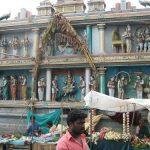
- The Tank (Pushkarni): A square-walled structure with submerged steps (ghats) leading into the water. The architecture allows for separate bathing quarters for men and women.
- The Dhandapani Sanctum: Located on the western side, the deity stands in the middle of a tub-like structure. This allows devotees to perform abhishekam (ritual bathing) directly with their hands using the surrounding water—a privilege rarely found in the main sanctum.
- Associated Shrines: The tank is flanked by a Vinayaga (Ganesha) Temple on the south side. As is customary in Murugan lore, where the younger brother resides, the elder brother Ganesha is always present nearby.
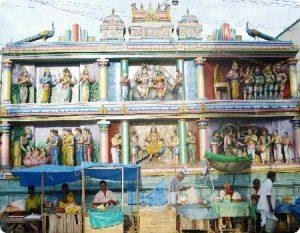
All the sacred pools here are named duly after Muruga. And especially Saravana Poygai is very intimately connected with Muruga. We have to pay a fee to bathe in it. Just behind the temple of Avinankudi, there are two rows of six stucco niches. Let us go there. Paintings of Muruga being tended by six Karthikai maidens attract us. Here too we have to pay a fee and get in.
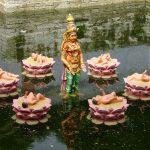
It is not a pool but only a deep well. It must have been a tank once. A square wall has been erected. In the south is the bathing ghats. Several steps are submerged in the water. People in the past got down through these steps and bathed. Now as that is not possible, the water is very clean. Coins have been strewn into the water. This is an old custom and persists. When people who travel by train cross the bridge of any sacred river, they throw coins into it, thinking it is a holy act.
In the south-east is the Kshatrice Chaurav madam, and in the south is a Vinayaga temple. Wherever there is a tank invariably there will be a Pilliar Koil on the bank and here where his brother Muruga happens to reside the elder brother is sure to abide. In the west side of the ghats is a tub like structure half filled with water and Deity.
Dhandapani stands in the middle. We can bathe him by our hands with the water around him. In the sanctum we can not enter and perform ablutions. But here there are no such restrictions. Here arrangements have been made to bathe separately. (Gents and Ladies) in rooms by bringing water through pumps. We bathe chanting “OM Saravana Bava”.
4. Darshan & Ritual Logistics
The Saravana Polgai is primarily visited for the Saravana Snanam (ritual bath). It is generally open from early morning until late evening.
Daily Timings
| Session | Timings | Activity |
|---|---|---|
| Morning | 06:00 AM – 12:00 PM | Bathing, Abhishekam |
| Evening | 04:00 PM – 08:00 PM | Closure/Cleaning |
Seva Booking & Offerings
While direct booking for the tank is done on-site, the main Palani Murugan Temple allows online booking for Sevas.
- Abhishekam: Can be performed for the Dhandapani idol inside the tank premises.
- Online Booking: For main temple events (Vishnupathi Thirunalam, etc.), visit the official Palani Arulmigu Dhandayuthapani Swamy Temple website.
2026 Major Festival Dates
- Thai Poosam: January 11, 2026
- Masi Magam: February 22, 2026
- Panguni Uthiram: March 25–28, 2026 (Grand finale of the festival season)
- Skanda Shashti: November 22, 2026
5. Practical Visitor Guidance
To ensure a respectful and hassle-free visit, please adhere to the following guidelines:
- Dress Code: Traditional attire is mandatory. Men should wear Dhoti or pants with a shirt; women should wear Saree, Salwar Kameez, or traditional sets. Western wear is strictly prohibited.
- Bathing Facilities: Separate changing rooms are available for men and women. There is a nominal fee for bathing (subject to change). Lockers are available for valuables, but it is advisable to carry minimal items.
- Crowd Management: The tank is less crowded than the main hill temple. However, during Weekends and Festivals, it can get crowded between 9:00 AM and 11:00 AM. The best time to visit is early morning (6:30 AM) or late afternoon (4:30 PM).
- Seasonal Advice: Summers in Palani (April–June) are extremely hot. Carry a water bottle and umbrella. The tank water is refreshing, but hydration is essential while walking the Giri Veethi (hill path).
6. Pilgrimage Connectivity
Location: Adivaram Rd, Giri Veethi, Palani, Tamil Nadu 624601
How to Reach
- By Air: The nearest airport is Coimbatore International Airport (approx. 100 km). Taxis and buses are available directly from the airport to Palani.
- By Train: Palani Railway Station connects to Madurai, Chennai, and Coimbatore via Pollachi. The Palani Express (Chennai Central – Palani) is a direct connection.
- By Road: Palani is well-connected via the Coimbatore-Palani-Madurai highway (State Highway). State transport buses run frequently from Coimbatore, Madurai, and Trichy.
Nearby Sacred Sites
- Palani Murugan Temple (Dhandayuthapani Swamy): The main temple atop the hill, accessible via the steep Giri Veethi path or the winch/cable car.
- Avinankudi: Located just behind Saravana Polgai, this is a small temple complex dedicated to Lord Murugan.
- Thiru Avinankudi: One of the two temples located at the foothills (Nadu Avinankudi and Vada Avinankudi).
7. Frequently Asked Questions (FAQ)
Is there an entry fee for Saravana Polgai?
Yes, a nominal fee is charged for bathing in the Saravana Polgai tank. This helps in the maintenance and cleaning of the sacred water body.
Can I visit this temple if I am not a Hindu?
While the sanctum of the main Palani hill temple has specific restrictions, the Saravana Polgai is an open tank. Visitors from all backgrounds are generally allowed to view the architecture and rituals, but bathing is reserved for practicing devotees out of respect for religious traditions.
Is there a VIP darshan entry?
VIP darshan is primarily for the main hill temple. For the Saravana Polgai, access is usually based on the flow of devotees. However, special arrangements can be made for elderly or differently-abled pilgrims through the temple office.
What is the significance of throwing coins into the water?
Throwing coins is a folk tradition symbolizing the offering of material wealth to the divine to seek spiritual abundance. In the context of Saravana Polgai, it is also a gesture of gratitude for safe travel, akin to rituals performed at river bridges.
How far is Saravana Polgai from the base of the hill?
It is located right at the foothills of the Palani Malai, specifically on Adivaram Road. It is easily walkable from the town center and the base of the Giri Veethi path.
Photo Gallery





Recent Posts

ओ सांवरे तूने ही मुझको संभाला – Lyrics & Meaning
ओ सांवरे तूने ही मुझको संभाला – A Prayer to Shyam Origin & Spiritual Essence Why This Bhajan Resonates Devotees chant this when overwhelmed by life’s storms—the refrain ‘तूने ही मुझको संभाला’ is the soul’s sigh of relief: “You…

कथा ये है महाराज मेरे की – Lyrics & Meaning
कथा ये है महाराज मेरे की छत्रपति संभाजी महाराज – A Prayer to Chhatrapati Sambhaji Maharaj Origin & Spiritual Essence Why This Bhajan Resonates Devotees chant this when their spirit feels tested—its powerful refrain “महाराज मेरे” is a soul’s…

Rigveda Samhita Yathartha Anuvada (ऋग्वेद संहिता यथार्थ अनुवाद) – Complete Set with Anvayartha & Hindi/English Translation
The Rigveda is the oldest surviving scripture of humanity and the foundational text of Sanātana Dharma. For serious students, scholars, UPSC aspirants studying ancient Indian history, Sanskrit learners, and spiritual seekers, a precise and grammatically structured translation is indispensable.…

आना भी अकेला है जाना भी अकेला है – Lyrics & Meaning | BharatTemples
आना भी अकेला है जाना भी अकेला है – A Prayer to the Divine Witness Origin & Spiritual Essence Why This Bhajan Resonates Devotees turn to this bhajan in moments of deep reflection—when life’s attachments begin to ache. The…

माता शेरावाली के द्वार जो भी जाता है – Lyrics & Meaning
माता शेरावाली के द्वार जो भी जाता है – A Prayer to Maa Sherawali Origin & Spiritual Essence Why This Bhajan Resonates Devotees turn to this bhajan in times of fear or uncertainty—its promise that no one leaves Maa’s…

मार लेना सपणी उबार लेणा भवरा – Lyrics & Meaning
मार लेना सपणी उबार लेणा भवरा – A Prayer to the Divine Beloved Origin & Spiritual Essence Why This Bhajan Resonates Devotees chant this in moments of deep vulnerability—its cry of “मार लेना सपणी, उबार लेणा भवरा” is the…

हमें श्याम सुंदर भरोसा तुम्हारा – Lyrics & Meaning
हमें श्याम सुंदर भरोसा तुम्हारा – A Prayer to Shyam Sundar Origin & Spiritual Essence Why This Bhajan Resonates Devotees chant this when feeling alone—its refrain ‘de do sahara’ is the soul’s cry for divine support. Lyrics in Hindi…

Mere Satguru Ne Di Thi Davai Lyrics in Hindi & Meaning
Mere Satguru Ne Di Thi Davai: Invoking the Guru’s Liberating Wisdom This soul-stirring bhajan venerates the Satguru (True Spiritual Master) as the divine physician who dispenses the only remedy for life’s deepest sufferings. Composed by Sant Karmaveer Tufani, it…

Janm Diyo Thari Maa Dukh Dekhiyo Lyrics in Hindi & Meaning
जन्म दियो थारी माँ दुख देखियो (Maa’s Grief Upon Birthing You) This soul-stirring Chetavani Bhajan (admonitory hymn) is addressed to the Divine Mother (Maa) – a call for repentance when children forget their filial duties in the dark age…
Bhadi Sabha Mein Thane Manaun Lyrics in Hindi & Meaning
Bhadi Sabha Mein Thane Manaun: Invoking the Spear-Wielding Mother Mata Bhawani (श्री ज्वाला भवानी), the fiery manifestation of Shakti worshipped as the Protector of Dharma in Her Dhaulagarh sanctum. Origin & Spiritual Essence Composed in Rajasthani folk tradition by…