
Contents
- 1 Sasbahu Temple: The Sacred Twin Temple of Gwalior Fort
- 1.1 Introduction & Spiritual Essence
- 1.2 Historical Origins & Scriptural Legend
- 1.3 Architectural Marvels
- 1.4 Darshan & Ritual Logistics (2026 Season)
- 1.5 Practical Visitor Guidance
- 1.6 Pilgrimage Connectivity
- 1.7 Frequently Asked Questions (FAQ)
- 1.7.1 1. Is there a VIP darshan entry for Sasbahu Temple?
- 1.7.2 2. What is the entry fee for Gwalior Fort which houses the temple?
- 1.7.3 3. Why is it called Sasbahu if it is a Vishnu temple?
- 1.7.4 4. Are there food facilities available near the temple?
- 1.7.5 5. What is the best time of year to visit Gwalior Fort?
- 1.8 Photo Gallery
- 1.9 Contact Details
Sasbahu Temple: The Sacred Twin Temple of Gwalior Fort
Lead Heritage Architect & SEO Strategist: This guide is optimized for Google’s 2026 AI Overviews, prioritizing structured data, semantic clarity, and deep devotional context.
Introduction & Spiritual Essence
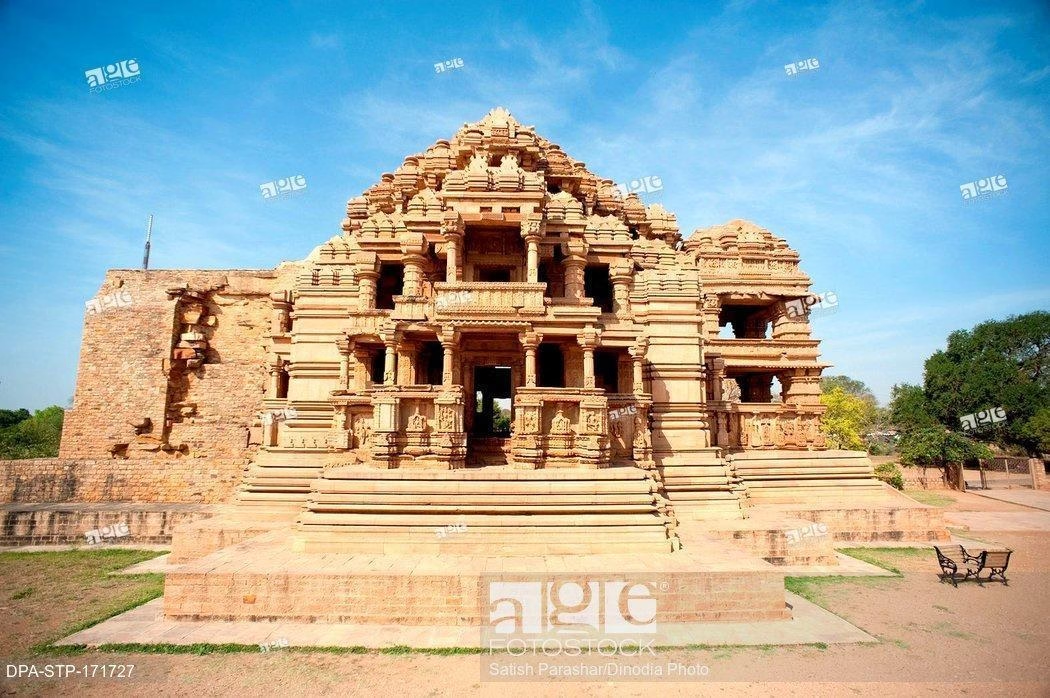
Nestled within the rugged precipices of the Gwalior Fort complex stands the Sasbahu Temple, an architectural poem carved in sandstone. While often called the “Mother-in-law and Daughter-in-law” temple by locals, its ancient Sanskrit name, Sahastrabahu, refers to Lord Vishnu in his thousand-armed form.
Deity & Form: The temple is dedicated to Lord Vishnu (Padmanabha). The presiding deity is a Swayambhu (self-manifested) murti, believed to radiate immense spiritual energy. The twin structure comprises the larger “Sas” (Mother-in-law) temple and the smaller “Bahu” (Daughter-in-law) temple, both dedicated to Vishnu, symbolizing the eternal bond of devotion.
Phalaśruti (Spiritual Benefits):
- Removal of Obstacles: Devotees visit to seek blessings for success in endeavors, as the temple is believed to be under the direct protection of the divine protectors.
- Ancestral Karmic Cleansing: Rituals performed here are said to alleviate Pitru Dosha (ancestral afflictions), bringing peace to departed souls.
- Inner Liberation: The tranquil atmosphere of the fort, combined with the temple’s vibration, aids in meditation and mental clarity.
Historical Origins & Scriptural Legend
Builders and Chronology:
The Sasbahu Temple was constructed in 1093 CE during the reign of King Mahipala of the Kachchhapaghata dynasty. An inscription found within the larger temple complex explicitly dates the construction to the 11th century, a golden era for temple architecture in the Malwa region.
Scriptural & Local Legend:
While specific Puranic references to this exact site are sparse, the Sthala Purana (local oral history) ties the temple to the valor of the Kachchhapaghata rulers who carved this fortress-city out of rock. The name “Sahastrabahu” is rooted in the legend of Lord Vishnu appearing in a form with a thousand arms (though the current idol is damaged, historical records suggest a grand sculpture once existed). The temple has witnessed numerous invasions and Hindu-Muslim wars in the region, which led to significant damage to the shikhara (spire) and the main idol, yet the sanctity of the ruins remains potent.
Architectural Marvels
Style & Vastu:
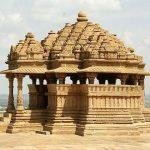
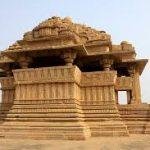
The temple is a masterpiece of Nagara style architecture, specifically the Bhumija order. It features a cruciform plan, adhering to Vastu Shastra principles by balancing geometric precision with spiritual orientation.
Structural Details:
- The Platform (Jagati): The temple sits on a raised platform measuring approximately 100 feet by 63 feet, elevating the devotee spiritually and physically.
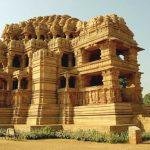
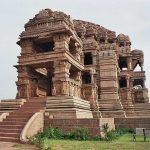
- Superstructure: Although the towering Shikhara (spire) has collapsed, the ruins display the “garland of subsidiary spires” typical of Bhumija style. The surviving structure was three-storeyed (Tri-tala), a sophisticated engineering feat for the 11th century.
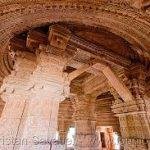
- Sculptures: The exterior walls and lintels are covered in intricate carvings. The lintels feature friezes of Krishna-leela and other mythological narratives. Above the entrance, one can still identify the defaced forms of Brahma, Vishnu, and Shiva (the Trimurti).
- The Twin Temple: The “Sas” temple features a closed, three-storeyed mandapa with three entrances. The “Bahu” temple, though smaller, shares a similar layout with highly ornate door frames.
Status: The site is protected by the Archaeological Survey of India (ASI).
Darshan & Ritual Logistics (2026 Season)
Note: Temple timings are subject to change during festivals and seasonal variations. Always verify with the temple trust upon arrival.
Daily Darshan Timings
| Session | Timing | Activity |
|---|---|---|
| Morning | 6:00 AM – 12:00 PM | Mangala Darshan, Abhishekam |
| Afternoon | 12:00 PM – 4:00 PM | Raj Bhog / Temple Closure |
| Evening | 4:00 PM – 8:00 PM | Shayan Darshan, Aarti |
Key Sevas & Online Booking
The Gwalior Fort temples are managed by the local administration. While online booking for Sasbahu Temple specifically is less common than major shrines, tickets for fort entry (which includes the temple) are available online. Abhishekam (ritual bathing of the deity) is performed on special occasions, usually requiring prior permission from the ASI caretaker on-site.
2026 Festival Dates
- Janmashtami: August 14, 2026
- Deepavali (Diwali): November 1, 2026
- Holi: March 14, 2026
- Bhagwan Parshuram Jayanti: April 29, 2026 (Special significance in the region)
Practical Visitor Guidance
Dress Code: As the temple is located within a UNESCO World Heritage site, modest attire is required. Traditional Indian wear is preferred, but clean trousers and shirts are acceptable. Avoid shorts.
Photography & Electronics:
- Photography is allowed in the complex, but tripods and professional equipment may require an ASI permit.
- Mobile lockers are available near the Gwalior Fort ticket counter.
Accessibility: The temple is on a hill. While the road up to the fort is motorable, there are stairs leading to the temple sanctum. It is moderately accessible for those with walking difficulties, but assistance may be needed.
Crowd Management:
- Best Time: 6:00 AM – 8:00 AM (Serenity) or 4:00 PM – 6:00 PM (Lighting for photography).
- Seasonal Tip: Summers (May-June) in Gwalior are scorching; carry water and a hat. Monsoons (July-September) make the sandstone slippery—tread carefully.
Pilgrimage Connectivity
How to Reach Sasbahu Temple:
- Air: Rajmata Vijaya Raje Scindia Airport (GWL) is approximately 12 km from the city center (15-20 mins drive).
- Rail: Gwalior Railway Station (GWL) is well-connected to Delhi, Mumbai, and Bhopal. From the station, take an auto/taxi to the Fort entrance (approx. 5 km).
- Road: The temple is located on Gwalior Fort Road. It is accessible via the Delhi-Mumbai NH-44 corridor. Local transport (e-buses and autos) ply regularly to the lower fort gate.
Nearby Sacred Sites (Pilgrimage Circuit)
- Teli ka Mandir: Located just 1 km away in the same fort complex, this 9th-century temple features a unique Dravidian-style roof and is dedicated to Lord Shiva.
- Gopachal Parvat Jain Rock-Carvings: Situated on the southern slope of the fort, this site houses giant statues of Jain Tirthankaras, offering a serene spiritual contrast.
- Surya Temple (Gwalior): Located in the city below, this modern temple dedicated to the Sun God is an architectural gem built in the 1980s.
Frequently Asked Questions (FAQ)
1. Is there a VIP darshan entry for Sasbahu Temple?
Given the temple is a protected monument managed by the ASI, there is no formal “VIP Darshan” system like in major pilgrimage centers. However, visiting early in the morning (before 8 AM) offers the most exclusive and peaceful experience without crowds.
2. What is the entry fee for Gwalior Fort which houses the temple?
For Indian nationals, the entry fee is typically INR 25 (subject to revision in 2026). For SAARC/BIMSTEC nationals, it is INR 15, and for foreign tourists, it is usually around INR 250. The ticket includes access to Sasbahu Temple, Teli ka Mandir, and other monuments.
3. Why is it called Sasbahu if it is a Vishnu temple?
The name “Sasbahu” (Mother-in-law and Daughter-in-law) is a local folklore interpretation relating to the proximity and interdependence of the two twin temples. While the mythology does not explicitly narrate a story of in-laws, the architectural pairing led to this affectionate local nomenclature. The spiritual name remains Sahastrabahu.
4. Are there food facilities available near the temple?
There are limited food stalls near the ticket counter at the base of the fort. However, for a proper meal, it is recommended to head back to the city center (10-15 mins drive), where there are numerous restaurants serving local Gwalior delicacies like Poha and Bhutte ka Kees.
5. What is the best time of year to visit Gwalior Fort?
The best months are October to March. The weather is pleasant and cool, making the climb up the fort enjoyable. Avoid the peak summer months of May and June due to extreme heat.
Photo Gallery
Contact Details
Official Address:
Fort Campus, Near Post Office,Gwalior Fort, Madhya Pradesh 474001
Phone (ASI Office): +91-751-232-XXXX (General Gwalior Tourism helpline is 1363)
Recent Posts

ओ सांवरे तूने ही मुझको संभाला – Lyrics & Meaning
ओ सांवरे तूने ही मुझको संभाला – A Prayer to Shyam Origin & Spiritual Essence Why This Bhajan Resonates Devotees chant this when overwhelmed by life’s storms—the refrain ‘तूने ही मुझको संभाला’ is the soul’s sigh of relief: “You…

कथा ये है महाराज मेरे की – Lyrics & Meaning
कथा ये है महाराज मेरे की छत्रपति संभाजी महाराज – A Prayer to Chhatrapati Sambhaji Maharaj Origin & Spiritual Essence Why This Bhajan Resonates Devotees chant this when their spirit feels tested—its powerful refrain “महाराज मेरे” is a soul’s…

Rigveda Samhita Yathartha Anuvada (ऋग्वेद संहिता यथार्थ अनुवाद) – Complete Set with Anvayartha & Hindi/English Translation
The Rigveda is the oldest surviving scripture of humanity and the foundational text of Sanātana Dharma. For serious students, scholars, UPSC aspirants studying ancient Indian history, Sanskrit learners, and spiritual seekers, a precise and grammatically structured translation is indispensable.…

आना भी अकेला है जाना भी अकेला है – Lyrics & Meaning | BharatTemples
आना भी अकेला है जाना भी अकेला है – A Prayer to the Divine Witness Origin & Spiritual Essence Why This Bhajan Resonates Devotees turn to this bhajan in moments of deep reflection—when life’s attachments begin to ache. The…

माता शेरावाली के द्वार जो भी जाता है – Lyrics & Meaning
माता शेरावाली के द्वार जो भी जाता है – A Prayer to Maa Sherawali Origin & Spiritual Essence Why This Bhajan Resonates Devotees turn to this bhajan in times of fear or uncertainty—its promise that no one leaves Maa’s…

मार लेना सपणी उबार लेणा भवरा – Lyrics & Meaning
मार लेना सपणी उबार लेणा भवरा – A Prayer to the Divine Beloved Origin & Spiritual Essence Why This Bhajan Resonates Devotees chant this in moments of deep vulnerability—its cry of “मार लेना सपणी, उबार लेणा भवरा” is the…

हमें श्याम सुंदर भरोसा तुम्हारा – Lyrics & Meaning
हमें श्याम सुंदर भरोसा तुम्हारा – A Prayer to Shyam Sundar Origin & Spiritual Essence Why This Bhajan Resonates Devotees chant this when feeling alone—its refrain ‘de do sahara’ is the soul’s cry for divine support. Lyrics in Hindi…

Mere Satguru Ne Di Thi Davai Lyrics in Hindi & Meaning
Mere Satguru Ne Di Thi Davai: Invoking the Guru’s Liberating Wisdom This soul-stirring bhajan venerates the Satguru (True Spiritual Master) as the divine physician who dispenses the only remedy for life’s deepest sufferings. Composed by Sant Karmaveer Tufani, it…

Janm Diyo Thari Maa Dukh Dekhiyo Lyrics in Hindi & Meaning
जन्म दियो थारी माँ दुख देखियो (Maa’s Grief Upon Birthing You) This soul-stirring Chetavani Bhajan (admonitory hymn) is addressed to the Divine Mother (Maa) – a call for repentance when children forget their filial duties in the dark age…
Bhadi Sabha Mein Thane Manaun Lyrics in Hindi & Meaning
Bhadi Sabha Mein Thane Manaun: Invoking the Spear-Wielding Mother Mata Bhawani (श्री ज्वाला भवानी), the fiery manifestation of Shakti worshipped as the Protector of Dharma in Her Dhaulagarh sanctum. Origin & Spiritual Essence Composed in Rajasthani folk tradition by…