
Contents
1. Introduction & Spiritual Essence
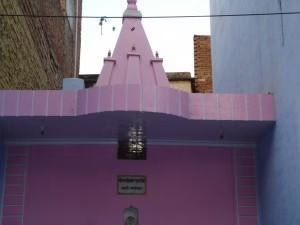
The Satishwar Temple in Varanasi is a profound sanctuary dedicated to Lord Shiva (Satishwar). Located in the heart of Kashi (Varanasi), this temple is a revered site for devotees seeking spiritual fulfillment and the blessings of the supreme deity. The presiding deity here is a Swayambhu (self-manifested) Lingam, believed to have appeared to Goddess Parvati during her quest for a suitable consort.
Phalaśruti: The Divine Benefits
According to the sacred texts of the Kashi Khand, worshipping the Satishwar Lingam yields immense spiritual and material benefits. The primary Phalaśruti (scriptural benefit) associated with this temple is the granting of a righteous and harmonious spouse. Devotees—both men and women—who visit with sincere devotion are believed to find their ideal life partners. Furthermore, unwavering prayers to Satishwar are said to cleanse ancestral karma and grant Moksha (liberation) for the souls of departed ancestors.
2. Historical Origins & Scriptural Legend
The history of Satishwar Temple is deeply rooted in the Kashi Khand (Chapter 93) of the Skanda Purana. The legend recounts a time when Lord Brahma performed intense penance to please Lord Shiva. Appeased by the prayers, Lord Shiva offered a divine wish. Lord Brahma requested that Shiva be born as his son, while Goddess Parvati would become the daughter of Daksha.
Tradition holds that Lord Shiva manifested as a young boy named Rudra from Brahma’s head. Meanwhile, Parvati incarnated as Sati, the daughter of Daksha. As she matured, Sati traveled to Kashi to find a suitable husband. While performing rigorous worship, a Lingam miraculously appeared before her. It was the Satishwar Lingam. From within, the divine voice of Lord Shiva resonated, assuring Sati that her wish for a worthy husband would be fulfilled. He declared that the Lingam would henceforth be worshipped by all seeking the grace of a life partner and the fulfillment of desires.
3. Architectural Marvels
While specific historical records regarding the dynasty that built the current structure are sparse in public archives, the temple showcases the enduring Nagara style of architecture typical of ancient temples in the Himalayan and North Indian plains. The temple complex is characterized by its towering Shikhara (spire), which rises towards the sky, symbolizing the ascent of the soul towards the divine.
The sanctum sanctorum (Garbhagriha) houses the Swayambhu Lingam, which is the focal point of the structure. The walls of the temple feature intricate carvings depicting various forms of Lord Shiva and scenes from Hindu mythology. The Mandapa (pillared hall) allows for the congregation of devotees during rituals. The architecture follows strict Vastu Shastra principles, ensuring a flow of positive energy that enhances the meditative experience of the visitor.
4. Darshan & Ritual Logistics (2026 Guide)
Visitors are advised to verify the current timings upon arrival, as they may vary slightly during festivals or specific seasons. Assuming the standard timings for 2026:
| Session | Timings |
|---|---|
| Morning Darshan | 6:00 AM – 12:00 PM |
| Evening Darshan | 4:00 PM – 9:00 PM |
| Special Note | Timings may extend during Maha Shivaratri. |
Key Sevas & Online Booking
To facilitate a smooth spiritual journey, the temple administration has digitized several services. Devotees can book the following Sevas online through the official Varanasi temple portals (e.g., Kashi Vishwanath Temple Trust portals or local administration sites):
- Abhishekam: Ritual bathing of the Lingam (usually performed early morning).
- Archana: Recitation of names and hymns (can be done individually or for families).
- Rudrabhishek: A powerful Vedic ritual for cleansing negativity.
Major 2026 Festival Dates
- Maha Shivaratri: February 26, 2026 (Expect extended hours and heavy crowds).
- Month of Shravan: July 14 – August 23, 2026 (The most auspicious time for Shiva worship; Tuesdays and Fridays are particularly crowded).
- Nag Panchami: July 30, 2026.
5. Practical Visitor Guidance
Adhering to local customs ensures a respectful visit to Varanasi’s sacred sites.
- Dress Code: Modest attire is mandatory. Men should remove footwear and wear shirts/pants; women are advised to wear sarees, salwar kameez, or skirts. Avoid shorts and sleeveless tops.
- Photography: Photography is generally restricted inside the inner sanctum (Garbhagriha). Please seek permission from temple authorities for external shots.
- Mobile & Lockers: Electronic devices are often discouraged during the inner Darshan. Keep phones on silent mode. While large lockers may not be available at this specific smaller temple, it is recommended to carry minimal luggage. Large bags may need to be deposited at designated points near the temple entrance.
- Crowd Management: The best time to visit is early morning (6:00 AM – 7:30 AM) to avoid rush. In summer (May–June), carry a water bottle as temperatures in Varanasi can rise above 40°C.
6. Pilgrimage Connectivity
How to Reach Satishwar Temple
Located at K-46/32 in Varanasi, the temple is situated on the road leading to Vridhha Kaleshwar and Mrityunjeshwar temples.
- Nearest Airport: Lal Bahadur Shastri International Airport (LBS), Varanasi (approx. 25 km).
- Nearest Railway Station: Varanasi Junction (approx. 5-6 km).
- By Road: The temple is accessible via the Varanasi-Rohilkhand highway. Visitors can take a rickshaw from the Bisheshwarganj/GPO area, which serves as a major landmark.
Nearby Sacred Sites (The Kashi Pilgrimage Circuit)
While visiting Satishwar, pilgrims should not miss these nearby temples to complete their spiritual circuit:
- Vridhha Kaleshwar Temple: Just a short distance away, dedicated to Lord Shiva in his form as the deity of time.
- Mrityunjeshwar Temple: Also nearby, this temple is dedicated to Lord Shiva as the conqueror of death.
- Kashi Vishwanath Temple: The primary Jyotirlinga, located about 3-4 km away.
7. Frequently Asked Questions (FAQs)
Is there a VIP Darshan entry at Satishwar Temple?
Unlike the major Kashi Vishwanath Corridor, Satishwar Temple typically functions as a local heritage site. VIP entry is usually not required, and the darshan line moves fairly quickly due to the smaller size of the complex. However, during festivals, special passes may be issued by the district administration.
What is the best time of year to visit Varanasi for Darshan?
The ideal time is between October and March (winter months) when the weather is pleasant. However, for those seeking the specific spiritual energy of Lord Shiva, the month of Shravan (July-August) is the most potent time, despite the heat and crowds.
Can I perform the Satishwar Puja for my ancestors?
Yes. The temple is known for its potency in clearing ancestral karma. You can book a Shradh or specific Tarpan ritual by consulting the local Pandits (priests) available at the temple premises or via online booking platforms that list heritage temples in Varanasi.
Is the temple accessible for senior citizens and differently-abled devotees?
The temple structure is ancient, and there might be a few steps leading to the entrance. While the area inside the Mandapa is generally accessible, the inner sanctum may require navigating narrow passages. It is advisable to request assistance from temple volunteers if needed.
Where can I park my vehicle?
Parking is limited near the temple due to its location in a dense residential area. It is recommended to use public transport (auto-rickshaws) or park at designated parking zones near Bisheshwarganj/GPO and walk the remaining distance.
Recent Posts

Shri Kaamkoteeshwar Mandir, Varanasi – History & Significance
In the heart of Kashi, the eternal city of Lord Shiva, where the Ganges flows with celestial grace, stands the Shri Kaamkoteeshwar Mandir. This sacred Sannidhi is not merely a temple but a profound spiritual bridge between the Northern…

ओ सांवरे तूने ही मुझको संभाला – Lyrics & Meaning
ओ सांवरे तूने ही मुझको संभाला – A Prayer to Shyam Origin & Spiritual Essence Why This Bhajan Resonates Devotees chant this when overwhelmed by life’s storms—the refrain ‘तूने ही मुझको संभाला’ is the soul’s sigh of relief: “You…

कथा ये है महाराज मेरे की – Lyrics & Meaning
कथा ये है महाराज मेरे की छत्रपति संभाजी महाराज – A Prayer to Chhatrapati Sambhaji Maharaj Origin & Spiritual Essence Why This Bhajan Resonates Devotees chant this when their spirit feels tested—its powerful refrain “महाराज मेरे” is a soul’s…

Rigveda Samhita Yathartha Anuvada (ऋग्वेद संहिता यथार्थ अनुवाद) – Complete Set with Anvayartha & Hindi/English Translation
The Rigveda is the oldest surviving scripture of humanity and the foundational text of Sanātana Dharma. For serious students, scholars, UPSC aspirants studying ancient Indian history, Sanskrit learners, and spiritual seekers, a precise and grammatically structured translation is indispensable.…

आना भी अकेला है जाना भी अकेला है – Lyrics & Meaning | BharatTemples
आना भी अकेला है जाना भी अकेला है – A Prayer to the Divine Witness Origin & Spiritual Essence Why This Bhajan Resonates Devotees turn to this bhajan in moments of deep reflection—when life’s attachments begin to ache. The…

माता शेरावाली के द्वार जो भी जाता है – Lyrics & Meaning
माता शेरावाली के द्वार जो भी जाता है – A Prayer to Maa Sherawali Origin & Spiritual Essence Why This Bhajan Resonates Devotees turn to this bhajan in times of fear or uncertainty—its promise that no one leaves Maa’s…

मार लेना सपणी उबार लेणा भवरा – Lyrics & Meaning
मार लेना सपणी उबार लेणा भवरा – A Prayer to the Divine Beloved Origin & Spiritual Essence Why This Bhajan Resonates Devotees chant this in moments of deep vulnerability—its cry of “मार लेना सपणी, उबार लेणा भवरा” is the…

हमें श्याम सुंदर भरोसा तुम्हारा – Lyrics & Meaning
हमें श्याम सुंदर भरोसा तुम्हारा – A Prayer to Shyam Sundar Origin & Spiritual Essence Why This Bhajan Resonates Devotees chant this when feeling alone—its refrain ‘de do sahara’ is the soul’s cry for divine support. Lyrics in Hindi…

Mere Satguru Ne Di Thi Davai Lyrics in Hindi & Meaning
Mere Satguru Ne Di Thi Davai: Invoking the Guru’s Liberating Wisdom This soul-stirring bhajan venerates the Satguru (True Spiritual Master) as the divine physician who dispenses the only remedy for life’s deepest sufferings. Composed by Sant Karmaveer Tufani, it…

Janm Diyo Thari Maa Dukh Dekhiyo Lyrics in Hindi & Meaning
जन्म दियो थारी माँ दुख देखियो (Maa’s Grief Upon Birthing You) This soul-stirring Chetavani Bhajan (admonitory hymn) is addressed to the Divine Mother (Maa) – a call for repentance when children forget their filial duties in the dark age…