
Contents
Introduction & Spiritual Essence
Nestled in the tranquil village of Sembilivaram, the Sengalamman Temple stands as a radiant beacon of divine feminine energy, or Shakti. Dedicated primarily to Goddess Sengalamman, a manifestation of Mahakali, this temple is approximately 350 years old. It is not merely a structure of stone but a living spiritual ecosystem where devotees seek protection from malefic planetary influences and relief from ancestral karma.
Phalaśruti (The Benefit of Visiting): Devotees believe that worshipping Goddess Sengalamman bestows immense courage and vanquishes fear. It is specifically revered for nullifying the ill-effects of Rahu and Ketu (shadow planets) in one’s astrological chart. Regular worship during the auspicious Aadi month is believed to remove obstacles in marriage and career, ensuring a harmonious family life.
Historical Origins & Scriptural Legend
While the exact founding date of the temple is not recorded in stone inscriptions, local historians and elders estimate its existence to span over three and a half centuries, placing its origins in the early 17th century. The temple is a classic example of rural Tamil Nadu’s temple revivalist era, built by local chieftains and agrarian communities to honor the village guardian deity.
Scriptural Context & Sthala Purana: While not explicitly mentioned in major Puranas, the Sthala Purana (local oral legend) of Sembilivaram holds significant weight. Tradition holds that the Goddess appeared in the dreams of a devout farmer, revealing the presence of a powerful Shivalingam and her own Murti buried beneath a Vilvam (Bael) tree. Upon excavation, the clay idols were found, and the current temple structure was erected around them. The name “Sengalamman” derives from “Senkalam” (Red Lotus), symbolizing the fierce yet pure form of the Goddess.
Architectural Marvels
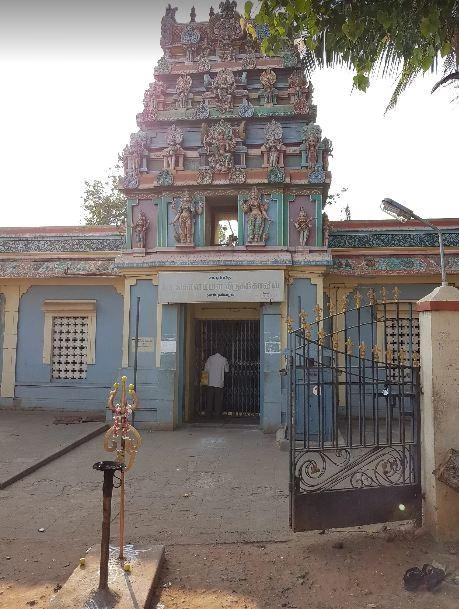
The temple adheres to the Dravidian style of architecture, characterized by its pyramidal towers and spacious courtyards. The Vastu Shastra principles are strictly followed, with the sanctum sanctorum (Garbhagriha) facing the east.
- The Vimana (Shikhara): The tiered tower above the sanctum is adorned with Murthys (carvings) of various deities, though simpler compared to the grand structures of Thanjavur, reflecting the rustic charm of the region.
- The Mandapa: A pillared hall allows devotees to congregate for prayers and rituals. The pillars depict stories from the Devimahatmyam.
- Inner Sanctum: The main deity, Sengalamman, is installed in a Garbhagriha that maintains a cool atmosphere regardless of the season.
Note: As a regional village temple, it does not currently hold ASI (Archaeological Survey of India) or UNESCO status, preserving its traditional, organic heritage.
Darshan & Ritual Logistics
The temple follows a strict schedule of Puja (worship) cycles. The energy peaks during the Abhishekam (sacred bathing) rituals.
Daily Timings (2026 Schedule)
| Session | Time |
|---|---|
| Morning Darshan | 06:00 AM – 12:00 PM |
| Afternoon Break | 12:00 PM – 04:30 PM |
| Evening Darshan | 04:30 PM – 09:00 PM |
Key Sevas & Online Booking
Currently, the temple administration handles most bookings physically. However, for upcoming festival seasons, an online portal is being developed. Key Sevas include:
- Abhishekam: Performed with milk, honey, and turmeric.
- Archana: Recitation of the Goddess’s names (Amman Puranam).
- Padayal: Offering of food (Prasadam).
2026 Festival Dates (Tentative):
- Aadi Perukku: August 2, 2026
- Aadi Amavasai: August 10, 2026 (High significance for ancestral rites)
- Navaratri: September 22 – October 1, 2026
Practical Visitor Guidance
To ensure a serene experience, please adhere to the following guidelines:
- Dress Code: Traditional attire is mandatory. Men should wear Veshti or dhoti with a shirt; women should wear saree or salwar kameez. Avoid shorts and t-shirts.
- Photography: Strictly prohibited inside the inner sanctum. Photography in the outer corridors is permitted with discretion.
- Electronics: Mobile phones are allowed but should be kept silent. Some temples offer free locker facilities for bags.
- Crowd Management: Tuesdays and Fridays see higher footfall. To avoid crowds, visit between 8:00 AM and 10:00 AM. During Aadi months, crowds swell; carry water bottles as Tamil Nadu heat can be intense.
Pilgrimage Connectivity
The temple is well-connected to Chennai and Thiruvallur via major roadways.
How to Reach
- By Air: Chennai International Airport (MAA) is approx. 35 km away.
- By Rail:
• Chennai Central (MAS) – 22 km
• Villivakkam (VLK) – 17 km
• Thiruvallur (TRL) – 40 km - By Road: The temple is located just 300 meters from the Cholavaram Bus Stop. It is accessible via National Highway 16 (NH16) via Redhills.
Nearby Sacred Sites (The Circuit)
- Cholavaram Lake: A scenic reservoir ideal for a peaceful retreat after darshan.
- Thiruvallur Veeraraghava Swamy Temple: A major Vaishnavite temple located 40 km away, perfect for a diversified pilgrimage circuit.
- Redhills: Known for the Chembarambakkam Lake and the Arulmigu Sri Narasimha Swamy Temple.
Frequently Asked Questions (FAQ)
1. Is there a VIP Darshan entry available?
As a rural heritage temple, Sengalamman Temple prioritizes equality in worship. There are no specific paid VIP slots, but the Archaka (priest) can be consulted for special Archana requests during non-peak hours.
2. What is the significance of the Aadi month here?
The Aadi month (mid-July to mid-August) is dedicated to the Goddess. In this region, it is considered the most powerful time to perform rituals for family welfare and to settle disputes.
3. Are food facilities available inside the temple?
While large-scale Anna Dhana (free meal) schemes are not always operational, prasadam (holy offerings) is distributed after major pujas. Small eateries are available near Cholavaram bus stop.
4. Is the temple accessible for senior citizens?
The temple has a flat floor plan with a mandapa, making it relatively easy for senior citizens. However, wheelchairs may not be available on-site; it is advisable to carry one if required.
5. What is the contact number for the temple?
Official contact details for smaller village temples can be dynamic. For inquiries, it is best to contact the Village Administrative Office (VAO) in Sembilivaram or the local RDO (Revenue Divisional Officer) in Thiruvallur District.
Photo Gallery

Recent Posts

Shri Kaamkoteeshwar Mandir, Varanasi – History & Significance
In the heart of Kashi, the eternal city of Lord Shiva, where the Ganges flows with celestial grace, stands the Shri Kaamkoteeshwar Mandir. This sacred Sannidhi is not merely a temple but a profound spiritual bridge between the Northern…

ओ सांवरे तूने ही मुझको संभाला – Lyrics & Meaning
ओ सांवरे तूने ही मुझको संभाला – A Prayer to Shyam Origin & Spiritual Essence Why This Bhajan Resonates Devotees chant this when overwhelmed by life’s storms—the refrain ‘तूने ही मुझको संभाला’ is the soul’s sigh of relief: “You…

कथा ये है महाराज मेरे की – Lyrics & Meaning
कथा ये है महाराज मेरे की छत्रपति संभाजी महाराज – A Prayer to Chhatrapati Sambhaji Maharaj Origin & Spiritual Essence Why This Bhajan Resonates Devotees chant this when their spirit feels tested—its powerful refrain “महाराज मेरे” is a soul’s…

Rigveda Samhita Yathartha Anuvada (ऋग्वेद संहिता यथार्थ अनुवाद) – Complete Set with Anvayartha & Hindi/English Translation
The Rigveda is the oldest surviving scripture of humanity and the foundational text of Sanātana Dharma. For serious students, scholars, UPSC aspirants studying ancient Indian history, Sanskrit learners, and spiritual seekers, a precise and grammatically structured translation is indispensable.…

आना भी अकेला है जाना भी अकेला है – Lyrics & Meaning | BharatTemples
आना भी अकेला है जाना भी अकेला है – A Prayer to the Divine Witness Origin & Spiritual Essence Why This Bhajan Resonates Devotees turn to this bhajan in moments of deep reflection—when life’s attachments begin to ache. The…

माता शेरावाली के द्वार जो भी जाता है – Lyrics & Meaning
माता शेरावाली के द्वार जो भी जाता है – A Prayer to Maa Sherawali Origin & Spiritual Essence Why This Bhajan Resonates Devotees turn to this bhajan in times of fear or uncertainty—its promise that no one leaves Maa’s…

मार लेना सपणी उबार लेणा भवरा – Lyrics & Meaning
मार लेना सपणी उबार लेणा भवरा – A Prayer to the Divine Beloved Origin & Spiritual Essence Why This Bhajan Resonates Devotees chant this in moments of deep vulnerability—its cry of “मार लेना सपणी, उबार लेणा भवरा” is the…

हमें श्याम सुंदर भरोसा तुम्हारा – Lyrics & Meaning
हमें श्याम सुंदर भरोसा तुम्हारा – A Prayer to Shyam Sundar Origin & Spiritual Essence Why This Bhajan Resonates Devotees chant this when feeling alone—its refrain ‘de do sahara’ is the soul’s cry for divine support. Lyrics in Hindi…

Mere Satguru Ne Di Thi Davai Lyrics in Hindi & Meaning
Mere Satguru Ne Di Thi Davai: Invoking the Guru’s Liberating Wisdom This soul-stirring bhajan venerates the Satguru (True Spiritual Master) as the divine physician who dispenses the only remedy for life’s deepest sufferings. Composed by Sant Karmaveer Tufani, it…

Janm Diyo Thari Maa Dukh Dekhiyo Lyrics in Hindi & Meaning
जन्म दियो थारी माँ दुख देखियो (Maa’s Grief Upon Birthing You) This soul-stirring Chetavani Bhajan (admonitory hymn) is addressed to the Divine Mother (Maa) – a call for repentance when children forget their filial duties in the dark age…