
Contents
- 1 Seval Vilrutham Temple Palani: The Divine Abode of Valli Amman
Seval Vilrutham Temple Palani: The Divine Abode of Valli Amman
Nestled within the sacred hills of Palani, Seval Vilrutham is a significant spiritual landmark revered by devotees of Lord Murugan. While the main shrine atop the hill is dedicated to Lord Dandayudhapani, the foothills house this ancient tank and shrine dedicated to Valli Amman, the divine consort. This guide serves as a comprehensive resource for pilgrims planning their visit in 2026, detailing the spiritual essence, historical context, and practical logistics for a fulfilling darshan.
1. Introduction & Spiritual Essence
The Deity and Form
Primary Deity: Goddess Valli Amman (Valli).
Alternate Names: Seval Vilrutham, Valli Spring.
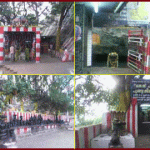
Form: This shrine is centered around a holy tank known as the Valli Spring. According to local tradition, the waters here are an overflow from a mountain spring, collecting in a depression to form a tank. It is strictly fenced with iron bars to preserve its sanctity.
Phalaśruti: The Benefits of Visit
Devotees visit Seval Vilrutham to seek the blessings of Goddess Valli, who is known for her protective and benevolent nature. The primary spiritual benefits include:
- Cleansing Ancestral Karma: It is believed that performing ablutions in the waters of Valli Spring washes away sins and purifies the lineage.
- Remedies for Naga Dosha: The presence of Nagas (serpent deities) stones at the edge of the tank makes this a powerful site for Naga Dosha Parihara. Devotees perform abhishekam with the water here to pacify planetary afflictions.
- Harvest and Prosperity: Historically, Valli guarded the ragi fields. Devotees pray here for agricultural prosperity and wealth.
2. Historical Origins & Scriptural Legend
The Legend of Seval Vilrutham
According to local folklore and the Sthala Purana, the name “Seval Vilrutham” refers to the \’rooster\’ (Seval) associated with Lord Murugan. The legend is deeply intertwined with the tale of Lord Murugan marrying Devasena and returning to Palani. Valli, the hunter princess, was his beloved second consort.
The spring is named after Valli because it is the site where she performed her penance. Tradition holds that Valli stood in the hot sun guarding the millet fields of the tribe. To provide her respite from the heat and hardship, the Devasthanam (temple administration) enshrined her in a protective setting near the spring. The water is considered an overflow from the divine mountain spring, collected in a natural depression.
Adjacent to the spring, under the open sky, 35 images of deities are housed in a row. It resembles an army parade, representing the divine forces. Devotees practice a unique ritual here: pressing coins onto these images to receive blessings, a practice believed to yield a \’big harvest\’ from Dandapani (Lord Murugan).
Architectural and Historical Context
While specific dynastic construction dates for this specific tank are not explicitly recorded in modern ASI data, the site is part of the ancient Palani temple complex. The architecture of the surrounding shrines reflects the traditional Tamil style, with laterite stone and stucco work typical of the Pandyan era influence in the Dindigul district.
3. Architectural Marvels
Layout and Design
The architecture of Seval Vilrutham is utilitarian yet deeply symbolic:
- The Sacred Tank: The water is encircled by iron bar fencing, symbolizing the protection of the sacred space. Devotees are permitted to sprinkle water on their heads but are not allowed to enter the tank directly, preserving its purity.
- The Naga Stones: Located at the edge of the tank are two distinct Naga stones. These are aniconic representations of serpent deities. The architectural placement ensures that water used for ablutions flows past these stones, enhancing their spiritual potency for devotees.
- Open-Air Sanctum: The 35 images housed on a dais abutting the hill are arranged in a linear fashion, creating a unique open-air temple corridor (Mandapa). This design allows for continuous darshan even during crowded festivals.
4. Darshan & Ritual Logistics
Daily Temple Timings (2026 Schedule)
Temple timings may vary slightly during festival seasons. Below is the standard schedule:
| Session | Timings |
|---|---|
| Morning Darshan | 06:00 AM – 12:00 PM |
| Afternoon Break | 12:00 PM – 03:00 PM |
| Evening Darshan | 03:00 PM – 08:30 PM |
Key Sevas and Offerings
- Naga Pratishta Pooja: A specific ritual for those with Naga Dosha. Performed with milk and abhishekam water from the Valli Spring.
- Coin Offering (Vilakku): As mentioned in the local tradition, devotees offer coins which are then pressed onto the images of the 35 deities. This is considered a unique blessing of the temple.
- Archana: Can be performed by request at the counter near the spring.
Online Seva Booking
While the Seval Vilrutham tank is a public site, the broader Palani temple administration manages specific sevas. For major rituals, it is recommended to book through the official Palani temple online portal. For local offerings at the Seval Vilrutham tank, direct payment is usually accepted at the counter.
Festival Dates for 2026
Devotees planning a visit during these times should book accommodation in advance.
- Thaipusam: January 12, 2026 (Monday)
A grand procession carrying the Murthi to the temple. - Panguni Uthiram: March 28, 2026 (Saturday)
Celebrating the celestial wedding of Lord Murugan. - Vaikasi Visakam: May 26, 2026 (Tuesday)
Birthday of Lord Murugan (Skanda Sashti).
5. Practical Visitor Guidance
Dress Code and Etiquette
As this is a sacred tank and shrine, modesty is essential. Men should wear dhotis or pants with shirts. Women should wear sarees, churidars, or full-length skirts. Avoid wearing black to the temple.
Photography and Restrictions
- Photography is generally restricted near the tank area to maintain sanctity.
- Mobile lockers are available at the foothills complex before ascending to the temple area.
- Important: The tank is fenced with iron bars. Do not attempt to climb or cross the barrier. The water is for sprinkling on the head only.
Crowd Management
Best Hours to Visit: 6:00 AM to 8:00 AM is the quietest time for contemplation. Evenings after 6:00 PM are less crowded than afternoons.
Seasonal Advice: Palani can be extremely hot in May and June. Carry a water bottle (fill up at the foothills) and a head cover. During the monsoon (October–December), carry an umbrella as the steps can be slippery.
6. Pilgrimage Connectivity
How to Reach
By Plane
The nearest airport is Coimbatore International Airport (CJB), approximately 100 km away. Coimbatore connects to major Indian cities including Ahmedabad, Bangalore, Calicut, Chennai, Cochin, Hyderabad, Mumbai, New Delhi, and Sharjah.
By Train
There is a rail line through Palani Station stretching from Madurai to Coimbatore via Pollachi. Regular trains operate on this line, including the Tiruchendur–Palani Express and Chennai Central–Palani Express.
By Bus
The state transport corporation (TNSTC) and private operators ply buses from Palani to major cities in Tamil Nadu such as Chennai, Coimbatore, Madurai, Trichy, and Tuticorin, as well as to Kerala (Palakkadu, Kochin).
Nearby Sacred Sites
To complete your pilgrimage, visit these nearby shrines:
- Idumban Koil: Located on the path to the spring, this temple is dedicated to Idumban (the carrier of Murugan). It is mandatory to visit Idumban before ascending the hill for Murugan\’s darshan.
- Kulasekhara Patti: An ancient temple at the foothills associated with the Pandya kings.
- Periyanayaki Amman Temple: Located in Palani, dedicated to Parvati, the mother of Murugan.
Photo Gallery
Frequently Asked Questions (FAQ)
1. Is there a VIP darshan entry for Seval Vilrutham?
While the Seval Vilrutham tank is generally accessible to all pilgrims, VIP darshan tickets are available for the main Palani Murugan temple. These tickets allow faster access to the hilltop shrine and sometimes include guided access to the foothills areas.
2. Can I perform an abhishekam for the Naga stones?
Yes, specific prayers and abhishekam (ablutions) can be performed for the Nagas stones located at the edge of the Valli Spring. Priests are available to assist with this ritual.
3. Is there any fee for the coin offering ritual?
There is no fixed fee for the ritual itself, but you must purchase the coins required for the offering. The ritual involves pressing these coins onto the images housed near the tank.
4. Is the Seval Vilrutham tank accessible for senior citizens?
The tank is located at the foothills of Palani, making it easily accessible without climbing steps. It is wheelchair accessible via the main road leading to the foothills complex.
5. What is the significance of the Valli Spring water?
The water is considered a natural mountain spring overflow. It is holy water used for cleansing sins and performing Naga Dosha remedies. It is not for bathing but is strictly for sprinkling on the head.
Contact Details
For temple inquiries, contact the Palani Devasthanam:
- Phone: +91-4545-242424
- Address: The Executive Officer, Palani Devasthanam, Palani, Dindigul District, Tamil Nadu – 624601.
Recent Posts

Shri Kaamkoteeshwar Mandir, Varanasi – History & Significance
In the heart of Kashi, the eternal city of Lord Shiva, where the Ganges flows with celestial grace, stands the Shri Kaamkoteeshwar Mandir. This sacred Sannidhi is not merely a temple but a profound spiritual bridge between the Northern…

ओ सांवरे तूने ही मुझको संभाला – Lyrics & Meaning
ओ सांवरे तूने ही मुझको संभाला – A Prayer to Shyam Origin & Spiritual Essence Why This Bhajan Resonates Devotees chant this when overwhelmed by life’s storms—the refrain ‘तूने ही मुझको संभाला’ is the soul’s sigh of relief: “You…

कथा ये है महाराज मेरे की – Lyrics & Meaning
कथा ये है महाराज मेरे की छत्रपति संभाजी महाराज – A Prayer to Chhatrapati Sambhaji Maharaj Origin & Spiritual Essence Why This Bhajan Resonates Devotees chant this when their spirit feels tested—its powerful refrain “महाराज मेरे” is a soul’s…

Rigveda Samhita Yathartha Anuvada (ऋग्वेद संहिता यथार्थ अनुवाद) – Complete Set with Anvayartha & Hindi/English Translation
The Rigveda is the oldest surviving scripture of humanity and the foundational text of Sanātana Dharma. For serious students, scholars, UPSC aspirants studying ancient Indian history, Sanskrit learners, and spiritual seekers, a precise and grammatically structured translation is indispensable.…

आना भी अकेला है जाना भी अकेला है – Lyrics & Meaning | BharatTemples
आना भी अकेला है जाना भी अकेला है – A Prayer to the Divine Witness Origin & Spiritual Essence Why This Bhajan Resonates Devotees turn to this bhajan in moments of deep reflection—when life’s attachments begin to ache. The…

माता शेरावाली के द्वार जो भी जाता है – Lyrics & Meaning
माता शेरावाली के द्वार जो भी जाता है – A Prayer to Maa Sherawali Origin & Spiritual Essence Why This Bhajan Resonates Devotees turn to this bhajan in times of fear or uncertainty—its promise that no one leaves Maa’s…

मार लेना सपणी उबार लेणा भवरा – Lyrics & Meaning
मार लेना सपणी उबार लेणा भवरा – A Prayer to the Divine Beloved Origin & Spiritual Essence Why This Bhajan Resonates Devotees chant this in moments of deep vulnerability—its cry of “मार लेना सपणी, उबार लेणा भवरा” is the…

हमें श्याम सुंदर भरोसा तुम्हारा – Lyrics & Meaning
हमें श्याम सुंदर भरोसा तुम्हारा – A Prayer to Shyam Sundar Origin & Spiritual Essence Why This Bhajan Resonates Devotees chant this when feeling alone—its refrain ‘de do sahara’ is the soul’s cry for divine support. Lyrics in Hindi…

Mere Satguru Ne Di Thi Davai Lyrics in Hindi & Meaning
Mere Satguru Ne Di Thi Davai: Invoking the Guru’s Liberating Wisdom This soul-stirring bhajan venerates the Satguru (True Spiritual Master) as the divine physician who dispenses the only remedy for life’s deepest sufferings. Composed by Sant Karmaveer Tufani, it…

Janm Diyo Thari Maa Dukh Dekhiyo Lyrics in Hindi & Meaning
जन्म दियो थारी माँ दुख देखियो (Maa’s Grief Upon Birthing You) This soul-stirring Chetavani Bhajan (admonitory hymn) is addressed to the Divine Mother (Maa) – a call for repentance when children forget their filial duties in the dark age…