
Contents
Introduction & Spiritual Essence
The Shruteeshwar Temple, nestled in the ancient lanes of Varanasi, stands as a testament to the eternal spiritual fabric of Kashi. Located near the revered Ratneshwar Mahadev, this temple is not merely a structure of stone but a gateway to higher consciousness. In the sacred geography of Varanasi, where every corner resonates with divinity, Shruteeshwar holds a unique position as a deity representing the very mind and consciousness of the divine.
The Form of Shruteeshwar
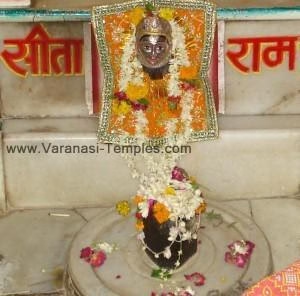
The temple is dedicated to Lord Shiva, worshipped here in the form of a Swayambhu (self-manifested) Shiv Ling. Unlike many temples where the deity is consecrated by human hands, the energy here is believed to have emerged from the earth itself, making it a potent spiritual center for devotees.
Phalaśruti: The Fruit of Devotion
Why do devotees flock to the Shruteeshwar Temple in Varanasi? According to ancient spiritual texts, the significance of offering prayers here transcends worldly desires. Tradition holds that worshippers of Shruteeshwar are blessed with a happy, prosperous life and ultimately attain Moksha (liberation from the cycle of birth and death). As a representative of the “head” in the cosmic human form of Kashi, devotion here is believed to cleanse the mind of impurities and bestow clarity.
Historical Origins & Scriptural Legend
The history of Shruteeshwar is deeply rooted in the Kashi Khand of the Shiva Purana. While specific construction dates for many ancient Kashi temples are obscured by time and the cyclical destruction of the city, the spiritual lineage is unbroken.
Kashi Khand Reference
Specifically, Kashi Khand, Chapter 33 offers a profound revelation. It describes various deities and Shiv Lings existing within the Kashi Kshetra. In a symbolic and cosmic reference, the text states that if all the Shiv Lings of Kashi are taken as a form of a human being, Shruteeshwar represents the head (and the decoration thereof). This elevates the temple to a paramount position, signifying that all spiritual energy flows through this sacred point.
Archaeological & Dynastic History
While the specific dynasty that originally commissioned the temple is a matter of ongoing historical research, the architecture suggests roots in the medieval period of Indian history, likely renovated over centuries by local patrons and royalty. According to temple records and local priests, the site has remained a continuous place of worship, surviving invasions and floods that characterized Varanasi’s long history.
Architectural Marvels
The architecture of Shruteeshwar Temple is a classic example of the Nagara style, prevalent in Northern India. The temple complex, though compact compared to grand monoliths, is rich in Vastu Shastra elements designed to channel cosmic energy.
The Shikhara and Mandapa
The temple features a curvilinear Shikhara (tower) that rises towards the sky, symbolizing the path to the divine. The inner sanctum, or Garbhagriha, is designed to hold the Shiv Ling in perfect alignment with natural elements. The Mandapa (hall) allows devotees to gather and chant hymns, with its pillars often adorned with intricate carvings of deities.
Sculptural Details
The temple walls and entrance feature traditional Indian motifs. While specific ASI (Archaeological Survey of India) status may vary for smaller shrines in Varanasi, the structural integrity and style reflect centuries of devotion. The vicinity of the temple, including nearby structures like Ratneshwar Mahadev, creates an architectural cluster that showcases the evolution of temple art in the holy city.
| Date built: | Unknown (Ancient Origins) |
|---|---|
| Deity: | Lord Shiva (Shruteeshwar) |
| Architectural style: | Nagara Style (North Indian) |
| Major festivals | Maha Shivaratri, Pradosh Vrat |
| Locale: | Varanasi |
| District: | Varanasi |
| Address: | K-53/40, Near Ratneshwar, Vridhha Kaleshwar Road, Varanasi, Uttar Pradesh 221001 |
| Phone: | – |
Darshan & Ritual Logistics
Performing Seva (service) at Shruteeshwar Temple is considered highly auspicious. The rituals are conducted according to Vedic traditions.
Daily Timings
Temple timings in Varanasi generally follow the rhythm of the Ganges. However, it is advisable to confirm timings locally as they can vary slightly by season.
| Session | Timing |
|---|---|
| Morning Darshan | 06:00 AM – 12:00 PM |
| Evening Darshan | 04:00 PM – 09:00 PM |
Key Sevas & Online Booking
Devotees can participate in various rituals. While on-the-spot booking is available for basic darshan, specialized online seva booking is recommended for major festivals to avoid crowds.
- Rudrabhishekam: Ritual bathing of the Shiv Ling with water, milk, and honey.
- Maha Aarti: The evening lamp offering (usually performed during twilight).
- Archana: Offering of flowers and sacred leaves (Bilva Patra) with specific mantras.
Devotees looking to book online can visit the official Kashi Vishwanath or Varanasi temple administration portals for specific 2026 festival slots.
2026 Festival Calendar Highlights
- Maha Shivaratri: February 26, 2026 (Extended timings and special Abhishekam).
- Pradosh Vrat: Observed every 13th day of the lunar month (Check local Panchang).
- Shravan Month: July – August 2026 (Peak season; expect heavy crowds).
Practical Visitor Guidance
Visiting a temple in Varanasi requires adherence to specific cultural and logistical protocols to ensure a smooth spiritual experience.
Code of Conduct & Dress Code
As Shruteeshwar is a traditional Shiva temple, modest attire is mandatory. Men should wear dhotis or trousers with a shirt, and women should wear sarees or full-length dresses. Photography is restricted inside the inner sanctum to preserve the sanctity of the deity.
Crowd Management
Varanasi is one of the world’s most densely packed spiritual cities.
- Best Hours: Early morning (6:00 AM – 8:00 AM) is the best time for a peaceful darshan.
- Seasonal Advice: During summer (May-June), the heat is intense; carry a water bottle and a head covering. During monsoon, humidity is high, but the temple atmosphere is lush and vibrant.
- Lockers: Small personal lockers are generally not available at this specific shrine; it is advised to travel light. Mobile lockers are available at the nearby Kashi Vishwanath Corridor complex.
Photo Gallery

Pilgrimage Connectivity
Reaching Shruteeshwar Temple is part of the Kashi pilgrimage experience. The temple is accessible via the narrow, vibrant streets of Varanasi.
How to Reach
- Nearest Airport: Lal Bahadur Shastri International Airport (LBS) is approximately 25 km away. Taxi or cab services are readily available to the Kashi Vishwanath Corridor.
- Nearest Railway Station: Varanasi Junction (BSB) is about 7 km from the temple area. Auto-rickshaws can take you to GPO (General Post Office) or Girja Ghat.
- Specific Route: From the Kashi Vishwanath Corridor, head towards the river and navigate towards the Ratneshwar area. Shruteeshwar is located at K-53/40 on the road leading to Vridhha Kaleshwar and Mrityunjeshwar. The nearest landmark is Bisheshwarganj/GPO. Rickshaws are the primary mode of transport for the last mile.
Nearby Sacred Sites (The Pilgrimage Circuit)
A visit to Shruteeshwar is incomplete without exploring the surrounding spiritual cluster:
- Ratneshwar Mahadev: Located just a short walk away, famous for its architectural incline.
- Vridhha Kaleshwar: Another ancient shrine in the vicinity dedicated to Lord Shiva.
- Satishwar & Mrityunjeshwar: Additional deities mentioned in the same sacred locale, forming a complete circuit of Shiva worship.
Contact Details
Official Address:
Shruteeshwar Temple
K-53/40, Near Ratneshwar
Vridhha Kaleshwar Road
Varanasi, Uttar Pradesh 221001, India
Frequently Asked Questions (FAQ)
1. Is there a VIP darshan entry at Shruteeshwar Temple?
Generally, Shruteeshwar is a traditional shrine where darshan is open to all devotees. VIP or special entry tickets are typically associated with the larger Kashi Vishwanath Temple. However, during non-peak hours, the darshan is usually swift and accessible.
2. What is the best time to visit Shruteeshwar Temple?
The best time to visit Varanasi is from October to March (post-monsoon and winter). The weather is pleasant, making the walk through the lanes comfortable. For a darshan specifically at Shruteeshwar, early mornings (6:00 AM – 8:00 AM) offer the most serene experience.
3. Can I perform an Abhishekam myself?
For smaller shrines like Shruteeshwar, the temple priests usually perform the Abhishekam. However, you can purchase offerings (milk, water, bilva leaves) and offer them to the priest to conduct the ritual on your behalf.
4. Are there accommodation options nearby?
Yes, the area around the GPO and Kashi Vishwanath Corridor has numerous guest houses (Dharamshalas) and hotels ranging from budget to mid-range. It is recommended to book in advance, especially during the Shravan month and Mahashivratri.
5. Is the temple wheelchair accessible?
Due to the ancient layout of Varanasi’s old city and the location of Shruteeshwar in narrow lanes, wheelchair access may be challenging. The paths are often uneven and crowded. Accessible facilities are better utilized at the main Kashi Vishwanath Corridor entrance.
Recent Posts

ओ सांवरे तूने ही मुझको संभाला – Lyrics & Meaning
ओ सांवरे तूने ही मुझको संभाला – A Prayer to Shyam Origin & Spiritual Essence Why This Bhajan Resonates Devotees chant this when overwhelmed by life’s storms—the refrain ‘तूने ही मुझको संभाला’ is the soul’s sigh of relief: “You…

कथा ये है महाराज मेरे की – Lyrics & Meaning
कथा ये है महाराज मेरे की छत्रपति संभाजी महाराज – A Prayer to Chhatrapati Sambhaji Maharaj Origin & Spiritual Essence Why This Bhajan Resonates Devotees chant this when their spirit feels tested—its powerful refrain “महाराज मेरे” is a soul’s…

Rigveda Samhita Yathartha Anuvada (ऋग्वेद संहिता यथार्थ अनुवाद) – Complete Set with Anvayartha & Hindi/English Translation
The Rigveda is the oldest surviving scripture of humanity and the foundational text of Sanātana Dharma. For serious students, scholars, UPSC aspirants studying ancient Indian history, Sanskrit learners, and spiritual seekers, a precise and grammatically structured translation is indispensable.…

आना भी अकेला है जाना भी अकेला है – Lyrics & Meaning | BharatTemples
आना भी अकेला है जाना भी अकेला है – A Prayer to the Divine Witness Origin & Spiritual Essence Why This Bhajan Resonates Devotees turn to this bhajan in moments of deep reflection—when life’s attachments begin to ache. The…

माता शेरावाली के द्वार जो भी जाता है – Lyrics & Meaning
माता शेरावाली के द्वार जो भी जाता है – A Prayer to Maa Sherawali Origin & Spiritual Essence Why This Bhajan Resonates Devotees turn to this bhajan in times of fear or uncertainty—its promise that no one leaves Maa’s…

मार लेना सपणी उबार लेणा भवरा – Lyrics & Meaning
मार लेना सपणी उबार लेणा भवरा – A Prayer to the Divine Beloved Origin & Spiritual Essence Why This Bhajan Resonates Devotees chant this in moments of deep vulnerability—its cry of “मार लेना सपणी, उबार लेणा भवरा” is the…

हमें श्याम सुंदर भरोसा तुम्हारा – Lyrics & Meaning
हमें श्याम सुंदर भरोसा तुम्हारा – A Prayer to Shyam Sundar Origin & Spiritual Essence Why This Bhajan Resonates Devotees chant this when feeling alone—its refrain ‘de do sahara’ is the soul’s cry for divine support. Lyrics in Hindi…

Mere Satguru Ne Di Thi Davai Lyrics in Hindi & Meaning
Mere Satguru Ne Di Thi Davai: Invoking the Guru’s Liberating Wisdom This soul-stirring bhajan venerates the Satguru (True Spiritual Master) as the divine physician who dispenses the only remedy for life’s deepest sufferings. Composed by Sant Karmaveer Tufani, it…

Janm Diyo Thari Maa Dukh Dekhiyo Lyrics in Hindi & Meaning
जन्म दियो थारी माँ दुख देखियो (Maa’s Grief Upon Birthing You) This soul-stirring Chetavani Bhajan (admonitory hymn) is addressed to the Divine Mother (Maa) – a call for repentance when children forget their filial duties in the dark age…
Bhadi Sabha Mein Thane Manaun Lyrics in Hindi & Meaning
Bhadi Sabha Mein Thane Manaun: Invoking the Spear-Wielding Mother Mata Bhawani (श्री ज्वाला भवानी), the fiery manifestation of Shakti worshipped as the Protector of Dharma in Her Dhaulagarh sanctum. Origin & Spiritual Essence Composed in Rajasthani folk tradition by…