
Contents
- 1 Siddheswara Swamy Temple, Andhra Pradesh
Siddheswara Swamy Temple, Andhra Pradesh
Nestled within the lush embrace of the Sri Venkateswara National Park in Chittoor District, the Siddheswara Swamy Temple stands as a spiritual beacon near the majestic Talakona waterfall. As the highest waterfall in Andhra Pradesh (270 feet), Talakona is a natural wonder, but the ancient temple dedicated to Lord Shiva serves as the divine heart of this region.
For devotees and pilgrims planning a visit to this unique hill shrine, this definitive guide covers the temple’s spiritual essence, history, architecture, and practical logistics for a serene darshan experience.
| Date built:- | Remains unknown (Ancient) |
|---|---|
| Deity: | Lord Shiva (as Siddheswara Swamy) |
| Architectural style: | Dravidian architecture |
| Major festivals | Maha Shivaratri, Karthika Masam |
| Locale: | Talakona, Siddavatam |
| District:: | Chittoor |
| Address:- | Talakona Waterfalls Road, Siddavatam, Chittoor Dist, Andhra Pradesh |
| Phone | – |
1. Introduction & Spiritual Essence
The Siddheswara Swamy Temple is a Shakti Peetha style shrine where the primary deity is Lord Shiva, worshipped as a Swayambhu Lingam. “Swayambhu” implies that the Lingam is self-manifested, not carved by human hands, adding to the sanctity of the site.
Phalaśruti (Spiritual Benefits):
Devotees believe that performing abhishekam and prayers here brings immense relief from planetary afflictions, particularly related to Rahu and Ketu. The temple is known for:
- Removing Mental Stress: The calming sound of the nearby waterfall acts as a natural meditation aid.
- Cleansing Ancestral Karma: Performing rituals here is believed to help ancestors attain moksha.
- Wish Fulfillment: It is a local belief that tying a thread around the holy tree in the temple complex fulfills sincere desires.
2. Historical Origins & Scriptural Legend
Historical Context
According to temple records and local administrative sources, the Siddheswara Swamy Temple dates back several centuries, though precise records of the initial construction date are often unavailable for ancient forest shrines. The structure has been maintained and renovated periodically by the Tirumala Tirupati Devasthanams (TTD), ensuring the preservation of its sanctity.
Legends of Talakona
The Shiva Connection: “Siddha” refers to a saint or accomplished being, and “Ishwara” is the Lord. Legend holds that a sage performed intense penance at this location. Pleased by his devotion, Lord Shiva appeared in the form of a Swayambhu Lingam.
The Waterfall Origin: Folklore suggests that the Talakona waterfall derives its holy waters from the Ganges flowing through the hair of Lord Shiva, making the water sacred for ritual bathing.
3. Architectural Marvels
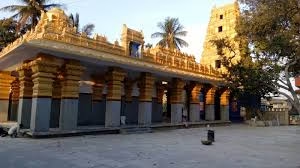
The temple showcases the classical Dravidian architectural style, characterized by its stepped pyramidal towers and spacious pillared halls.
- The Sanctum (Garbhagriha): The inner sanctum houses the self-manifested Lingam. The atmosphere here is dimly lit, enhancing the meditative experience.
- The Mandapas: The temple features a pillared hall (Mandapa) where devotees can sit for prayers. The pillars are adorned with intricate carvings depicting scenes from Hindu mythology.
- Surroundings: Located amidst the dense deciduous forests of the Eastern Ghats, the temple architecture blends seamlessly with the natural landscape.
The temple is situated at the foothills of the Eastern Ghats, surrounded by lush greenery, making it an architectural gem within a natural sanctuary.
4. Darshan & Ritual Logistics
To ensure a smooth pilgrimage, here are the daily timings and seva details. Note that timings may vary slightly based on local solar calendars and TTD announcements.
Daily Temple Timings
| Darshan Type | Timings |
|---|---|
| Morning Darshan | 06:00 AM – 12:00 PM |
| Afternoon Break | 12:00 PM – 03:00 PM |
| Evening Darshan | 03:00 PM – 07:00 PM |
| Closing Time | 07:00 PM |
Key Sevas & Booking
While standard darshan is free, special sevas can be booked via the TTD website or locally at the administrative office near Talakona.
- Suprabhatam: The morning wake-up ritual.
- Abhishekam: Ritual bathing of the deity (usually performed with milk, honey, and tender coconut).
- Archana: Recitation of names of the Lord.
- Rudrabhishekam: A potent Vedic ritual for purification.
Online Booking: Most sevas for TTD-managed temples can be booked via the official TTD website (ttdevasthanams.ap.gov.in). However, for Siddheswara Swamy Temple specifically, some sevas may require on-the-spot registration due to the remote location.
2026 Festival Dates
- Maha Shivaratri: February 26, 2026 (Special midnight darshan and lighting of lamps).
- Karthika Deepam: Begins in November 2026 (Lighting of lamps throughout the month).
- Pradosham: Occurring twice monthly (ideal for Lord Shiva worship).
5. Practical Visitor Guidance
As the temple is located inside a national park, regulations are strict to preserve the environment.
Dress Code & Etiquette
- Attire: Traditional Indian clothing (Dhoti/Saree) is preferred. Western attire should be modest (avoid shorts/tank tops).
- Footwear: Must be removed at the designated shoe stand before entering the temple premises.
Photography & Mobiles
- Cameras: Photography is strictly prohibited inside the sanctum sanctorum. Outdoor photography is generally allowed but check for specific notices.
- Mobile Phones: Use is discouraged during darshan. Lockers are usually available for secure storage.
Crowd Management & Seasonal Advice
- Best Hours: Early morning (6:00 AM – 7:30 AM) offers the calmest experience and best weather.
- Monsoon (June-Sept): The falls are magnificent, but paths can be slippery. Carry rain gear.
- Summer (May): Temperatures can rise; carry sufficient water and wear a hat.
6. Pilgrimage Connectivity
How to Reach Siddheswara Swamy Temple
The temple is located in Talakona, near Siddavatam, Chittoor District.
- By Air: The nearest airport is Tirupati Airport (TIR), approximately 85 km away. From there, taxis are available.
- By Rail: The nearest railway junction is Tirupati Railway Station. From there, buses and cabs ply to Talakona.
- By Road:
- From Tirupati: Take the NH69 (Tirupati-Pileru road) towards Talakona.
- From Chittoor: Travel via Punganur to reach Siddavatam.
Nearby Sacred Sites (Pilgrimage Circuit)
- Talakona Waterfall: Just a short walk from the temple. The cascading water is considered holy.
- Kailasa Kona (Nagalapuram): Another sacred waterfall temple nearby, dedicated to Lord Surya Narayana and Vishnu.
- Sri Kalyana Venkateswara Swamy Temple, Srinivasamangapuram: Located about 40 km away, this is an important TTD temple for pre-marital rituals.
Photo Gallery




Frequently Asked Questions (FAQ)
Is there a VIP or Special Entry Darshan available?
Yes, due to the temple being under the management of TTD, there are provisions for Divya Darshan (for pilgrims walking through the forest path) and special entry tickets. However, VIP darshan is generally reserved for protocol holders. For regular devotees, purchasing a Special Entry ticket at the counter is the most efficient method.
What is the best time of year to visit Talakona?
The ideal time to visit is between October and February. During these months, the weather is pleasant, and the waterfalls are active post-monsoon. Summers can be hot, and the monsoon season might close the trekking paths due to safety concerns.
Are there accommodation facilities near the temple?
Basic accommodation is available at Siddavatam and the Talakona Guest House. For luxury options, pilgrims usually stay in Tirupati or Chittoor, which are well-connected by road. TTD choultrys in Tirupati are a reliable option for budget stays.
Can we carry food and water inside the temple?
Plastic bottles and outside food are discouraged inside the temple sanctum. However, drinking water facilities are available at the entrance. Since the temple is located within a national park, maintaining cleanliness is mandatory.
Is the temple accessible for senior citizens?
While the temple is at the foothills, the terrain leading to the waterfall and temple can be uneven. There is a parking area near the temple entrance, minimizing the walk required. Wheelchair accessibility is limited due to the ancient steps and natural surroundings.
Contact Details
Official Address: Office of the Executive Officer, Sri Siddheswara Swamy Temple, Talakona, Siddavatam Post, Chittoor District, Andhra Pradesh – 517123.
Note: Visitors are advised to check the official TTD website or local authorities for real-time updates on timings and closures due to weather or maintenance.
Recent Posts

Shri Kaamkoteeshwar Mandir, Varanasi – History & Significance
In the heart of Kashi, the eternal city of Lord Shiva, where the Ganges flows with celestial grace, stands the Shri Kaamkoteeshwar Mandir. This sacred Sannidhi is not merely a temple but a profound spiritual bridge between the Northern…

ओ सांवरे तूने ही मुझको संभाला – Lyrics & Meaning
ओ सांवरे तूने ही मुझको संभाला – A Prayer to Shyam Origin & Spiritual Essence Why This Bhajan Resonates Devotees chant this when overwhelmed by life’s storms—the refrain ‘तूने ही मुझको संभाला’ is the soul’s sigh of relief: “You…

कथा ये है महाराज मेरे की – Lyrics & Meaning
कथा ये है महाराज मेरे की छत्रपति संभाजी महाराज – A Prayer to Chhatrapati Sambhaji Maharaj Origin & Spiritual Essence Why This Bhajan Resonates Devotees chant this when their spirit feels tested—its powerful refrain “महाराज मेरे” is a soul’s…

Rigveda Samhita Yathartha Anuvada (ऋग्वेद संहिता यथार्थ अनुवाद) – Complete Set with Anvayartha & Hindi/English Translation
The Rigveda is the oldest surviving scripture of humanity and the foundational text of Sanātana Dharma. For serious students, scholars, UPSC aspirants studying ancient Indian history, Sanskrit learners, and spiritual seekers, a precise and grammatically structured translation is indispensable.…

आना भी अकेला है जाना भी अकेला है – Lyrics & Meaning | BharatTemples
आना भी अकेला है जाना भी अकेला है – A Prayer to the Divine Witness Origin & Spiritual Essence Why This Bhajan Resonates Devotees turn to this bhajan in moments of deep reflection—when life’s attachments begin to ache. The…

माता शेरावाली के द्वार जो भी जाता है – Lyrics & Meaning
माता शेरावाली के द्वार जो भी जाता है – A Prayer to Maa Sherawali Origin & Spiritual Essence Why This Bhajan Resonates Devotees turn to this bhajan in times of fear or uncertainty—its promise that no one leaves Maa’s…

मार लेना सपणी उबार लेणा भवरा – Lyrics & Meaning
मार लेना सपणी उबार लेणा भवरा – A Prayer to the Divine Beloved Origin & Spiritual Essence Why This Bhajan Resonates Devotees chant this in moments of deep vulnerability—its cry of “मार लेना सपणी, उबार लेणा भवरा” is the…

हमें श्याम सुंदर भरोसा तुम्हारा – Lyrics & Meaning
हमें श्याम सुंदर भरोसा तुम्हारा – A Prayer to Shyam Sundar Origin & Spiritual Essence Why This Bhajan Resonates Devotees chant this when feeling alone—its refrain ‘de do sahara’ is the soul’s cry for divine support. Lyrics in Hindi…

Mere Satguru Ne Di Thi Davai Lyrics in Hindi & Meaning
Mere Satguru Ne Di Thi Davai: Invoking the Guru’s Liberating Wisdom This soul-stirring bhajan venerates the Satguru (True Spiritual Master) as the divine physician who dispenses the only remedy for life’s deepest sufferings. Composed by Sant Karmaveer Tufani, it…

Janm Diyo Thari Maa Dukh Dekhiyo Lyrics in Hindi & Meaning
जन्म दियो थारी माँ दुख देखियो (Maa’s Grief Upon Birthing You) This soul-stirring Chetavani Bhajan (admonitory hymn) is addressed to the Divine Mother (Maa) – a call for repentance when children forget their filial duties in the dark age…