
Contents
- 1 Sundararaja Perumal Temple, Sitharkadu: A Definitive Pilgrimage Guide
Sundararaja Perumal Temple, Sitharkadu: A Definitive Pilgrimage Guide
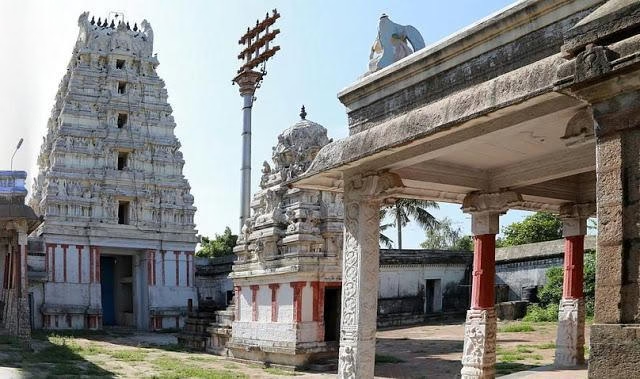
Nestled in the serene surroundings of Sitharkadu, near Poonamallee, lies the ancient Sundararaja Perumal Temple—a spiritual oasis dedicated to Lord Vishnu. As the Lead Heritage Architect for BharatTemples.com, I invite you on a journey through time, faith, and architectural splendor. This guide is meticulously crafted for the modern pilgrim, blending scriptural depth with practical logistics for your 2026 pilgrimage.
1. Introduction & Spiritual Essence
The Deity: Sundararaja Perumal
The presiding deity of this sacred shrine is Sundararaja Perumal (Lord Vishnu), celebrated for his supreme beauty and grace. In Sanskrit, ‘Sundara’ translates to beautiful, befitting the form of the Lord who appeared here to bless his devotees. He is flanked by his divine consorts, Sri Devi and Bhoo Devi, who symbolize spiritual and earthly abundance respectively.
Phalaśruti: The Spiritual Benefit
Why do devotees flock to Sitharkadu? According to temple lore, this site is a powerhouse of spiritual energy. It is particularly renowned for:
- Cleansing Ancestral Karma: Performing rituals here is believed to alleviate Pitru Dosham (ancestral curses).
- Healing Energies: The temple is intrinsically linked to Garudakkodi Siddhar, a sage revered for curing chronic eye and health ailments. Devotees with Swati Nakshatra (birth star) consider this a must-visit site to unlock their potential.
- Beauty and Harmony: Worshipping Sundararaja Perumal is said to bestow physical beauty, mental peace, and harmonious relationships.
2. Historical Origins & Scriptural Legend
The Legend of Sundararaja
Tradition holds that in ancient times, this location was a dense forest known as Sowgandhika Puram, filled with fragrant flowers. Lord Brahma, captivated by the aesthetic and spiritual ambiance, began a severe penance here to please Lord Vishnu. Pleased by his devotion, Vishnu manifested alongside Goddess Lakshmi. Overwhelmed by their divine beauty, Brahma named the Lord Sundararaja (The Beautiful King) and the Goddess Sundaravalli.
Etymology and Alwar Connection
The village was historically referred to as Tirumandram or Harisaranalaya Nallur. It is also a hallowed ground associated with Tirumazhisai Alwar, one of the twelve revered Vaishnite saints, who is said to have performed intense penance at this very site.
Furthermore, the village derived its name Sitharkadu (Siddhar Forest) from the numerous Siddhas (sages) who resided here. Specifically, the great Garudakkodi Siddhar lived here as a devotee of Garuda, the eagle mount of Vishnu.
3. Architectural Marvels
Dravidian Style & Vastu
The temple exemplifies the classic Dravidian architectural style. The layout follows traditional Vastu Shastra, facing eastward to welcome the rising sun. The structure is a compact yet profound spiritual complex.
Notable Features
- The Rajagopuram: The towering entrance gateway serves as a beacon for pilgrims, visible from the approach road.
- Garudakkodi Siddhar Pillar: A highlight of the Mandapam (hall) near the Andal shrine is the intricately carved pillar depicting Garudakkodi Siddhar. This iconography is unique and draws devotees seeking relief from eye-related ailments.
- Sanctum Sanctorum: The inner sanctum houses Sundararaja Perumal in a standing posture, exuding a sense of divine protection.
Adjacent to this temple is the Sitharkadu Dhatreeswarar Temple (dedicated to Lord Shiva), making the location a harmonious confluence of Shaivism and Vaishnavism.
4. Darshan & Ritual Logistics (2026 Update)
Daily Timings
Based on standard Agamic protocols for Vishnu temples in Tamil Nadu, the following schedule is observed. (Please verify locally before travel).
| Period | Timing |
|---|---|
| Temple Opening | 06:00 AM |
| Morning Darshan | 06:30 AM – 11:00 AM |
| Afternoon Break | 11:00 AM – 04:30 PM |
| Evening Darshan | 04:30 PM – 07:30 PM |
| Closing | 08:00 PM |
Key Sevas & Online Booking
The temple management facilitates various offerings. While walk-ins are common for general darshan, special Sevas require advance notice.
- Abhishekam: Ritual bathing of the deity (usually performed on Ekadashi days).
- Archana: Recitation of holy names.
- Garudakkodi Siddhar Puja: A special prayer for health and healing.
Online Booking: As of 2026, most regional temples in Tamil Nadu are integrated with the HR&CE (Hindu Religious and Charitable Endowments) portal. Please visit temple.tamilnadutourism.tn.gov.in or the official HR&CE website to book specific slots.
2026 Festival Calendar
Major festivals are celebrated with great fervor:
- Puratasi Sani: Every Saturday in the Tamil month of Puratasi (Sept–Oct).
- Vaikunta Ekadashi: January 2026 (Specific date varies by Panchangam). A major event where the celestial gates of Vaikuntam are believed to open.
- Brahmotsavam: The annual temple festival, likely falling in April/May 2026, lasting for 3 to 5 days.
- Naraka Chaturdashi/Deepavali: October/November 2026.
- Masi Magam: February/March 2026 (Highly auspicious for temple tanks).
5. Practical Visitor Guidance
Visitor Etiquette & Rules
- Dress Code: Traditional attire is mandatory. Men should wear dhotis or trousers with shirts; women should wear sarees, salwar kameez, or skirts. Avoid shorts and sleeveless tops.
- Photography: Photography is strictly prohibited inside the inner sanctum (Garbhagriha). You may take photos of the exterior architecture and mandapams.
- Mobiles & Lockers: Silence your phones. Small locker facilities may be available at the entrance for bags, but it is advisable to travel light.
- Accessibility: The temple has stone steps at the entrance. While the inner sanctum is compact, the courtyard is accessible. Elderly pilgrims may request assistance from temple volunteers.
Crowd Management & Seasonal Advice
- Best Hours: For a peaceful darshan, visit between 8:00 AM and 10:00 AM on weekdays. Avoid weekends and full moon days (Pournami) if you prefer shorter queues.
- Summer (April–June): Chennai/Tiruvallur temperatures can soar above 40°C. Carry a water bottle, wear a hat, and use an umbrella.
- Monsoon (Nov–Dec): Roads leading to Sitharkadu can get waterlogged. Check local weather updates before commuting.
6. Pilgrimage Connectivity
How to Reach Sundararaja Perumal Temple
Address: Sitharkadu, Near Poonamallee, Thiruvallur District, Tamil Nadu.
By Air: The nearest airport is Chennai International Airport (MAA), approximately 27 km away (approx. 45 mins by car via the Chennai Outer Ring Road).
By Rail:
- Pattabiram Railway Station: 5 km (Suburban/local trains available from Chennai Central/Egmore).
- Thiruninravur (TNR): 7 km.
By Road: The temple is accessible via the Chennai – Poonamallee Bypass (NH4 or NH64 connecting routes).
- From Chennai: Take the route towards Poonamallee. Look for the signals near RRB Energy and the Brewery. Turn right towards Pattabiram/Sitharkadu.
- Bus Services: Buses (including M54C) ply from Poonamallee Bus Terminus. Shared auto-rickshaws are also available.
Nearby Sacred Sites (Pilgrimage Circuit)
Enhance your spiritual journey by visiting these nearby temples:
- Dhatreeswarar Temple (Sitharkadu): Located just behind the Sundararaja Perumal Temple, dedicated to Lord Shiva.
- Prasanna Venkateshwara Perumal Temple (Thirumazhisai): 9 km away. A very famous Vishnu temple associated with the poet-saint Thirumazhisai Alwar.
- Agastheeswarar Temple (Pattabiram): 5 km away. An ancient Shiva temple with a rich historical backdrop.
7. Frequently Asked Questions (FAQs)
1. Is there a VIP darshan entry?
While the temple is not as crowded as mega-shrines like Tirupati, special entry arrangements are sometimes available for elderly pilgrims or those with special permits from the HR&CE department. It is best to inquire with the temple administrator upon arrival.
2. What is the significance of Swati Nakshatra here?
The Sundararaja Perumal Temple is considered a Kshetra particularly powerful for those born under the Swati star. Worshipping here is believed to remove obstacles in their life path and enhance prosperity.
3. Are there accommodation facilities nearby?
The temple does not have an attached guest house. However, several lodges and guest houses are available in Poonamallee (9 km) and Avadi (9 km), offering comfortable stays ranging from budget to mid-range.
4. Is the temple vegetarian-friendly?
As a Vishnu temple, it strictly adheres to a lacto-vegetarian diet. Prasadam (offering) is usually offered to the deity before distribution. Non-vegetarian food and alcohol are prohibited within the temple premises.
5. Can I perform hair tonsuring (Mundan) here?
Unlike large temples with dedicated facilities for tonsuring, this temple is a smaller shrine. It is recommended to perform this ritual at a larger specialized center or simply offer symbolic hair during the Archana.
About the Author:
As the Lead Heritage Architect and SEO Strategist for BharatTemples.com, I ensure that every guide combines architectural precision with spiritual authenticity. This guide is updated for the 2026 pilgrim season.
Recent Posts

ओ सांवरे तूने ही मुझको संभाला – Lyrics & Meaning
ओ सांवरे तूने ही मुझको संभाला – A Prayer to Shyam Origin & Spiritual Essence Why This Bhajan Resonates Devotees chant this when overwhelmed by life’s storms—the refrain ‘तूने ही मुझको संभाला’ is the soul’s sigh of relief: “You…

कथा ये है महाराज मेरे की – Lyrics & Meaning
कथा ये है महाराज मेरे की छत्रपति संभाजी महाराज – A Prayer to Chhatrapati Sambhaji Maharaj Origin & Spiritual Essence Why This Bhajan Resonates Devotees chant this when their spirit feels tested—its powerful refrain “महाराज मेरे” is a soul’s…

Rigveda Samhita Yathartha Anuvada (ऋग्वेद संहिता यथार्थ अनुवाद) – Complete Set with Anvayartha & Hindi/English Translation
The Rigveda is the oldest surviving scripture of humanity and the foundational text of Sanātana Dharma. For serious students, scholars, UPSC aspirants studying ancient Indian history, Sanskrit learners, and spiritual seekers, a precise and grammatically structured translation is indispensable.…

आना भी अकेला है जाना भी अकेला है – Lyrics & Meaning | BharatTemples
आना भी अकेला है जाना भी अकेला है – A Prayer to the Divine Witness Origin & Spiritual Essence Why This Bhajan Resonates Devotees turn to this bhajan in moments of deep reflection—when life’s attachments begin to ache. The…

माता शेरावाली के द्वार जो भी जाता है – Lyrics & Meaning
माता शेरावाली के द्वार जो भी जाता है – A Prayer to Maa Sherawali Origin & Spiritual Essence Why This Bhajan Resonates Devotees turn to this bhajan in times of fear or uncertainty—its promise that no one leaves Maa’s…

मार लेना सपणी उबार लेणा भवरा – Lyrics & Meaning
मार लेना सपणी उबार लेणा भवरा – A Prayer to the Divine Beloved Origin & Spiritual Essence Why This Bhajan Resonates Devotees chant this in moments of deep vulnerability—its cry of “मार लेना सपणी, उबार लेणा भवरा” is the…

हमें श्याम सुंदर भरोसा तुम्हारा – Lyrics & Meaning
हमें श्याम सुंदर भरोसा तुम्हारा – A Prayer to Shyam Sundar Origin & Spiritual Essence Why This Bhajan Resonates Devotees chant this when feeling alone—its refrain ‘de do sahara’ is the soul’s cry for divine support. Lyrics in Hindi…

Mere Satguru Ne Di Thi Davai Lyrics in Hindi & Meaning
Mere Satguru Ne Di Thi Davai: Invoking the Guru’s Liberating Wisdom This soul-stirring bhajan venerates the Satguru (True Spiritual Master) as the divine physician who dispenses the only remedy for life’s deepest sufferings. Composed by Sant Karmaveer Tufani, it…

Janm Diyo Thari Maa Dukh Dekhiyo Lyrics in Hindi & Meaning
जन्म दियो थारी माँ दुख देखियो (Maa’s Grief Upon Birthing You) This soul-stirring Chetavani Bhajan (admonitory hymn) is addressed to the Divine Mother (Maa) – a call for repentance when children forget their filial duties in the dark age…
Bhadi Sabha Mein Thane Manaun Lyrics in Hindi & Meaning
Bhadi Sabha Mein Thane Manaun: Invoking the Spear-Wielding Mother Mata Bhawani (श्री ज्वाला भवानी), the fiery manifestation of Shakti worshipped as the Protector of Dharma in Her Dhaulagarh sanctum. Origin & Spiritual Essence Composed in Rajasthani folk tradition by…