
Contents
- 1 Introduction & Spiritual Essence of Swayambeeswarar
- 2 Historical Origins & Scriptural Legend
- 3 Architectural Marvels
- 4 Darshan & Ritual Logistics (2026 Guide)
- 5 Practical Visitor Guidance
- 6 Pilgrimage Connectivity
- 7 Photo Gallery
- 8 Frequently Asked Questions (FAQ)
- 8.1 1. Is there a VIP Darshan entry available at Swayambeeswarar Temple?
- 8.2 2. What is the special significance of the Maragatha Lingam?
- 8.3 3. Are there accommodation facilities in Illalur?
- 8.4 4. Is the temple accessible for senior citizens?
- 8.5 5. What is the best time to visit for a peaceful Darshan?
- 9 Contact Details
Introduction & Spiritual Essence of Swayambeeswarar
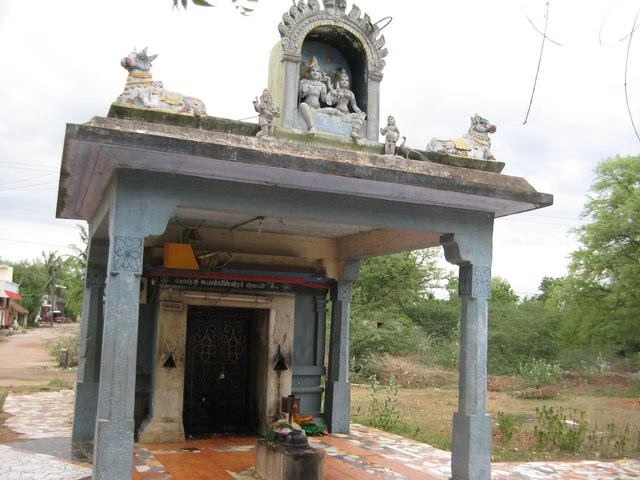
Nestled in the serene village of Illalur, just a few miles from the bustling temple town of Thiruporur, lies the Swayambeeswarar Temple. This ancient shrine is a sanctuary of tranquility, dedicated to Lord Shiva. The presiding deity, Swayambeeswarar (meaning “Lord who manifested Himself”), is revered as a Swayambhu Lingam—a self-manifested lingam requiring no human sculpting. Unlike ornate stone idols, this lingam is believed to be a crystallized Maragatha Lingam (Emerald Lingam), radiating a soothing green hue that captivates devotees.
Phalaśruti (Spiritual Benefits): According to temple lore and devotee tradition, worshipping the Maragatha Lingam at Illalur grants profound spiritual benefits. It is believed to:
- Remediate afflictions caused by Planetary Rahu (Serpent Node), offering relief from chronic ailments and anxiety.
- Help cleanse ancestral karma, ensuring peace for departed souls and prosperity for the living generations.
- Enhance mental clarity and inner peace, as the Emerald lingam is associated with the heart chakra.
Historical Origins & Scriptural Legend
The Legend of the Emerald Lingam
While specific inscriptions regarding the exact century of construction are currently under restoration review, local tradition holds that the temple dates back to the Pallava era, with subsequent expansions during the Chola period. The primary legend revolves around the Swayambhu nature of the idol. Tradition holds that farmers tilling the land in Illalur struck a hard substance. Upon excavation, a glowing Maragatha (Emerald) lingam emerged from the earth, which refused to be moved from the spot. Hence, the temple was constructed around the deity.
Scriptural Significance
The temple is considered a significant Prithvi (Earth) Sthalam among the Panchaboodha Sthalams (five elemental representations of Shiva). While the formal Vedic scriptures mention the general worship of Shiva as the primal source, the Sthala Purana of Illalur specifically narrates the self-manifested origin of the idol, distinct from the carved deities found in later Dravidian dynasties.
Architectural Marvels
The Swayambeeswarar Temple showcases the quintessential Dravidian style of architecture. The structure is designed to follow traditional Vastu Shastra principles, creating a transition from the chaotic outer world to a sacred inner sanctum.
- The Sanctum (Garbhagriha): The inner chamber houses the Maragatha Lingam, which is naturally formed and smooth to the touch. The low-ceilinged sanctum enhances the acoustic vibration during chanting.
- The Mandapas: The temple features a pillared Mandapa (hall) leading to the sanctum. The pillars depict carvings of deities, though many remain rustic due to the temple’s village setting.
- The Prakaram: The outer courtyard allows for the traditional Pradakshina (circumambulation). The sanctity of the site is emphasized by the lack of excessive ornamentation, allowing the natural energy of the Swayambhu lingam to take center stage.
Note: While this temple holds significant local heritage value, it is not an ASI-protected monument or a UNESCO World Heritage site.
Darshan & Ritual Logistics (2026 Guide)
To ensure a smooth spiritual experience, devotees are encouraged to check the daily schedule. While timings may vary slightly during festivals, the following is the standard schedule applicable for 2026.
Daily Temple Timings
| Session | Timings |
|---|---|
| Morning Darshan | 6:00 AM – 12:00 PM |
| Afternoon Closing | 12:00 PM – 4:00 PM |
| Evening Darshan | 4:00 PM – 8:00 PM |
Key Sevas and Offerings
Devotees can participate in various rituals to invoke the blessings of Lord Swayambeeswarar:
- Abhishekam: Ritual bathing of the lingam. Usually performed with milk, honey, and sandalwood paste. Timing: 8:00 AM daily.
- Archana: Offering flowers while chanting the 108 names of Shiva. Available throughout opening hours.
- Rudra Homam: Special fire ritual performed on Pradosham (13th lunar day).
Online Seva Booking
Currently, being a local heritage temple, bookings are primarily handled directly at the temple counter or through the local temple committee. However, for 2026, the temple administration is expected to integrate with the Tamil Nadu HR&CE online portal for Archana and Special Abhishekam bookings. Devotees are advised to check the Tamil Nadu Tourism Portal for updates.
Major Festivals 2026
- Shivaratri (Feb 26, 2026): The most significant event at Swayambeeswarar Temple, featuring night-long chanting and special Maragatha Abhishekam.
- Aadi Perukku (Aug 2, 2026): Celebrated with Pongal offerings near the temple tank.
- Karthigai Deepam (Nov 5, 2026): Lighting of the holy lamp (Agal Vilakku) to illuminate the earth element.
Practical Visitor Guidance
Dress Code & Etiquette
As a traditional village temple, modesty is strictly observed. Men should wear Dhoti or Pants with a Shirt, and women should wear Sarees, Salwar Kameez, or traditional Full-Length Dresses. Western attire like shorts and sleeveless tops is generally discouraged.
Crowd Management & Best Time to Visit
The Illalur temple is relatively quieter than the main Thiruporur temple, making it ideal for meditation. However, during Pradosham and Shivaratri, crowds are heavy.
- Best Time: Tuesday and Friday evenings, or early mornings at 6:30 AM.
- Seasonal Advice: During the peak summer months (April–June), carry water and an umbrella. The temple floor can get hot during midday.
Photography & Mobiles
Photography inside the sanctum is strictly prohibited to preserve the sanctity of the Maragatha Lingam. Mobile phones are allowed, but silence must be maintained. There are no digital lockers; devotees must carry minimal belongings.
Pilgrimage Connectivity
The temple is located in Illalur Village, off the Thiruporur-Chengalpattu route.
How to Reach
- By Air: Chennai International Airport (MAA) is the nearest airport, approximately 50 km away.
- By Rail: The nearest railway station is Chengalpattu Junction (approx. 20 km). From there, taxis and buses are available to Thiruporur.
- By Road: The temple is located off State Highway 58 (SH 58). It is about 5 km before Thiruporur when traveling from Chennai. Once you reach the Thiruporur junction, turn right (West) towards Madurantakam and travel 3 km to reach Illalur.
Nearby Sacred Sites (Pilgrimage Circuit)
Combine your visit to Swayambeeswarar Temple with these nearby shrines:
- Thiruporur Murugan Temple: Located just 5 km away, this is a major Murugan shrine known for its grand architecture and the annual Kartikai Deepam festival.
- Uthira Merur Vaitheeswarar Temple: About 15 km away, dedicated to Shiva as the healer.
- Chengalpattu Maha Kali Temple: A powerful Shakthi shrine located near the railway station on your return route.
Photo Gallery


Frequently Asked Questions (FAQ)
1. Is there a VIP Darshan entry available at Swayambeeswarar Temple?
As a local heritage temple, there is no formal VIP ticket system like in Tirupati. However, devotees can request a special entry for Abhishekam timings by speaking directly with the temple priest.
2. What is the special significance of the Maragatha Lingam?
The Maragatha (Emerald) Lingam represents the ‘Earth’ element (Prithvi). Worshipping it is believed to stabilize one’s life, remove negative energy, and cure diseases related to the nervous system.
3. Are there accommodation facilities in Illalur?
Illalur is a small village with limited lodging. For comfortable stay options, it is recommended to travel 5 km to Thiruporur or 20 km to Chengalpattu, where multiple hotels and lodges are available.
4. Is the temple accessible for senior citizens?
The temple has a flat approach path. However, the sanctum requires climbing two small steps. Wheelchairs can be used in the outer areas, but assistance is needed for the inner sanctum.
5. What is the best time to visit for a peaceful Darshan?
Weekday mornings (Tuesday to Thursday) between 7:00 AM and 9:00 AM are the least crowded, allowing for an intimate darshan of the Swayambhu Lingam.
Contact Details
Official Address:
Swayambeeswarar Temple,
Illalur Village, Thiruporur Taluk,
Kanchipuram District – 603108.
Phone: +91 94443 26012 (Local Temple Committee)
Recent Posts

ओ सांवरे तूने ही मुझको संभाला – Lyrics & Meaning
ओ सांवरे तूने ही मुझको संभाला – A Prayer to Shyam Origin & Spiritual Essence Why This Bhajan Resonates Devotees chant this when overwhelmed by life’s storms—the refrain ‘तूने ही मुझको संभाला’ is the soul’s sigh of relief: “You…

कथा ये है महाराज मेरे की – Lyrics & Meaning
कथा ये है महाराज मेरे की छत्रपति संभाजी महाराज – A Prayer to Chhatrapati Sambhaji Maharaj Origin & Spiritual Essence Why This Bhajan Resonates Devotees chant this when their spirit feels tested—its powerful refrain “महाराज मेरे” is a soul’s…

Rigveda Samhita Yathartha Anuvada (ऋग्वेद संहिता यथार्थ अनुवाद) – Complete Set with Anvayartha & Hindi/English Translation
The Rigveda is the oldest surviving scripture of humanity and the foundational text of Sanātana Dharma. For serious students, scholars, UPSC aspirants studying ancient Indian history, Sanskrit learners, and spiritual seekers, a precise and grammatically structured translation is indispensable.…

आना भी अकेला है जाना भी अकेला है – Lyrics & Meaning | BharatTemples
आना भी अकेला है जाना भी अकेला है – A Prayer to the Divine Witness Origin & Spiritual Essence Why This Bhajan Resonates Devotees turn to this bhajan in moments of deep reflection—when life’s attachments begin to ache. The…

माता शेरावाली के द्वार जो भी जाता है – Lyrics & Meaning
माता शेरावाली के द्वार जो भी जाता है – A Prayer to Maa Sherawali Origin & Spiritual Essence Why This Bhajan Resonates Devotees turn to this bhajan in times of fear or uncertainty—its promise that no one leaves Maa’s…

मार लेना सपणी उबार लेणा भवरा – Lyrics & Meaning
मार लेना सपणी उबार लेणा भवरा – A Prayer to the Divine Beloved Origin & Spiritual Essence Why This Bhajan Resonates Devotees chant this in moments of deep vulnerability—its cry of “मार लेना सपणी, उबार लेणा भवरा” is the…

हमें श्याम सुंदर भरोसा तुम्हारा – Lyrics & Meaning
हमें श्याम सुंदर भरोसा तुम्हारा – A Prayer to Shyam Sundar Origin & Spiritual Essence Why This Bhajan Resonates Devotees chant this when feeling alone—its refrain ‘de do sahara’ is the soul’s cry for divine support. Lyrics in Hindi…

Mere Satguru Ne Di Thi Davai Lyrics in Hindi & Meaning
Mere Satguru Ne Di Thi Davai: Invoking the Guru’s Liberating Wisdom This soul-stirring bhajan venerates the Satguru (True Spiritual Master) as the divine physician who dispenses the only remedy for life’s deepest sufferings. Composed by Sant Karmaveer Tufani, it…

Janm Diyo Thari Maa Dukh Dekhiyo Lyrics in Hindi & Meaning
जन्म दियो थारी माँ दुख देखियो (Maa’s Grief Upon Birthing You) This soul-stirring Chetavani Bhajan (admonitory hymn) is addressed to the Divine Mother (Maa) – a call for repentance when children forget their filial duties in the dark age…
Bhadi Sabha Mein Thane Manaun Lyrics in Hindi & Meaning
Bhadi Sabha Mein Thane Manaun: Invoking the Spear-Wielding Mother Mata Bhawani (श्री ज्वाला भवानी), the fiery manifestation of Shakti worshipped as the Protector of Dharma in Her Dhaulagarh sanctum. Origin & Spiritual Essence Composed in Rajasthani folk tradition by…