
Contents
Introduction & Spiritual Essence
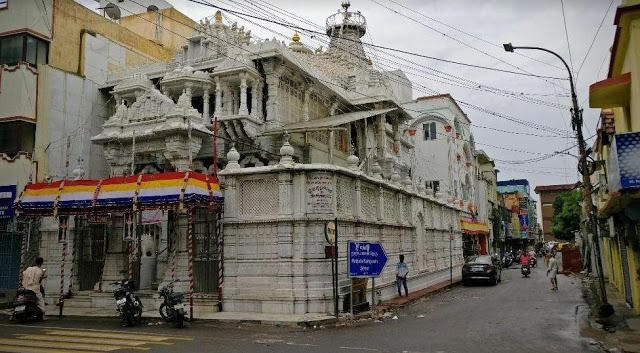
The Swetambara Jain Temple in Mylapore stands as a serene sanctuary amidst the bustling heart of Chennai. Dedicated primarily to Lord Vasupujya Swami, the 12th Tirthankara, and other revered Tirthankaras including Lord Mahavira, this temple belongs to the Swetambara sect of Jainism. The term “Swetambara” translates to “white-clad,” referring to the monks and nuns who wear white robes. Unlike the digambara (sky-clad) tradition, Swetambara ascetics wear simple white clothing, symbolizing a life of purity and non-violence.
Phalaśruti (Spiritual Benefits): Devotees visit this temple to seek spiritual liberation (Moksha) and to accumulate positive karma. According to Jain philosophy, worshipping the Tirthankaras helps in cleansing the soul of worldly attachments and ancestral karma. The temple serves as a focal point for meditation and austerity, particularly during the holy month of Paryushan, where the soul is purified through fasting and prayers.
Historical Origins & Scriptural Legend
While specific architectural records of the temple’s founding date are sparse, the presence of the Swetambara Jain Temple in Mylapore—a neighborhood rich in Dravidian history—dates back several centuries, likely established during the trading migrations of Jain communities to the Coromandel Coast. Mylapore has historically been a hub for various religious communities, including Jains, who have lived here for centuries alongside the Shaivite and Vaishnavite populations.
Sthala Purana: Tradition holds that the Tirthankaras enshrined here act as eternal guardians of the neighborhood. Unlike the neighboring Kapaleeshwarar Temple, which is deeply rooted in Saivism, the Jain temple offers a counter-narrative of asceticism and self-control. The temple was likely expanded by wealthy Jain merchants during the 18th or 19th century who settled in Mylapore for trade. The legend associated with the temple emphasizes the Anekantavada (many-sided reality) of Jainism, suggesting that spiritual truth can be found in the heart of a diverse city like Chennai.
Architectural Marvels
The temple showcases a harmonious blend of traditional Dravidian architectural styles adapted for Jain worship. While the exterior features the typical pyramidal towers (Vimana) seen in South Indian temples, the interior design aligns with the Jain concept of symmetry and peace.
Key Features:
- Garbhagriha (Sanctum Sanctorum): The inner sanctum houses the serene idol of Lord Vasupujya Swami in a meditative posture (Dhyana Mudra). The idols are often carved from marble or stone, adorned with simple yet majestic jewelry.
- Mandapa: The hall leading to the sanctum allows devotees to sit for meditation. The pillars often feature carvings of the 24 Tirthankaras.
- Shikhara (Spire): Though adapted to the Dravidian style, the temple spire represents the celestial abode of the Tirthankaras.
Darshan & Ritual Logistics
The temple operates on a strict schedule to accommodate the daily rituals and the monastic routine. Below are the tentative timings for Darshan and Sevas. Please verify with the temple office upon arrival, as timings may change during festivals.
Daily Timings
| Session | Timing | Activity |
|---|---|---|
| Morning | 6:00 AM – 11:00 AM | Abhishekam, Mangala Darshan |
| Afternoon | 11:00 AM – 5:00 PM | Temple Closed (Cleaning/Rest) |
| Evening | 5:00 PM – 8:00 PM | Sandhya Darshan, Aarti |
Seva and Online Booking
Devotees can participate in various Sevas (services) such as:
- Abhishekam: Ritual bathing of the deity (usually performed in the morning).
- Archana: Recitation of the 108 names of the Tirthankara.
- Bhog/Nivedana: Offering pure vegetarian food (cooked without onion/garlic).
While some local temples require online booking, the Swetambara Jain Temple traditionally operates on a direct darshan basis. However, for specific annual events, inquiries can be made via the temple’s contact number (listed below) or through local Jain community associations in Chennai.
2026 Festival Calendar
- January 14, 2026: Lord Vasupujya Swami Janmotsavam (Birth Anniversary).
- August 2026 (Specific dates TBD): Paryushan Parva (The most important Jain festival lasting 8-10 days, culminating in Forgiveness Day).
- October/November 2026: Diwali (Celebrated as Jain New Year; the temple is illuminated).
Practical Visitor Guidance
Dress Code: As a mark of respect, visitors are required to wear modest clothing. Men should wear dhotis or full-length trousers/shirts. Women should wear sarees, salwar kameez, or long skirts. Western casual wear (shorts/t-shirts) is generally discouraged inside the sanctum.
Photography & Mobiles: Photography is strictly prohibited inside the inner sanctum. Mobile phones should be kept on silent mode. Locker facilities may be available for storing footwear and bags.
Crowd Management: Weekends and festival days can be crowded. To experience a peaceful Darshan, it is recommended to visit between 7:00 AM and 9:00 AM on weekdays. May (Summer): Chennai experiences high temperatures; carry a water bottle and an umbrella when walking to the temple.
Pilgrimage Connectivity
How to Reach
The temple is located in the heart of Mylapore, approximately 500 meters from the Mylapore Bus Stop and the Thirumayilai (Mylapore) Railway Station.
The nearest station is Thirumayilai on the MRTS line. It connects directly to Chennai Beach (North) and Velachery (South). From the station, it is a short 5-minute walk.
Mylapore is well-connected by MTC buses. Major routes include:
• Route 1: Thiruvottriyur to Thiruvanmiyur (via Mylapore).
• Route 21G: Broadway to Tambaram.
• Route M15: Tambaram East to Mylapore.
Chennai International Airport (MAA) is the nearest airport, located approximately 17 km away. A taxi or cab (Ola/Uber) is the most convenient mode of transport.
Nearby Sacred Sites
Complete your spiritual circuit by visiting these landmarks within 2 km of the Swetambara Jain Temple:
- Kapaleeshwarar Temple: A masterpiece of Dravidian architecture dedicated to Lord Shiva, located just 1 km away.
- Sri Parthasarathy Temple: A UNESCO-recognized heritage site dedicated to Lord Krishna (located in Triplicane, approx 2 km).
- Santhome Cathedral Basilica: A historic church built over the tomb of St. Thomas the Apostle.
Frequently Asked Questions (FAQ)
1. Is there a VIP darshan entry?
No, the Swetambara Jain Temple operates on a democratic principle of equality. There is no special VIP entry; all devotees stand in the same queue and are treated equally, reflecting the core Jain values of humility and non-discrimination.
2. Can non-Jains visit the temple?
Yes, absolutely. The temple welcomes people of all faiths and backgrounds. However, visitors are expected to respect the Jain way of life, which includes refraining from consuming non-vegetarian food, alcohol, or smoking within the temple premises.
3. Is there a guesthouse or accommodation nearby?
While the temple itself does not have an attached guesthouse, Mylapore offers numerous options ranging from heritage hotels to budget lodges. The Sri Kalyana Vishnava Guest House (in nearby Triplicane) or hotels around Luz Corner are popular choices.
4. What is the best time to visit?
The ideal months are November to February when Chennai’s weather is cooler and pleasant. However, the temple is air-conditioned and comfortable year-round for short visits.
5. Is there a dress code for children?
Children are exempt from strict dress codes, but it is appreciated if they wear clean, modest attire. There is no entry fee for anyone.
Photo Gallery








Contact Details
Address: Swetambara Jain Temple, Mathala Narayanan Street, Mylapore, Chennai, Tamil Nadu 600004.
Phone: (Please contact the local Jain community association for the most current contact number as specific temple landline data may vary).
Note: While specific architectural dates for this temple are not listed in mainstream records, its presence is a testament to the centuries-old Jain heritage in Tamil Nadu. Please verify specific ritual timings during major festivals like Paryushan.
Recent Posts

Shri Kaamkoteeshwar Mandir, Varanasi – History & Significance
In the heart of Kashi, the eternal city of Lord Shiva, where the Ganges flows with celestial grace, stands the Shri Kaamkoteeshwar Mandir. This sacred Sannidhi is not merely a temple but a profound spiritual bridge between the Northern…

ओ सांवरे तूने ही मुझको संभाला – Lyrics & Meaning
ओ सांवरे तूने ही मुझको संभाला – A Prayer to Shyam Origin & Spiritual Essence Why This Bhajan Resonates Devotees chant this when overwhelmed by life’s storms—the refrain ‘तूने ही मुझको संभाला’ is the soul’s sigh of relief: “You…

कथा ये है महाराज मेरे की – Lyrics & Meaning
कथा ये है महाराज मेरे की छत्रपति संभाजी महाराज – A Prayer to Chhatrapati Sambhaji Maharaj Origin & Spiritual Essence Why This Bhajan Resonates Devotees chant this when their spirit feels tested—its powerful refrain “महाराज मेरे” is a soul’s…

Rigveda Samhita Yathartha Anuvada (ऋग्वेद संहिता यथार्थ अनुवाद) – Complete Set with Anvayartha & Hindi/English Translation
The Rigveda is the oldest surviving scripture of humanity and the foundational text of Sanātana Dharma. For serious students, scholars, UPSC aspirants studying ancient Indian history, Sanskrit learners, and spiritual seekers, a precise and grammatically structured translation is indispensable.…

आना भी अकेला है जाना भी अकेला है – Lyrics & Meaning | BharatTemples
आना भी अकेला है जाना भी अकेला है – A Prayer to the Divine Witness Origin & Spiritual Essence Why This Bhajan Resonates Devotees turn to this bhajan in moments of deep reflection—when life’s attachments begin to ache. The…

माता शेरावाली के द्वार जो भी जाता है – Lyrics & Meaning
माता शेरावाली के द्वार जो भी जाता है – A Prayer to Maa Sherawali Origin & Spiritual Essence Why This Bhajan Resonates Devotees turn to this bhajan in times of fear or uncertainty—its promise that no one leaves Maa’s…

मार लेना सपणी उबार लेणा भवरा – Lyrics & Meaning
मार लेना सपणी उबार लेणा भवरा – A Prayer to the Divine Beloved Origin & Spiritual Essence Why This Bhajan Resonates Devotees chant this in moments of deep vulnerability—its cry of “मार लेना सपणी, उबार लेणा भवरा” is the…

हमें श्याम सुंदर भरोसा तुम्हारा – Lyrics & Meaning
हमें श्याम सुंदर भरोसा तुम्हारा – A Prayer to Shyam Sundar Origin & Spiritual Essence Why This Bhajan Resonates Devotees chant this when feeling alone—its refrain ‘de do sahara’ is the soul’s cry for divine support. Lyrics in Hindi…

Mere Satguru Ne Di Thi Davai Lyrics in Hindi & Meaning
Mere Satguru Ne Di Thi Davai: Invoking the Guru’s Liberating Wisdom This soul-stirring bhajan venerates the Satguru (True Spiritual Master) as the divine physician who dispenses the only remedy for life’s deepest sufferings. Composed by Sant Karmaveer Tufani, it…

Janm Diyo Thari Maa Dukh Dekhiyo Lyrics in Hindi & Meaning
जन्म दियो थारी माँ दुख देखियो (Maa’s Grief Upon Birthing You) This soul-stirring Chetavani Bhajan (admonitory hymn) is addressed to the Divine Mother (Maa) – a call for repentance when children forget their filial duties in the dark age…