
Contents
- 1 Thanumalayan Temple, Suchindram, Kanyakumari
- 1.1 1. Introduction & Spiritual Essence: The Trimurti Convergence
- 1.2 2. Historical Origins & Scriptural Legend
- 1.3 3. Architectural Marvels: Dravidian Grandeur
- 1.4 4. Darshan & Ritual Logistics (Updated 2026)
- 1.5 5. Practical Visitor Guidance
- 1.6 6. Pilgrimage Connectivity
- 1.7 7. Frequently Asked Questions (FAQs)
- 1.8 Photo Gallery
Thanumalayan Temple, Suchindram, Kanyakumari
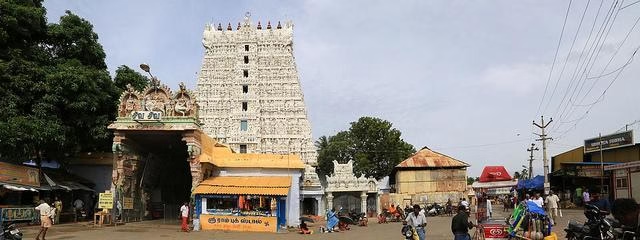
Welcome to the Thanumalayan Temple (Sthanumalayan Temple), a sanctified architectural marvel located in the serene village of Suchindram, Kanyakumari District, Tamil Nadu. As a Lead Heritage Architect and devotee, I present this definitive guide to the temple where the deities of the Hindu Trinity—Brahma, Vishnu, and Shiva—are worshipped in a single, unique form.
1. Introduction & Spiritual Essence: The Trimurti Convergence
Unlike most temples dedicated to a specific deity, the Thanumalayan Temple stands unique in the whole of India. The name Sthanumalayan itself is a Sanskrit etymology representing the Hindu Trinity:
- Sthanu: Lord Shiva
- Mal: Lord Vishnu
- Ayan: Lord Brahma
This Kshetram (sacred geography) is also known as Gnanaranya (Forest of Wisdom). It is of profound importance to both Shaivite and Vaishnavite sects. The sanctum houses a single Shiva Lingam divided into three sections: the bottom represents Brahma, the middle Vishnu, and the top Shiva. This Swayambhu (self-manifested) form is the focal point of worship.
Phalaśruti: Why Devotees Visit
The spiritual benefits (Phalaśruti) of visiting Thanumalayan Temple are immense, particularly for resolving specific life challenges:
- Marriage & Longevity: The temple is a renowned Prathana Sthalam for those seeking marital bliss, delayed marriages, and the removal of ancestral obstacles.
- Health & Prosperity: Special worship of Lord Anjaneya (Hanuman) within the temple complex is known to grant physical strength and mental peace.
- Karmic Cleansing: Tradition holds that praying here purifies the soul, much like the legend of Indra being cleansed of his sins.
2. Historical Origins & Scriptural Legend
The Legend of Anusuya and the Trimurti
According to local tradition and the Sthala Purana, the origin of the Trimurti Lingam is rooted in the legend of Anusuya, the wife of Sage Athri.
The Goddesses Lakshmi, Saraswati, and Parvati, hearing of Anusuya’s unshakeable chastity, sought to test her. They convinced their husbands (Vishnu, Brahma, and Shiva) to approach her as three mendicants. When they requested alms, they imposed a condition: Anusuya must serve them without clothes. Praying to her Lord, Anusuya sprinkled holy water (Paatha Theertham) and transformed the three gods into babies. To feed them, she had to be unclad, a state of pure maternal innocence that preserved her chastity. When the Goddesses realized the truth and begged for their husbands’ return, the Trinity emerged in their original forms. To honor this event, they merged into a single Lingam at Suchindram.
The Purification of Indra
The town’s name, Suchindram, is derived from “Suchi” (purify) and “Indran” (King of Gods). Legend states that Indra, cursed for his infatuation with Ahalya, was relieved of his sins at this very spot, making the site a powerful center for spiritual cleansing.
Builder & Renovation
The current structural majesty of the temple is largely attributed to the Travancore Royal Family. The major portions of the temple, including the towering Vimana, were reconstructed and expanded under the patronage of Maharaja Marthanda Varma in the 17th and 18th centuries. While the exact date of the original foundation is obscured by antiquity, the Vijayanagara influence is visible in the pillared corridors.
3. Architectural Marvels: Dravidian Grandeur
The Thanumalayan Temple is a textbook example of the Dravidian style of temple architecture. It is designed according to Vastu Shastra, with a precise alignment of the cardinal axes.
The Majestic Gopurams
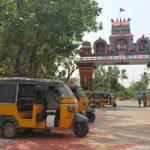
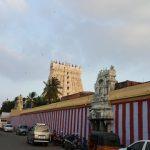
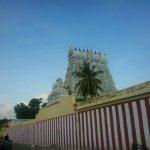
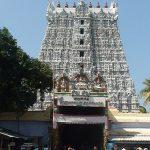
The temple features a three-tiered rajagopuram (main gateway) that greets pilgrims from the east. As you step inside, the transition from the outer world to the inner sanctity is marked by intricate friezes depicting scenes from Hindu epics.
The Musical Pillars & Sculptural Granthis
The most celebrated architectural feature is the musical pillars located in the Azhwar Mandapam and the main Mandapam. These monolithic pillars are carved with distinct geometric sections. When tapped gently, each section resonates with a specific musical note (scales of Carnatic music), a testament to the acoustic engineering of the era.
The ceiling and columns are adorned with Sculptural Granthis—knots entwined with figures of deities and floral motifs—displaying the zenith of wood-carving and stone sculpture.
Sanctum Sanctorum
The inner sanctum is square and modest, focusing attention entirely on the central Lingam. To the left of the main sanctum is the shrine for Lord Anjaneya (Hanuman), which holds immense significance. The temple also houses shrines for Lord Muruga and Lord Ganesha.
4. Darshan & Ritual Logistics (Updated 2026)
To facilitate a smooth visit, we have compiled the official timings and ritual schedules. Note that timings may vary slightly during festivals.
Daily Temple Opening Hours
| Session | Timings |
|---|---|
| Morning Darshan | 4:30 AM – 11:30 AM |
| Afternoon Break | 11:30 AM – 5:00 PM |
| Evening Darshan | 5:00 PM – 8:30 PM |
Daily Pooja / Ritual Schedule
- 04:15 AM: Abisheka Pooja for Moola Lingam
- 04:45 AM: Abisheka Pooja for Thanumalayan Deity (Main Sanctum)
- 05:30 AM: Daily Festival Pooja
- 06:30 AM: Tharai Abisheka Pooja
- 07:00 AM: Mistanga Pooja
- 11:00 AM: Uchikala Pooja & Deepa Aradhanai
- 06:30 PM: Deepa Aradhanai, Ahala Pooja & Arthajama Pooja (Closing Ritual)
Online Seva Booking & Key Festivals 2026
Currently, the temple administration (HR&CE) provides offline ticket counters for Sevas like Abhishekam (ritual bathing of the deity) and Archana (recitation of names). For specific 2026 dates, devotees are advised to check the Tamil Nadu Tourism or HR&CE portal closer to the festival season.
Major Festivals:
- Margazhi Car Festival (December/January): The 10-day Ther Thiruvizha is the highlight. On the 9th day, deities are pulled in massive wooden temple cars through the streets. Thousands gather for this event.
- Theppam (Float Festival): Celebrated in April/May (Chittirai). The deities are floated on a raft in the temple tank (Pushkarani).
5. Practical Visitor Guidance
Dress Code & Etiquette
- Attire: Traditional Indian wear is recommended. Men should wear dhotis or formal trousers with shirts; women should wear sarees or salwar kameez. Avoid shorts, ripped jeans, or sleeveless tops.
- Photography: Strictly prohibited inside the sanctum and mandapams. Refer to the gallery section below for permitted areas.
- Footwear: There are designated shoe-keeping facilities at the entrance. A nominal fee applies.
Crowd Management & Seasonal Advice
- Best Time to Visit: Winters (November to February) offer the pleasant weather for exploring Kanyakumari.
- Avoiding Crowds: Early morning darshan (5:00 AM – 6:00 AM) is peaceful. Avoid weekends and full moon days if you prefer a quieter experience.
- Summer (May): Kanyakumari experiences high humidity. Essential: Carry a water bottle and a head covering. The temple queues can be exposed to the sun.
- Accessibility: The temple complex has ramps for wheelchair access to the main Mandapam, though the inner sanctum steps may require assistance.
6. Pilgrimage Connectivity
How to Reach Suchindram
Suchindram is strategically located in the Kanyakumari district, well-connected by road and rail.
- By Air: The nearest airport is Trivandrum International Airport (TRV) in Kerala, approximately 75–80 km away. From there, you can hire a taxi or take a bus to Nagercoil/Kanyakumari.
- By Rail: Nagercoil Junction is the nearest railway station (approx. 5 km). It is a major junction with good connectivity to Chennai, Bangalore, and Thiruvananthapuram.
- By Road: The temple is located just 300 meters from the Suchindram Bus Stand. It lies on the NH-66 (formerly NH-47). Frequent buses are available from Nagercoil, Kanyakumari, and Thirunelveli.
Nearby Sacred Sites (Pilgrimage Circuit)
Extend your spiritual journey with these nearby destinations:
- Kanyakumari Amman Temple: Located 14 km away. Visit the virgin goddess who waits for Lord Shiva (who turned back at Suchindram).
- Muttom Beach & Sangumal: A scenic coastal spot ideal for viewing the sunset.
- Thiruvalluvar Statue: A monumental statue of the Tamil poet and philosopher, accessible via a short ferry ride from Kanyakumari.
7. Frequently Asked Questions (FAQs)
1. Is there a VIP Darshan entry available?
Yes, the temple administration offers a Special Darshan ticket (typically priced between ₹50 to ₹100) to bypass the general queue during peak hours. Tickets are available at the counter near the entrance.
2. Can non-Hindus visit the Thanumalayan Temple?
Yes. Unlike some strictly non-denominational temples in Tamil Nadu, visitors of all faiths are permitted inside the Thanumalayan Temple complex, provided they respect the dress code and rituals.
3. What is the significance of the musical pillars?
The pillars are carved from single stones and produce distinct musical tones when tapped. They represent the scientific advancement of the Dravidian craftsmen who understood acoustic properties of stone.
4. Are there accommodation facilities in Suchindram?
While there are limited lodges in Suchindram, it is recommended to stay in Nagercoil (10 mins drive) or Kanyakumari (20 mins drive), which offer a wide range of hotels and guest houses.
5. What is the contact number for the temple?
For current queries, you can contact the temple office at +91 4652 241270 or email suchindrum@tnhrce.org.
Photo Gallery





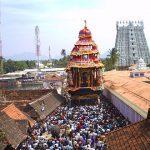
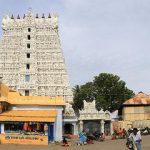
Temple Address & Contact
| Temple Name | Thanumalayan Temple (Sthanumalayan) |
| Address | Suchindram – 629 704, Kanyakumari District, Tamil Nadu |
| Phone | +91 4652 241270 |
| suchindrum@tnhrce.org |
Recent Posts

ओ सांवरे तूने ही मुझको संभाला – Lyrics & Meaning
ओ सांवरे तूने ही मुझको संभाला – A Prayer to Shyam Origin & Spiritual Essence Why This Bhajan Resonates Devotees chant this when overwhelmed by life’s storms—the refrain ‘तूने ही मुझको संभाला’ is the soul’s sigh of relief: “You…

कथा ये है महाराज मेरे की – Lyrics & Meaning
कथा ये है महाराज मेरे की छत्रपति संभाजी महाराज – A Prayer to Chhatrapati Sambhaji Maharaj Origin & Spiritual Essence Why This Bhajan Resonates Devotees chant this when their spirit feels tested—its powerful refrain “महाराज मेरे” is a soul’s…

Rigveda Samhita Yathartha Anuvada (ऋग्वेद संहिता यथार्थ अनुवाद) – Complete Set with Anvayartha & Hindi/English Translation
The Rigveda is the oldest surviving scripture of humanity and the foundational text of Sanātana Dharma. For serious students, scholars, UPSC aspirants studying ancient Indian history, Sanskrit learners, and spiritual seekers, a precise and grammatically structured translation is indispensable.…

आना भी अकेला है जाना भी अकेला है – Lyrics & Meaning | BharatTemples
आना भी अकेला है जाना भी अकेला है – A Prayer to the Divine Witness Origin & Spiritual Essence Why This Bhajan Resonates Devotees turn to this bhajan in moments of deep reflection—when life’s attachments begin to ache. The…

माता शेरावाली के द्वार जो भी जाता है – Lyrics & Meaning
माता शेरावाली के द्वार जो भी जाता है – A Prayer to Maa Sherawali Origin & Spiritual Essence Why This Bhajan Resonates Devotees turn to this bhajan in times of fear or uncertainty—its promise that no one leaves Maa’s…

मार लेना सपणी उबार लेणा भवरा – Lyrics & Meaning
मार लेना सपणी उबार लेणा भवरा – A Prayer to the Divine Beloved Origin & Spiritual Essence Why This Bhajan Resonates Devotees chant this in moments of deep vulnerability—its cry of “मार लेना सपणी, उबार लेणा भवरा” is the…

हमें श्याम सुंदर भरोसा तुम्हारा – Lyrics & Meaning
हमें श्याम सुंदर भरोसा तुम्हारा – A Prayer to Shyam Sundar Origin & Spiritual Essence Why This Bhajan Resonates Devotees chant this when feeling alone—its refrain ‘de do sahara’ is the soul’s cry for divine support. Lyrics in Hindi…

Mere Satguru Ne Di Thi Davai Lyrics in Hindi & Meaning
Mere Satguru Ne Di Thi Davai: Invoking the Guru’s Liberating Wisdom This soul-stirring bhajan venerates the Satguru (True Spiritual Master) as the divine physician who dispenses the only remedy for life’s deepest sufferings. Composed by Sant Karmaveer Tufani, it…

Janm Diyo Thari Maa Dukh Dekhiyo Lyrics in Hindi & Meaning
जन्म दियो थारी माँ दुख देखियो (Maa’s Grief Upon Birthing You) This soul-stirring Chetavani Bhajan (admonitory hymn) is addressed to the Divine Mother (Maa) – a call for repentance when children forget their filial duties in the dark age…
Bhadi Sabha Mein Thane Manaun Lyrics in Hindi & Meaning
Bhadi Sabha Mein Thane Manaun: Invoking the Spear-Wielding Mother Mata Bhawani (श्री ज्वाला भवानी), the fiery manifestation of Shakti worshipped as the Protector of Dharma in Her Dhaulagarh sanctum. Origin & Spiritual Essence Composed in Rajasthani folk tradition by…