
Contents
- 1 Introduction & Spiritual Essence
- 2 Historical Origins & Scriptural Legend
- 3 Architectural Marvels
- 4 Darshan & Ritual Logistics
- 5 Practical Visitor Guidance
- 6 Pilgrimage Connectivity
- 7 Photo Gallery
- 8 Frequently Asked Questions (FAQs)
- 8.1 1. Is there a VIP or Special Entry Darshan available?
- 8.2 2. Can we perform the tonsuring (Mottai) ritual at the temple?
- 8.3 3. Is non-vegetarian food allowed near the temple?
- 8.4 4. Why is the Rooster (Kukkuta) significant here?
- 8.5 5. What are the opening hours?
- 8.6 6. Is accommodation available nearby?
- 9 Contact Details
Introduction & Spiritual Essence
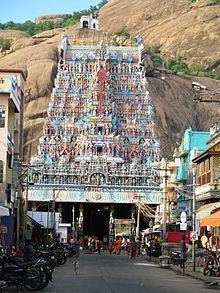
Perched majestically on a rocky hillock just 8 kilometers from Madurai, the Thirupparamkunram Murugan Temple stands as a timeless sentinel of faith. It is revered as the first among the Arupadaiveedu (Six Sacred Abodes) of Lord Murugan. While the other five abodes are situated on hilltops, Thirupparamkunram is unique as it lies directly within the hill itself, carved into the ancient rock.
The Primary Deity: The main sanctum houses Lord Subramanya (Murugan) in the form of a Shadhabhuja (six-armed) deity, flanked by his consorts, Deivayanai (Valli is revered in a separate shrine). The presiding Shiva form here is known as Parangirinathar (or Parangiri Nayakar), and his consort is Aavudai Nayaki.
Phalaśruti: The Boon of Visiting
Devotees flock to this ancient rock-cut temple to seek blessings for victory over enemies and the removal of obstacles (Vighna). According to the Skanda Purana, worshipping Murugan here absolves one of ancestral karma and grants longevity. It is the very site where Surapadman (the demon king) was vanquished and where Murugan married Deivayanai, the divine daughter of Indra. Bathing in the temple tank is believed to cure ailments and purify the soul.
Historical Origins & Scriptural Legend
According to temple records and archaeological evidence, the structure dates back to the Pandya dynasty (6th Century CE). However, oral tradition suggests a much deeper antiquity.
The Legend of Surapadman
Tradition holds that this is the battlefield where Murugan, spear in hand, battled the demon king Surapadman. Unable to defeat the demon in his demonic form, Murugan split him in two with his Vel (divine spear). The two halves transformed into a rooster (cock) and a peacock. This is why the rooster (Kukkuta) is associated with the temple—the peacock became his Vahana, and the rooster his flag (Kodi). The divine marriage to Deivayanai took place here immediately after the victory, witnessed by celestial beings.
Evolution of the Structure
While the core sanctum is rock-cut (cave temple style), evidence suggests the site was originally a Jain cave complex before being consecrated as a Hindu temple during the 8th Century under the guidance of the minister Gajapathy. The magnificent pillared halls and Rajagopuram (main tower) were significantly expanded during the Nayaka dynasty (16th Century), specifically under the patronage of King Thirumalai Nayakkar of Madurai.
Architectural Marvels
The temple is a masterpiece of Pandya Rock-Cut architecture fused with Dravida style additions by the Nayak rulers.
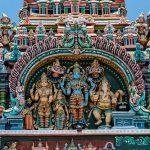
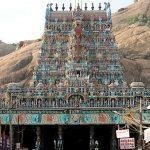
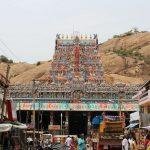
- The Rajagopuram: A towering seven-tiered gateway rising 150 feet, inviting pilgrims into the sacred precincts.
- Aasthaana Mandapa: The hall of ceremonies features artistically carved pillars, often depicting the cosmic dance of Shiva and scenes from the Puranas.
- Unique Orientation: The main sanctum is a marvel of spatial theology. Unlike most temples where deities face specific directions, here Lord Parangirinathar (Shiva) and Lord Narayana (Vishnu) face each other directly. This is a rare feature in Hindu temple architecture, symbolizing the harmony of Shaivism and Vaishnavism.
- The Rock: The temple is carved out of a single massive limestone hill (Parankundram). The sanctums of Vinayaka, Durga, Shiva, Vishnu, and Murugan are all hewn from the cave walls.
- Five Theerthams: The temple complex houses five sacred water bodies: Saravana Poigai, Lakshmi Theertham, Kasi Sunai, Saniyasi Kinaru, and Sathiya Koopam.
Darshan & Ritual Logistics
The temple follows the strict Agama Shastra and conducts six daily rituals. The administration is handled by the Hindu Religious and Endowment (HR&CE) Board of Tamil Nadu.
Daily Darshan Timings
| Period | Timing | Activity |
|---|---|---|
| Morning | 05:00 AM – 12:00 PM | Opening, Abhishekam, Archana |
| Afternoon | 12:00 PM – 04:00 PM | Mid-day Recess |
| Evening | 04:00 PM – 09:00 PM | Evening Darshan, Pooja, Closing |
*Note: Timings may vary slightly during festivals. Please check the official HRCE website before travel.
Key Sevas & Online Booking
For 2026, devotees can book the following sevas online via the Tamil Nadu HR&CE portal:
- Abhishekam: Performed to the main deity with milk, sandalwood, and honey.
- Kavala Archana: Offering of betel leaves and nuts to Lord Murugan.
- Kumkum Archana: Special offering for feminine deities.
- Tonsuring (Mottai): A significant ritual performed by devotees fulfilling vows.
2026 Festival Highlights
- Thai Poosam: January/February 2026 – Celebrated in the Tamil month of Thai. Huge crowds gather for the procession of the divine chariot.
- Vaikasi Visakam: May/June 2026 – The birthday of Lord Murugan.
- Kantha Sashti: October/November 2026 (Aippasi Month). The most important festival here, commemorating the slaying of Surapadman. The Soorasamharam (the grand battle re-enactment) on the sixth day is a spectacle not to be missed.
Practical Visitor Guidance
Dress Code & Etiquette
Modest attire is mandatory. Men should wear dhotis or formal pants with shirts; women should wear sarees, salwar kameez, or long skirts. Avoid shorts and sleeveless tops.
Crowd Management & Best Times
Thirupparamkunram is extremely popular. To experience a peaceful Darshan:
- Best Time: Early mornings (6:00 AM – 8:00 AM) or late evenings (after 7:00 PM).
- Avoid: Tuesday evenings and Friday evenings, as they are particularly crowded.
- Seasonal Advice: May (Tamil month of Vaikasi) is hot; carry water and an umbrella. Monsoons (Oct-Nov) are ideal for climate but expect heavy crowds for Sashti.
Facilities
- Mobile Lockers: Available at the entrance for electronic devices (Photography is strictly prohibited inside the sanctum).
- Shoe Storage: Free shoe-keeping facility is provided.
- Accessibility: Ramps are available for senior citizens near the main entrance, though the inner cave sanctum involves steps.
Pilgrimage Connectivity
How to Reach
By Air: Madurai International Airport (IXM) is the nearest airport, located approximately 15 km away. Taxis and Airport buses connect directly to Tirupparankunram.
By Rail: Madurai Junction (MDU) is the major railway station (8 km). Tirupparankunram Railway Station is the nearest local stop (1.5 km).
By Road: The temple is located on the Madurai – Tirumangalam Road (SH-74). It is well connected by city buses from Madurai Periyar Bus Stand.
Nearby Sacred Sites (Pilgrimage Circuit)
- Madurai Meenakshi Amman Temple: Located 8 km away. A visit to Tirupparankunram is considered incomplete without the blessings of Goddess Meenakshi.
- Alagar Koyil (Azharar Kovil): 21 km away. The hill temple of Lord Vishnu (Alagar) situated amidst the lush Solaimalai hills.
- Kallazhagar Temple: 30 km away, located near Azhar Kovil, famous for its annual Chithirai festival.
Photo Gallery
Visuals of the Rock-cut Architecture and Festive Processions.
Frequently Asked Questions (FAQs)
1. Is there a VIP or Special Entry Darshan available?
Yes, the temple administration provides a ‘Special Entry’ darshan ticket for a nominal fee (usually around ₹50 – ₹100). This allows devotees to bypass the general queue, especially during weekdays. Tickets can be purchased at the counter near the entrance.
2. Can we perform the tonsuring (Mottai) ritual at the temple?
Absolutely. Thirupparamkunram is one of the most popular places for fulfilling vows of tonsuring. The temple has dedicated areas for this ritual, and razors are available, though you may bring your own for hygiene.
3. Is non-vegetarian food allowed near the temple?
No. Being a holy site dedicated to Lord Murugan, the temple and its immediate vicinity are strictly vegetarian. Alcohol and meat are prohibited. Several quality vegetarian canteens operate inside the complex serving Annaprasadam.
4. Why is the Rooster (Kukkuta) significant here?
Legend states that when Murugan struck the demon Surapadman, the demon split into a rooster and a peacock. Murugan accepted the peacock as his mount (Vahana) and the rooster as his emblem (Kodi). This temple is the origin of that symbolism.
5. What are the opening hours?
The temple typically opens at 5:00 AM and closes at 9:00 PM, with a break in the afternoon between 12:00 PM and 4:00 PM.
6. Is accommodation available nearby?
While there are limited choultries directly managed by the temple, numerous private lodges and hotels are available in Madurai (8 km) and the surrounding areas of Tirupparankunram town.
Contact Details
Arulmigu Parangirinathar Temple (Thirupparamkunram Murugan Temple)Tirupparankunram, Madurai District, Tamil Nadu 625005.
Phone: 0452 248 4359 (Administrative Office)
Official Website: www.tirupparankunramtemple.tnhrce.in
Recent Posts

Shri Kaamkoteeshwar Mandir, Varanasi – History & Significance
In the heart of Kashi, the eternal city of Lord Shiva, where the Ganges flows with celestial grace, stands the Shri Kaamkoteeshwar Mandir. This sacred Sannidhi is not merely a temple but a profound spiritual bridge between the Northern…

ओ सांवरे तूने ही मुझको संभाला – Lyrics & Meaning
ओ सांवरे तूने ही मुझको संभाला – A Prayer to Shyam Origin & Spiritual Essence Why This Bhajan Resonates Devotees chant this when overwhelmed by life’s storms—the refrain ‘तूने ही मुझको संभाला’ is the soul’s sigh of relief: “You…

कथा ये है महाराज मेरे की – Lyrics & Meaning
कथा ये है महाराज मेरे की छत्रपति संभाजी महाराज – A Prayer to Chhatrapati Sambhaji Maharaj Origin & Spiritual Essence Why This Bhajan Resonates Devotees chant this when their spirit feels tested—its powerful refrain “महाराज मेरे” is a soul’s…

Rigveda Samhita Yathartha Anuvada (ऋग्वेद संहिता यथार्थ अनुवाद) – Complete Set with Anvayartha & Hindi/English Translation
The Rigveda is the oldest surviving scripture of humanity and the foundational text of Sanātana Dharma. For serious students, scholars, UPSC aspirants studying ancient Indian history, Sanskrit learners, and spiritual seekers, a precise and grammatically structured translation is indispensable.…

आना भी अकेला है जाना भी अकेला है – Lyrics & Meaning | BharatTemples
आना भी अकेला है जाना भी अकेला है – A Prayer to the Divine Witness Origin & Spiritual Essence Why This Bhajan Resonates Devotees turn to this bhajan in moments of deep reflection—when life’s attachments begin to ache. The…

माता शेरावाली के द्वार जो भी जाता है – Lyrics & Meaning
माता शेरावाली के द्वार जो भी जाता है – A Prayer to Maa Sherawali Origin & Spiritual Essence Why This Bhajan Resonates Devotees turn to this bhajan in times of fear or uncertainty—its promise that no one leaves Maa’s…

मार लेना सपणी उबार लेणा भवरा – Lyrics & Meaning
मार लेना सपणी उबार लेणा भवरा – A Prayer to the Divine Beloved Origin & Spiritual Essence Why This Bhajan Resonates Devotees chant this in moments of deep vulnerability—its cry of “मार लेना सपणी, उबार लेणा भवरा” is the…

हमें श्याम सुंदर भरोसा तुम्हारा – Lyrics & Meaning
हमें श्याम सुंदर भरोसा तुम्हारा – A Prayer to Shyam Sundar Origin & Spiritual Essence Why This Bhajan Resonates Devotees chant this when feeling alone—its refrain ‘de do sahara’ is the soul’s cry for divine support. Lyrics in Hindi…

Mere Satguru Ne Di Thi Davai Lyrics in Hindi & Meaning
Mere Satguru Ne Di Thi Davai: Invoking the Guru’s Liberating Wisdom This soul-stirring bhajan venerates the Satguru (True Spiritual Master) as the divine physician who dispenses the only remedy for life’s deepest sufferings. Composed by Sant Karmaveer Tufani, it…

Janm Diyo Thari Maa Dukh Dekhiyo Lyrics in Hindi & Meaning
जन्म दियो थारी माँ दुख देखियो (Maa’s Grief Upon Birthing You) This soul-stirring Chetavani Bhajan (admonitory hymn) is addressed to the Divine Mother (Maa) – a call for repentance when children forget their filial duties in the dark age…