
Contents
Introduction & Spiritual Essence
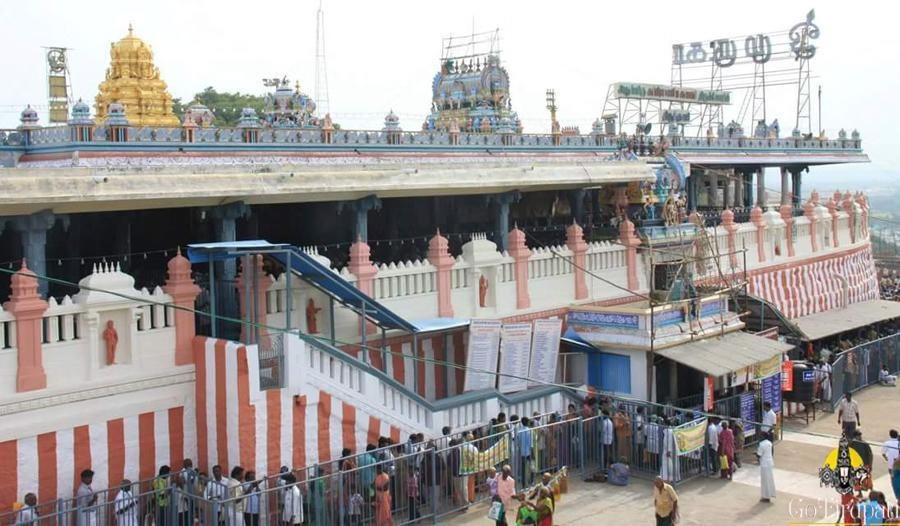
The Thiruthani Murugan Temple, perched atop the serene Thanigai Hill in Tamil Nadu, stands as one of the six most sacred abodes (Arupadaiveedu) of Lord Muruga. This temple is unique in its spiritual topology; reaching the sanctum requires ascending a flight of 365 steps, symbolically representing the days of the year that a devotee dedicates to the divine. Here, Lord Muruga is worshipped as Shaktidharar, the bearer of power.
Phalaśruti: The Boon of Visiting
Devotees flock to Thiruthani to seek relief from planetary afflictions, particularly those caused by Kala Sarpa Dosha (serpent energy blockages). According to temple lore, worshipping here cleanses ancestral karma and grants mental peace. The hill is believed to be the place where Lord Muruga merged with a divine light after battling the demon Surapadma, making it a potent site for moksha (liberation).
Historical Origins & Scriptural Legend
Ancient Roots and Patronage
The temple’s origins are deeply embedded in antiquity. It finds mention in the Sangam period masterpiece Tirumurugaatruppadai by the poet Nakkeerar. While the exact century of construction is unrecorded, historical records indicate significant patronage by the Vijayanagara rulers and local zamindars, who contributed to the structural expansion and renovation of the complex.
The Sthala Purana (Local Legends)
Tradition holds that this hill is the divine wedding venue of Lord Muruga and Deivayanai, the daughter of Indra (the King of Gods). Several legends saturate the soil of Thiruthani:
- Indra’s White Elephant: Indra gifted his white elephant, Airavatam, as part of the dowry. When the elephant returned to Indra, his wealth waned. Lord Muruga offered to return it, but Indra insisted the elephant face him. Hence, the iconography here uniquely depicts the elephant facing the east.
- The Sandal Stone: Indra also presented a sandal stone. The paste ground on this stone is applied to the deity and is said to possess miraculous medicinal properties.
- Lord Rama’s Solace: After the war with Ravana, Lord Rama visited this hill to find mental tranquility before returning to Ayodhya.
- Arjuna’s Blessings: During his southern pilgrimage for the Mahabharata, Arjuna received divine blessings here.
- Agasthya Muni: It is believed that the sage Agasthya received the gift of the Tamil language from Muruga at this very site.
Architectural Marvels
The temple exemplifies the grandeur of Dravidian Architecture. The structure is built with precision, adhering to Vastu Shastra, oriented to channel cosmic energies toward the sanctum.
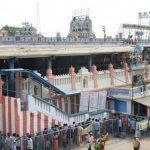
- The Gopuram: The temple features a magnificent five-tiered gopuram (gateway tower), richly decorated with intricate stucco work and depictions of Hindu mythology.
- The Sanctum Layout: The deity, Shaktidharar, stands with his consort, Valli, on his right. However, Deivayanai is enshrined in a separate, spacious shrine on the southern side—a unique architectural feature distinguishing it from other Murugan temples.
- The Hollow Chest: The main idol of Muruga is depicted with a hollow in the chest region. Legend explains this as the spot where Lord Muruga absorbed the discus (Chakra) thrown by the demon Tarakasura.
- Water Bodies: The hill houses several sacred tanks, including Brahmasonai, where Lord Brahma is said to have bathed to regain his creative faculties.
Darshan & Ritual Logistics
The temple follows strict agamic traditions. Below are the standard timings. Note: Timings may vary slightly during festival seasons.
| Darshan Session | Timings |
|---|---|
| Morning Opening | 6:00 AM |
| Morning Pooja Break | 12:00 PM – 4:00 PM |
| Evening Opening | 4:00 PM |
| Closing | 9:00 PM |
Key Sevas & Booking
To perform sevas like Abhishekam (sacred bathing of the idol) or Archana (recitation of names), devotees can utilize the online booking system managed by the Tamil Nadu Hindu Religious and Charitable Endowments (HR&CE) Department.
2026 Festival Calendar
- Thaipusam: January 13, 2026
- Vel Kavadi: January 14, 2026
- Skanda Shashti: November 1, 2026 – November 7, 2026 (Main event on Nov 6)
- Panguni Uthiram: March 15, 2026
Practical Visitor Guidance
Visiting Thiruthani requires physical preparation due to the elevation.
- Dress Code: Traditional attire is mandatory. Men should wear dhotis or trousers with shirts; women should wear sarees, salwar kameez, or long skirts.
- Footwear: Shoes must be removed at the base of the hill. Shoe storage is available for a nominal fee.
- Photography: Strictly prohibited inside the inner sanctum and the temple complex.
- Crowd Management: The best time to visit is between 6:00 AM and 8:00 AM on weekdays. Avoid weekends and festivals if you prefer a serene darshan.
- Seasonal Advice: The granite steps become hot during peak summer (May). Carry a water bottle and wear protective footwear for the ascent.
Pilgrimage Connectivity
How to Reach
The temple is located approximately 87 km from Chennai.
- By Road: Take National Highway 75 (Chennai-Bangalore Highway) to Thiruthani. Frequent buses are available from Tirupati, Chennai, and Chittoor.
- By Rail: The nearest railway station is Thiruthani (TYM), which is well-connected to Chennai. From the station, local auto-rickshaws are available to the foothills.
- By Air: The nearest airport is Chennai International Airport (MAA), roughly 80 km away.
Nearby Sacred Sites
Enhance your pilgrimage by visiting these nearby abodes of Lord Muruga:
- Sri Kalahasteeswara Temple: Located 35 km away, a major Shiva temple famous for Rahu-Ketu dosha relief.
- Srikurmam: Located 45 km away, one of the rare temples where Lord Vishnu is worshipped in his Kurma (tortoise) avatar.
- Ekambareswarar Temple (Kanchipuram): A 50 km drive to one of the Pancha Bhoota Stalam temples.
Photo Gallery

Frequently Asked Questions (FAQ)
Is there a VIP darshan entry available?
Yes, the temple offers a special darshan ticket (usually priced around INR 50-100) that allows devotees to bypass the general queue during non-peak hours. However, during Skanda Shashti and Thaipusam, all tickets are subject to queue management rules.
Can I drive my car to the top of the hill?
No, private vehicles are not allowed atop the hill to preserve the sanctity and safety of the temple steps. You must park at the designated area at the foothills and climb the steps or use the palanquin service (Doli) available for elderly devotees and infants.
What is the significance of the 365 steps?
The 365 steps represent the 365 days of the year. Climbing them is considered an act of penance and dedication, where each step corresponds to a day of spiritual consciousness.
Is online seva booking available for Thiruthani Murugan Temple?
Yes, the Tamil Nadu HR&CE portal facilitates online booking for archana and abhishekam. It is advisable to book at least 24 hours in advance for special occasions.
What are the contact details for the temple?
Official Address: Thiruthani Hill, Thiruthani, Tamil Nadu 631209
Phone: 044-27885243 (Temple Office)
Recent Posts

Shri Kaamkoteeshwar Mandir, Varanasi – History & Significance
In the heart of Kashi, the eternal city of Lord Shiva, where the Ganges flows with celestial grace, stands the Shri Kaamkoteeshwar Mandir. This sacred Sannidhi is not merely a temple but a profound spiritual bridge between the Northern…

ओ सांवरे तूने ही मुझको संभाला – Lyrics & Meaning
ओ सांवरे तूने ही मुझको संभाला – A Prayer to Shyam Origin & Spiritual Essence Why This Bhajan Resonates Devotees chant this when overwhelmed by life’s storms—the refrain ‘तूने ही मुझको संभाला’ is the soul’s sigh of relief: “You…

कथा ये है महाराज मेरे की – Lyrics & Meaning
कथा ये है महाराज मेरे की छत्रपति संभाजी महाराज – A Prayer to Chhatrapati Sambhaji Maharaj Origin & Spiritual Essence Why This Bhajan Resonates Devotees chant this when their spirit feels tested—its powerful refrain “महाराज मेरे” is a soul’s…

Rigveda Samhita Yathartha Anuvada (ऋग्वेद संहिता यथार्थ अनुवाद) – Complete Set with Anvayartha & Hindi/English Translation
The Rigveda is the oldest surviving scripture of humanity and the foundational text of Sanātana Dharma. For serious students, scholars, UPSC aspirants studying ancient Indian history, Sanskrit learners, and spiritual seekers, a precise and grammatically structured translation is indispensable.…

आना भी अकेला है जाना भी अकेला है – Lyrics & Meaning | BharatTemples
आना भी अकेला है जाना भी अकेला है – A Prayer to the Divine Witness Origin & Spiritual Essence Why This Bhajan Resonates Devotees turn to this bhajan in moments of deep reflection—when life’s attachments begin to ache. The…

माता शेरावाली के द्वार जो भी जाता है – Lyrics & Meaning
माता शेरावाली के द्वार जो भी जाता है – A Prayer to Maa Sherawali Origin & Spiritual Essence Why This Bhajan Resonates Devotees turn to this bhajan in times of fear or uncertainty—its promise that no one leaves Maa’s…

मार लेना सपणी उबार लेणा भवरा – Lyrics & Meaning
मार लेना सपणी उबार लेणा भवरा – A Prayer to the Divine Beloved Origin & Spiritual Essence Why This Bhajan Resonates Devotees chant this in moments of deep vulnerability—its cry of “मार लेना सपणी, उबार लेणा भवरा” is the…

हमें श्याम सुंदर भरोसा तुम्हारा – Lyrics & Meaning
हमें श्याम सुंदर भरोसा तुम्हारा – A Prayer to Shyam Sundar Origin & Spiritual Essence Why This Bhajan Resonates Devotees chant this when feeling alone—its refrain ‘de do sahara’ is the soul’s cry for divine support. Lyrics in Hindi…

Mere Satguru Ne Di Thi Davai Lyrics in Hindi & Meaning
Mere Satguru Ne Di Thi Davai: Invoking the Guru’s Liberating Wisdom This soul-stirring bhajan venerates the Satguru (True Spiritual Master) as the divine physician who dispenses the only remedy for life’s deepest sufferings. Composed by Sant Karmaveer Tufani, it…

Janm Diyo Thari Maa Dukh Dekhiyo Lyrics in Hindi & Meaning
जन्म दियो थारी माँ दुख देखियो (Maa’s Grief Upon Birthing You) This soul-stirring Chetavani Bhajan (admonitory hymn) is addressed to the Divine Mother (Maa) – a call for repentance when children forget their filial duties in the dark age…