
Contents
- 1 Thiruvalluvar Temple, Mylapore: A Definitive Pilgrimage Guide
Thiruvalluvar Temple, Mylapore: A Definitive Pilgrimage Guide
By Bharat Temples Heritage & SEO Team
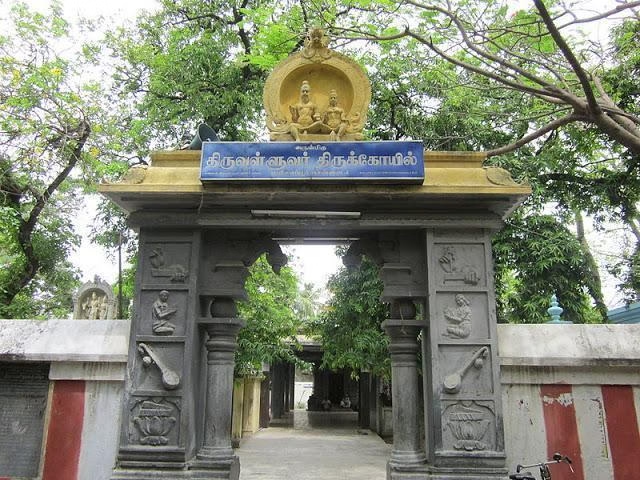
In the heart of the ancient neighborhood of Mylapore in Chennai stands a sanctuary dedicated not to a celestial deity born of myth, but to a mortal whose wisdom transcended time: Thiruvalluvar. This shrine is a unique testament to the reverence accorded to literary genius in Tamil culture. Here, the Thirukural—often called the “Bible of the Tamil Land”—is not just a text; it is the living spirit of the temple.
1. Introduction & Spiritual Essence
The Thiruvalluvar Temple in Mylapore is an architectural and spiritual hybrid. While Thiruvalluvar is traditionally classified as a Manitha Nayakar (Human Hero) among the 63 Nayanmars (Saivite saints), this shrine elevates him to a status of divine reverence.
Primary Deity & Form
- Primary Deity: Thiruvalluvar (also known as Valluvar).
- Form: A seated stone idol in the sanctum sanctorum.
- Presiding Deity (Moola Moorthi): While the temple is dedicated to Valluvar, the main sanctum traditionally houses Ekambareswarar (a form of Lord Shiva).
- Consort: Vasuki Ammaiyar (Vasuki), Valluvar’s wife, has a dedicated shrine.
Phalaśruti: Why Visit?
Devotees flock to this temple not for boons of material wealth, but for intellectual clarity and spiritual purification.
- Knowledge & Wisdom: It is believed that praying here unlocks the analytical wisdom found in the Thirukural.
- Ancestral Karma: Performing rites here is said to cleanse Pithru Dosham (ancestral imbalances), as Valluvar is the ultimate ancestor of Tamil ethical living.
- Cultural Grounding: It serves as a spiritual anchor for those seeking to reconnect with the roots of Dravidian philosophy.
2. Historical Origins & Scriptural Legend
Unlike most ancient temples where history is obscured by mythology, the history of this temple is a matter of archival research and revival.
Builders & Renovations
- Origin Era: Though the exact date is unrecorded, literary references suggest the memorial existed as a simple shrine long before the 16th century.
- Documentation: A book on Mylapore temples published in 1929 refers to it as the “Thiruvalluvar Temple,” confirming its existence as a dedicated shrine by that time.
- Renovations: The structure underwent extensive renovation in the early 1970s by the Government of Tamil Nadu, replacing many thatched or dilapidated structures with concrete and stone.
Scriptural Legend & The Iluppai Tree
Tradition holds that this location marks the birthplace of Thiruvalluvar. The central legend revolves around the Iluppai (Butter tree) under which the sage was born.
According to local records, a massive Iluppai tree stood here for over two millennia. In 1935, a severe storm damaged the tree beyond recovery. However, the temple authorities preserved the sacred base and roots of the tree, which are now encased in a concrete cylinder and displayed for devotees to venerate.
There is also a legendary well here connected to Vasuki Ammaiyar. It is said that when Valluvar called her while she was fetching water, she left the pot suspended in mid-air, a miracle commemorated by the preserved well (now sealed and protected by a grill).
3. Architectural Marvels
The temple showcases a blend of traditional Dravidian Architecture and simplified memorial aesthetics.
Vastu & Structural Layout
- Orientation: The main sanctum (Garbhagriha) faces East, adhering to Vastu principles for energy flow.
- Sanctum Sanctorum: A simple two-roomed shrine enclosed by an open-pillared portico (Mandapa).
- Sculptural Highlights:
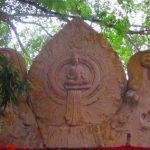
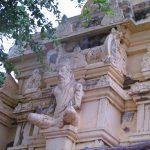
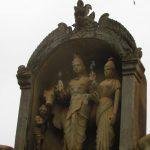
- Vimana Idols: Unique stucco idols of Valluvar are depicted on the Vimana (tower over the sanctum).
- Niche Deities: Images of Ganesha and Subramanya-Valli-Devasena flank the entrance.
- Koshta Idols: Niches on the outer wall feature Dakshina Murti, Lingodhbava, Brahma, and Durga.
Sub-Shrines
The temple complex is comprehensive despite its compact size:
- Ekambareswarar Shrine: Located within the complex, interpreted by some researchers as the birthplace and by others as the Samadhi spot.
- Kamakshi Shrine: A dedicated sub-shrine for the Goddess.
- Navagraha & Saivite Saints: Shrines for Hanuman, Ganesha, Chandikeswara, Bhairava, and Saneeswara.
- Amman Shrine: Located to the rear near a Neem tree, surrounded by Naga (serpent) statues.
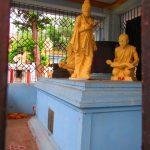
- Memorial Statue: A larger-than-life marble statue depicts Valluvar seated, while a bronze relief shows his parents, Sri Adi and Sri Bhagavan, with the infant Valluvar.
4. Darshan & Ritual Logistics (2026 Guide)
Devotees should note that this is a smaller shrine, and timings may vary slightly during festival seasons. It is advisable to call ahead before visiting.
Daily Darshan Timings
| Session | Timing |
|---|---|
| Morning Darshan | 06:00 AM – 12:00 PM |
| Afternoon Break | 12:00 PM – 04:00 PM |
| Evening Darshan | 04:00 PM – 08:30 PM |
Key Sevas (Rituals) & Booking
- Abhishekam: Performed to the Ekambareswarar Linga and the Valluvar idol. Timing: 08:00 AM daily.
- Archana: Recitation of Thirukural couplets. Available throughout the day.
- Deepa Aradhana: Evening lamp offering.
- Online Booking: While this temple is a smaller heritage site, major ritual bookings are typically handled on-site. However, for larger festivals, the Chennai Corporation or Hindu Religious & Charitable Endowments (HR&CE) department may release online slots via the official Tamil Nadu temple portal.
2026 Festival Dates
- Aadi Pooram: July 2026 (Celebrating the Goddess).
- Navaratri: October 2026 (Special decorations for Kamakshi).
- Karthigai Deepam: November 2026 (Grand lighting of lamps).
- Pongal (Thai Pongal): January 14, 2026 (Special treatment of the idol).
5. Practical Visitor Guidance
To ensure a respectful visit, please adhere to the following guidelines.
Code of Conduct
- Dress Code: Traditional attire is recommended. Men should wear dhotis or pants with shirts; women should wear sarees, salwar kameez, or churidars. Avoid shorts and sleeveless tops.
- Photography: Photography is permitted in the outer halls but strictly prohibited inside the sanctum sanctorum.
- Mobile Phones: Please silence devices. There are no dedicated locker facilities, so carry minimal belongings.
Crowd Management & Seasonal Advice
- Best Time to Visit: Early mornings (6:00 AM – 8:00 AM) offer the most peaceful darshan.
- Summer (May – June): Chennai experiences high temperatures. Carry a water bottle and wear head coverings.
- Monsoon (October – November): Mylapore is prone to waterlogging during heavy rains; check weather alerts before visiting.
- Accessibility: The temple is located on a narrow lane. It is not wheelchair accessible due to uneven stone steps at the entrance.
6. Pilgrimage Connectivity
How to Reach
The temple is located roughly 700 meters East of the famous Thiruvalluvar Statue on Royapettah High Road, near the Luz Anjaneyar Temple.
- Nearest Airport: Chennai International Airport (MAA) – Approx. 17 km (45 mins by taxi).
- Nearest Railway Station:
- Mylapore (Mylapore MRTS): 700 meters (10-minute walk).
- Chennai Central (MAS): 9 km.
Road Connectivity (NH & Bus Routes)
The temple is accessible via Royapettah High Road and Luz Corner. Major MTC bus routes include:
- Route 1/1A/1C/1D: Connects Thiruvottriyur/Ennore to Thiruvanmiyur via Royapettah and Mylapore.
- Route 21: Mandaveli to Broadway (stops at Mylapore).
- Route 12B: Foreshore Estate to Vadapalani via Luz Corner.
Nearby Sacred Sites (Pilgrimage Circuit)
- Kapaleeshwarar Temple: Located just 1 km away, this Dravidian masterpiece is the epicenter of Mylapore’s spiritual life.
- Luz Anjaneyar Temple: A historic Hanuman temple located adjacent to the approach road.
- Santhome Basilica: A historical cathedral (3 km away) built over the tomb of St. Thomas, offering a glimpse into Chennai’s multicultural religious history.
7. Frequently Asked Questions (FAQ)
Is there a VIP darshan entry?
No, Thiruvalluvar Temple is a small shrine managed by the Chennai Corporation. It does not have a VIP darshan queue like large pilgrim centers. Darshan is general and accessible to all.
Can I offer my own flowers/prasadam?
Yes, devotees are allowed to bring flowers and fruits for personal offering. However, standard temple prasadam is usually distributed by the temple caretakers.
Is there a parking facility?
There is no dedicated parking lot inside the temple lane. Devotees usually park along the main Royapettah High Road or use paid parking near Luz Corner.
What is the significance of the Ekambareswarar shrine here?
While the temple is famous for Thiruvalluvar, the presence of the Ekambareswarar Linga signifies the Shiva-centric roots of the location. Some scholars believe this specific Linga marks the exact spot of Valluvar’s birth or spiritual absorption.
Is the temple open on Sundays?
Yes, the temple remains open on Sundays, though timings might be slightly shorter (usually 7 AM to 12 PM and 5 PM to 8 PM).
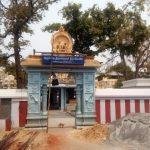
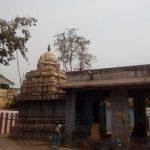
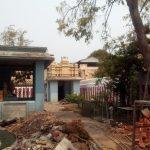
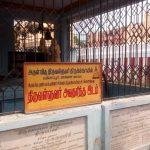
Photo Gallery



Contact Details
Address: Thiruvalluvar Temple, Nattu Subburaya Mudali Street, Mylapore, Chennai, Tamil Nadu 600004.
Phone: +91-44-2499 0845 (Chennai Corporation Zonal Office – Mylapore).
Recent Posts

Shri Kaamkoteeshwar Mandir, Varanasi – History & Significance
In the heart of Kashi, the eternal city of Lord Shiva, where the Ganges flows with celestial grace, stands the Shri Kaamkoteeshwar Mandir. This sacred Sannidhi is not merely a temple but a profound spiritual bridge between the Northern…

ओ सांवरे तूने ही मुझको संभाला – Lyrics & Meaning
ओ सांवरे तूने ही मुझको संभाला – A Prayer to Shyam Origin & Spiritual Essence Why This Bhajan Resonates Devotees chant this when overwhelmed by life’s storms—the refrain ‘तूने ही मुझको संभाला’ is the soul’s sigh of relief: “You…

कथा ये है महाराज मेरे की – Lyrics & Meaning
कथा ये है महाराज मेरे की छत्रपति संभाजी महाराज – A Prayer to Chhatrapati Sambhaji Maharaj Origin & Spiritual Essence Why This Bhajan Resonates Devotees chant this when their spirit feels tested—its powerful refrain “महाराज मेरे” is a soul’s…

Rigveda Samhita Yathartha Anuvada (ऋग्वेद संहिता यथार्थ अनुवाद) – Complete Set with Anvayartha & Hindi/English Translation
The Rigveda is the oldest surviving scripture of humanity and the foundational text of Sanātana Dharma. For serious students, scholars, UPSC aspirants studying ancient Indian history, Sanskrit learners, and spiritual seekers, a precise and grammatically structured translation is indispensable.…

आना भी अकेला है जाना भी अकेला है – Lyrics & Meaning | BharatTemples
आना भी अकेला है जाना भी अकेला है – A Prayer to the Divine Witness Origin & Spiritual Essence Why This Bhajan Resonates Devotees turn to this bhajan in moments of deep reflection—when life’s attachments begin to ache. The…

माता शेरावाली के द्वार जो भी जाता है – Lyrics & Meaning
माता शेरावाली के द्वार जो भी जाता है – A Prayer to Maa Sherawali Origin & Spiritual Essence Why This Bhajan Resonates Devotees turn to this bhajan in times of fear or uncertainty—its promise that no one leaves Maa’s…

मार लेना सपणी उबार लेणा भवरा – Lyrics & Meaning
मार लेना सपणी उबार लेणा भवरा – A Prayer to the Divine Beloved Origin & Spiritual Essence Why This Bhajan Resonates Devotees chant this in moments of deep vulnerability—its cry of “मार लेना सपणी, उबार लेणा भवरा” is the…

हमें श्याम सुंदर भरोसा तुम्हारा – Lyrics & Meaning
हमें श्याम सुंदर भरोसा तुम्हारा – A Prayer to Shyam Sundar Origin & Spiritual Essence Why This Bhajan Resonates Devotees chant this when feeling alone—its refrain ‘de do sahara’ is the soul’s cry for divine support. Lyrics in Hindi…

Mere Satguru Ne Di Thi Davai Lyrics in Hindi & Meaning
Mere Satguru Ne Di Thi Davai: Invoking the Guru’s Liberating Wisdom This soul-stirring bhajan venerates the Satguru (True Spiritual Master) as the divine physician who dispenses the only remedy for life’s deepest sufferings. Composed by Sant Karmaveer Tufani, it…

Janm Diyo Thari Maa Dukh Dekhiyo Lyrics in Hindi & Meaning
जन्म दियो थारी माँ दुख देखियो (Maa’s Grief Upon Birthing You) This soul-stirring Chetavani Bhajan (admonitory hymn) is addressed to the Divine Mother (Maa) – a call for repentance when children forget their filial duties in the dark age…