
Though the Lord has innumerable names, the
Vishnu Sahasranama which contains a thousand selected names of the Supreme Being, is in the nature of a hymn which can be chanted by all. There is a great secret in it.
The sequence of the names of the Vishnu in the verses, in Anushtubh metre has a rationale.
Twenty-four names of Lord Vishnu had been incorporated in the three opening verses of the Vishnu Sahasranama. These twenty-four names denote the 24 syllabled Gayatri mantra, each syllable corresponding to a particular name. The name Gayatri connotes that it protects those who chant it. Poperly and regularly only comes later after practise. Hence better try than never.
Some could feel that they do not know the correct pronunciation, and so do not want to chant incorrectly. H. J. Achar, in his book “Sri Vishnu Sahasranama – A Study”, H.J. Achar, Sharada Press, Mangalore, 1972, has given the analogy of a mother to whom a child goes and asks for an orange. The child does not know how to pronounce the word “orange”, and so asks for “ange”. The mother does not turn away the child and does not refuse to give the child the orange just because the child does not know how to pronounce the word. It is the spirit or bhava that matters, and so as long as one chants the name of God with sincerity, considerations such as not knowing the meaning, not knowing the pronunciation, etc., do not matter, and God who is the Mother of all of us will confer His blessings on us.
In the introductory part of the Vishnu Sahasranama Stotram, Yudhishthira asks Bhishma six questions, related to how mankind can attain happiness. These are contained in two stanzas starting with “kim ekam daivatam loke” in the Stotram. These questions are:
- Who is the One (Supreme) Deity?
- What is the highest goal of life?
- By praising which Deity’s auspicious qualities will human beings attain prosperity in this world as well as bliss in the next?
- By meditating on which Deity will human beings attain prosperity in this world as well as bliss in the next?
- By reciting which mantra will man be released from the bondage of the cycle of birth and death?
- Of the three means referred to above (i.e., recitation, praise or archana, and meditation), which is the best means for attaining the grace of the Supreme Deity based on your vast experience and knowledge?
According to the 149th chapter of Anush? sanaparva in the epic Mahabharata, the names were handed down to Yudihsthira by the famous warrior Bhisma was on his death bed at the battle of Kuruukshetera Yudhisthira asks Bhishma the following questions: kimekam daivatam loke In this universe who is the one Deva of all? (i.e., at whose command all beings function? or who is God of all?)
• kim v?pyekam par?ya?am
o Who is the one greatest refuge for all?
• stuvanta? kam kamarcanta? pr?pnuyurm?nav?? subham
o Who is the one Divinity by praising and by worshiping whom a man attains good?
• ko dharma? sarva dharm???m bhavata? paramo mata?
o Which according to you is that highest form of Dharma (capable of bestowing salvation and prosperity on man)?
• kim japan mucyate jantu? janmasams?rabandhan?t
o What is that by uttering or reciting which any living being can attain freedom from cycle of births and deaths?
Recent Posts

Mere Satguru Ne Di Thi Davai Lyrics in Hindi & Meaning
Mere Satguru Ne Di Thi Davai: Invoking the Guru’s Liberating Wisdom This soul-stirring bhajan venerates the Satguru (True Spiritual Master) as the divine physician who dispenses the only remedy for life’s deepest sufferings. Composed by Sant Karmaveer Tufani, it…

Janm Diyo Thari Maa Dukh Dekhiyo Lyrics in Hindi & Meaning
जन्म दियो थारी माँ दुख देखियो (Maa’s Grief Upon Birthing You) This soul-stirring Chetavani Bhajan (admonitory hymn) is addressed to the Divine Mother (Maa) – a call for repentance when children forget their filial duties in the dark age…
Bhadi Sabha Mein Thane Manaun Lyrics in Hindi & Meaning
Bhadi Sabha Mein Thane Manaun: Invoking the Spear-Wielding Mother Mata Bhawani (श्री ज्वाला भवानी), the fiery manifestation of Shakti worshipped as the Protector of Dharma in Her Dhaulagarh sanctum. Origin & Spiritual Essence Composed in Rajasthani folk tradition by…

श्याम सुन्दरवा छोटे छोटे कनुवा Lyrics & Meaning
श्याम सुन्दरवा छोटे छोटे कनुवा (Shyam Sundarva Chhote Chhote Kanuva) is a heartfelt invocation to Lord Krishna in his most enchanting form—Shyam Sundar (the dark, beautiful one). This bhajan is a plea for the divine child Kanha to grace…
Maat Meri Chintapurni Lyrics in Hindi & Meaning
Maat Meri Chintapurni is a heartfelt devotional prayer dedicated to Maa Chintapurni, a form of the Divine Mother. She is revered as the remover of worries and the granter of wishes, especially venerated in the Himalayan region of Himachal…
थारी रे नदियां का ढावा पे खीची राजा Lyrics & Meaning
खीची राजा का अद्भुत युद्ध: एक शौर्य गाथा यह भजन एक पौराणिक या ऐतिहासिक शूरवीर राजा की वीरता का वर्णन करता है, जो प्रायः गुजराती लोक संस्कृति में लोककथाओं का हिस्सा है। इसकी रचना दुर्गेश कटारा ने की है…
बेगो बेगो चाल श्याम सिंगोली बुलावे रे Lyrics in Hindi & Meaning
Bhajan Title & Deity This bhajan, बेगो बेगो चाल श्याम सिंगोली बुलावे रे, is dedicated to Lord Shyam, a revered form of Lord Krishna. Origin & Spiritual Essence The composer of this bhajan is not specified, but it is…
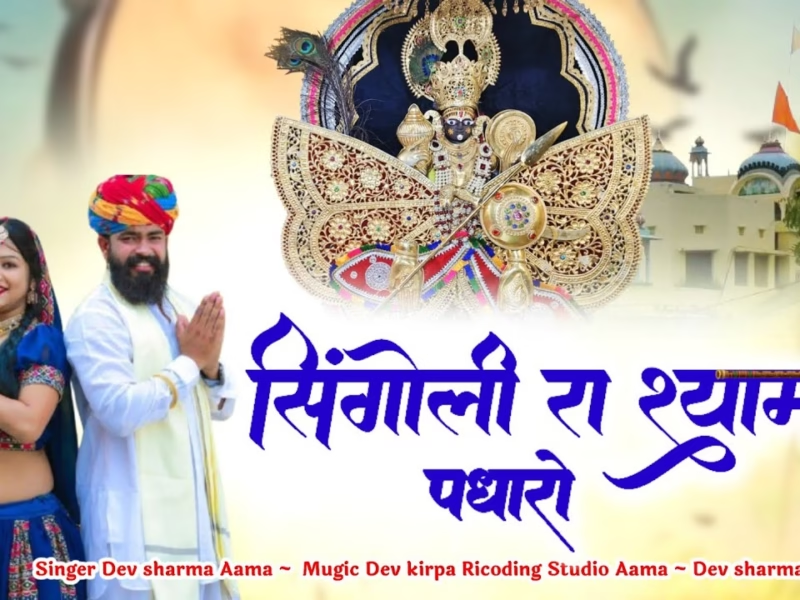
सिंगोली रा श्याम पधारो Lyrics in Hindi & Meaning
सिंगोली रा श्याम पधारो Bhajan & Deity This sacred bhajan, सिंगोली रा श्याम पधारो, is dedicated to Lord Shyam, a revered deity in the Hindu tradition. The composer of this bhajan is Dev Sharma Aama. Origin & Spiritual Significance…

हंसकर पार्वती शिव जी ने वचन सुनावती जी Lyrics in Hindi & Meaning
हंसकर पार्वती शिव जी ने वचन सुनावती जी – A Devotional Bhajan Origin & Spiritual Significance This beautiful bhajan, हंसकर पार्वती शिव जी ने वचन सुनावती जी, is a heartfelt devotion to Lord Shiva and Goddess Parvati, embodying the…

ज्ञान सतगुरु समझायो ए Lyrics in Hindi & Meaning
This bhajan, ज्ञान सतगुरु समझायो ए, is dedicated to the revered deity, Shyam, and is a testament to the transformative power of spiritual guidance. The composer of this bhajan is unknown, but it is deeply rooted in the Rajasthani…