Tribhuwan Keshav Temple Varanasi: History, Darshan Timings & Complete Guide
Receive daily temple updates, divine darshan, and morning bhajans directly on WhatsApp.
Contents
- 1 Introduction & Spiritual Essence
- 2 Historical Origins & Scriptural Legend
- 3 Architectural Marvels
- 4 Darshan & Ritual Logistics
- 5 Practical Visitor Guidance
- 6 Pilgrimage Connectivity
- 7 Frequently Asked Questions (FAQs)
Introduction & Spiritual Essence
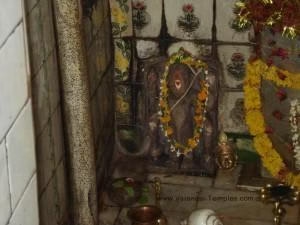
The Tribhuwan Keshav Temple stands as a profound testament to the spiritual density of Varanasi, often referred to as the spiritual capital of India. Located in the southern quadrant of the ancient city, specifically near the revered Dashashwamedh Ghat, this temple is dedicated to Lord Vishnu in his form as Tribhuwan Keshav.
In the sacred geography of Kashi, this temple is situated in what is known as the “South Kashi” region. While the local vernacular might refer to the presiding deity of this area as Tri Lok Sundari Vandi Devi (a form of the Divine Mother), the sanctum sanctorum houses the mighty Lord Vishnu. It is noteworthy that the temple priest also venerates this deity as Dharani Varaha, adding layers of theological depth to the site.
Phalaśruti: The Boon of Liberation
According to the ancient texts of Kashi Khand, the spiritual benefits of worshipping at this temple are unparalleled. The Phalaśruti (the stated benefits of devotion) claims that a devotee who offers sincere prayers to Tribhuwan Keshav is freed from the cycle of rebirth (Samsara). Specifically, it is believed that such a devotee “will not see the womb again,” signifying Moksha (liberation) and a permanent release from the suffering of material existence.
Historical Origins & Scriptural Legend
The history of the Tribhuwan Keshav Temple is deeply interwoven with the scriptural legacy of Varanasi. The primary source of its origin is the Kashi Khand of the Skanda Purana, a vital text that delineates the sacred geography of Kashi.
The Legend of South Kashi
Tradition holds that Madhyameshwar is the geographical and spiritual midpoint of Kashi Kshetra. As per the ancient mapping in Kashi Khand, Dashashwamedh Ghat falls to the South of this midpoint, designating the area as “South Kashi.” The Tribhuwan Keshav Temple is a central anchor in this southern quadrant, standing as a guardian of the southern spiritual borders.
📖 Related: Samudreshwar Temple, Varanasi: History, Darshan Timings & Kashi Khand Legend
While specific dynastic records regarding the original construction are sparse—a common occurrence with ancient Kashi temples that have been reconstructed over centuries—the oral history preserved by the local Pujaris (priests) dates the idol’s worship back to medieval eras. The temple complex also houses a Shiv Linga known as Prayageshwar, suggesting a harmonious syncretism of Vaishnavite and Shaivite traditions within the premises.
Architectural Marvels
The architectural style of the Tribhuwan Keshav Temple is a classic representation of the Nagara style, predominant in North India. While the exterior structure is modest compared to the massive temples of the plains, it exhibits the quintessential elements of Hindu temple architecture.
- Shikhara (Tower): The temple features a curvilinear Shikhara that rises towards the sky, symbolizing the Meru mountain—the axis of the universe. The spire is adorned with Amalakas (stone disks) and a Kalasha (finial) at the apex.
- Mandapa (Hall): The prayer hall is designed to accommodate devotees, featuring carved stone brackets and pillars that depict scenes from Hindu mythology.
- Sanctum Sanctorum (Garbhagriha): The innermost chamber is intimate and dark, housing the Murti (idol) of Tribhuwan Keshav. The idol depicts Lord Vishnu with his attributes—the Sudarshana Chakra (discus) and the Shankha (conch).
- Stone Work: The temple utilizes the local sandstone typical of Varanasi architecture, featuring intricate carvings that have been maintained by generations of caretakers.
| Date built: | – |
|---|---|
| Deity: | Tribhuwan Keshav |
| Architectural style: | Hindu Temple architecture |
| Major festivals | – |
| Locale: | Varanasi |
| District:: | Varanasi |
| Address: | – |
| Phone | – |
Darshan & Ritual Logistics
For devotees planning a visit to this ancient site, the temple follows traditional Vedic rituals. The atmosphere is particularly charged during the early morning and evening Aartis.
Daily Darshan Timings
Timings are subject to change during festivals and special occasions. The temple generally opens at dawn and closes late at night.
| Session | Timing | Activity |
|---|---|---|
| Morning Darshan | 05:30 AM – 12:00 PM | Mangala Aarti, Shringar Darshan |
| Afternoon Break | 12:00 PM – 3:00 PM | Temple remains closed |
| Evening Darshan | 4:00 PM – 9:00 PM | Shayan Aarti, Bhog Offering |
Seva & Pooja Bookings
While this is an ancient temple, many rituals are managed through local priestly families. For standardized online bookings, devotees often utilize the central Varanasi temple commission portals or direct on-site arrangements.
- Abhishekam: Performed with milk, honey, and ghee. Best time: 7:00 AM.
- Archana: Recitation of 108 names of Lord Vishnu. Available throughout the day.
- Online Seva: For this specific shrine, direct online booking via government portals is limited. It is recommended to contact the temple priest locally or book through broader Kashi Vishwanath Temple trust portals if integrated, or simply perform rituals personally for a more intimate experience.
📖 Related: Ganeshwar Rameshwar Temple Varanasi: History, Darshan Timings & Guide
2026 Festival Dates
Mark your calendars for these major celebrations at Tribhuwan Keshav Temple:
- Maha Shivaratri: February 26, 2026 (Celebrated with special Pujas for the Prayageshwar Shiv Ling).
- Rama Navami: April 6, 2026 (Birth of Lord Rama, an avatar of Vishnu).
- Janmashtami: August 14, 2026 (Birth of Lord Krishna).
- Diwali: October 21, 2026 (Deepotsav lighting of lamps).
- Bhaidooj: October 24, 2026 (Festival honoring the brother-sister bond).
Practical Visitor Guidance
Visiting the Tribhuwan Keshav Temple requires preparation regarding attire and logistics, as it is located in the bustling lanes near the Ghat.
- Dress Code: Traditional Indian attire (Kurta-Pajama for men, Saree/Salwar Kameez for women) is recommended. Modest clothing covering shoulders and knees is mandatory.
- Photography: Photography is strictly prohibited inside the sanctum sanctorum. Mobile phones should be kept silent.
- Lockers: There are no official mobile lockers at this small shrine. It is advisable to carry minimal belongings. Secure storage is available at larger facilities near Dashashwamedh Ghat.
- Accessibility: The temple is accessible via narrow stone-paved alleys. It is not wheelchair accessible. Wear comfortable, slip-resistant footwear as the lanes can be slippery.
Crowd Management
- Best Hours: The ideal time for a peaceful Darshan is between 6:00 AM and 8:00 AM, or after 7:00 PM in the evening.
- Seasonal Advice: In summer (May-June), temperatures in Varanasi can exceed 40°C (104°F). Carry a water bottle and a head covering. Winters (Dec-Jan) are pleasant but mornings are foggy; carry a light jacket.
Pilgrimage Connectivity
The temple is situated at a highly significant location in Varanasi, making it accessible via multiple modes of transport.
How to Reach
- Airport: Lal Bahadur Shastri International Airport (VNS) is approximately 25 km away. Taxis and E-rickshaws are available directly to Dashashwamedh Ghat.
- Railway Station: Varanasi Junction (BSB) is roughly 6 km away. Auto-rickshaws are the most common transport to the ghat area.
- Road: The temple is near NH-19 (formerly NH-2). From the main road, one must walk towards Dashashwamedh Ghat.
Location Specifics
Address: D.17/100, Bandi Devi, Dasaswamedh Ghat, Varanasi, Uttar Pradesh 221001.
📖 Related: Mahabal Narsimha Temple Varanasi: History, Darshan Timings & Guide
Note on Confusion: There is some theological debate among local Pundits regarding the exact identity of the deity at D.17/100. Some refer to it as Dharani Varaha or Prayag Madhav. However, the consensus among the temple priests at this location is that the worshipped form is Tribhuwan Keshav. It is best to inquire at the vegetable market just before the Ghat for specific directions to “Bandi Devi” or “Tribhuwan Keshav.”
Nearby Sacred Sites (Pilgrimage Circuit)
Enhance your spiritual journey by visiting these nearby landmarks:
- Dashashwamedh Ghat: Just steps away, famous for the grand Ganga Aarti.
- Kashi Vishwanath Temple (New Temple): Located approximately 1.5 km away (a 15-minute walk through the lanes).
- Manikarnika Ghat: The sacred cremation ground, 1 km north, representing the ultimate truth of life and death.
In Tri Lok Sundari Vandi Devi’s South Kashi, Lord Vishnu is present in the form of Tribhuwan Keshav. (Kashi Khand mentions this as Bhuwan Keshav).
Devotees who worship Tribhuwan Keshav will not see womb again, meaning thereby that there will be no rebirth.
Frequently Asked Questions (FAQs)
1. Is there a VIP Darshan entry at Tribhuwan Keshav Temple?
As this is a smaller, ancient temple in the old city, there is no formal VIP entry system like at larger institutional temples. Darshan is generally accessible to all, though visiting early in the morning naturally offers a quicker, more intimate experience.
2. Can I perform Rudrabhishek at this temple?
Yes, due to the presence of the Prayageshwar Shiv Ling in the temple premises, Rudrabhishek and other Shaivite rituals can be performed here by the resident priest.
3. Is non-vegetarian food allowed near the temple?
No. Varanasi is a holy city, and the area surrounding the temple is strictly vegetarian. Alcohol and meat are prohibited in the vicinity of the temple and on the Ghats.
4. What is the significance of the name “Tribhuwan Keshav”?
“Tribhuwan” refers to the three worlds (Earth, Heaven, and Netherworld), and “Keshav” is a name of Lord Vishnu meaning the one who controls the sun, moon, and fire. The name signifies the omnipresence of the Lord across all realms.
5. Where can I park my vehicle?
Parking is extremely limited near Dashashwamedh Ghat. It is advisable to park at the designated parking areas near Godaulia or Lanka and walk or take an electric rickshaw to the ghat area.