

Contents
Introduction & Spiritual Essence
Perched amidst the lush green hills of Tripura, Unakoti is not merely a stone carving site; it is a living, breathing ashram of eternal silence and divine grace. Literally translating to “one less than a crore” (from Bengali Ek-koti) in local folklore, the site is home to thousands of ancient rock-cut reliefs and stone sculptures dating back to the 7th to 9th centuries CE. This massive open-air gallery is the premier Shaivite pilgrimage destination in North East India.
Phalaśruti: Why Devotees Visit
According to ancient texts and local beliefs, a visit to Unakoti washes away the sins of past lives. Unlike conventional temples where a deity resides in the sanctum, here the entire hill is the manifestation of the divine.
- Karmic Cleansing: It is believed that Lord Shiva himself cursed the gods who failed to wake up on time to turn to stone. Witnessing these stones is said to absolve devotees of the burden of Karma.
- Ancestral Peace: Offering prayers here is considered highly auspicious for Pitra Tarpan (paying homage to ancestors), helping their souls attain Moksha (liberation).
- Spiritual Awakening: The site’s alignment with the natural landscape offers a unique energy field conducive to meditation and inner peace.
Historical Origins & Scriptural Legend
The history of Unakoti is shrouded in the mists of time, blending archaeological evidence with rich oral traditions.
The Legend of the Sleeping Gods
The primary Sthala Purana (local legend) narrates a fascinating story. It is said that Lord Shiva was journeying to Kashi (Varanasi) with one crore gods and goddesses. He halted at this spot for the night and instructed the entourage to wake up before sunrise. However, when the sun rose, only Lord Shiva was awake. Annoyed by their slumber, he cursed the others to turn into stone images. Consequently, the hill bears one less than a crore sculptures—thus the name Unakoti.
Another popular folklore speaks of a master blacksmith named Kallu who wished to accompany Shiva and Parvati to Mount Kailash. The Goddess challenged him to carve one crore idols of Shiva in a single night. Though he nearly succeeded, the count fell short by one, cementing the name of the site.
Archaeological & Administrative Timeline
While theological traditions date the site to the Treta Yuga, historians and the Archaeological Survey of India (ASI) place the carvings between the 7th and 9th centuries AD, likely during the reign of the Manikya Dynasty. The Manikya rulers were the sovereigns of the princely state of Tripura, noted in the Rajmala (the royal chronicle of Tripura).
Following the North-East Reorganisation Act of 1971, Tripura gained full statehood in 1972. The administrative boundaries shifted over the decades, leading to the creation of the Unakoti District on January 21, 2012, with its headquarters in Kailashahar, to preserve and promote this heritage site.
Architectural Marvels
Unakoti represents the earliest and finest examples of rock-cut architecture in Eastern India. The complex is a unique blend of indigenous tribal aesthetics and classical Indian temple architecture.
Style and Vastu
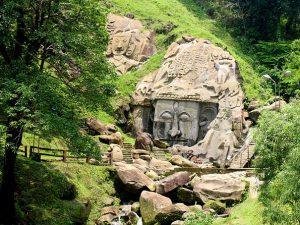
The architecture primarily follows the Nagara style of temple design, characterized by vertical superstructures, though it bears distinct tribal influences. The carvings are executed on laterite rock faces, creating a visual narrative that spirals up the hill.
Key Sculptural Features
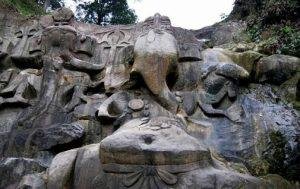
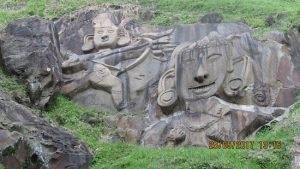
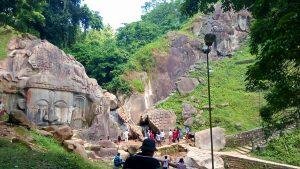
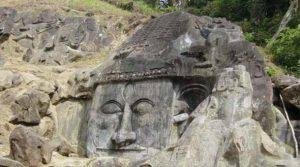
- Unakotiswara Kal Bhairava: The central attraction is a colossal 3-meter high relief of Lord Shiva (Unakotiswara) with an elaborate headdress. Flanking him are two full-scale female figures—Abhira (Goddess Ganga) and Chandi (Goddess Durga)—adding to the height.
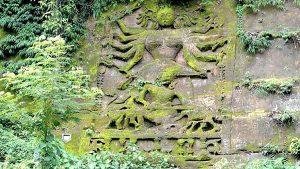
- Nataraja: Several panels depict Shiva as the cosmic dancer (Nataraja), showcasing movement and fluidity carved into hard rock.
- Devi Panels: Aside from the central figures, smaller reliefs of deities like Ganesh and Vishnu are scattered around.
While the carvings themselves are the primary structure, the site is complemented by the Three-tiered waterfall nearby, creating a natural Mandapa (hall) for the divine imagery. Unakoti is currently under review for potential inclusion as a UNESCO World Heritage Site due to its outstanding universal value.
Darshan & Ritual Logistics (2026 Update)
To facilitate a smooth spiritual journey, devotees should be aware of the timings and specific sevas offered.
Daily Darshan Timings
| Session | Timings | Details |
|---|---|---|
| Morning | 06:00 AM – 12:00 PM | Best for photography and peaceful viewing. Begins with morning aarti. |
| Afternoon | 12:00 PM – 04:00 PM | Site partially closed for maintenance and cleaning. |
| Evening | 04:00 PM – 06:30 PM | Ideal for seeing the carvings in the golden hour light. Gates close at dusk. |
Sevas & Online Booking
While traditional temple priesthood services are performed by local priests (mostly descendants of the Raj Purohit), the Tourism Department and local trusts organize special pujas during festivals. For specific rituals like Rudrabhishekam, devotees must contact the Unakoti Tourism Development Corporation desk at the entry gate.
Note: As of 2026, a dedicated app for “Tripura Darshan” is available for booking guided heritage walks, though live-stream darshan services are currently in beta testing for remote devotees.
Major Festivals in 2026
- Maha Shivaratri: February 26, 2026. The most significant event here. Thousands gather for a night-long vigil, accompanied by traditional Dhak (drum) beats and Baul folk music.
- Ashokashtami: April 4, 2026. A special chariot procession is held in the nearby Kailashahar area, closely linked to Unakoti’s mythology.
- Kharchi Puja: July 2026 (dates TBD). Although primarily a Agartala festival, special pujas are often organized here to honor the tribal deities merged with Shaivism.
Practical Visitor Guidance
Visiting Unakoti requires moderate physical fitness due to the hilly terrain.
Visitor Etiquette & Essentials
- Dress Code: Traditional or modest clothing is recommended. As this is a major pilgrimage site, avoid sleeveless tops or very short garments.
- Photography: Photography is allowed and encouraged for personal use. However, professional shoots and drones require prior permission from the local magistrate due to security concerns in the border state.
- Footwear & Lockers: Shoes must be removed at the designated holding area before climbing the main stairs. Secure shoe-keeping facilities are available for a nominal fee.
- Accessibility: The main carvings are accessible via stone steps. While ramps have been installed in newer sections, the uppermost levels remain challenging for wheelchair users.
Crowd Management & Seasonal Advice
- Best Hours: 6:00 AM – 8:00 AM on weekdays offers the most serene experience.
- Weather: October to March is ideal. Summers (April–June) are humid and sunny; carry a hat, sunglasses, and ample water.
- Monsoon: The rocks become slippery during heavy rains (July–September). Exercise extreme caution on the steps.
Pilgrimage Connectivity
How to Reach Unakoti
- By Air: The nearest airport is Maharaja Bir Bikram Airport in Agartala (IXB), approximately 178 km away. Taxis are available from the airport.
- By Rail: The closest railhead is Dharmanagar Railway Station (19.6 km). It connects to Guwahati and Kolkata via the Lumding–Sabroom section. The journey from Agartala to Dharmanagar by train takes about 3 hours.
- By Road: Unakoti is located 8 km east of Kailashahar. The site is well-connected via the Dharmanagar – Kailashahar Road (NH 8). Regular bus and taxi services operate from Agartala, Dharmanagar, and Kailashahar.
Nearby Sacred Sites (The Pilgrimage Circuit)
Extend your spiritual journey by visiting these nearby destinations:
- Kamala Sagar Kali Temple: Located in Kasba (approx. 18 km from Unakoti). A historic temple built by the Manikya kings on the banks of the Kamala Sagar river.
- Panchakot (Panchakunda): An ancient archaeological site featuring the ruins of a 10th-century temple complex, showcasing terracotta art and stone sculptures.
- Rudrasagar Lake: A significant wetland and sacred water body located in Melaghar (approx. 60 km away), known for the Neer Mahal palace.
Photo Gallery
Frequently Asked Questions (FAQs)
1. Is there a VIP darshan entry available at Unakoti?
Generally, Unakoti does not offer a VIP darshan system like Tirupati. However, elderly citizens and differently-abled visitors can use an electric buggy service (subject to availability) to reach the halfway point. For group VIP visits, prior permission from the Unakoti District Magistrate is required.
2. What is the entry fee for Unakoti?
There is a nominal entry fee for Indian citizens (typically around INR 20-50) and a higher fee for foreign tourists (INR 500+). Prices are subject to revision by the Archaeological Survey of India (ASI) and State Tourism.
3. Are there accommodation options near the temple?
Yes. Options range from the Tourist Lodge maintained by TADC in Kailashahar to budget hotels and homestays in Dharmanagar. For a spiritual stay, the Dharamshalas (pilgrim rest houses) in Kailashahar offer basic amenities.
4. Is the site safe for solo female travelers?
Unakoti is generally considered safe for solo travelers. However, due to the remote forest setting, it is advisable to visit during daylight hours. ASI security personnel are usually present at the site entry.
5. Why is it called “One less than a crore”?
The name is derived from a local legend. It is said Lord Shiva traveled with one crore (10 million) gods and goddesses. When they overslept and were turned to stone, the count of sculptures found was one less than a crore, hence the name “Unakoti.”
Contact Details
Unakoti Archaeological Site Office
Address: Dharmanagar – Kailashahar Rd, Uttar Unakoti R.F., Tripura 799254
District: Unakoti
Nearest Town: Kailashahar (8 km)
For the latest updates on ticket prices and visiting hours, please contact the Unakoti District Tourism Office at Kailashahar.
Recent Posts

Shri Kaamkoteeshwar Mandir, Varanasi – History & Significance
In the heart of Kashi, the eternal city of Lord Shiva, where the Ganges flows with celestial grace, stands the Shri Kaamkoteeshwar Mandir. This sacred Sannidhi is not merely a temple but a profound spiritual bridge between the Northern…

ओ सांवरे तूने ही मुझको संभाला – Lyrics & Meaning
ओ सांवरे तूने ही मुझको संभाला – A Prayer to Shyam Origin & Spiritual Essence Why This Bhajan Resonates Devotees chant this when overwhelmed by life’s storms—the refrain ‘तूने ही मुझको संभाला’ is the soul’s sigh of relief: “You…

कथा ये है महाराज मेरे की – Lyrics & Meaning
कथा ये है महाराज मेरे की छत्रपति संभाजी महाराज – A Prayer to Chhatrapati Sambhaji Maharaj Origin & Spiritual Essence Why This Bhajan Resonates Devotees chant this when their spirit feels tested—its powerful refrain “महाराज मेरे” is a soul’s…

Rigveda Samhita Yathartha Anuvada (ऋग्वेद संहिता यथार्थ अनुवाद) – Complete Set with Anvayartha & Hindi/English Translation
The Rigveda is the oldest surviving scripture of humanity and the foundational text of Sanātana Dharma. For serious students, scholars, UPSC aspirants studying ancient Indian history, Sanskrit learners, and spiritual seekers, a precise and grammatically structured translation is indispensable.…

आना भी अकेला है जाना भी अकेला है – Lyrics & Meaning | BharatTemples
आना भी अकेला है जाना भी अकेला है – A Prayer to the Divine Witness Origin & Spiritual Essence Why This Bhajan Resonates Devotees turn to this bhajan in moments of deep reflection—when life’s attachments begin to ache. The…

माता शेरावाली के द्वार जो भी जाता है – Lyrics & Meaning
माता शेरावाली के द्वार जो भी जाता है – A Prayer to Maa Sherawali Origin & Spiritual Essence Why This Bhajan Resonates Devotees turn to this bhajan in times of fear or uncertainty—its promise that no one leaves Maa’s…

मार लेना सपणी उबार लेणा भवरा – Lyrics & Meaning
मार लेना सपणी उबार लेणा भवरा – A Prayer to the Divine Beloved Origin & Spiritual Essence Why This Bhajan Resonates Devotees chant this in moments of deep vulnerability—its cry of “मार लेना सपणी, उबार लेणा भवरा” is the…

हमें श्याम सुंदर भरोसा तुम्हारा – Lyrics & Meaning
हमें श्याम सुंदर भरोसा तुम्हारा – A Prayer to Shyam Sundar Origin & Spiritual Essence Why This Bhajan Resonates Devotees chant this when feeling alone—its refrain ‘de do sahara’ is the soul’s cry for divine support. Lyrics in Hindi…

Mere Satguru Ne Di Thi Davai Lyrics in Hindi & Meaning
Mere Satguru Ne Di Thi Davai: Invoking the Guru’s Liberating Wisdom This soul-stirring bhajan venerates the Satguru (True Spiritual Master) as the divine physician who dispenses the only remedy for life’s deepest sufferings. Composed by Sant Karmaveer Tufani, it…

Janm Diyo Thari Maa Dukh Dekhiyo Lyrics in Hindi & Meaning
जन्म दियो थारी माँ दुख देखियो (Maa’s Grief Upon Birthing You) This soul-stirring Chetavani Bhajan (admonitory hymn) is addressed to the Divine Mother (Maa) – a call for repentance when children forget their filial duties in the dark age…