Up Shanteshwar Temple, Varanasi: History, Darshan Timings & Pilgrimage Guide
Receive daily temple updates, divine darshan, and morning bhajans directly on WhatsApp.
Contents
- 1 Introduction & Spiritual Essence
- 2 Historical Origins & Scriptural Legend
- 3 Architectural Marvels
- 4 Darshan & Ritual Logistics
- 5 Practical Visitor Guidance
- 6 Pilgrimage Connectivity
- 7 Frequently Asked Questions (FAQ)
- 8 Photo Gallery
- 9 Contact Details
Introduction & Spiritual Essence
In the labyrinthine spiritual geography of Kashi (Varanasi), every lane resonates with divine vibrations. The Up Shanteshwar Temple stands as a testament to the profound spiritual wealth described in the ancient texts. Dedicated to Lord Shiva in the form of a Swayambhu (self-manifested) Lingam, this shrine is a beacon of inner peace and purification.
According to the sacred Kashi Khand of the Skanda Purana, Up Shanteshwar is not merely a temple but a cosmic center for mental tranquility. The primary deity, Shanteshwar Mahadev (the Lord of Peace), is revered for his ability to absolve devotees of the burdens of their past actions and accumulated sins.
Phalaśruti: The Fruits of Visiting
Devotees flock to this ancient shrine seeking specific spiritual benefits:
- Mental Peace (Shanti): The very name “Up Shanteshwar” implies the attainment of supreme mental calm and the dissolution of anxiety.
- Cleansing of Ancestral Karma: It is believed that performing rituals here helps liberate ancestors from the cycle of rebirth, particularly those trapped in Pitru Dosha.
- Sin Removal: As per local legends, a mere touch of the Lingam washes away sins accumulated over lifetimes.
Historical Origins & Scriptural Legend
While the exact date of construction is not marked in stone, the temple’s origins are deeply rooted in the Vedic era, preserved through oral tradition and scripture.
The Legend of Kashi Khand
Tradition holds that during a divine discourse between Lord Shiva and Goddess Parvati, the secret geography of Kashi was revealed. In Chapter 97 of the Kashi Khand, Lord Shiva describes the divine powers of the Bhadreshwar Lingam. To the north-east of Bhadreshwar lies the Up Shanteshwar Ling.
📖 Related: Gabhasteeshwar Temple, Varanasi: History, Timings & Complete Guide
The scripture narrates that whoever worships this Ling is cleansed of impurities and attains the state of Shanta (peace). This places the temple within a specific spiritual grid of Kashi, where each Lingam represents a chakra of the human body.
Architectural Lineage
Though Varanasi has faced numerous invasions and reconstructions, the Up Shanteshwar Temple represents the resilience of Sanatana Dharma. The current structure, while modest in scale, reflects the classic Nagara style of North Indian temple architecture, adapted to the urban fabric of the old city.
Architectural Marvels
The temple is a fine example of how sacred geometry is integrated into the dense urban landscape of Varanasi.
Vastu Shastra and Design
The temple follows the principles of Vastu Shastra, oriented to capture the morning sun’s rays. The sanctum sanctorum (Garbhagriha) is designed to be intimate, encouraging a personal connection with the deity.
Notable Features
- The Shikhara: The spire above the sanctum is typical of the North Indian style, featuring tiered mini-spires (Urushringa) that ascend toward the sky, symbolizing the ascent of the soul.
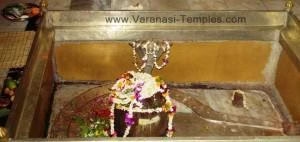
- The Lingam: The deity is a Swayambhu Lingam, naturally formed and housed in a niche that amplifies the acoustic resonance during chanting.
- Sculptures: Though compact, the exterior walls feature intricate carvings of deities from the Hindu pantheon, showcasing the craftsmanship of the Kashi artisans.
Darshan & Ritual Logistics
Visiting Up Shanteshwar requires an appreciation for the slow, devotional pace of temple rituals in Varanasi. Unlike modern complexes, the experience here is organic and immersive.
Daily Timings
Please note: Temple timings in Varanasi are often fluid and may change during festivals or special occasions.
| Session | Timings | Activity |
|---|---|---|
| Morning | 05:00 AM – 12:00 PM | Mangala Aarti, Shringar Darshan |
| Afternoon | 12:00 PM – 04:00 PM | General Darshan (Raj Bhog) |
| Evening | 04:00 PM – 09:00 PM | Shayan Aarti, Closing |
Sevas and Online Booking
While the temple is a smaller shrine, it maintains the sanctity of Vedic rituals.
- Abhishekam: Performed with milk, honey, and Ganga Jal. Best performed during the morning hours.
- Rudrabhishek: A powerful ritual for planetary alignment and peace.
- Archana: Offering of flowers and Bilva leaves with individual name chanting.
📖 Related: Vimal Aditya Temple Varanasi: History, Darshan Timings & Significance
Online Booking: As the Up Shanteshwar Temple is a part of the greater Kashi Vishwanath Corridor ecosystem, specific bookings for smaller shrines are often managed locally. However, for larger rituals, devotees can visit the official Kashi Vishwanath Temple portal or arrange through local priests at the temple office.
Festivals in 2026
- Shivratri (Feb 26, 2026): Night-long vigil and special Abhishekam.
- Sawan Somwar (July – August 2026): Special morning aartis and massive turnouts. Mondays in the month of Sawan are exceptionally auspicious here.
- Maha Shivratri: The temple is illuminated, and Rudrabhishek is performed throughout the day.
Practical Visitor Guidance
Navigating the old city of Varanasi requires preparation. Here is what you need to know for a seamless visit.
Rules and Regulations
- Dress Code: Traditional attire is recommended. Men should wear dhoti or trousers with a shirt; women should wear sarees or modest clothing. Avoid shorts and sleeveless tops.
- Photography: Photography is generally permitted in the outer courtyard but is strictly prohibited inside the Garbhagriha (sanctum).
- Electronic Devices: Mobile phones should be on silent mode. If you need to lock your belongings, small lockers are available near the main entrance of the wider temple complex area.
Crowd Management & Best Time to Visit
- Best Hours: The ideal time for Darshan is early morning (5:00 AM – 7:00 AM) when the streets are quiet and the spiritual atmosphere is dense.
- Seasonal Advice:
- Summer (May-June): Temperatures soar above 40°C. Carry a water bottle and cover your head while walking.
- Monsoon (July-Sept): The Ghats are beautiful, but streets can be slippery. Wear rubber-soled footwear.
Pilgrimage Connectivity
How to Reach
The temple is located in the heart of the old city, making vehicular access restricted. The best approach is on foot or by cycle rickshaw.
- Address: House No. Ck.2/4, Patani Tola, Bhosala Ghat, Varanasi, Uttar Pradesh 221001.
- By Road: Auto-rickshaws can take you to Chowk or Godaulia. From there, it is a 5-10 minute walk through the narrow lanes.
- By Boat: One can hire a boat to Bhosala Ghat. From the Ghat, climb the stairs and navigate through the lanes toward Sankata Devi Temple.
- Landmarks: Look for the Sankata Devi Temple and the Gangamahal Building. The temple is situated nearby.
Nearby Sacred Sites (Pilgrimage Circuit)
- Kashi Vishwanath Temple (Approx. 1.5 km): The main Jyotirlinga. A visit to Varanasi is incomplete without this.
- Sankata Devi Temple (Walking Distance): Located very close to Up Shanteshwar, this temple is dedicated to Goddess Sankata (the remover of obstacles).
- Bhadreshwar Temple (Walking Distance): The parent Lingam mentioned in the Kashi Khand, from which Up Shanteshwar is situated to the north-east.
📖 Related: Jateeshwar & Pataleshwar Temple History and Darshan Timings: Varanasi Guide
Frequently Asked Questions (FAQ)
1. What is the history of Up Shanteshwar Temple?
According to the Kashi Khand (Chapter 97) of the Skanda Purana, Lord Shiva described the significance of this Lingam to Goddess Parvati. It is situated near Bhadreshwar and is considered a site for attaining supreme mental peace and cleansing sins.
2. Is there a VIP darshan entry available?
As Up Shanteshwar is a smaller, historic shrine within the old city, there is no formal VIP darshan system like larger tourist attractions. Darshan is first-come, first-served. However, approaching the temple during off-peak hours (early morning) ensures a peaceful and quick audience with the deity.
3. How can I perform an Abhishekam at the temple?
Devotees can perform Abhishekam by speaking to the resident priest at the temple. It is advisable to carry milk, curd, honey, and ghee from reputable local vendors. While online booking for major temples like Kashi Vishwanath exists, rituals at Up Shanteshwar are typically arranged directly on-site.
4. Is the temple accessible for senior citizens?
The temple is located in the old city, which has narrow, uneven lanes. While the temple itself has minimal steps, the approach road is challenging for wheelchairs. It is recommended to use a cycle rickshaw right up to the entrance gate.
5. What is the significance of the ‘Up’ in the temple name?
In Sanskrit and local context, ‘Up’ often means ‘near’ or ‘secondary’. In this context, it refers to the temple’s location relative to the Bhadreshwar Lingam. However, its spiritual power is considered equally potent as a primary shrine.
Photo Gallery

Up-Shanteshwar2-300×142, Up Shanteshwar Temple, Varanasi
Contact Details
For local inquiries or priest services:
Address: House No. Ck.2/4, Patani Tola, Bhosala Ghat, Varanasi, Uttar Pradesh 221001
Map location is approximate. Please navigate via local landmarks Sankata Devi Temple and Gangamahal Building.