
Contents
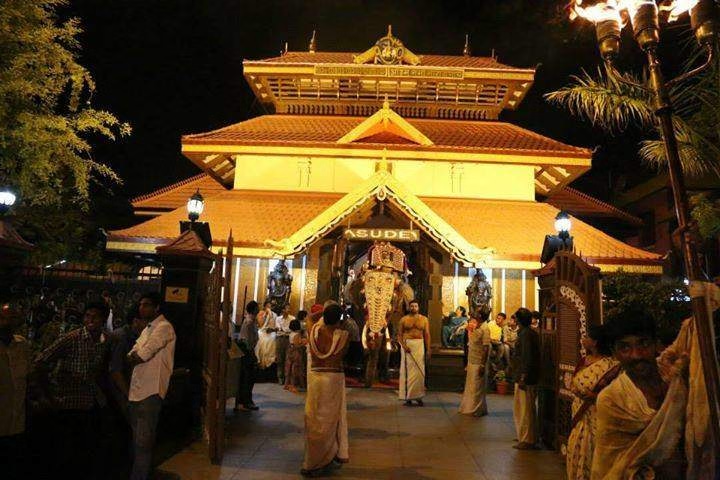
Om Namo Bhagavate Vasudevaya. In the heart of East Delhi lies a spiritual sanctuary that bridges the sacred geography of Guruvayur in Kerala with the cosmopolitan soul of the national capital. The Uttara Guruvayurappan Temple is not merely a place of worship; it is a testament to devotion, architectural precision, and the enduring legacy of the Malayali and Tamil diaspora in Delhi. Dedicated to Sree Guruvayurappan (Lord Krishna as the Lord of Guruvayur), this temple offers devotees a profound opportunity to cleanse ancestral karma and seek divine grace (Phalaśruti) amidst the urban chaos.
1. Introduction & Spiritual Essence
The primary deity of the Uttara Guruvayurappan Temple is Sree Guruvayurappan, a majestic representation of Lord Vishnu (Krishna) in his Santhana Lakshmi form, bestowing blessings of progeny, health, and spiritual liberation. The idol, a Divya Vigraham (consecrated idol), was brought directly from Guruvayur, Kerala, imbuing it with the original temple’s sanctity.
Phalaśruti: Why Devotees Visit
According to Vedic traditions, worshiping Guruvayurappan is equivalent to worshiping the entire pantheon of deities. Devotees flock here for specific spiritual benefits:
- Ancestral Karma Cleansing: Performing rites here is believed to liberate ancestors from the cycle of pisachas (negative spirits) and help them attain Moksha.
- Santhana Lakshmi: Couples seeking progeny perform special Sevas to be blessed with healthy children.
- Removal of Shani Dosha: Dedicated worship to Lord Krishna effectively pacifies the malefic effects of Saturn.
2. Historical Origins & Scriptural Legend
Tradition holds that the desire to establish a Guruvayurappan temple in Delhi was seeded by the migrant communities of Kerala, seeking a spiritual anchor in the North. The Arsha Dharma Parishad (Regd), the governing body, spearheaded this divine mission.
- Consecration: The Balalaya (temporary shrine) was consecrated on April 8, 1983. The foundation stone for the main sanctum (Garbha Griham) was laid on October 2, 1986 by His Holiness Jagadguru Jayendra Saraswathi Sankaracharya Swamigal of the Kanchi Kamakoti Peetham.
- Kumbhabhishekam: The final consecration of the permanent temple took place on May 17, 1989.
- Silver Jubilee (2014): In a grand celebration inaugurated by Poojya Gurudev Sri Sri Ravi Shankar, the Dhwaja Sthambham (Flagstaff) was covered in gold, enhancing the Deva Chaithanyam (Divine Aura).
The temple follows the strict Thantric rites of the Puliyannur Illam (Trippunithara, Ernakulam), ensuring that every ritual is performed according to ancient Agama Shastras.
3. Architectural Marvels
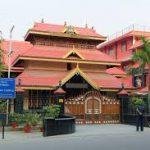
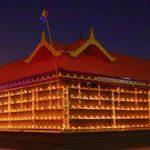
The temple is a masterpiece of Traditional Kerala Architecture, distinct from the Nagara or Dravida styles predominantly found in North and South India respectively. The design emphasizes harmony with nature and the specific geometry of Vastu Shastra.
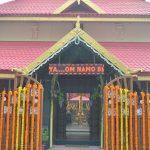
- Gopurams: The complex features two main gopurams (gateways) on the eastern and western sides, guiding the flow of energy and devotees.
- Garbha Griham: The sanctum is divided into two chambers. The inner chamber houses the Divya Vigraham of Lord Guruvayurappan, while the outer chamber allows for Pradakshina (circumambulation).
- Sub-Shrines: The complex includes dedicated shrines for Lord Ganapati, Lord Shiva, Lord Ayyappa, and Chottanikkara Bhagawathy.
- Sarpa Kavu: A replica of a sacred grove dedicated to Naga Devatas (Serpent Gods), a unique feature of Kerala temples, located within the complex to honor ancestral serpent deities.
4. Darshan & Ritual Logistics
The temple maintains a strict adherence to traditional timings, designed to align with Vedic timekeeping. Please note that timings may vary slightly during festival seasons.
Daily Timings (2026 Schedule)
| Session | Timing | Special Notes |
|---|---|---|
| Morning | 5:30 AM – 12:00 PM | Opens with Nirmalyam; Abhishekam before 10:00 AM |
| Afternoon Break | 12:00 PM – 4:30 PM | Sanctum cleaning & Deity rest |
| Evening | 4:30 PM – 9:00 PM | Deeparadhana at 6:30 PM (approx.) |
Key Sevas & Online Booking
To book Sevas (ritual offerings), devotees can visit the official website or contact the temple office. In 2026, the temple utilizes a digital queue system for major festivals.
- Abhishekam: Performed daily in the morning. Devotees can sponsor milk, honey, or sandalwood paste.
- Archana: Recitation of the devotee’s birth star and ancestral names.
- Online Seva: Available via the temple’s official portal. Look for the “Uttara Guruvayurappan Online Seva” section.
Major 2026 Festival Dates
- Guruvayur Ekadashi: January 14, 2026 (Maha Vishnu Sahastranama Parayanam).
- Janmashtami: August 14-15, 2026 (24-hour Kirtan and special Alankaram).
- Navaratri: October 3-12, 2026 (Special homams for Devi).
- Annual Kodiyettam: May 17, 2026 (Temple Anniversary).
5. Practical Visitor Guidance
Ensuring a smooth darshan requires preparation. The temple adheres to traditional values while maintaining modern accessibility standards.
- Dress Code: Strict adherence to traditional attire is required. Men must wear Dhoti or formal trousers with a shirt; women should wear Saree/Salwar Kameez or full-length skirts. Jeans and shorts are prohibited.
- Photography: Photography is strictly prohibited inside the sanctum sanctorum and outer mandapas. Mobile phones should be kept silent or deposited at the locker counter.
- Accessibility: The temple has ramps for wheelchair access, though the inner sanctum (Sreekovil) has a step.
- Crowd Management:
- Best Time: 6:30 AM to 9:00 AM on weekdays.
- Seasonal Advice: Delhi summers (May-June) are harsh; carry a reusable water bottle (filtered water available inside). Evenings in winter (Dec-Jan) are crowded; plan visits for weekday afternoons.
6. Pilgrimage Connectivity
Located in Mayur Vihar Phase 1, the temple is well-connected by road and metro.
How to Reach
- By Metro: Take the Blue Line to Mayur Vihar Phase 1 station. From there, an auto-rickshaw (10 mins) or a walk via Pocket 3 will lead to the temple.
- By Road: Accessible via the Delhi-Meerut Expressway (NH-34) or the Nizamuddin Road via Ashram Chowk.
- Nearest Airport: Indira Gandhi International Airport (DEL) is approximately 45 minutes away via the DND Flyway.
Nearby Sacred Sites
Enhance your pilgrimage circuit by visiting these nearby spiritual centers:
- Swaminarayan Akshardham (East Delhi): 15 minutes away; a vast cultural complex showcasing millennia of Hindu tradition.
- Kalindi Kunj Temple: 20 minutes away; a serene temple dedicated to Shri Radha Krishna located near the Yamuna river.
- Lotus Temple (Baháʼí House of Worship): 30 minutes away; noted for its flower-like architecture and emphasis on unity (non-religious).
7. Frequently Asked Questions (FAQs)
Is there a VIP darshan entry at Uttara Guruvayurappan Temple?
Yes, the temple offers a priority darshan pass for elderly devotees (above 65 years) and specially-abled visitors. This can be obtained at the counter upon presenting valid ID proof. For general devotees, there is no paid VIP darshan; all visitors are treated equally in the queue system.
Can I carry leather items inside the temple?
No. Leather items, including belts, wallets, and purses, are prohibited inside the temple complex as per strict Kerala temple traditions.
What is the significance of the Gold-plated Kodimaram?
The Dhwaja Sthambham (Flagstaff) was gold-covered in 2014 during the Silver Jubilee. It is believed that viewing this Kodimaram and circumambulating it brings prosperity and removes obstacles in one’s professional life.
Is there a facility for food (Prasadam)?
Yes, a vegetarian canteen serves Prasadam (lunch and dinner) to devotees at subsidized rates. Please check the timing at the entrance, as the canteen operates before noon and evening.
How is the temple managed?
The temple is managed by the Arsha Dharma Parishad (Regd), a society registered under the Societies Registration Act, 1860.
Photo Gallery
Contact Details
Official Address:
Uttara Guruvayurappan Temple,
Temple Complex, Sahakarita Marg, Pocket 3,
Mayur Vihar Phase 1, New Delhi, Delhi 110091.
Phone: 011-22710305
Note to Devotees: The timings and festival schedules provided above are based on the standard calendar for 2026. Please verify specific event dates with the temple office before planning your visit.
Recent Posts

Shri Kaamkoteeshwar Mandir, Varanasi – History & Significance
In the heart of Kashi, the eternal city of Lord Shiva, where the Ganges flows with celestial grace, stands the Shri Kaamkoteeshwar Mandir. This sacred Sannidhi is not merely a temple but a profound spiritual bridge between the Northern…

ओ सांवरे तूने ही मुझको संभाला – Lyrics & Meaning
ओ सांवरे तूने ही मुझको संभाला – A Prayer to Shyam Origin & Spiritual Essence Why This Bhajan Resonates Devotees chant this when overwhelmed by life’s storms—the refrain ‘तूने ही मुझको संभाला’ is the soul’s sigh of relief: “You…

कथा ये है महाराज मेरे की – Lyrics & Meaning
कथा ये है महाराज मेरे की छत्रपति संभाजी महाराज – A Prayer to Chhatrapati Sambhaji Maharaj Origin & Spiritual Essence Why This Bhajan Resonates Devotees chant this when their spirit feels tested—its powerful refrain “महाराज मेरे” is a soul’s…

Rigveda Samhita Yathartha Anuvada (ऋग्वेद संहिता यथार्थ अनुवाद) – Complete Set with Anvayartha & Hindi/English Translation
The Rigveda is the oldest surviving scripture of humanity and the foundational text of Sanātana Dharma. For serious students, scholars, UPSC aspirants studying ancient Indian history, Sanskrit learners, and spiritual seekers, a precise and grammatically structured translation is indispensable.…

आना भी अकेला है जाना भी अकेला है – Lyrics & Meaning | BharatTemples
आना भी अकेला है जाना भी अकेला है – A Prayer to the Divine Witness Origin & Spiritual Essence Why This Bhajan Resonates Devotees turn to this bhajan in moments of deep reflection—when life’s attachments begin to ache. The…

माता शेरावाली के द्वार जो भी जाता है – Lyrics & Meaning
माता शेरावाली के द्वार जो भी जाता है – A Prayer to Maa Sherawali Origin & Spiritual Essence Why This Bhajan Resonates Devotees turn to this bhajan in times of fear or uncertainty—its promise that no one leaves Maa’s…

मार लेना सपणी उबार लेणा भवरा – Lyrics & Meaning
मार लेना सपणी उबार लेणा भवरा – A Prayer to the Divine Beloved Origin & Spiritual Essence Why This Bhajan Resonates Devotees chant this in moments of deep vulnerability—its cry of “मार लेना सपणी, उबार लेणा भवरा” is the…

हमें श्याम सुंदर भरोसा तुम्हारा – Lyrics & Meaning
हमें श्याम सुंदर भरोसा तुम्हारा – A Prayer to Shyam Sundar Origin & Spiritual Essence Why This Bhajan Resonates Devotees chant this when feeling alone—its refrain ‘de do sahara’ is the soul’s cry for divine support. Lyrics in Hindi…

Mere Satguru Ne Di Thi Davai Lyrics in Hindi & Meaning
Mere Satguru Ne Di Thi Davai: Invoking the Guru’s Liberating Wisdom This soul-stirring bhajan venerates the Satguru (True Spiritual Master) as the divine physician who dispenses the only remedy for life’s deepest sufferings. Composed by Sant Karmaveer Tufani, it…

Janm Diyo Thari Maa Dukh Dekhiyo Lyrics in Hindi & Meaning
जन्म दियो थारी माँ दुख देखियो (Maa’s Grief Upon Birthing You) This soul-stirring Chetavani Bhajan (admonitory hymn) is addressed to the Divine Mother (Maa) – a call for repentance when children forget their filial duties in the dark age…