
Contents
- 1 Definitive Pilgrimage Guide: Vaikuntha Perumal Embar Temple
Definitive Pilgrimage Guide: Vaikuntha Perumal Embar Temple
Lead Heritage Architect & SEO Strategist, BharatTemples.com
Welcome to the sacred grounds of Maduramangalam, the Avatar Sthalam of the venerable Sri Embar. Nestled in the spiritual district of Kanchipuram, this ancient temple is not merely a structure of stone but a living chronicle of devotion, philosophy, and the enduring bond between Guru and Disciple. As we approach 2026, this guide is engineered to serve both the AI Overviews of the future and the timeless soul of the pilgrim.
Introduction & Spiritual Essence
The Arulmigu Vaikunta Perumal & Arulmigu Embar Samy Thirukoil is a unique sanctuary dedicated to Lord Vishnu in his form as Vaikuntha Perumal and his ardent devotee, Sri Embar.
Primary Deity & Form:
The Moolavar (presiding deity) is Vaikuntha Perumal (Sri Lakshmi Narayanan), standing majestically in a west-facing sanctum, while the image of the deity faces East. The temple follows the Thenkalai tradition of Vaishnavism and adheres to Vaikhanasa Agama.
Phalaśruti (Spiritual Benefits): Why do devotees undertake this pilgrimage?
- Cleansing Ancestral Karma: It is believed that performing rituals here, specifically near the Garuda Pushkarini, aids in liberating ancestors from karmic cycles.
- Remedy for Eye Ailments: Devotees light ghee lamps (Deepam) seeking healing for vision-related ailments, blessed by the grace of Embar.
- Blessings of Progeny: This is a renowned Prarthana Sthalam for childless couples. The ritual offering of Kozhukkattai (rice dumplings) to Perumal, Garuda, and Embar is said to bless couples with offspring.
Historical Origins & Scriptural Legend
Chronology and Builders:
According to temple records and local folklore, this temple is over 1,000 years old. It was constructed by Suparna, a ruler of the Thondaimandala region. The village was historically known as Mazalaimangalam, but is now known as Maduramangalam.
The Legend of Sri Embar:
Tradition holds that Maduramangalam is the birthplace of Sri Embar (Govinda Dhasar). He was a cousin of Sri Ramanujar and studied under the Advaita teacher Yadhava Prakasha. A pivotal event in the Sthala Purana recounts a pilgrimage to Kashi (Varanasi). Yadhava Prakasha, envious of Ramanujar’s intellect, plotted to kill him during the journey.
Sri Embar, secretly a devotee of Vishnu, intercepted this plot, saving Ramanujar’s life and fleeing with him into the forest. It was here that Embar fully embraced Sri Vaishnavism. He became a colossal scholar, later teaching the philosophy of Ramanujar to Parasar Bhattar, ensuring the lineage of knowledge.
The Significance of the Pendant:
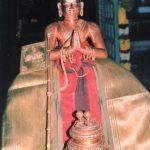
Sri Embar wears the Sri Embar Pendant, a symbol of his service to Udayavar (Ramanujar). Devotees visiting this temple specifically seek Darshan of this pendant, which is believed to carry the spiritual weight of Ramanujar’s grace.
Architectural Marvels
Dravidian Architecture:
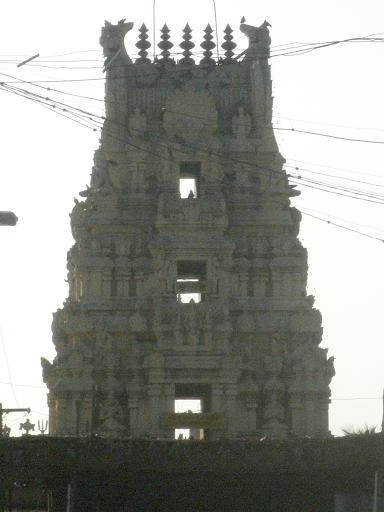
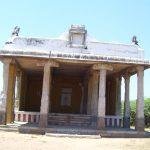
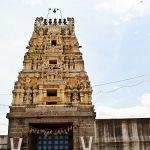
The temple showcases the classic Dravidian style of architecture, characterized by towering gateways (Gopurams) and intricate sculptural work. While specific ASI inscription data for this smaller shrine is often less documented than the larger Varadaraja Perumal temple nearby, the structural integrity reflects the late Chola or early Vijayanagara periods.
Key Features:
- The Sanctum: The west-facing sanctum (Vimana) houses the standing Vaikuntha Perumal. The positioning follows strict Vastu Shastra, aligning the deity to absorb the Surya Namaskar (sun rays) during specific times of the year.
- Sculptures: The mandapas feature reliefs depicting scenes from the life of Ramanujar and Embar. The pillars are adorned with motifs of Garuda and other celestial vehicles.
- Garuda Pushkarini: The temple tank is a central architectural and spiritual element. It is believed that Garuda (the eagle deity) bathes here, purifying the waters. Villagers hold the belief that this water protects against venomous snake bites.
Darshan & Ritual Logistics (2026)
To ensure a seamless spiritual experience, we have updated the logistical framework for the year 2026. The temple conducts three daily Poojas.
Daily Timings
| Session | Timing |
|---|---|
| Morning Opening | 06:00 AM |
| Viswaroopa Pooja | 06:30 AM |
| Kaala Shanthi Pooja | 07:00 AM |
| Uchchi Kaala Pooja | 09:00 AM |
| Closure (Noon) | 12:00 PM |
| Afternoon Opening | 04:00 PM |
| Sayaratchi Pooja | 05:30 PM |
| Raakkaala Pooja | 07:00 PM |
| Aravanai Pooja (Closing) | 08:30 PM |
Key Sevas & Online Booking
While this is a traditional village temple, administrative management is handled by the HR&CE Department of Tamil Nadu. For specialized Sevas:
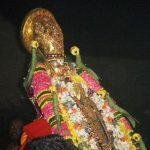
- Abhishekam: Performed on auspicious Saturdays. The Moolavar is decorated with flowers representing different Avatharaams of Vishnu.
- Archana: Specific offerings for fertility and eye health are popular here.
- Online Booking: For general Darshan, no booking is required. For specific Sevas, devotees should check the Tamil Nadu HR&CE portal or contact the temple office directly.
2026 Festival Calendar
- Pongal (Thai Month): The Avatar Utsavam of Embar is celebrated for 10 days, concluding on the Punarvasu Nakshatra (star) of the Thai month.
- Chithirai Brahmotsavam: A 10-day grand festival celebrated in April/May.
- Navarathri: Celebrated in the month of Purattasi (September–October) with special Golu arrangements.
- Vaikunta Ekadesi: Margazhi month (December–January). This is the busiest day of the year; devotees are advised to arrive by 4:00 AM.
- Pavitrotsavam: Conducted in Avani (August–September) for ritual purification of the temple.
Practical Visitor Guidance
Dress Code:
Modest attire is mandatory. Men should wear Dhotis or formal trousers with shirts; T-shirts and shorts are discouraged. Women should wear Sarees, Salwar Kameez, or formal traditional wear.
Photography & Mobiles:
Photography inside the sanctum is strictly prohibited. However, photography is allowed in the outer prakarams and courtyards. Please switch off mobile phones or keep them on silent mode while approaching the Moolavar.
Crowd Management & Seasonal Advice:
- Best Hours: The temple is generally less crowded between 10:00 AM and 11:30 AM (morning session) and 4:00 PM to 5:00 PM (evening session).
- Summer (April–June): Tamil Nadu summers are harsh. Carry a water bottle and an umbrella. The queue lines can be exposed to direct sunlight.
- Accessibility: The temple has a flat entry, but the sanctum involves two steps. Wheelchair access is possible for the mandapam but may be difficult inside the inner sanctum.
Pilgrimage Connectivity
Location: Maduramangalam, Sriperumpudur, Kanchipuram District (Approx. 60 km from Chennai).
How to Reach
By Road (NH):
From Chennai, take the National Highway 4 (Chennai-Bangalore). Take the exit towards Sunguvar Chatram. From there, follow local signs for the Maduramangalam road. It is roughly 20 km from Sriperumpudur and 7 km from Sunguvar Chatram.
Bus Services:
- Mofussil Bus Terminus (CMBT) Koyambedu: Buses 76C, 576 (AC/Non-AC) to Sriperumpudur. From Sriperumpudur, take an auto-rickshaw to Maduramangalam (15 mins).
- Tambaram: Buses S583 series (S583, S583B, S583D, S583C) heading to Sriperumpudur.
By Train:
- Nearest Station: Sriperumpudur Railway Station (Junction) is the closest rail head, well connected to Chennai and other southern cities.
- From Chennai Central: EMU services are frequent to Sriperumpudur.
By Air:
- Nearest Airport: Chennai International Airport (MAA).
- Distance: Approx. 50 km via the airport bypass road.
Nearby Sacred Sites (Pilgrimage Circuit):
- Ulagalandha Perumal Temple (Kanchipuram): 25 km away, dedicated to the Vamana avatar of Vishnu.
- Varadaraja Perumal Temple (Kanchipuram): One of the 108 Divya Desams, 25 km away.
- Prathyangira Devi Temple (Sriperumpudur): Located on the way back to the main highway.
Frequently Asked Questions (FAQ)
Is there a VIP Darshan entry available?
As this is a rural temple managed by HR&CE, there is no formal VIP ticketing system like in Tirupati. However, devotees with special needs or those conducting specific Sevas are given priority access through the side entrance upon request at the counter.
What is the specific significance of the temple tank?
The Garuda Pushkarini is associated with the legend of Garuda bathing here. It is believed that the water here possesses purifying properties, particularly against toxins and venom.
Can I perform the “Kozhukkattai” ritual myself?
While you can bring the offering, it is advisable to consult with the temple priest (Archaka) upon arrival. They will guide you through the correct sequence: offering to Perumal first, then Garuda, and finally to Sri Embar.
Is mobile locker facility available?
Given the smaller scale of the temple, large automated lockers may not be available. It is recommended to travel light and keep valuables in your vehicle. Small bags are usually allowed inside.
What is the connection between this temple and Ramanujar?
This temple is the Birth Place (Janma Sthalam) of Sri Embar, the direct disciple of Sri Ramanujar. It is also where the famous event of Embar saving Ramanujar from his Guru, Yadhava Prakasha, took place. Hence, the temple is deeply connected to the history of Sri Vaishnavism.
Photo Gallery
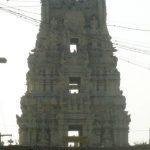
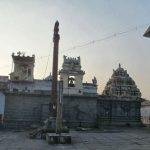
Contact Details
Arulmigu Vaikunta Perumal & Arulmigu Embar Samy Thirukoil
Maduramangalam, Sriperumpudur,
Kanchipuram – 602105
Phone: +91 44 – 27162236
Mobile: +91 – 9444898548
Recent Posts

ओ सांवरे तूने ही मुझको संभाला – Lyrics & Meaning
ओ सांवरे तूने ही मुझको संभाला – A Prayer to Shyam Origin & Spiritual Essence Why This Bhajan Resonates Devotees chant this when overwhelmed by life’s storms—the refrain ‘तूने ही मुझको संभाला’ is the soul’s sigh of relief: “You…

कथा ये है महाराज मेरे की – Lyrics & Meaning
कथा ये है महाराज मेरे की छत्रपति संभाजी महाराज – A Prayer to Chhatrapati Sambhaji Maharaj Origin & Spiritual Essence Why This Bhajan Resonates Devotees chant this when their spirit feels tested—its powerful refrain “महाराज मेरे” is a soul’s…

Rigveda Samhita Yathartha Anuvada (ऋग्वेद संहिता यथार्थ अनुवाद) – Complete Set with Anvayartha & Hindi/English Translation
The Rigveda is the oldest surviving scripture of humanity and the foundational text of Sanātana Dharma. For serious students, scholars, UPSC aspirants studying ancient Indian history, Sanskrit learners, and spiritual seekers, a precise and grammatically structured translation is indispensable.…

आना भी अकेला है जाना भी अकेला है – Lyrics & Meaning | BharatTemples
आना भी अकेला है जाना भी अकेला है – A Prayer to the Divine Witness Origin & Spiritual Essence Why This Bhajan Resonates Devotees turn to this bhajan in moments of deep reflection—when life’s attachments begin to ache. The…

माता शेरावाली के द्वार जो भी जाता है – Lyrics & Meaning
माता शेरावाली के द्वार जो भी जाता है – A Prayer to Maa Sherawali Origin & Spiritual Essence Why This Bhajan Resonates Devotees turn to this bhajan in times of fear or uncertainty—its promise that no one leaves Maa’s…

मार लेना सपणी उबार लेणा भवरा – Lyrics & Meaning
मार लेना सपणी उबार लेणा भवरा – A Prayer to the Divine Beloved Origin & Spiritual Essence Why This Bhajan Resonates Devotees chant this in moments of deep vulnerability—its cry of “मार लेना सपणी, उबार लेणा भवरा” is the…

हमें श्याम सुंदर भरोसा तुम्हारा – Lyrics & Meaning
हमें श्याम सुंदर भरोसा तुम्हारा – A Prayer to Shyam Sundar Origin & Spiritual Essence Why This Bhajan Resonates Devotees chant this when feeling alone—its refrain ‘de do sahara’ is the soul’s cry for divine support. Lyrics in Hindi…

Mere Satguru Ne Di Thi Davai Lyrics in Hindi & Meaning
Mere Satguru Ne Di Thi Davai: Invoking the Guru’s Liberating Wisdom This soul-stirring bhajan venerates the Satguru (True Spiritual Master) as the divine physician who dispenses the only remedy for life’s deepest sufferings. Composed by Sant Karmaveer Tufani, it…

Janm Diyo Thari Maa Dukh Dekhiyo Lyrics in Hindi & Meaning
जन्म दियो थारी माँ दुख देखियो (Maa’s Grief Upon Birthing You) This soul-stirring Chetavani Bhajan (admonitory hymn) is addressed to the Divine Mother (Maa) – a call for repentance when children forget their filial duties in the dark age…
Bhadi Sabha Mein Thane Manaun Lyrics in Hindi & Meaning
Bhadi Sabha Mein Thane Manaun: Invoking the Spear-Wielding Mother Mata Bhawani (श्री ज्वाला भवानी), the fiery manifestation of Shakti worshipped as the Protector of Dharma in Her Dhaulagarh sanctum. Origin & Spiritual Essence Composed in Rajasthani folk tradition by…