
Contents
- 1 The Definitive Pilgrimage Guide: Vaitheeswaran Temple, Pillaipakkam
The Definitive Pilgrimage Guide: Vaitheeswaran Temple, Pillaipakkam
Nestled in the sacred soil of Kanchipuram district, the Vaitheeswaran Temple in Pillaipakkam stands as a beacon of divine healing and ancient heritage. For the devoted pilgrim, this shrine is not merely a structure of stone but a living organism of spiritual energy. As we approach 2026, this guide offers a comprehensive roadmap for devotees seeking the blessings of Vaitheeswaran, the celestial physician.
1. Introduction & Spiritual Essence
The Vaitheeswaran Temple is dedicated to Lord Shiva in his form as Vaitheeswaran (The Divine Doctor) and the Mother Goddess as Thaiyal Nayagi (The Mother of Remedies). Unlike the fierce manifestations of Shiva found elsewhere, here the deity radiates a calming, curative aura.
Phalaśruti: The Boon of Visiting
Why do devotees undertake this journey?
- Ancestral Karmic Cleansing: It is believed that performing rites here for ancestors (Pithru Karyam) liberates their souls from the cycle of rebirth.
- Naga Dosha Nivarana: This temple is renowned for alleviating afflictions caused by the planetary influence of Rahu and Ketu, often associated with serpent energies.
- Healing of Ailments: Devotees visit to pray for recovery from prolonged illnesses, viewing the temple as a sanctuary where the divine physician heals.
2. Historical Origins & Scriptural Legend
The history of the Vaitheeswaran Temple is a tapestry of dynastic patronage and miraculous oral traditions.
The Pallava Beginnings & Chola Renovation
Tradition holds that the original sanctum was constructed during the Pallava era, a period marked by the flourishing of rock-cut architecture and Brahmi script. Centuries later, the temple saw a significant renaissance under Paranthaka Chola II (Sundara Chola). His contributions are etched in the temple’s Dravidian architectural nuances.
The Sthala Purana (Local Legend)
The village derives its name, Pillaipakkam, from a miraculous event. The legend states that the son of the temple’s hereditary Archagar (priest) was bitten by a venomous serpent. Grieving, the father placed the boy before the Lord. The Lord, in his infinite compassion, manifested as a divine cow (Camadhenu) and licked the poisoned wound, drawing out the venom and restoring the child to life. This event cemented the deity’s reputation as Vaitheeswaran—the supreme healer.
Resilience Through Time
While the temple’s roots are ancient, it faced destruction during the invasion of the Golkonda Nawab approximately 550 years ago. It lay in ruins until 1977, when Sri Namachivaya Chettiar, a devout villager, spearheaded a massive renovation, restoring the temple to its former glory.
3. Architectural Marvels
The temple is a textbook example of Dravidian Architecture, embodying the principles of Vastu Shastra and spiritual symbolism.
Structural Elements
Known locally as the Vada Vaitheeswaran Temple (The Northern Vaitheeswaran), the temple features a unique Gajaprashta Vimana (the roof structure resembling the back of an elephant). This style is distinct and contributes to the acoustic resonance during chants.
Iconography & Sanctums
Inside the complex, devotees encounter several specialized shrines:
- Kala Dakshinamoorthy: A rare form of Lord Dakshinamoorthy (the teacher), depicted with a staff (Soolayutham) and snake garland (Nagabaranam). He is the guardian against Naga Dosham.
- Kala Bairavar: The fierce protector form of Shiva.
- Chandikeshwari: A unique shrine where the fierce goddess Chandika resides alongside Chandikeswarar.
4. Darshan & Ritual Logistics
Planning your visit requires an understanding of the daily schedule and ritual offerings. Note that while specific timings are traditional, devotees should verify minor seasonal adjustments on-site.
Daily Temple Timings
| Session | Timing | Rituals |
|---|---|---|
| Morning | 6:00 AM – 12:00 PM | Ushathkala Pooja, Kalasha Pooja, Uchikala Pooja |
| Afternoon | 12:00 PM – 4:00 PM | Temple remains closed for Deity rest |
| Evening | 4:00 PM – 8:30 PM | Arthajama Pooja, Palliyarai Pooja |
Key Sevas & Online Booking
To ensure a seamless experience, the temple administration encourages online registration for major sevas.
- Abhishekam: Performed with holy waters, milk, and honey. Best performed on Mondays.
- Archana: Chanting of names. Highly recommended for those seeking specific remedies.
- Deepa Aradhana: Lamp offering for ancestral peace.
Booking: While this temple may not have a large commercial online portal, bookings are typically managed through local trust offices or via the Madras High Court Bench administration (as this is a temple under legal oversight). Pilgrims should contact the temple trust directly or visit the ‘Tamil Nadu Hindu Religious and Charitable Endowments (HR&CE)’ website for the latest links.
Major Festivals in 2026
Plan your visit around these auspicious dates:
- Pradosham: Every Monday and Saturday (Twilight ritual).
- Maha Shivaratri: February 26, 2026. Expect night-long vigils and special abhishekams.
- Aadi Perukku: August 4, 2026. A river bank festival honoring the water element.
- Arudra Darshan: December 15, 2026. Celebrating the cosmic dance of Nataraja.
5. Practical Visitor Guidance
To maintain the sanctity of the temple and ensure a smooth darshan, adhering to these guidelines is essential.
Code of Conduct & Dress Code
- Attire: Traditional Indian clothing is preferred. Men should wear dhotis or trousers with shirts; women should wear sarees, salwar kameez, or long skirts.
- Photography: Strictly prohibited inside the sanctum sanctorum (Garbhagriha). Photography may be restricted in outer courtyards.
- Electronics: Mobile phones are allowed but must be kept on silent. Some areas may require them to be checked in at lockers.
Crowd Management & Seasonal Advice
- Best Hours: The early morning (6:00 AM – 7:30 AM) and late evening (6:00 PM – 8:00 PM) are least crowded and most spiritually charged.
- Seasonal Tip: During the summer months (April–June), the Kanchipuram heat can be intense. Carry a water bottle, a cotton towel, and wear a hat while waiting in the queue.
Accessibility
The temple has moderate accessibility. While the inner sanctum requires climbing steps, the outer courtyards are accessible to senior citizens with assistance. Wheelchair access may be limited in older sections of the structure.
6. Pilgrimage Connectivity
How to Reach Pillaipakkam
By Air: The nearest airport is Chennai International Airport (MAA), located approximately 65 km away.
By Rail: The nearest major railway junction is Kanchipuram (approx. 20 km). Alternatively, travelers can use the Chengalpattu Railway Station.
By Road: Pillaipakkam is strategically located. From Chennai, take the National Highway 48 (NH48) (formerly NH4) towards Kanchipuram. Take the diversion towards Manimangalam/Pillaipakkam. It is approximately 3 km off the main highway.
Nearby Sacred Sites (Pilgrimage Circuit)
Extend your spiritual journey by visiting these nearby temples:
- Ekambareswarar Temple (Kanchipuram): One of the Pancha Bhoota Stalas, representing the Earth element. Located ~20 km away.
- Varadaraja Perumal Temple: A massive Vishnu temple complex in Kanchipuram, known for its intricate stone carvings.
- Manimangalam Temple: A historic village temple located very close to Pillaipakkam, perfect for a quiet, meditative visit.
7. Frequently Asked Questions (FAQ)
Is there a VIP or Special Darshan entry?
The temple administration prioritizes devotees with medical emergencies or those above 65 years of age. While there is no paid VIP ticket system here (unlike large commercial temples, due to legal restrictions), devotees can request the head priest for a special entry during non-peak hours.
What is the significance of the Kala Dakshinamoorthy here?
Unlike the usual seated form of Dakshinamoorthy, this form is standing and holds a weapon and a snake. This specific iconography is meant to combat specific malefic effects of planets and serpent curses (Naga Dosham).
Are non-Hindus allowed inside?
Generally, entry to the inner sanctum of Hindu temples is restricted to those who practice the faith. However, the outer complex may be accessible to all. It is respectful to consult the temple priest before entering.
Is accommodation available near the temple?
Pillaipakkam is a small village. For accommodation, it is best to stay in Kanchipuram town, which offers numerous budget lodges, guest houses, and hotels.
What are the contact details for the temple?
Since this is a smaller temple, a dedicated public phone line may not always be active. The temple is under the administrative purview of the Joint Commissioner, HR&CE, Kanchipuram. For urgent inquiries, visiting the local administrative office in Kanchipuram is the most reliable method.
Address: Vaitheeswaran Temple, Pillaipakkam, Kanchipuram District, Tamil Nadu.
Recent Posts

ओ सांवरे तूने ही मुझको संभाला – Lyrics & Meaning
ओ सांवरे तूने ही मुझको संभाला – A Prayer to Shyam Origin & Spiritual Essence Why This Bhajan Resonates Devotees chant this when overwhelmed by life’s storms—the refrain ‘तूने ही मुझको संभाला’ is the soul’s sigh of relief: “You…

कथा ये है महाराज मेरे की – Lyrics & Meaning
कथा ये है महाराज मेरे की छत्रपति संभाजी महाराज – A Prayer to Chhatrapati Sambhaji Maharaj Origin & Spiritual Essence Why This Bhajan Resonates Devotees chant this when their spirit feels tested—its powerful refrain “महाराज मेरे” is a soul’s…

Rigveda Samhita Yathartha Anuvada (ऋग्वेद संहिता यथार्थ अनुवाद) – Complete Set with Anvayartha & Hindi/English Translation
The Rigveda is the oldest surviving scripture of humanity and the foundational text of Sanātana Dharma. For serious students, scholars, UPSC aspirants studying ancient Indian history, Sanskrit learners, and spiritual seekers, a precise and grammatically structured translation is indispensable.…

आना भी अकेला है जाना भी अकेला है – Lyrics & Meaning | BharatTemples
आना भी अकेला है जाना भी अकेला है – A Prayer to the Divine Witness Origin & Spiritual Essence Why This Bhajan Resonates Devotees turn to this bhajan in moments of deep reflection—when life’s attachments begin to ache. The…

माता शेरावाली के द्वार जो भी जाता है – Lyrics & Meaning
माता शेरावाली के द्वार जो भी जाता है – A Prayer to Maa Sherawali Origin & Spiritual Essence Why This Bhajan Resonates Devotees turn to this bhajan in times of fear or uncertainty—its promise that no one leaves Maa’s…

मार लेना सपणी उबार लेणा भवरा – Lyrics & Meaning
मार लेना सपणी उबार लेणा भवरा – A Prayer to the Divine Beloved Origin & Spiritual Essence Why This Bhajan Resonates Devotees chant this in moments of deep vulnerability—its cry of “मार लेना सपणी, उबार लेणा भवरा” is the…

हमें श्याम सुंदर भरोसा तुम्हारा – Lyrics & Meaning
हमें श्याम सुंदर भरोसा तुम्हारा – A Prayer to Shyam Sundar Origin & Spiritual Essence Why This Bhajan Resonates Devotees chant this when feeling alone—its refrain ‘de do sahara’ is the soul’s cry for divine support. Lyrics in Hindi…

Mere Satguru Ne Di Thi Davai Lyrics in Hindi & Meaning
Mere Satguru Ne Di Thi Davai: Invoking the Guru’s Liberating Wisdom This soul-stirring bhajan venerates the Satguru (True Spiritual Master) as the divine physician who dispenses the only remedy for life’s deepest sufferings. Composed by Sant Karmaveer Tufani, it…

Janm Diyo Thari Maa Dukh Dekhiyo Lyrics in Hindi & Meaning
जन्म दियो थारी माँ दुख देखियो (Maa’s Grief Upon Birthing You) This soul-stirring Chetavani Bhajan (admonitory hymn) is addressed to the Divine Mother (Maa) – a call for repentance when children forget their filial duties in the dark age…
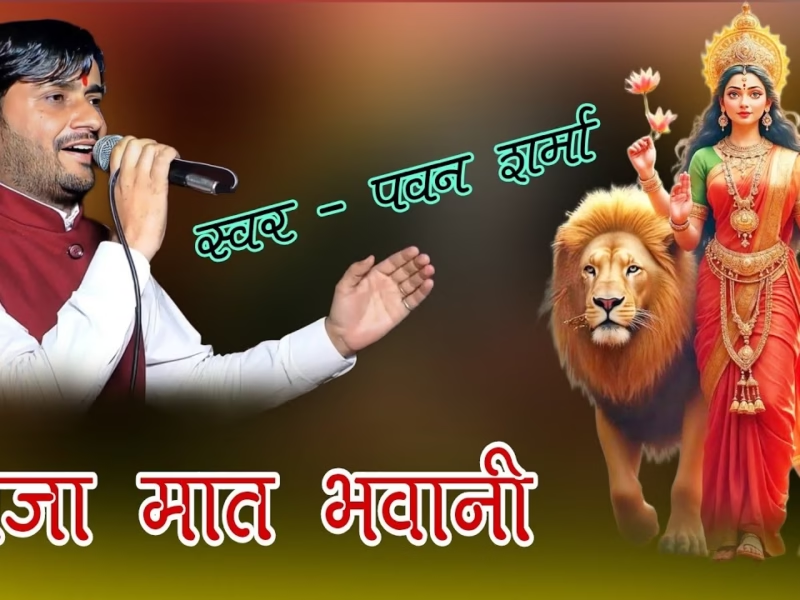
Bhadi Sabha Mein Thane Manaun Lyrics in Hindi & Meaning
Bhadi Sabha Mein Thane Manaun: Invoking the Spear-Wielding Mother Mata Bhawani (श्री ज्वाला भवानी), the fiery manifestation of Shakti worshipped as the Protector of Dharma in Her Dhaulagarh sanctum. Origin & Spiritual Essence Composed in Rajasthani folk tradition by…