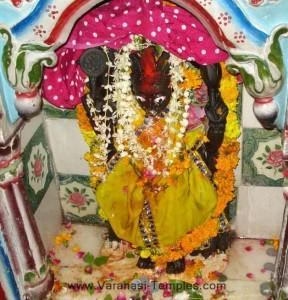
The Vaman Keshav Temple in Varanasi stands as a profound testament to the cosmic glory of Lord Vishnu in his Dwarf Incarnation (Vamana). Nestled in the sacred locality of Trilochan, this shrine is dedicated to the Swayambhu (self-manifested) deity revered as Vaman Keshav (also known locally as Madhusudan). According to ancient traditions, the temple is located near the Vaman Teerth, a holy water body mentioned in scriptures.
Phalaśruti (Spiritual Benefits): Devotees believe that taking a holy dip in the waters near Vaman Teerth (though not fully existent in its original form today) followed by Darshan of Vaman Keshav bestows the blessings of Lord Vamana—symbolizing the conquest of greed and the restoration of cosmic order. It is said that worshiping here brings “all-round happiness” and helps in cleansing ancestral karma, particularly for those seeking to overcome obstacles caused by planetary afflictions related to Jupiter.
Historical Origins & Scriptural Legend
Scriptural Legend: According to the Sthala Purana, the site is linked to the avatar of Vamana, the fifth incarnation of Lord Vishnu. As the legend goes, Vamana reclaimed the three worlds from the demon king Bali by taking three strides of earth. The local lore of Varanasi holds that the Vaman Teerth was the site where Lord Vamana planted his foot during this cosmic expansion. The deity is addressed as “Madhusudan,” a name referring to the slayer of the demon Madhu, further consolidating the Vishnu-centric lore of the temple.
Historical Context: While precise dynastic records of the initial construction are sparse—a common occurrence with ancient sites in Varanasi—the architectural vernacular suggests a significant period of sanctity spanning several centuries. Temple records and oral traditions passed down through generations of Pandas indicate that the site has been a center of worship for centuries, surviving the renaming of Varanasi itself. The address A.2/29, Trilochan, marks a segment of the old city that has retained its medieval character.
Architectural Marvels
The Vaman Keshav Temple is a quintessential example of the Nagara style of temple architecture, adapted to the dense urban fabric of Varanasi. Unlike the sprawling temple complexes of South India, this shrine is vertical and inward-focused, designed to channel the devotee’s gaze upward toward the Shikhara (spire).
Key Features:
The Shikhara: The towering spire represents the cosmic mountain Meru. The curvilinear tower, typical of Nagara style, features distinct Rathas (vertical segments) that draw the eye to the apex.
Garbhagriha & Mandapa: The inner sanctum houses the Vigraha (idol) of Vaman Keshav. The Mandapa (hall) is relatively compact, typical of Kashi temple designs where space is premium. The pillars are often carved with intricate motifs, reflecting the artistic sensibilities of the region.
Sculptural Elements: Though compact, the temple exterior often features niches housing images of deities, particularly the Dasha Avatars of Vishnu. The stone work shows signs of weathering, indicating its antiquity.
Darshan & Ritual Logistics
To facilitate a seamless spiritual journey, we have compiled the daily schedule and seva options. Note that timings may vary slightly during festivals.
Daily Darshan Timings (2026 Schedule)
Session
Timings
Details
Morning Darshan
05:30 AM – 12:00 PM
Includes Mangala Aarti (6:00 AM) and Shringar Darshan.
Devotees can book specific rituals to enhance their experience. The primary deity is worshipped as Vaman Keshav (Madhusudan).
Abhishekam (Ritual Bathing): Performed with Panchamrit (milk, honey, ghee, yogurt, sugar). Special offering on Akshaya Tritiya includes butter (Navaneetam), which is a signature offering for Madhusudan.
Archana (Name Recitation): 108 names of Vishnu/Vamana.
Sahasranama Archana: Recitation of 1,000 names.
Booking Method: While the temple is managed by local priests, devotees can coordinate specific pujas in advance. For major festivals, it is advisable to contact the temple trust directly using the contact details provided in this guide.
2026 Major Festival Dates
Festival
Date (2026)
Significance at Vaman Keshav
Akshaya Tritiya
April 30, 2026
The most auspicious day here; special butter offering (Seva) to Madhusudan.
Janmashtami
September 3, 2026
Celebration of Lord Krishna (an avatar of Vishnu).
Deepavali
November 8, 2026
Vishnu Puja and Kuber Puja.
Practical Visitor Guidance
Visiting Varanasi requires preparation. The Vaman Keshav Temple is located in the dense lanes of Trilochan.
Dress Code: Traditional Indian attire is highly recommended (Dhoti/Kurta for men, Saree/Salwar for women). Modest clothing is mandatory.
Photography & Electronics: Photography inside the sanctum is strictly prohibited. Mobile phones should be switched to silent mode. It is advised to use the locker services available at the entry points of the Varanasi Ghats or nearby shops before entering the narrow lanes of Trilochan.
Crowd Management:
Best Time to Visit: Early morning (6:00 AM – 8:00 AM) offers the most peaceful darshan.
Seasonal Advice: Summer (April-June) in Varanasi is hot; carry a water bottle and a handheld fan. Winters (Nov-Feb) are ideal. Monsoon (July-Aug) may cause waterlogging in the ghat areas.
Pilgrimage Connectivity
How to Reach:
Nearest Airport: Lal Bahadur Shastri International Airport (LBS) (approx. 25 km / 45 mins).
Road Access: The temple is accessible via the Varanasi-Ghazipur Highway. As it is in the old city, vehicles cannot go directly to the door. You must travel by Auto/Rickshaw to Machhodari or the entry point of Trilochan, then walk or take a cycle rickshaw.
By Water: A scenic route involves taking a boat ride to Trilochan Ghat and climbing the stairs to the temple.
Nearby Sacred Sites (The Kashi Pilgrimage Circuit):
Trilochan Temple: Just steps away, this is the primary temple of the locality.
Kashi Vishwanath Temple (New): Accessible via boat or walking through the old city.
Sankat Mochan Hanuman Temple: Located roughly 3 km away.
Frequently Asked Questions (FAQs)
Is there a VIP darshan entry at Vaman Keshav Temple?
Unlike large commercialized temples, Vaman Keshav is a neighborhood shrine. There is no formal VIP entry ticket. However, during Akshaya Tritiya and major festivals, early arrival (before 6 AM) is the best way to avoid crowds.
What is the significance of the butter offering?
The deity is also known as Madhusudan. Offering butter is historically and scripturally significant as it represents the sweetness of devotion and is the favorite food of Lord Krishna (an avatar of Vishnu). This is particularly emphasized on Akshaya Tritiya.
Is the Vaman Teerth (pond) currently available for bathing?
No. According to temple lore, Vaman Teerth is the site where the Lord stood, but the physical water body is not currently existent. Devotees usually offer water (Jal) at the temple instead.
Where can I park my vehicle?
Parking is not available directly at the temple. Visitors must park near the main roads (Lahurabir or Dashashwamedh area) or utilize paid parking near the Ghats before taking an auto or cycle rickshaw to the temple.
Is the temple accessible for senior citizens?
The path to the temple includes narrow lanes and stairs, particularly if approaching from Trilochan Ghat. While manageable with assistance, it may be challenging for those with mobility issues. The road approach via Machhodari is relatively flatter.
ओ सांवरे तूने ही मुझको संभाला – A Prayer to Shyam Origin & Spiritual Essence Why This Bhajan Resonates Devotees chant this when overwhelmed by life’s storms—the refrain ‘तूने ही मुझको संभाला’ is the soul’s sigh of relief: “You…
कथा ये है महाराज मेरे की छत्रपति संभाजी महाराज – A Prayer to Chhatrapati Sambhaji Maharaj Origin & Spiritual Essence Why This Bhajan Resonates Devotees chant this when their spirit feels tested—its powerful refrain “महाराज मेरे” is a soul’s…
The Rigveda is the oldest surviving scripture of humanity and the foundational text of Sanātana Dharma. For serious students, scholars, UPSC aspirants studying ancient Indian history, Sanskrit learners, and spiritual seekers, a precise and grammatically structured translation is indispensable.…
आना भी अकेला है जाना भी अकेला है – A Prayer to the Divine Witness Origin & Spiritual Essence Why This Bhajan Resonates Devotees turn to this bhajan in moments of deep reflection—when life’s attachments begin to ache. The…
माता शेरावाली के द्वार जो भी जाता है – A Prayer to Maa Sherawali Origin & Spiritual Essence Why This Bhajan Resonates Devotees turn to this bhajan in times of fear or uncertainty—its promise that no one leaves Maa’s…
मार लेना सपणी उबार लेणा भवरा – A Prayer to the Divine Beloved Origin & Spiritual Essence Why This Bhajan Resonates Devotees chant this in moments of deep vulnerability—its cry of “मार लेना सपणी, उबार लेणा भवरा” is the…
हमें श्याम सुंदर भरोसा तुम्हारा – A Prayer to Shyam Sundar Origin & Spiritual Essence Why This Bhajan Resonates Devotees chant this when feeling alone—its refrain ‘de do sahara’ is the soul’s cry for divine support. Lyrics in Hindi…
Mere Satguru Ne Di Thi Davai: Invoking the Guru’s Liberating Wisdom This soul-stirring bhajan venerates the Satguru (True Spiritual Master) as the divine physician who dispenses the only remedy for life’s deepest sufferings. Composed by Sant Karmaveer Tufani, it…
जन्म दियो थारी माँ दुख देखियो (Maa’s Grief Upon Birthing You) This soul-stirring Chetavani Bhajan (admonitory hymn) is addressed to the Divine Mother (Maa) – a call for repentance when children forget their filial duties in the dark age…
Bhadi Sabha Mein Thane Manaun: Invoking the Spear-Wielding Mother Mata Bhawani (श्री ज्वाला भवानी), the fiery manifestation of Shakti worshipped as the Protector of Dharma in Her Dhaulagarh sanctum. Origin & Spiritual Essence Composed in Rajasthani folk tradition by…