
Contents
- 1 Introduction & Spiritual Essence
- 2 Historical Origins & Scriptural Legend
- 3 Architectural Marvels
- 4 Darshan & Ritual Logistics
- 5 Practical Visitor Guidance
- 6 Pilgrimage Connectivity
- 7 Frequently Asked Questions (FAQ)
- 7.1 1. Is there a VIP Darshan entry available at Velladainatha Swami Temple?
- 7.2 2. Why is Lord Murugan facing South in this temple?
- 7.3 3. What is the significance of the Velvidai Theertham (well)?
- 7.4 4. Where can I find the contact number for the temple?
- 7.5 5. Is non-vegetarian food allowed in the temple area?
- 8 Photo Gallery
- 9 Contact Details
Introduction & Spiritual Essence
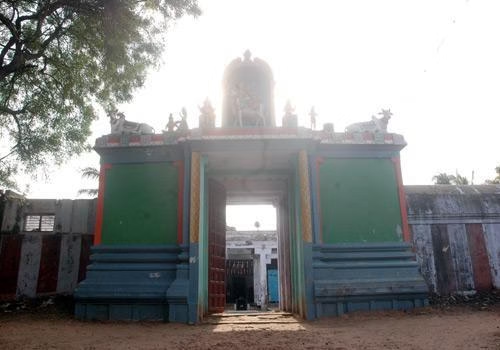
Nestled in the serene village of Thirukarugavur (also known historically as Kurukkavoor) in the Nagapattinam district, the Velladainatha Swami Temple stands as a beacon of spiritual rejuvenation and ancient Chola heritage. This sacred shrine is revered as the 67th in the series of 276 Paadal Petra Sthalams (divine abodes sung by the Saivite Nayanars). Here, the presiding deity, Velladainathar (a form of Lord Shiva), graces the sanctum as a Banalinga on a square peeta.
The spiritual significance of this temple is profound. According to scriptural records, visiting this temple is believed to cleanse ancestral karma and remove sins committed unknowingly. The deity is also known by other names, including Velvidai Nathar, Vedhapureeswarar, and Swetharishameswarar. The goddess, Kaviaganni (also referred to as Neelotpala Visalakshi), complements the divine energy of the sanctum.
Phalaśruti (Spiritual Benefits): Devotees flock here to seek liberation from hunger (through the grace of Lord Sundarar) and to absolve sins, particularly those related to destructive actions. The temple is unique for housing shrines to both Lord Vishnu and Lord Murugan within its complex, emphasizing the Shaiva-Vaishnava harmony.
Historical Origins & Scriptural Legend
The temple’s history is deeply intertwined with the Chola dynasty. While the origins are ancient, the current stone structure was largely rebuilt during the 10th century under the patronage of King Uttama Chola. Inscriptions from the eras of Raja Raja Chola, Rajendra Chola, and Kulottunga Chola I adorn the temple walls, offering a glimpse into the administrative and religious practices of the medieval period.
According to the Thirukarugavur Sthala Purana (local oral traditions), this village is the setting for two miraculous events involving the Saivite Nayanars:
- The Legend of Saint Sundarar: During his pilgrimage, Saint Sundarar visited this place but could not locate the temple in the dense jungle. Exhausted and hungry, he was miraculously served a feast by an old man (Lord Shiva in disguise). After the meal, Sundarar fell asleep, only to wake up and find the temple revealed before him. The Thai Amavasai
- The Legend of Thirugnana Sambandar: It is believed that Saint Thirugnana Sambandar, seeking to wash away the sins incurred from defeating Jains in debate (which resulted in their deaths), prayed to Lord Shiva here. The legend states that the holy river Ganga sprang forth from a well in this temple on the New Moon day in the month of Thai. The water in this well, known as Velvidai Theertham, is believed to turn milky white on this specific day.
Architectural Marvels
The temple is a classic example of Dravidian architecture. Following the distinct style of Chola temple construction, the structure features a single Prakaram (enclosure). The Shikhara (tower) above the sanctum is modest yet intricately designed with traditional motifs.
Inside the Ardhamandapam (half-hall), devotees can view a gallery of exquisite niche sculptures (Alankara Bhumis) representing various forms of Shiva and his manifestations. These include:
- Lord Nataraja (Cosmic Dancer)
- Lingodbhavar (The manifest form of Shiva)
- Dakshinamurthy (The teacher)
- Vishnu as Mohini (The enchantress avatar)
Notably, the temple is not currently designated as an ASI-protected monument, but its preservation is maintained by the Hindu Religious and Charitable Endowments (HR&CE) Department of Tamil Nadu.
Darshan & Ritual Logistics
Daily Opening Hours
The temple follows a traditional schedule, closing during the afternoon for a brief period.
| Session | Timing |
|---|---|
| Morning Darshan | 06:00 AM – 10:30 AM |
| Afternoon Break | 10:30 AM – 05:00 PM |
| Evening Darshan | 05:00 PM – 07:30 PM |
Key Sevas & Offerings
Four worship services (Pooja) are conducted daily. Devotees can perform Abhishekam (ritual bathing) and offer Vastras (cloth) to the deity.
- Regular Seva: Morning and Evening Pooja.
- Special Seva: Thursday Pujas for Lord Murugan (Jupiter-Dakshinamurthy).
- Online Booking: While traditional booking is available at the temple counter, online Seva booking for Tamil Nadu temples is currently centralized through the official HR&CE Portal (Tamil Nadu Arulmigu) or via the “Tamil Nadu Temples” mobile app.
2026 Festival Dates
- Thai Amavasai (New Moon): Approximately January 11, 2026. This is the most significant day when the Theertham (well water) is believed to turn white. Thirugnana Sambandar’s procession from Sirkali Brahmapureeswarar Temple takes place.
- Chithirai Pournami (Full Moon): Approximately April 12, 2026. Celebrates the legendary feeding of Saint Sundarar.
- Skanda Sashti: June 2026 (Dates vary based on lunar calendar). Celebrates Lord Murugan’s victory over evil.
Practical Visitor Guidance
Code of Conduct & Essentials
- Dress Code: Traditional attire is mandatory. Men must wear Dhotis (Veshti) or trousers with a shirt, and women should wear Sarees or Salwar Kameez. Modern western attire (shorts/jeans) is strictly prohibited.
- Photography: Photography is strictly prohibited inside the inner sanctum (Garbhagriha) and shrine areas. You may take photos of the exterior architecture and the temple tank.
- Mobile Phones & Lockers: While electronic lockers may not be available on-site, it is advisable to keep mobile phones on silent mode and avoid usage inside the temple premises as a sign of respect.
- Accessibility: The temple features traditional stone steps. There may be difficulty for wheelchairs on the inner prakaram due to the heritage structure.
Crowd Management & Seasonal Advice
- Best Hours to Visit: For a peaceful darshan, visit between 6:00 AM and 7:30 AM or after 6:00 PM. Avoid Thai Amavasai and Chithirai Pournami if you dislike crowds, as devotees flock in thousands.
- Seasonal Tips:
– May (Summer): Carry a water bottle and a head cover. The stone floors absorb heat, making it intense during midday.
– November–February (Winter): Ideal time to visit. Weather is pleasant, and temple tanks are filled with water.
Pilgrimage Connectivity
How to Reach
Velladainatha Swami Temple, Thirukarugavur is located approximately 5 km from Sirkali and 30 km from Mayiladuthurai.
- By Road: From Sirkali, take the road towards Vadakal. The nearest bus stop is Vadakal, from which the temple is 1 km away (walking or auto). From Nagapattinam, follow SH-64 towards Sirkali.
- By Train: The nearest railway junction is Mayiladuthurai (approx. 30 km). From there, frequent buses/taxis are available to Sirkali.
- By Air: The nearest airport is Tiruchirappalli International Airport (TRZ), located approximately 115 km away.
Nearby Sacred Sites (Pilgrimage Circuit)
Enhance your trip by visiting these nearby Padal Petra Sthalams:
- Brahmapureeswarar Temple, Sirkali (5 km): The primary temple of the region, known for its towering Rajagopuram and unique planetary worship.
- Kasi Viswanathar Temple, Kumbakonam (30 km): A powerful Shiva temple revered as an alternative to Kashi (Varanasi).
- Sathyavageeswarar Temple, Thiruchengattangudi (15 km): Another ancient Chola temple dedicated to Lord Shiva.
Frequently Asked Questions (FAQ)
1. Is there a VIP Darshan entry available at Velladainatha Swami Temple?
Currently, the temple does not have a specific paid VIP entry lane like major tn-corporate temples. Darshan is based on standard queue systems. However, those requiring assistance due to age or disability may contact the temple office near the entrance for priority access during non-peak hours.
2. Why is Lord Murugan facing South in this temple?
Uniquely, Lord Murugan here faces the South direction, which is traditionally associated with Lord Shiva (as Dakshinamurthy) and the planet Jupiter (Guru). In this temple, Murugan is revered as Jupiter-Dakshinamurthy. Devotees worship him on Thursdays for wisdom and higher knowledge.
3. What is the significance of the Velvidai Theertham (well)?
The temple well contains the Velvidai Theertham. Unlike regular water, the water in this well is believed to turn milky white on the New Moon day (Thai Amavasai) as a divine manifestation. This water is only distributed to devotees on that specific day annually.
4. Where can I find the contact number for the temple?
For queries regarding timings or special events, you can contact the temple administration at +91-9245 612 705. However, it is advisable to call during morning hours (8:00 AM to 10:00 AM) for a response.
5. Is non-vegetarian food allowed in the temple area?
No. As a traditional Hindu temple, the premises are strictly vegetarian. Alcohol and non-vegetarian food are prohibited. There are small tea stalls and vegetarian messes available in the vicinity of Sirkali and Vadakal.
Photo Gallery
Contact Details
Sri Velladainathaswami Temple
Pillayar Koil Street, Thirukarukavoor,
Vadakal post, Sirkali Taluk,
Nagapattinam District – 609109
Mobile: +91-9245 612 705
Recent Posts

ओ सांवरे तूने ही मुझको संभाला – Lyrics & Meaning
ओ सांवरे तूने ही मुझको संभाला – A Prayer to Shyam Origin & Spiritual Essence Why This Bhajan Resonates Devotees chant this when overwhelmed by life’s storms—the refrain ‘तूने ही मुझको संभाला’ is the soul’s sigh of relief: “You…

कथा ये है महाराज मेरे की – Lyrics & Meaning
कथा ये है महाराज मेरे की छत्रपति संभाजी महाराज – A Prayer to Chhatrapati Sambhaji Maharaj Origin & Spiritual Essence Why This Bhajan Resonates Devotees chant this when their spirit feels tested—its powerful refrain “महाराज मेरे” is a soul’s…

Rigveda Samhita Yathartha Anuvada (ऋग्वेद संहिता यथार्थ अनुवाद) – Complete Set with Anvayartha & Hindi/English Translation
The Rigveda is the oldest surviving scripture of humanity and the foundational text of Sanātana Dharma. For serious students, scholars, UPSC aspirants studying ancient Indian history, Sanskrit learners, and spiritual seekers, a precise and grammatically structured translation is indispensable.…

आना भी अकेला है जाना भी अकेला है – Lyrics & Meaning | BharatTemples
आना भी अकेला है जाना भी अकेला है – A Prayer to the Divine Witness Origin & Spiritual Essence Why This Bhajan Resonates Devotees turn to this bhajan in moments of deep reflection—when life’s attachments begin to ache. The…

माता शेरावाली के द्वार जो भी जाता है – Lyrics & Meaning
माता शेरावाली के द्वार जो भी जाता है – A Prayer to Maa Sherawali Origin & Spiritual Essence Why This Bhajan Resonates Devotees turn to this bhajan in times of fear or uncertainty—its promise that no one leaves Maa’s…

मार लेना सपणी उबार लेणा भवरा – Lyrics & Meaning
मार लेना सपणी उबार लेणा भवरा – A Prayer to the Divine Beloved Origin & Spiritual Essence Why This Bhajan Resonates Devotees chant this in moments of deep vulnerability—its cry of “मार लेना सपणी, उबार लेणा भवरा” is the…

हमें श्याम सुंदर भरोसा तुम्हारा – Lyrics & Meaning
हमें श्याम सुंदर भरोसा तुम्हारा – A Prayer to Shyam Sundar Origin & Spiritual Essence Why This Bhajan Resonates Devotees chant this when feeling alone—its refrain ‘de do sahara’ is the soul’s cry for divine support. Lyrics in Hindi…

Mere Satguru Ne Di Thi Davai Lyrics in Hindi & Meaning
Mere Satguru Ne Di Thi Davai: Invoking the Guru’s Liberating Wisdom This soul-stirring bhajan venerates the Satguru (True Spiritual Master) as the divine physician who dispenses the only remedy for life’s deepest sufferings. Composed by Sant Karmaveer Tufani, it…

Janm Diyo Thari Maa Dukh Dekhiyo Lyrics in Hindi & Meaning
जन्म दियो थारी माँ दुख देखियो (Maa’s Grief Upon Birthing You) This soul-stirring Chetavani Bhajan (admonitory hymn) is addressed to the Divine Mother (Maa) – a call for repentance when children forget their filial duties in the dark age…
Bhadi Sabha Mein Thane Manaun Lyrics in Hindi & Meaning
Bhadi Sabha Mein Thane Manaun: Invoking the Spear-Wielding Mother Mata Bhawani (श्री ज्वाला भवानी), the fiery manifestation of Shakti worshipped as the Protector of Dharma in Her Dhaulagarh sanctum. Origin & Spiritual Essence Composed in Rajasthani folk tradition by…