
Contents
Introduction & Spiritual Essence
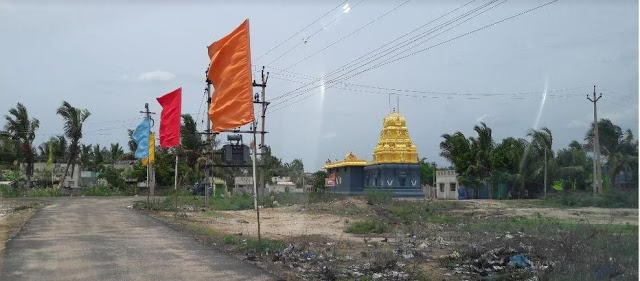
Nestled in the serene coastal belt of Sathankuppam, Pulicat, in the Thiruvallur district of Tamil Nadu, the Venkatesa Perumal Temple stands as a bastion of devotion to Lord Vishnu. This temple is a spiritual sanctuary dedicated to Venkatesa Perumal (an aspect of Vishnu, also revered as Balaji) and his consort, Goddess Sridevi.
The primary deity, Venkatesa Perumal, is worshipped here in a serene form, bestowing blessings upon devotees who seek relief from worldly burdens. While many temples are known for their grandeur, the spiritual essence of this shrine lies in its tranquil location and the powerful Sthala Puranam (local legend) associated with it.
Phalaśruti: Why Visit?
Devotees visit this temple seeking specific spiritual benefits:
- Ancestral Liberation: It is believed that prayers offered here help cleanse ancestral karma, bringing peace to departed souls.
- Relief from Shani Dosha: As Lord Venkateswara is associated with planetary alignments, offering prayers here is considered auspicious for mitigating the ill effects of Saturn.
- Mental Peace: The temple’s location near the Pulicat backwaters provides a natural setting for meditation and calming the mind.
Historical Origins & Scriptural Legend
Unlike some major temples with meticulously recorded dynastic histories, the Venkatesa Perumal Temple, Sathankuppam is a jewel of local heritage. While specific historical records regarding the exact century of construction are sparse, the architectural motifs suggest a traditional legacy maintained by local communities.
The Local Legend (Sthala Purana)
Tradition holds that the deity manifested here to protect the local devotees of the region. The temple is deeply rooted in the traditions of the Bhagavata Marga. According to local oral history, the location in Pulicat—near the border of Tamil Nadu and Andhra Pradesh—was historically a region of trade and cultural exchange, where Vaishnavism flourished due to its proximity to the Sri Venkateswara temple centers of Andhra.
The temple is maintained by the local administration and devotees, preserving the ancient rituals passed down through generations. The absence of a specific recorded dynastic founder (unlike the grand Chola or Vijayanagara structures) highlights its role as a Gramam (village) temple, directly serving the spiritual needs of the local populace.
Architectural Marvels
The temple exemplifies the Dravidian Architectural Style, characterized by its pyramidal towers (Vimana) and spacious pillared halls (Mandapas).
- Sanctum Sanctorum (Garbhagriha): The inner sanctum houses the presiding deity, Venkatesa Perumal, facing East. The structure is compact yet profound, allowing for an intimate Darshan experience.
- Mandapas: The temple features a pillared hall used for religious discourses and public gatherings during festivals. The pillars often carry carvings depicting scenes from the Puranas, typical of Dravidian temple art.
- Vimana: The tower above the sanctum follows the traditional Tamil style, though more modest in scale compared to the massive structural temples of the Chola emperors. It emphasizes verticality and spiritual ascent.
The temple complex is enclosed by a compound wall, separating the sacred precinct from the outer world, which is essential for maintaining the sanctity required for Vaikhanasa Agama rituals.
Darshan & Ritual Logistics (2026 Update)
Planning your visit requires understanding the daily routine of the temple. Please note that timings may vary during festival seasons.
Daily Timings
| Session | Timing |
|---|---|
| Morning Darshan | 07:00 AM – 12:00 PM |
| Mid-day Closure | 12:00 PM – 04:30 PM |
| Evening Darshan | 04:30 PM – 07:30 PM |
| Special Seva Timings | 08:00 AM (Daily Abhishekam) |
Key Sevas & Online Booking
While the temple administration is local, many regional temples in Tamil Nadu utilize the TNCE (Tamil Nadu Temples) official portal for special pujas. For specific online booking availability at Sathankuppam, devotees are advised to check the local temple office notice board or the district temple administration website.
- Thirumanjanam (Abhishekam): Performed daily with sacred water, milk, and honey.
- Archana: Offered with the names of the deity (Sahasranamam).
- Vishesha Archana: For special occasions (birthdays, anniversaries).
2026 Major Festivals
Plan your pilgrimage around these auspicious days:
- Janmashtami: September 5, 2026 (Devotees gather for night-long vigils).
- Brahmotsavam: Usually held in April/May (check local calendar).
- Vaikuntha Ekadashi: December 30, 2026 (A major festival for Vishnu temples).
- Rama Navami: April 2, 2026.
Practical Visitor Guidance
To ensure a respectful and smooth darshan experience:
- Dress Code: Traditional attire is mandatory. Men should wear dhotis or trousers with shirts; women should wear sarees, salwar kameez, or long skirts.
- Photography: Photography is strictly prohibited inside the sanctum sanctorum. Respect the sanctity of the inner sanctum.
- Mobile Phones: Please silence your phones before entering. Some temples may require you to deposit them at lockers, though this is not universally enforced in smaller shrines—courtesy is appreciated.
- Crowd Management: The temple is generally peaceful. However, during festivals, the Garbhapradakshina (circumambulation) space can get crowded. Early morning hours (7:00 AM – 8:00 AM) offer the most peaceful darshan.
- Seasonal Advice: During the summer months (April–June), carry a water bottle and a head covering, as the coastal heat in Pulicat can be intense.
Pilgrimage Connectivity
How to Reach
The Venkatesa Perumal Temple is strategically located in Sathankuppam, near Pulicat, making it accessible from Chennai and surrounding regions.
- By Air: Chennai International Airport (MAA) is the nearest airport, located approximately 69 Kms away.
- By Rail: The nearest major railway station is Ponneri Railway Station (approx. 19 Kms). Alternatively, Chennai Central serves as a major hub, and from there, you can hire a taxi or take a bus.
- By Road:
- The temple is 54 Kms from Chennai via the NH16 (Asian Highway).
- From Thiruvallur, it is approximately 73 Kms.
- Town buses are frequently available from Ponneri and Red Hills to Thangal Bus Stop. From Thangal, the temple is just 1 km.
Nearby Sacred Sites (The Pilgrimage Circuit)
Enhance your spiritual journey by visiting these nearby landmarks:
- Pulicat Lake & Naganatha Swamy Temple: Just a short drive away, offering a blend of natural beauty and devotion.
- Thirupalaivanam: Located 8 Kms away, known for its ancient temple dedicated to Lord Shiva.
- Karungali (11 Kms): Another notable religious site in the vicinity.
Contact Details
Address: Venkatesa Perumal Temple, Sathankuppam, Pulicat, Thiruvallur District, Tamil Nadu.
(Official phone numbers are subject to change; please contact the local Thiruvallur district temple administration for the latest contact information).
Photo Gallery


Frequently Asked Questions (FAQ)
1. Is there a VIP darshan entry available?
As a local temple, the Venkatesa Perumal Temple focuses on equality and community worship. Unlike mega-temples, dedicated VIP queues are rarely found. However, speaking politely with the temple priest or the custodian for a closer darshan during non-peak hours is usually accommodated.
2. Are there accommodation facilities at the temple?
The temple itself does not have guest houses. However, devotees can find budget accommodation and lodges in Ponneri (19 km) or travel back to Chennai (54 km) for hotels. For a spiritual retreat, some devotees prefer staying in guest houses near the Pulicat Lake.
3. Is the temple accessible for senior citizens and disabled persons?
The temple complex is relatively compact. While there are no advanced ramps or lifts (as it is an older structure), the floor is generally even. Senior citizens are usually allowed direct entry to the sanctum by prior request with the priest. Please carry a walking stick for support.
4. What is the significance of the temple’s location in Pulicat?
Pulicat is a historic port town. The presence of a Vishnu temple here signifies the spread of Vaishnavism along the Coromandel Coast. The temple’s proximity to the Pulicat estuary symbolizes the life-giving waters associated with Lord Vishnu (often depicted with a conch).
5. Can we offer Prasadam from home?
Yes, the temple administration generally allows devotees to offer Prasadam like Tulasi leaves, fruits, and sweets. However, it is best to consult with the temple priest before bringing elaborate meals to ensure they align with the temple’s rituals.
Recent Posts

ओ सांवरे तूने ही मुझको संभाला – Lyrics & Meaning
ओ सांवरे तूने ही मुझको संभाला – A Prayer to Shyam Origin & Spiritual Essence Why This Bhajan Resonates Devotees chant this when overwhelmed by life’s storms—the refrain ‘तूने ही मुझको संभाला’ is the soul’s sigh of relief: “You…

कथा ये है महाराज मेरे की – Lyrics & Meaning
कथा ये है महाराज मेरे की छत्रपति संभाजी महाराज – A Prayer to Chhatrapati Sambhaji Maharaj Origin & Spiritual Essence Why This Bhajan Resonates Devotees chant this when their spirit feels tested—its powerful refrain “महाराज मेरे” is a soul’s…

Rigveda Samhita Yathartha Anuvada (ऋग्वेद संहिता यथार्थ अनुवाद) – Complete Set with Anvayartha & Hindi/English Translation
The Rigveda is the oldest surviving scripture of humanity and the foundational text of Sanātana Dharma. For serious students, scholars, UPSC aspirants studying ancient Indian history, Sanskrit learners, and spiritual seekers, a precise and grammatically structured translation is indispensable.…

आना भी अकेला है जाना भी अकेला है – Lyrics & Meaning | BharatTemples
आना भी अकेला है जाना भी अकेला है – A Prayer to the Divine Witness Origin & Spiritual Essence Why This Bhajan Resonates Devotees turn to this bhajan in moments of deep reflection—when life’s attachments begin to ache. The…

माता शेरावाली के द्वार जो भी जाता है – Lyrics & Meaning
माता शेरावाली के द्वार जो भी जाता है – A Prayer to Maa Sherawali Origin & Spiritual Essence Why This Bhajan Resonates Devotees turn to this bhajan in times of fear or uncertainty—its promise that no one leaves Maa’s…

मार लेना सपणी उबार लेणा भवरा – Lyrics & Meaning
मार लेना सपणी उबार लेणा भवरा – A Prayer to the Divine Beloved Origin & Spiritual Essence Why This Bhajan Resonates Devotees chant this in moments of deep vulnerability—its cry of “मार लेना सपणी, उबार लेणा भवरा” is the…

हमें श्याम सुंदर भरोसा तुम्हारा – Lyrics & Meaning
हमें श्याम सुंदर भरोसा तुम्हारा – A Prayer to Shyam Sundar Origin & Spiritual Essence Why This Bhajan Resonates Devotees chant this when feeling alone—its refrain ‘de do sahara’ is the soul’s cry for divine support. Lyrics in Hindi…

Mere Satguru Ne Di Thi Davai Lyrics in Hindi & Meaning
Mere Satguru Ne Di Thi Davai: Invoking the Guru’s Liberating Wisdom This soul-stirring bhajan venerates the Satguru (True Spiritual Master) as the divine physician who dispenses the only remedy for life’s deepest sufferings. Composed by Sant Karmaveer Tufani, it…

Janm Diyo Thari Maa Dukh Dekhiyo Lyrics in Hindi & Meaning
जन्म दियो थारी माँ दुख देखियो (Maa’s Grief Upon Birthing You) This soul-stirring Chetavani Bhajan (admonitory hymn) is addressed to the Divine Mother (Maa) – a call for repentance when children forget their filial duties in the dark age…
Bhadi Sabha Mein Thane Manaun Lyrics in Hindi & Meaning
Bhadi Sabha Mein Thane Manaun: Invoking the Spear-Wielding Mother Mata Bhawani (श्री ज्वाला भवानी), the fiery manifestation of Shakti worshipped as the Protector of Dharma in Her Dhaulagarh sanctum. Origin & Spiritual Essence Composed in Rajasthani folk tradition by…