
Contents
Introduction & Spiritual Essence
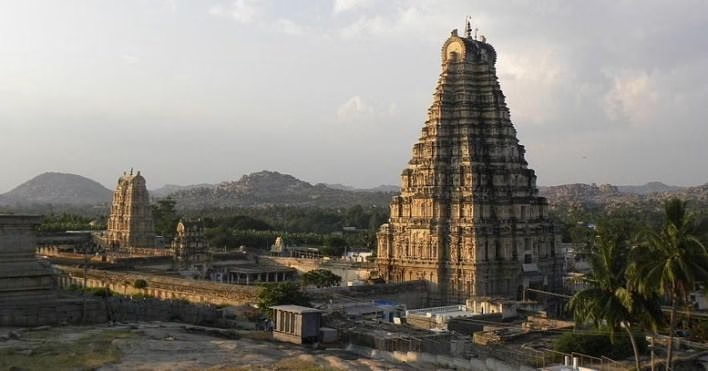
Virupaksha Temple Hampi stands as the spiritual heart of the ancient Vijayanagara Empire, located in the Bellary district of Karnataka. Dedicated to Lord Shiva in his fierce yet benevolent form as Virupaksha (meaning “Oblique Eye” or “Asymmetrical Eye”), this temple is a living monument, unlike the ruins surrounding it. It is deeply revered as the consort of Pampadevi, the local river goddess associated with the Tungabhadra.
Phalaśruti (Spiritual Benefits): According to temple tradition and local lore, a pilgrimage to this sacred sanctuary is believed to cleanse ancestral karma and grant the devotee the clarity of vision. Lord Virupaksha is worshipped here as the Swayambhu (self-manifested) form, and it is said that offering prayers here fulfills the sincere desires of the heart, especially those related to overcoming obstacles.
Historical Origins & Scriptural Legend
The Vijayanagara Legacy
The temple’s history is uninterrupted since the 7th century, though the grand structure visible today primarily dates to the Vijayanagara Empire (14th–16th century). According to temple records, the massive shrine was constructed by Lakkana Dandesha, a nayaka (chieftain) under the ruler Deva Raya II. Inscriptions dating back to the 9th and 10th centuries found on the temple walls reference the worship of Shiva here long before the empire’s capital was established.
Scriptural & Local Legends
Tradition holds that the Sthala Purana of Hampi revolves around the union of Shiva (Virupaksha) and the Earth Goddess Pampa. The region, known as Pampa Kshetra, is one of the five holy river-banks on the Tungabhadra. Legend narrates that after Pampa performed intense penance here to win Shiva as her husband, he appeared as Virupaksha to marry her. This divine marriage is celebrated annually through the temple’s festivals.
Architectural Marvels
The Virupaksha Temple is a masterpiece of Dravidian architecture, preserved meticulously despite the destruction of surrounding structures.
Structural Highlights
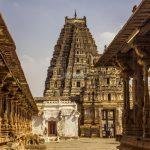
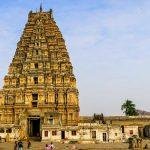
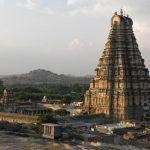
- The Eastern Gopuram: This nine-tiered gateway tower stands 50 meters high. It features a brick superstructure atop a stone base and serves as the primary entrance to the outer courtyard.
- Kanakagiri Gopura: A smaller northern gateway leading to a subsidiary shrine and eventually to the Tungabhadra River.
- Pillared Hall (Mandapa): The ornate central hall, commissioned by Krishnadevaraya in 1510 AD, showcases intricate carvings and frescoes depicting mythological narratives.
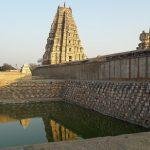
- Water Management: A unique hydraulic marvel is the channel of the Tungabhadra that flows along the temple terrace, descends through the temple kitchen, and exits through the outer court.
- Fractal Geometry: The temple design employs repeating patterns that mimic natural fractals (similar to snowflakes), symbolizing the infinite nature of the divine.
Note on Preservation: The temple is a protected monument under the Archaeological Survey of India (ASI) and forms a core component of the UNESCO World Heritage Site “Group of Monuments at Hampi.”
Darshan & Ritual Logistics (2026 Updates)
The temple remains an active place of worship. While specific timings can fluctuate during festivals, the following schedule serves as the standard for 2026.
Daily Darshan Timings
| Session | Timings | Activity |
|---|---|---|
| Morning | 6:00 AM – 1:00 PM | Morning Rituals, General Darshan |
| Afternoon Break | 1:00 PM – 3:00 PM | Sanctum Sanctorum is closed |
| Evening | 3:00 PM – 9:00 PM | Evening Darshan & Puja |
Key Sevas & Booking
Devotees can book specific rituals online via the official Karnataka temple portal or at the temple counter.
- Abhishekam: Performed daily before 12:00 PM. Devotees can sponsor the ritual or attend via livestream.
- Archana: Recitation of names. Available throughout the day.
- Kumkumarchana: Special offering believed to bring prosperity.
2026 Major Festival Dates:
Virupaksha Brahmotsava: April 15 – April 25, 2026 (Includes the chariot festival which draws lakhs of devotees).
Deepavali: October 20 – 24, 2026.
Shivaratri: February 26, 2026.
Practical Visitor Guidance
- Dress Code: Traditional attire is recommended. Men should wear dhotis or trousers with shirts; women should wear sarees, salwar kameez, or full-length skirts. Avoid shorts and tank tops.
- Photography: Photography is permitted in the outer courtyards and mandapas but is strictly prohibited inside the Garbhagriha (Sanctum Sanctorum).
- Mobile & Lockers: Electronic devices should be kept on silent. Lockers are available near the entrance for cameras and mobile phones.
- Accessibility: The temple complex has stone-paved pathways. The inner courtyards are accessible for wheelchairs with assistance, though the ruins outside the temple may be challenging.
Pilgrimage Connectivity
How to Reach
- By Air: The nearest airport is Vidyanagar Airport (JDY) in Ballari (50 km). Bengaluru Kempegowda International Airport (BLR) is approximately 350 km away.
- By Rail: The nearest railway junction is Hospet Junction (HPT), located 13 km from Hampi. Regular buses and taxis are available from Hospet.
- By Road: Hampi is well-connected via NH 67 and NH 50. BKSRTC runs regular buses from Bengaluru and Hubli.
Nearby Sacred Sites (The Pilgrimage Circuit)
- Vitthala Temple: Famous for its stone chariot and musical pillars, located 2 km from the main bus stand.
- Virupaksha Gudi (Basantpur): The smaller shrine dedicated to Virupaksha on the other side of the river.
- Sasivekalu Ganesha & Kadalekalu Ganesha: Monolithic statues of Lord Ganesha carved out of single boulders.
Frequently Asked Questions (FAQs)
1. Is there a VIP Darshan entry at Virupaksha Temple?
Yes, the temple management offers a special entry pass during non-peak hours (usually between 1:00 PM and 3:00 PM) for a nominal fee. However, during the Brahmotsava festival in April, general darshan queues may extend to several hours.
2. Is the temple open year-round?
Yes, unlike some mountain shrines that close during winter, Virupaksha Temple remains open 365 days a year. However, visits during the summer (May) are advised only in the early morning or late evening due to intense heat.
3. What is the best time to visit Hampi to avoid crowds?
The best months for a peaceful darshan are October to February. The weather is pleasant, and the footfall is manageable compared to the summer and festival seasons.
4. Can I take the Prasadam inside the temple?
Outside food items are generally not allowed inside the sanctum sanctorum. However, the temple administration provides sanctified Prasadam (lunch and dinner) at designated halls (Dharmashala) within the complex for devotees.
5. Is there a dress code for the Tungabhadra River entry?
While the river access is outside the temple, visitors are expected to maintain modesty. Nudity or bathing in swimwear is strictly prohibited as the Tungabhadra flows through a sacred zone adjacent to the temple.
Recent Posts

ओ सांवरे तूने ही मुझको संभाला – Lyrics & Meaning
ओ सांवरे तूने ही मुझको संभाला – A Prayer to Shyam Origin & Spiritual Essence Why This Bhajan Resonates Devotees chant this when overwhelmed by life’s storms—the refrain ‘तूने ही मुझको संभाला’ is the soul’s sigh of relief: “You…

कथा ये है महाराज मेरे की – Lyrics & Meaning
कथा ये है महाराज मेरे की छत्रपति संभाजी महाराज – A Prayer to Chhatrapati Sambhaji Maharaj Origin & Spiritual Essence Why This Bhajan Resonates Devotees chant this when their spirit feels tested—its powerful refrain “महाराज मेरे” is a soul’s…

Rigveda Samhita Yathartha Anuvada (ऋग्वेद संहिता यथार्थ अनुवाद) – Complete Set with Anvayartha & Hindi/English Translation
The Rigveda is the oldest surviving scripture of humanity and the foundational text of Sanātana Dharma. For serious students, scholars, UPSC aspirants studying ancient Indian history, Sanskrit learners, and spiritual seekers, a precise and grammatically structured translation is indispensable.…

आना भी अकेला है जाना भी अकेला है – Lyrics & Meaning | BharatTemples
आना भी अकेला है जाना भी अकेला है – A Prayer to the Divine Witness Origin & Spiritual Essence Why This Bhajan Resonates Devotees turn to this bhajan in moments of deep reflection—when life’s attachments begin to ache. The…

माता शेरावाली के द्वार जो भी जाता है – Lyrics & Meaning
माता शेरावाली के द्वार जो भी जाता है – A Prayer to Maa Sherawali Origin & Spiritual Essence Why This Bhajan Resonates Devotees turn to this bhajan in times of fear or uncertainty—its promise that no one leaves Maa’s…

मार लेना सपणी उबार लेणा भवरा – Lyrics & Meaning
मार लेना सपणी उबार लेणा भवरा – A Prayer to the Divine Beloved Origin & Spiritual Essence Why This Bhajan Resonates Devotees chant this in moments of deep vulnerability—its cry of “मार लेना सपणी, उबार लेणा भवरा” is the…

हमें श्याम सुंदर भरोसा तुम्हारा – Lyrics & Meaning
हमें श्याम सुंदर भरोसा तुम्हारा – A Prayer to Shyam Sundar Origin & Spiritual Essence Why This Bhajan Resonates Devotees chant this when feeling alone—its refrain ‘de do sahara’ is the soul’s cry for divine support. Lyrics in Hindi…

Mere Satguru Ne Di Thi Davai Lyrics in Hindi & Meaning
Mere Satguru Ne Di Thi Davai: Invoking the Guru’s Liberating Wisdom This soul-stirring bhajan venerates the Satguru (True Spiritual Master) as the divine physician who dispenses the only remedy for life’s deepest sufferings. Composed by Sant Karmaveer Tufani, it…

Janm Diyo Thari Maa Dukh Dekhiyo Lyrics in Hindi & Meaning
जन्म दियो थारी माँ दुख देखियो (Maa’s Grief Upon Birthing You) This soul-stirring Chetavani Bhajan (admonitory hymn) is addressed to the Divine Mother (Maa) – a call for repentance when children forget their filial duties in the dark age…
Bhadi Sabha Mein Thane Manaun Lyrics in Hindi & Meaning
Bhadi Sabha Mein Thane Manaun: Invoking the Spear-Wielding Mother Mata Bhawani (श्री ज्वाला भवानी), the fiery manifestation of Shakti worshipped as the Protector of Dharma in Her Dhaulagarh sanctum. Origin & Spiritual Essence Composed in Rajasthani folk tradition by…