
Contents
- 1 Vyaseshwar Temple Varanasi: A Definitive Pilgrimage Guide
- 1.1 1. Introduction & Spiritual Essence
- 1.2 2. Historical Origins & Scriptural Legend
- 1.3 3. Architectural Marvels
- 1.4 4. Darshan & Ritual Logistics (2026 Season)
- 1.5 5. Practical Visitor Guidance
- 1.6 6. Pilgrimage Connectivity
- 1.7 7. Frequently Asked Questions (FAQ)
- 1.7.1 1. Is there a VIP darshan entry at Vyaseshwar Temple?
- 1.7.2 2. Can we take a dip in the Ghanta Karna Pushkarini?
- 1.7.3 3. What is the significance of worshipping Vyaseshwar?
- 1.7.4 4. Is online seva booking available for this specific temple?
- 1.7.5 5. When is the best time to visit for a peaceful darshan?
Vyaseshwar Temple Varanasi: A Definitive Pilgrimage Guide
1. Introduction & Spiritual Essence
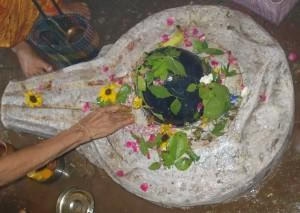
Amidst the divine chaos and eternal spiritual vibrations of Varanasi lies a sanctuary of profound scriptural significance—Vyaseshwar Temple. This holy site is dedicated to Lord Shiva in the form of a Swayambhu (self-manifested) Lingam. Known locally as Vyaseshwar Mahadev, this temple is not merely a place of worship but a living testament to the theological debates and ultimate surrender described in ancient Hindu lore.
Phalaśruti: The Fruits of Devotion
According to the Kashi Khand of the Skanda Purana, the presiding deity Shri Vyaseshwar bestows Jnana (supreme knowledge) and spiritual liberation. Phalaśruti (the promise of spiritual benefit) dictates that devotees who take a holy dip in the adjoining Ghanta Karna Pushkarini and offer prayers to this Lingam are cleansed of accumulated sins and ancestral karma. It is believed that true devotion here grants the ultimate merit: Moksha (liberation from the cycle of rebirth) within the sacred geography of Kashi.
2. Historical Origins & Scriptural Legend
The Legend of Sage Vyas
The soul of Vyaseshwar Temple is its Sthala Purana (local legend). Tradition holds that Maharishi Vyas, the revered author of the Mahabharata and eighteen Puranas, engaged in a fierce theological debate regarding the supremacy of the divine. Sage Vyas argued that Lord Vishnu was the supreme entity, while other sages contended that Lord Shiva held the ultimate position.
To prove his devotion, Sage Vyas arrived in Kashi with ten thousand disciples. He bathed in the Panchganga Ghat, worshipped at the Bindu Madhav Temple (a Vishnu shrine), and began reciting Vishnu Bhajans near the Kashi Vishwanath Temple. His devotion reached a crescendo as he danced with one hand raised in praise.
According to temple records and oral tradition, Nandi (the divine bull vehicle of Shiva) appeared and immobilized Sage Vyas’s raised hand and tongue. When Lord Vishnu arrived, he revealed the ultimate truth: all his divine powers were granted by Lord Shiva. Realizing his error, Sage Vyas pleaded for forgiveness. Lord Vishnu touched Vyas’s larynx, restoring his speech, while Nandi restored the movement of his hand. Upon regaining his faculties, Sage Vyas immediately sang praises of Lord Shiva and installed a Shiva Lingam at the spot where Karn Ghanta Pushkarini exists today. This Lingam came to be known as Vyaseshwar.
Scriptural & Historical Context
While the exact century of construction is obscured by antiquity, the temple is referenced in the Kashi Khand of the Skanda Purana, placing its spiritual origins in the classical era of Vedic literature. The structure stands as a testament to the enduring Shaivite-Vaishnavite synthesis unique to Varanasi.
3. Architectural Marvels
Style and Layout
The Vyaseshwar Temple exhibits a traditional Nagara style of architecture, though it has been modified over centuries due to renovations and the unique constraints of its urban setting in Varanasi. The temple complex is compact yet spiritually expansive, adhering to Vastu Shastra principles where the sanctum sanctorum (Garbhagriha) is perfectly aligned to allow the flow of cosmic energy.
The Sanctum and Pushkarini
The most distinct architectural feature is the temple’s proximity to the Ghanta Karna Pushkarini (sacred pond). Unlike typical temples where the tank is a separate facility, here the sanctity of the water is integral to the temple’s identity. The Shikhara (spire) is modest but houses a potent Shiva Lingam. Inside the sanctum, the Lingam is worshipped with offerings of milk, water, and bilva leaves.
Note on Preservation: The site is recognized under local heritage mandates for its connection to the Kashi Khand, maintaining its traditional aesthetic despite the dense urban fabric surrounding it.
4. Darshan & Ritual Logistics (2026 Season)
For pilgrims planning their visit in 2026, it is essential to note that this is a Swayambhu site. Unlike major temples with massive crowds, the atmosphere here is intimate and meditative.
Daily Timings
| Session | Time | Activity |
|---|---|---|
| Morning | 05:00 AM – 11:00 AM | Morning Aarti, Abhishekam, and Darshan |
| Afternoon | 11:00 AM – 4:00 PM | Closed for Rest / Deep Cleaning |
| Evening | 04:00 PM – 09:00 PM | Evening Aarti and Shayan Darshan |
Key Sevas & Online Booking
As the temple integrates into the digital ecosystem of Kashi, online seva booking is available via the Kashi Vishwanath Temple app or the local Varanasi temple trust portals.
- Abhishekam: Performed with milk and honey (Morning 6:00 AM – 8:00 AM).
- Rudrabhishek: A specialized Vedic ritual for relief from afflictions.
- Maha Mangalarati: A profound 15-minute prayer session.
2026 Major Festival Dates
- Maha Shivaratri: February 26, 2026 (Grand night vigil and special Abhishekam).
- Pradosh Vrat: 1st Jan (Evening), 16th Jan (Evening) – Monthly observance for debt relief.
- Guru Purnima / Ashad Purnima: July 10, 2026 (Special significance for Ghanta Karna Pushkarini bathing).
- Kartik Purnima: November 15, 2026.
5. Practical Visitor Guidance
Dress Code and Etiquette
Visitors must adhere to traditional dress codes. Men should wear dhotis or full-length trousers and shirts; women should wear sarees, salwar kameez, or full-length skirts. Modesty is strictly enforced as per temple tradition.
Photography and Mobiles
Photography is prohibited inside the sanctum sanctorum. Mobile lockers are available nearby for devotees to store electronics before darshan, as keeping devices in pockets is discouraged during the ritual.
Crowd Management & Accessibility
Unlike the main Vishwanath corridor, Vyaseshwar is less crowded. However, the lanes of Varanasi are narrow.
- Best Hours: 5:00 AM (for a serene experience) or 6:00 PM (for evening Aarti).
- Seasonal Advice: Summers (April-June) can be intense; carry a water bottle. The area near the pond can be humid.
- Accessibility: The temple is accessible via narrow alleyways. It is not wheelchair accessible due to ancient architectural constraints.
6. Pilgrimage Connectivity
How to Reach Vyaseshwar Temple
The temple is located in the Bulanala area, near Karn Ghanta.
- By Air: The nearest airport is Lal Bahadur Shastri International Airport (VNS), approximately 30 km away. Taxis and e-rickshaws are available directly to Dashashwamedh Ghat area.
- By Rail: Varanasi Junction (BSB) is the closest major railway station (5 km). Auto-rickshaws can take you to Godaulia, from where it is a short walk or e-rickshaw ride to Bulanala.
- By Road: The temple is on the banks of the Ghanta Karna Pushkarini. The nearest major access point is National Highway 19 (NH-19) via Varanasi Cantt. From there, local transport is required to navigate the pedestrian-friendly inner city.
Nearby Sacred Sites (Kashi Yatra Circuit)
Enhance your pilgrimage by visiting these nearby shrines:
- Kashi Vishwanath Temple (Jyotirlinga): Just a 10-minute walk from Vyaseshwar. The epicenter of Kashi spirituality.
- Bindu Madhav Temple: The Vishnu shrine mentioned in the legend where Sage Vyas first bathed. Located near Panchganga Ghat.
- Sankat Mochan Hanuman Temple: A 15-minute drive from the core city, dedicated to Lord Hanuman, famous for relieving troubles.
7. Frequently Asked Questions (FAQ)
1. Is there a VIP darshan entry at Vyaseshwar Temple?
Currently, Vyaseshwar Temple does not have a dedicated VIP entrance like the Kashi Vishwanath Corridor. Darshan is general and open to all devotees, maintaining the traditional spiritual atmosphere.
2. Can we take a dip in the Ghanta Karna Pushkarini?
Traditionally, the Kashi Khand recommends a bath in this pond. However, currently, the water levels vary seasonally. While devotees historically bathed during Guru Purnima, it is advisable to check local conditions or consult a priest before entering the water. Many devotees currently offer water libations instead.
3. What is the significance of worshipping Vyaseshwar?
Worshipping the Vyaseshwar Lingam is believed to grant Jnana (knowledge). It is specifically recommended for those seeking relief from the negative effects of past deeds (Karma) and for ancestors’ peace.
4. Is online seva booking available for this specific temple?
While many temples in Varanasi offer online booking, smaller shrines like Vyaseshwar often operate on a direct-seva basis. However, comprehensive bookings for Shiva-centric sevas in Varanasi can often be managed through the unified Varanasi district temple trust portals or local priest networks.
5. When is the best time to visit for a peaceful darshan?
The best time is early morning (5:00 AM – 7:00 AM) during the summer or late afternoon (4:00 PM – 6:00 PM) during winter months. Avoid peak Aarti times of Kashi Vishwanath if you prefer a quieter experience.
Recent Posts

Shri Kaamkoteeshwar Mandir, Varanasi – History & Significance
In the heart of Kashi, the eternal city of Lord Shiva, where the Ganges flows with celestial grace, stands the Shri Kaamkoteeshwar Mandir. This sacred Sannidhi is not merely a temple but a profound spiritual bridge between the Northern…

ओ सांवरे तूने ही मुझको संभाला – Lyrics & Meaning
ओ सांवरे तूने ही मुझको संभाला – A Prayer to Shyam Origin & Spiritual Essence Why This Bhajan Resonates Devotees chant this when overwhelmed by life’s storms—the refrain ‘तूने ही मुझको संभाला’ is the soul’s sigh of relief: “You…

कथा ये है महाराज मेरे की – Lyrics & Meaning
कथा ये है महाराज मेरे की छत्रपति संभाजी महाराज – A Prayer to Chhatrapati Sambhaji Maharaj Origin & Spiritual Essence Why This Bhajan Resonates Devotees chant this when their spirit feels tested—its powerful refrain “महाराज मेरे” is a soul’s…

Rigveda Samhita Yathartha Anuvada (ऋग्वेद संहिता यथार्थ अनुवाद) – Complete Set with Anvayartha & Hindi/English Translation
The Rigveda is the oldest surviving scripture of humanity and the foundational text of Sanātana Dharma. For serious students, scholars, UPSC aspirants studying ancient Indian history, Sanskrit learners, and spiritual seekers, a precise and grammatically structured translation is indispensable.…

आना भी अकेला है जाना भी अकेला है – Lyrics & Meaning | BharatTemples
आना भी अकेला है जाना भी अकेला है – A Prayer to the Divine Witness Origin & Spiritual Essence Why This Bhajan Resonates Devotees turn to this bhajan in moments of deep reflection—when life’s attachments begin to ache. The…

माता शेरावाली के द्वार जो भी जाता है – Lyrics & Meaning
माता शेरावाली के द्वार जो भी जाता है – A Prayer to Maa Sherawali Origin & Spiritual Essence Why This Bhajan Resonates Devotees turn to this bhajan in times of fear or uncertainty—its promise that no one leaves Maa’s…

मार लेना सपणी उबार लेणा भवरा – Lyrics & Meaning
मार लेना सपणी उबार लेणा भवरा – A Prayer to the Divine Beloved Origin & Spiritual Essence Why This Bhajan Resonates Devotees chant this in moments of deep vulnerability—its cry of “मार लेना सपणी, उबार लेणा भवरा” is the…

हमें श्याम सुंदर भरोसा तुम्हारा – Lyrics & Meaning
हमें श्याम सुंदर भरोसा तुम्हारा – A Prayer to Shyam Sundar Origin & Spiritual Essence Why This Bhajan Resonates Devotees chant this when feeling alone—its refrain ‘de do sahara’ is the soul’s cry for divine support. Lyrics in Hindi…

Mere Satguru Ne Di Thi Davai Lyrics in Hindi & Meaning
Mere Satguru Ne Di Thi Davai: Invoking the Guru’s Liberating Wisdom This soul-stirring bhajan venerates the Satguru (True Spiritual Master) as the divine physician who dispenses the only remedy for life’s deepest sufferings. Composed by Sant Karmaveer Tufani, it…

Janm Diyo Thari Maa Dukh Dekhiyo Lyrics in Hindi & Meaning
जन्म दियो थारी माँ दुख देखियो (Maa’s Grief Upon Birthing You) This soul-stirring Chetavani Bhajan (admonitory hymn) is addressed to the Divine Mother (Maa) – a call for repentance when children forget their filial duties in the dark age…