
Contents
Introduction & Spiritual Essence
In the divine tapestry of Kashi (Varanasi), every corner vibrates with spiritual energy, but few locations hold the esoteric potency of the Yagya Varaha Temple. Dedicated to Lord Vishnu in his Boar (Varaha) incarnation, this shrine is not merely a structure but a living testament to the Vedic concept of Yajna (sacrifice).
The Divine Deity: Yagya Varaha
The presiding deity is Yagya Varaha, a unique manifestation where Lord Varaha is revered as the embodiment of the Sacred Fire Sacrifice. Unlike the standard Varaha murti found elsewhere, the Yagya Varaha form symbolizes the preservation of the cosmos through ritual purity. According to the Kashi Khand of the Skanda Purana, this is one of the 52 sacred Teerths of Varanasi.
Phalaśruti: Spiritual Benefits
Devotees flock to this temple seeking the spiritual merit equivalent to performing complex Vedic rituals. Phalaśruti (scriptural benefit) states that worshipping Yagya Varaha grants the results of a completed Maha Yajna. It is specifically revered for:
- Cleansing Ancestral Karma: Performing rituals here is believed to liberate ancestors from spiritual debts (Rina).
- Attainment of Abundance: As Yajna feeds the gods, which in turn bless the devotee, it is a prime site for invoking prosperity.
- Spiritual Equipoise: It aids in balancing the elements within the body, mirroring the cosmic balance maintained by the Varaha avatar.
Historical Origins & Scriptural Legend
The existence of the Yagya Varaha Temple is deeply interwoven with the ancient texts of Sanatana Dharma.
Scriptural References
According to the Kashi Khand of the Skanda Purana, Lord Vishnu proclaimed that he would reside in Varanasi in the form of a Yajna (sacrifice) to protect the city from cosmic disturbances. It is here that the Yagya Varaha Teerth was established. While the original Teerth (water body) mentioned in ancient texts is no longer physically visible, the temple marks its sacred location.
Local Legend
Tradition holds that this site is where the essence of the Ashvamedha Yajna (Horse Sacrifice) converges with the Varaha avatar. While specific dynastic records for the initial construction are sparse due to Varanasi’s antiquity, the temple architecture and stone carvings suggest origins in the medieval era, likely renovated by local kings who were ardent Vishnu devotees. The temple has undergone several renovations to preserve its sanctity amidst the dense urban fabric of the Old City.
Architectural Marvels
The temple represents a classic example of the Nagara style of temple architecture, prevalent in North India. Despite being nestled in a crowded lane of Varanasi, the temple’s architecture commands attention.
Structural Highlights
- The Shikhara (Spire): The main spire rises above the sanctum, depicting tiers of miniature shrines (Urushringas) culminating in the Amalaka (disk) and Kalasha (pot finial).
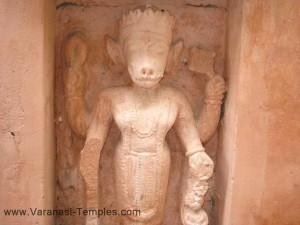
- Sanctum Sanctorum (Garbhagriha): The inner chamber houses the idol of Yagya Varaha, carved from black stone, depicting the boar head on a human body, symbolizing the lifting of the earth from the cosmic waters.
- Ornamentation: The outer walls feature intricate carvings of Apsaras (celestial nymphs) and Dwarapalas (gate guardians), though simplified compared to grander temples due to space constraints in the galis (lanes).
Photo Gallery
Darshan & Ritual Logistics
To facilitate a smooth spiritual experience, devotees should note the timings and rituals. The atmosphere shifts from the serene morning chants to the resonant evening Aarti.
Daily Timings (2026 Schedule)
The temple generally follows the traditional Panchakala worship pattern. Please verify locally for minor seasonal adjustments.
| Session | Timings | Activity |
|---|---|---|
| Morning | 05:00 AM – 12:00 PM | Mangala Darshan & Abhishekam |
| Afternoon | 12:00 PM – 04:00 PM | Temple Rest (Deep Cleaning) |
| Evening | 04:00 PM – 09:00 PM | Sandhya Aarti & Shayan Darshan |
Key Sevas & Online Booking
Devotees can offer specific services to the deity. While online infrastructure for smaller temples varies, the Varanasi temple board is digitizing operations.
- Abhishekam: Ritual bathing of the idol with milk, honey, and ghee. Best performed during morning hours.
- Archana: Recitation of the 108 names of Yagya Varaha.
- Suprabhatam: Morning awakening ritual.
- Online Seva Booking: For large-scale rituals, check the official Varanasi Devayatna portal or consult the temple priest (Pujari) upon arrival. For 2026, advance booking is recommended for festival days.
2026 Major Festival Dates
Plan your visit around these auspicious days for heightened spiritual energy:
- Varaha Jayanti: April 14, 2026 (Specific to the Varaha Avatar).
- Narasimha Jayanti: May 11, 2026 (Highly significant for Vishnu devotees).
- Janmashtami: September 4, 2026 (Lord Krishna’s birth).
- Deepavali: October 21, 2026.
Practical Visitor Guidance
Visiting Varanasi is a profound experience, but the Old City (Kashi) presents unique challenges. Preparation ensures a focused pilgrimage.
Dress Code & Etiquette
As with all Hindu temples in India, modest dress is mandatory. Men should wear dhotis or full-length trousers and shirts; women should wear sarees or salwar kameez. Shoes must be removed at the designated stand outside the temple (usually a nominal fee applies).
Photography & Mobiles
Photography inside the sanctum is strictly prohibited to maintain the sanctity of the Darshan. However, photography in the outer courtyard is usually permitted. Silence is requested near the Garbhagriha.
Accessibility & Crowd Management
The temple is located in the narrow lanes of Panch Agni Akhada Ghat. Accessibility is challenging for those with mobility issues due to steep stairs and uneven paths.
- Best Time to Visit: October to March (Winter months) for pleasant weather.
- Avoid: May and June (peak summer heat) and late afternoons during peak tourist season.
- Locker Facilities: Available at the nearest major ghat or designated tourist kiosks, but carry minimal luggage for this specific temple visit.
Pilgrimage Connectivity
How to Reach Yagya Varaha Temple
The temple is situated at A.11/30, near Swarleeneshwar, Panch Agni Akhada Ghat.
- Nearest Airport: Varanasi Lal Bahadur Shastri International Airport (LBS), approximately 25 km from the temple.
- Nearest Railway Station: Varanasi Junction (BSB), roughly 7 km away.
- By Road: The temple is accessible via NH-22 (formerly NH-2). From the railway station, take an auto-rickshaw to Prahalad Ghat Chauraha. From there, it is a short walk through the market lanes.
- Boat Route: A unique way to reach is by taking a boat to Panch Agni Akhada Ghat and climbing the steps directly to the temple lane.
Nearby Sacred Sites (Pilgrimage Circuit)
Enhance your spiritual journey by visiting these nearby landmarks:
- Swarleeneshwar Mahadev Temple: Located right next to Yagya Varaha, dedicated to Lord Shiva.
- Panch Ganga Ghat: Just a short walk away, where five rivers are believed to meet in the Ganges.
- Sankat Mochan Hanuman Temple: Located a few kilometers away, one of the most powerful Hanuman shrines in India.
Frequently Asked Questions (FAQ)
Is there a VIP darshan entry available?
While there are no formal VIP tickets like major southern temples, devotees can often get faster access by contacting the head priest or making a prior donation for a specific Archana. It is best to ask the local priest upon arrival.
Can we perform ancestral rituals (Pind Daan) here?
Yes. Given the temple’s association with the Yagya Varaha Teerth and its benefits regarding ancestral karma, performing Pind Daan or other Shradh rituals here is considered highly auspicious. Local Brahmins can be hired for the ceremony.
What is the best mode of transport to reach the temple from the ghats?
Walking is the most practical way, as the temple is in a pedestrian-only lane. Alternatively, a boat ride to Panch Agni Akhada Ghat followed by a short walk is recommended to avoid the congested streets near Dashashwamedh Ghat.
Are there hotels nearby for accommodation?
Yes, Varanasi has accommodations ranging from luxury hotels near Assi Ghat to budget Dharamshalas near Dashashwamedh. Staying near the river provides easier access to the temple via boat.
What is the primary language spoken by the priests?
The priests primarily speak Hindi and Bhojpuri. However, many understand basic English, and guides are available in the city who can facilitate communication.
Recent Posts

ओ सांवरे तूने ही मुझको संभाला – Lyrics & Meaning
ओ सांवरे तूने ही मुझको संभाला – A Prayer to Shyam Origin & Spiritual Essence Why This Bhajan Resonates Devotees chant this when overwhelmed by life’s storms—the refrain ‘तूने ही मुझको संभाला’ is the soul’s sigh of relief: “You…

कथा ये है महाराज मेरे की – Lyrics & Meaning
कथा ये है महाराज मेरे की छत्रपति संभाजी महाराज – A Prayer to Chhatrapati Sambhaji Maharaj Origin & Spiritual Essence Why This Bhajan Resonates Devotees chant this when their spirit feels tested—its powerful refrain “महाराज मेरे” is a soul’s…

Rigveda Samhita Yathartha Anuvada (ऋग्वेद संहिता यथार्थ अनुवाद) – Complete Set with Anvayartha & Hindi/English Translation
The Rigveda is the oldest surviving scripture of humanity and the foundational text of Sanātana Dharma. For serious students, scholars, UPSC aspirants studying ancient Indian history, Sanskrit learners, and spiritual seekers, a precise and grammatically structured translation is indispensable.…

आना भी अकेला है जाना भी अकेला है – Lyrics & Meaning | BharatTemples
आना भी अकेला है जाना भी अकेला है – A Prayer to the Divine Witness Origin & Spiritual Essence Why This Bhajan Resonates Devotees turn to this bhajan in moments of deep reflection—when life’s attachments begin to ache. The…

माता शेरावाली के द्वार जो भी जाता है – Lyrics & Meaning
माता शेरावाली के द्वार जो भी जाता है – A Prayer to Maa Sherawali Origin & Spiritual Essence Why This Bhajan Resonates Devotees turn to this bhajan in times of fear or uncertainty—its promise that no one leaves Maa’s…

मार लेना सपणी उबार लेणा भवरा – Lyrics & Meaning
मार लेना सपणी उबार लेणा भवरा – A Prayer to the Divine Beloved Origin & Spiritual Essence Why This Bhajan Resonates Devotees chant this in moments of deep vulnerability—its cry of “मार लेना सपणी, उबार लेणा भवरा” is the…

हमें श्याम सुंदर भरोसा तुम्हारा – Lyrics & Meaning
हमें श्याम सुंदर भरोसा तुम्हारा – A Prayer to Shyam Sundar Origin & Spiritual Essence Why This Bhajan Resonates Devotees chant this when feeling alone—its refrain ‘de do sahara’ is the soul’s cry for divine support. Lyrics in Hindi…

Mere Satguru Ne Di Thi Davai Lyrics in Hindi & Meaning
Mere Satguru Ne Di Thi Davai: Invoking the Guru’s Liberating Wisdom This soul-stirring bhajan venerates the Satguru (True Spiritual Master) as the divine physician who dispenses the only remedy for life’s deepest sufferings. Composed by Sant Karmaveer Tufani, it…

Janm Diyo Thari Maa Dukh Dekhiyo Lyrics in Hindi & Meaning
जन्म दियो थारी माँ दुख देखियो (Maa’s Grief Upon Birthing You) This soul-stirring Chetavani Bhajan (admonitory hymn) is addressed to the Divine Mother (Maa) – a call for repentance when children forget their filial duties in the dark age…
Bhadi Sabha Mein Thane Manaun Lyrics in Hindi & Meaning
Bhadi Sabha Mein Thane Manaun: Invoking the Spear-Wielding Mother Mata Bhawani (श्री ज्वाला भवानी), the fiery manifestation of Shakti worshipped as the Protector of Dharma in Her Dhaulagarh sanctum. Origin & Spiritual Essence Composed in Rajasthani folk tradition by…