
Contents
- 1 The Definitive Pilgrimage Guide to Hareshwar Temple, Varanasi
The Definitive Pilgrimage Guide to Hareshwar Temple, Varanasi
1. Introduction & Spiritual Essence
Amidst the eternal vibrancy of Kashi (Varanasi), where the Ganges meets the spiritual landscape, stands the ancient Hareshwar Temple. Dedicated to Lord Shiva in his form as Hareshwar, this sacred shrine is a testament to the city’s infinite divine presence. Known locally as Hareshwar Mahadev, this temple is not merely a structure but a powerful vortex of spiritual energy where devotion has flowed for centuries.
Phalaśruti (Spiritual Benefits):
According to the sacred scriptures and local tradition, worshipping Lord Hareshwar bestows specific divine grace. The primary significance of this temple is the bestowal of victory (Vijaya) in one’s ventures and endeavors. Devotees believe that a sincere darshan of Hareshwar removes the obstacles that block the path to success, cleansing ancestral karma and filling the devotee’s life with auspiciousness.
2. Historical Origins & Scriptural Legend
The roots of Hareshwar Temple are deeply embedded in the scriptural texts of Kashi Khand, a portion of the Skanda Purana. While the exact date of construction is obscured by the mists of time and the cyclical rebuilding typical of Varanasi, the legends surrounding it are vivid and timeless.
The Legend of Kashi Khand (Chapter 69):
Tradition holds that this temple is intrinsically linked to the cosmic narrative of Lord Shiva. According to Kashi Khand, Chapter 69, the area where Lord Shiva wore the skin of the demon Gajasur (after slaying him) became known as Rudra Vasam. It is in this sanctified geography that Hareshwar resides.
The Arrival of the Lingam:
Scriptural records suggest that the Hareshwar Lingam appeared from the holy Harishchandra Kshetra (the cremation grounds of Varanasi) and manifested within the city limits. The legend narrates a dialogue where Nandi, the vahana of Shiva, explains to the Goddess that there are 68 places of worship in Kashi. The Hareshwar Lingam is one of these ancient manifestations, originally brought from afar and installed at this specific site.
Renovations:
The current architectural footprint suggests a structure maintained over centuries, likely rebuilt during the Maratha and Shukla regimes of the 18th and 19th centuries, preserving the ancient sanctity while restoring the physical edifice.
3. Architectural Marvels
Hareshwar Temple is a classic example of the Nagara style of temple architecture, adapted to the urban landscape of Varanasi. While not a colossal monument, its architectural intricacy commands deep reverence.
Key Architectural Features:
- The Shikhara (Spire): The temple features a towering shikhara that rises above the dense housing of Rajghat. Unlike the gopurams of South India (Dravida style), this spire is curvilinear, symbolizing the ascent of the soul toward the heavens.
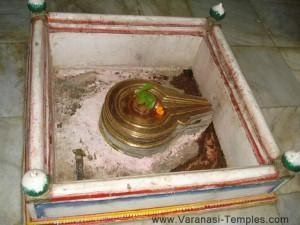
- The Sanctum (Garbhagriha): The inner sanctum houses the Swayambhu (self-manifested) Lingam of Hareshwar. The darkness within the sanctum enhances the mystical atmosphere, illuminated only by the flickering light of the Jyotirlinga representation.
- Artistic Sculpture: The exterior walls feature intricate carvings depicting scenes from Hindu mythology, including various forms of Shiva and the divine feminine.
4. Darshan & Ritual Logistics
Visiting Hareshwar Temple requires an understanding of the ritual schedule. While Varanasi temples often follow natural light cycles, the following timings are standard for visitor planning.
Daily Timings
| Session | Timing | Activity |
|---|---|---|
| Morning | 05:00 AM – 12:00 PM | Mangala Darshan & Abhishekam |
| Evening | 04:00 PM – 09:00 PM | Shayan Darshan & Aarti |
Seva & Online Booking (2026 Updates)
Devotees can partake in various Sevas (ritual services) to deepen their connection with the divine.
- Abhishekam: The ritual bathing of the Lingam with water, milk, and honey. Best performed during the morning session.
- Archana: Individual prayers (Sankalp) offered by the head priest.
- Rudrabhishek: A powerful Vedic ritual for peace and prosperity.
Booking: For 2026, many Varanasi temples have adopted digital systems. While specific online portals for Hareshwar Temple may be managed through local trusts, general bookings for priests in the Rajghat area can often be arranged through the Kashi Vishwanath Temple administration or directly at the temple office upon arrival.
2026 Major Festival Dates
- Maha Shivaratri: February 26, 2026 (Extended night-long darshan).
- Shravan Maas: July to August 2026 (Mondays are particularly auspicious for Shiva darshan).
- Kartik Purnima: November 5, 2026 (Deep Daan and Ganga Snan).
5. Practical Visitor Guidance
To ensure a serene experience, please adhere to the following guidelines:
- Dress Code: Traditional attire is recommended. Men should wear dhotis or trousers, and women should wear sarees or modest clothing that covers the shoulders and knees.
- Photography: Photography is strictly prohibited inside the inner sanctum (Garbhagriha) to maintain the sanctity of the ritual space. Exterior photography may be permitted at the discretion of the temple management.
- Mobile Lockers: Given the compact nature of the temple, it is advisable to carry minimal valuables. Mobile phones should be switched to silent mode.
- Crowd Management:
- Best Hours: Early morning (5:00 AM – 7:00 AM) or late evening (8:00 PM – 9:00 PM) offer the most peaceful darshan.
- Seasonal Advice: During the summer months (April–June), carry a water bottle and a handkerchief. In the monsoon (July–September), be cautious of slippery steps.
6. Pilgrimage Connectivity
Address: A-37/51, Rajghat Fort, Varanasi, Uttar Pradesh 221001.
How to Reach
- By Air: Lal Bahadur Shastri International Airport (LBS) is approximately 25 km from Rajghat Fort. A taxi or cab (via NH 19) takes about 45-60 minutes.
- By Rail: Varanasi Junction (BSB) is the nearest major railway station, roughly 5 km away. Autorickshaws and cycle rickshaws are readily available.
- By Road: The temple is located near Rajghat on the banks of the Ganges. It is accessible via the Varanasi-Chunar Road (SH 5). Devotees can travel directly to Rajghat Fort by autorickshaw, cycle rickshaw, or car.
Nearby Sacred Sites
Hareshwar Temple is situated near the Kashi Vishwanath Corridor. Consider visiting these nearby shrines to complete your pilgrimage circuit:
- Kashi Vishwanath Temple: The holiest Jyotirlinga, just a short distance away.
- Sankat Mochan Hanuman Temple: Located on the banks of the Assi Ganga, known for removing troubles.
- Kedareshwar Temple: An ancient temple dedicated to Lord Shiva, believed to be one of the oldest in Varanasi.
7. Frequently Asked Questions (FAQ)
1. Is there a VIP darshan entry available at Hareshwar Temple?
While Hareshwar Temple is a smaller shrine compared to the main Kashi Vishwanath complex, priority darshan is often available for elderly devotees and those with specific needs. VIP passes for the Kashi Vishwanath Corridor generally do not apply to Hareshwar, but donation-based priority entry can be arranged locally with the temple priest.
2. What is the significance of the Hareshwar Lingam?
The Lingam is believed to be highly energized for bestowing victory in legal matters, business ventures, and personal struggles. It is specifically linked to the legend of Lord Shiva wearing the skin of Gajasur.
3. Are foreigners allowed inside the temple?
Yes, Hareshwar Temple is open to all, regardless of religion or nationality, provided standard temple etiquette and dress codes are respected. However, access to the inner sanctum may be restricted during specific rituals.
4. Is there a facility for accommodation near the temple?
Being in the heart of Varanasi, numerous hotels, guest houses (Dharamshalas), and heritage stays are available in the nearby lanes of Godaulia, Dashashwamedh, and Lahurabir. It is advisable to book in advance during festivals.
5. What is the best way to donate to the temple?
Donations can be offered directly in the Hundi (donation box) inside the temple or to the head priest for specific Sevas. Digital payment options are becoming common in Varanasi but carrying some cash is recommended for smaller shrines.
Recent Posts

Shri Kaamkoteeshwar Mandir, Varanasi – History & Significance
In the heart of Kashi, the eternal city of Lord Shiva, where the Ganges flows with celestial grace, stands the Shri Kaamkoteeshwar Mandir. This sacred Sannidhi is not merely a temple but a profound spiritual bridge between the Northern…

ओ सांवरे तूने ही मुझको संभाला – Lyrics & Meaning
ओ सांवरे तूने ही मुझको संभाला – A Prayer to Shyam Origin & Spiritual Essence Why This Bhajan Resonates Devotees chant this when overwhelmed by life’s storms—the refrain ‘तूने ही मुझको संभाला’ is the soul’s sigh of relief: “You…

कथा ये है महाराज मेरे की – Lyrics & Meaning
कथा ये है महाराज मेरे की छत्रपति संभाजी महाराज – A Prayer to Chhatrapati Sambhaji Maharaj Origin & Spiritual Essence Why This Bhajan Resonates Devotees chant this when their spirit feels tested—its powerful refrain “महाराज मेरे” is a soul’s…

Rigveda Samhita Yathartha Anuvada (ऋग्वेद संहिता यथार्थ अनुवाद) – Complete Set with Anvayartha & Hindi/English Translation
The Rigveda is the oldest surviving scripture of humanity and the foundational text of Sanātana Dharma. For serious students, scholars, UPSC aspirants studying ancient Indian history, Sanskrit learners, and spiritual seekers, a precise and grammatically structured translation is indispensable.…

आना भी अकेला है जाना भी अकेला है – Lyrics & Meaning | BharatTemples
आना भी अकेला है जाना भी अकेला है – A Prayer to the Divine Witness Origin & Spiritual Essence Why This Bhajan Resonates Devotees turn to this bhajan in moments of deep reflection—when life’s attachments begin to ache. The…

माता शेरावाली के द्वार जो भी जाता है – Lyrics & Meaning
माता शेरावाली के द्वार जो भी जाता है – A Prayer to Maa Sherawali Origin & Spiritual Essence Why This Bhajan Resonates Devotees turn to this bhajan in times of fear or uncertainty—its promise that no one leaves Maa’s…

मार लेना सपणी उबार लेणा भवरा – Lyrics & Meaning
मार लेना सपणी उबार लेणा भवरा – A Prayer to the Divine Beloved Origin & Spiritual Essence Why This Bhajan Resonates Devotees chant this in moments of deep vulnerability—its cry of “मार लेना सपणी, उबार लेणा भवरा” is the…

हमें श्याम सुंदर भरोसा तुम्हारा – Lyrics & Meaning
हमें श्याम सुंदर भरोसा तुम्हारा – A Prayer to Shyam Sundar Origin & Spiritual Essence Why This Bhajan Resonates Devotees chant this when feeling alone—its refrain ‘de do sahara’ is the soul’s cry for divine support. Lyrics in Hindi…

Mere Satguru Ne Di Thi Davai Lyrics in Hindi & Meaning
Mere Satguru Ne Di Thi Davai: Invoking the Guru’s Liberating Wisdom This soul-stirring bhajan venerates the Satguru (True Spiritual Master) as the divine physician who dispenses the only remedy for life’s deepest sufferings. Composed by Sant Karmaveer Tufani, it…

Janm Diyo Thari Maa Dukh Dekhiyo Lyrics in Hindi & Meaning
जन्म दियो थारी माँ दुख देखियो (Maa’s Grief Upon Birthing You) This soul-stirring Chetavani Bhajan (admonitory hymn) is addressed to the Divine Mother (Maa) – a call for repentance when children forget their filial duties in the dark age…