
Contents
Author’s Note: As the Lead Heritage Architect for BharatTemples.com, I have crafted this guide blending architectural precision with deep devotion. Note that the Kaholeshwar Lingam is historically situated within the premises of the Batuk Bhairav Temple in the Kamachha area.
Introduction & Spiritual Essence
Nestled within the labyrinthine lanes of Varanasi (Kashi), the Kaholeshwar Temple stands as a testament to the city’s eternal spiritual fabric. While the specific outer structure may blend with the surrounding architecture of the Batuk Bhairav Temple complex in Kamachha, the energy within is singular and potent.
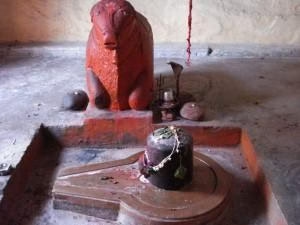
The Primary Deity: The temple enshrines the Kaholeshwar Lingam, a self-manifested (Swayambhu) form of Lord Shiva. In the dense, sacred geography of Kashi, every Lingam possesses a unique frequency, and Kaholeshwar is no exception.
Phalaśruti: Why Devotees Visit
According to the ancient Kashi Khand of the Skanda Purana, Goddess Parvati once expressed her desire to learn about the various Shiv Lingas scattered throughout Kashi. Lord Shiva, in his infinite grace, revealed the mysteries of these sites.
Worship at Kaholeshwar is believed to bestow the full benefits of residing in Kashi. Devotees flock here to:
- Attain Siddhi: Gain mastery over the senses and spiritual powers.
- Gain Divine Blessings: Specifically for relief from planetary afflictions (Graha Dosha).
- Attain Moksha: Liberation from the cycle of birth and death.
Historical Origins & Scriptural Legend
The Narrative of Kashi Khand
The primary scriptural reference for Kaholeshwar is found in Chapter 97 of the Kashi Khand. As tradition holds, Lord Shiva narrated the history of Kaholeshwar to Goddess Parvati, explaining that this Lingam grants the devotee the merit of living in the holy city of Kashi, even if they are transient visitors.
Architectural & Historical Context
While exact architectural inscriptions dating the construction are scarce in modern records, the temple’s presence in the Kamachha region points to a lineage of worship spanning centuries. The Kamachha area is historically significant for its association with Bhairav (a fierce manifestation of Shiva), and Kaholeshwar serves as the serene, cosmic balance to Bhairav’s intensity.
| Attribute | Details |
|---|---|
| Deity | Kaholeshwar (Lord Shiva) |
| Location | Kamachha (Near Batuk Bhairav Temple), Varanasi |
| Scriptural Source | Kashi Khand, Skanda Purana |
| Type | Swayambhu (Self-manifested) Lingam |
Architectural Marvels
As an architectural heritage site, Kaholeshwar represents the Nagara style of temple architecture, adapted to the compact urban footprint of Varanasi.
Key Features:
- The Sanctum (Garbhagriha): The focal point is the ancient Lingam. The energy of the space is concentrated here, with the structure typically low-roofed, immersing the devotee in a cave-like, meditative atmosphere.
- Vastu Shastra: The temple is situated in the Kamachha locality, which is geographically aligned to the energy flows of the city. The presence of the Batuk Bhairav at the gate represents the protective guardian (Dwarpala) of the sacred site.
- Sculptural Elements: While the outer façade may appear modest, the inner sanctum often features traditional stone carvings typical of Varanasi temples, depicting floral motifs and traditional Shilpa Shastra patterns.
Darshan & Ritual Logistics (2026 Guide)
Note: Specific timings for the internal Kaholeshwar shrine within the Batuk Bhairav complex may vary slightly based on seasonal priest schedules. The following is based on standard operating hours for major Varanasi temples.
Daily Timings
| Session | Timings | Activity |
|---|---|---|
| Morning | 05:00 AM – 12:00 PM | Mangala Darshan, Abhishekam |
| Afternoon | 12:00 PM – 4:00 PM | Temple Cleaning / Rest (Varies) |
| Evening | 4:00 PM – 9:00 PM | Sandhya Aarti, Shringar |
Key Sevas & Online Booking
While smaller shrines may not have extensive online portals, the adjoining Batuk Bhairav Temple often has administrative offices for rituals.
- Abhishekam: Ritual bathing of the Lingam (Usually requires prior notice).
- Archana: Recitation of names (Namasmaraṇa).
- Maha Aarti: Performed during twilight.
Booking: For standardized rituals in Varanasi, devotees can often use the Kashi Vishwanath Corridor official portals or local temple trust offices. Keywords: Online seva booking Varanasi temples.
2026 Festival Calendar (Varanasi Specific)
- Shivratri (Feb 26, 2026): The primary festival. The temple remains open 24 hours.
- Kartik Purnima (Nov 5, 2026): Dev Deepawali celebration near Assi Ghat; temple illumination.
- Maha Shivratri (March 2026): Special Abhishekam at 3:00 AM.
Practical Visitor Guidance
Dress Code & Etiquette
As with all Shiva temples in Varanasi, modesty is paramount. Traditional Indian attire (Kurta-Pajama or Dhoti for men, Saree/Salwar Kameez for women) is recommended. Avoid leather goods inside the sanctum.
Crowd Management
- Best Time: Early morning (5:00 AM – 7:00 AM) or late evening (7:30 PM).
- Seasonal Advice: Varanasi summers (April-June) are extreme. Carry a water bottle (plastic-free), umbrella, and wear breathable cotton.
- Mobiles & Lockers: Photography inside the sanctum is strictly prohibited. There are locker facilities available near the entrance of the Batuk Bhairav complex.
- Accessibility: The lanes of Kamachha are narrow. Access is best via Rickshaw or on foot. It is not wheelchair accessible due to traditional stone steps.
Pilgrimage Connectivity
How to Reach
- Nearest Airport: Lal Bahadur Shastri International Airport (LBS) (approx. 25 km).
- Nearest Railway Station: Varanasi Junction (BSB) (approx. 5-6 km). Auto-rickshaws are readily available.
- By Road: Located on the banks of the Ganges. The temple is situated in Kamachha, near the Bhairav intersection. Route: From Godaulia intersection, head towards Kamachha.
Nearby Sacred Sites (The Kashi Circuit)
- Batuk Bhairav Temple: The immediate complex housing Kaholeshwar. Known for fulfilling immediate wishes.
- Shri Kashi Vishwanath Temple (Golden Temple): Approximately 3-4 km away. The epicenter of the pilgrimage.
- Sankat Mochan Hanuman Temple: Located near BHU, accessible via a short drive.
Frequently Asked Questions (FAQ)
1. What is the historical origin of Kaholeshwar Temple?
According to the Kashi Khand of the Skanda Purana, Kaholeshwar is an ancient, self-manifested (Swayambhu) Lingam. The physical structure is located within the Batuk Bhairav Temple complex in Kamachha, Varanasi.
2. Is there a VIP Darshan entry available?
As this is a heritage shrine within a larger temple complex, formal VIP tickets are not typically issued. However, devotees can contact the Batuk Bhairav Temple administration office for special entry during peak festival times like Shivratri.
3. What is the significance of worshipping Lord Kaholeshwar?
Worship here grants the full spiritual merit of residing in Kashi. It is believed to help devotees acquire Siddhi (spiritual power) and ultimately attain Moksha (liberation).
4. Can I offer milk (Abhishekam) to the Lingam?
Yes, but usually through the designated temple priest. It is advised to bring milk in a clean container or purchase it from vendors near the temple who supply ritual materials.
5. Is the temple accessible via the Kashi Vishwanath Corridor?
Kaholeshwar is located in the Kamachha locality, which is separate from the main Kashi Vishwanath Corridor complex but is considered a vital part of the broader spiritual ecosystem of Varanasi. It is best accessed via local transport.
Recent Posts

Shri Kaamkoteeshwar Mandir, Varanasi – History & Significance
In the heart of Kashi, the eternal city of Lord Shiva, where the Ganges flows with celestial grace, stands the Shri Kaamkoteeshwar Mandir. This sacred Sannidhi is not merely a temple but a profound spiritual bridge between the Northern…

ओ सांवरे तूने ही मुझको संभाला – Lyrics & Meaning
ओ सांवरे तूने ही मुझको संभाला – A Prayer to Shyam Origin & Spiritual Essence Why This Bhajan Resonates Devotees chant this when overwhelmed by life’s storms—the refrain ‘तूने ही मुझको संभाला’ is the soul’s sigh of relief: “You…

कथा ये है महाराज मेरे की – Lyrics & Meaning
कथा ये है महाराज मेरे की छत्रपति संभाजी महाराज – A Prayer to Chhatrapati Sambhaji Maharaj Origin & Spiritual Essence Why This Bhajan Resonates Devotees chant this when their spirit feels tested—its powerful refrain “महाराज मेरे” is a soul’s…

Rigveda Samhita Yathartha Anuvada (ऋग्वेद संहिता यथार्थ अनुवाद) – Complete Set with Anvayartha & Hindi/English Translation
The Rigveda is the oldest surviving scripture of humanity and the foundational text of Sanātana Dharma. For serious students, scholars, UPSC aspirants studying ancient Indian history, Sanskrit learners, and spiritual seekers, a precise and grammatically structured translation is indispensable.…

आना भी अकेला है जाना भी अकेला है – Lyrics & Meaning | BharatTemples
आना भी अकेला है जाना भी अकेला है – A Prayer to the Divine Witness Origin & Spiritual Essence Why This Bhajan Resonates Devotees turn to this bhajan in moments of deep reflection—when life’s attachments begin to ache. The…

माता शेरावाली के द्वार जो भी जाता है – Lyrics & Meaning
माता शेरावाली के द्वार जो भी जाता है – A Prayer to Maa Sherawali Origin & Spiritual Essence Why This Bhajan Resonates Devotees turn to this bhajan in times of fear or uncertainty—its promise that no one leaves Maa’s…

मार लेना सपणी उबार लेणा भवरा – Lyrics & Meaning
मार लेना सपणी उबार लेणा भवरा – A Prayer to the Divine Beloved Origin & Spiritual Essence Why This Bhajan Resonates Devotees chant this in moments of deep vulnerability—its cry of “मार लेना सपणी, उबार लेणा भवरा” is the…

हमें श्याम सुंदर भरोसा तुम्हारा – Lyrics & Meaning
हमें श्याम सुंदर भरोसा तुम्हारा – A Prayer to Shyam Sundar Origin & Spiritual Essence Why This Bhajan Resonates Devotees chant this when feeling alone—its refrain ‘de do sahara’ is the soul’s cry for divine support. Lyrics in Hindi…

Mere Satguru Ne Di Thi Davai Lyrics in Hindi & Meaning
Mere Satguru Ne Di Thi Davai: Invoking the Guru’s Liberating Wisdom This soul-stirring bhajan venerates the Satguru (True Spiritual Master) as the divine physician who dispenses the only remedy for life’s deepest sufferings. Composed by Sant Karmaveer Tufani, it…

Janm Diyo Thari Maa Dukh Dekhiyo Lyrics in Hindi & Meaning
जन्म दियो थारी माँ दुख देखियो (Maa’s Grief Upon Birthing You) This soul-stirring Chetavani Bhajan (admonitory hymn) is addressed to the Divine Mother (Maa) – a call for repentance when children forget their filial duties in the dark age…