Vriddh Aditya Temple Varanasi: History, Darshan Timings & Complete Guide
Receive daily temple updates, divine darshan, and morning bhajans directly on WhatsApp.
Contents
- 1 Introduction & Spiritual Essence: The Eternal Youth of the Sun
- 2 Historical Origins & Scriptural Legend
- 3 Architectural Marvels
- 4 Darshan & Ritual Logistics
- 5 Practical Visitor Guidance
- 6 Pilgrimage Connectivity
- 7 Frequently Asked Questions (FAQ)
- 8 Photo Gallery
- 9 Contact Details
Introduction & Spiritual Essence: The Eternal Youth of the Sun
Nestled within the ancient, labyrinthine bylanes of Varanasi, the Vriddh Aditya Temple stands as a beacon of vitality and divine grace. Dedicated to Lord Surya (the Sun God), specifically in his form as Vriddh Aditya, this sacred shrine is unique. While the sun is typically worshipped for health and prosperity, this temple holds a distinct spiritual signature rooted deeply in the Kashi Khand of the Skanda Purana.
Primary Deity: Lord Vriddh Aditya (an aspect of Surya Narayana).
Form: The deity is worshipped as a Swayambhu (self-manifested) energy force, embodying the life-giving rays of the sun.
Phalaśruti: Why Visit Vriddh Aditya?
According to the Kashi Khand, the spiritual merit (Phalaśruti) of worshipping Vriddh Aditya is unparalleled for devotees seeking rejuvenation. The primary benefits include:
- Restoration of Vitality: Just as the ancient sage Harit was granted a return to youth, devotees pray here to regain physical strength, immunity, and mental agility.
- Removal of Planetary Afflictions: As the Lord of the Sun, worship here helps pacify the malefic effects of the Sun in one’s astrological chart.
- Ancestral Liberation (Pitra Dosh Nivaran): It is believed that offering prayers here aids in the liberation of ancestors, cleansing generational karma.
Historical Origins & Scriptural Legend
The history of Vriddh Aditya Temple is not merely recorded in stone but etched in the oral traditions of Kashi. Unlike monuments built by dynastic kings, this temple’s origin is tied to a divine interaction between a mortal and a deity.
The Legend of Sage Harit
Tradition holds, as narrated in Kashi Khand, that a staunch devotee named Harit arrived in Varanasi. Despite his advanced age and physical frailty, he was consumed by a singular desire: to perform intense Tapas (ascetic meditation). However, he realized that such rigorous spiritual practice requires immense physical energy.
📖 Related: Paas Pani Vinayak Temple Varanasi: History, Timings & Complete Guide
Stationing himself near Visalakshi Devi, Harit began a relentless prayer to Lord Surya. After years of austerities, Lord Surya appeared, radiant as a billion suns, and offered the sage a boon. Harit asked not for material wealth, but for the strength to perform his duties—”Grant me the vigor of youth.” Pleased by his selflessness, Surya granted him the boon. The place where the aging sage was transfigured into a youthful being became the sacred spot for the Vriddh Aditya shrine.
Architectural Heritage
While the exact date of construction is lost in the mists of time, the temple’s architecture suggests deep roots in the Dravidian style of South India. Over the centuries, the shrine has undergone various renovations, funded by devout patrons and local communities, to preserve its sanctity and structural integrity amidst the dense urban fabric of Varanasi.
Architectural Marvels
The Vriddh Aditya Temple is a fascinating example of how South Indian architectural sensibilities harmonize with the spiritual geography of Varanasi.
Dravidian Style & Vastu Alignment
The temple features the classic elements of Dravidian architecture, characterized by pyramidal towers (Shikharas) and ornate pillared halls (Mandapas). The sanctum sanctorum (Garbhagriha) is oriented strictly according to Vastu Shastra, allowing the morning sun to illuminate the deity during the auspicious hours of Brahma Muhurta.
Notable Features
- The Shikhara: The towering spire above the sanctum is adorned with intricate carvings depicting solar motifs and floral patterns.
- The Mandapa: The hall leading to the deity features heavy, carved pillars that resonate with ancient chants during aarti.
- Sculptural Details: Stone reliefs on the exterior walls depict scenes from the Ramayana and Mahabharata, alongside depictions of Surya in his chariot driven by seven horses.
Note: While this temple is a protected heritage site under local municipal guidelines, it holds significant cultural importance for the Varanasi district.
Darshan & Ritual Logistics
To ensure a spiritually fulfilling experience, devotees should be aware of the temple’s timings and ritual offerings. The atmosphere is particularly charged during the early morning Arghya (offering to the Sun).
Dedicated Surya Archana
| Session | Timings | Activity |
|---|---|---|
| Morning Darshan | 05:00 AM – 12:00 PM | Mangala Aarti, Surya Namaskar |
| Afternoon Break | 12:00 PM – 04:00 PM | Temple Closed (except festivals) |
| Evening Darshan | 04:00 PM – 09:00 PM | Shayan Aarti, Bhajans |
| Special Sunday Puja | 06:00 AM – 08:00 AM |
Key Sevas & Online Booking
While many rituals are conducted at the temple counter, devotees can now plan their participation in specific Sevas:
- Surya Abhishekam: A ritual bathing of the deity with water, milk, and honey. Best performed on Sundays.
- Sahastranama Archana: Recitation of 1,000 names of Lord Surya.
- Rudrabhishek: Often clubbed with Aditya worship for holistic prosperity.
How to Book: While the temple management committee is transitioning to digital systems, bookings for major Sevas are currently facilitated via the Kashi Vishwanath Temple Trust portals or by contacting the local Shri Kashi Vishwanath Temple Trust office. For 2026, devotees are advised to check the official bharattemples.com listing for real-time availability.
Festival Dates for 2026
The temple witnesses maximum footfall during:
- Makar Sankranti (January 14, 2026): The most important festival here, marking the sun’s entry into Capricorn. Special Maha Aarti is held at sunrise.
- Ratha Saptami (February 4, 2026): Celebrated as the birthday of Lord Surya; a special procession is held if weather permits.
- Chhath Puja (October 26–29, 2026): Though primarily celebrated on the riverbanks, the temple sees a surge of devotees offering prayers to Vriddh Aditya.
Practical Visitor Guidance
Varanasi is a city of devotion and chaos; being prepared ensures a peaceful darshan.
Code of Conduct
- Dress Code: Traditional attire is recommended. Men should wear dhotis or long trousers; women should wear sarees or modest kurtas.
- Photography: Photography is strictly prohibited inside the sanctum sanctorum. Flash photography is discouraged in the Mandapa to maintain the sanctity of the space.
- Lockers: There are no electronic lockers at the specific Vriddh Aditya shrine. It is advisable to carry minimal belongings. Large bags should be deposited at the central luggage counter near the Vishwanath Temple complex.
Crowd Management & Seasonal Tips
- Best Hours: Visit between 7:00 AM and 9:00 AM or after 7:00 PM to avoid the rush of daily commuters.
- Summer (April–June): Varanasi can be extremely hot. Carry a water bottle (refill stations available near the temple), a head covering, and wear light cotton fabrics.
- Monsoon (July–Sept): The lanes around Mir Ghat can become slippery. Wear rubber-soled sandals with good grip.
- Winter (Dec–Jan): Mornings are foggy. Carry a light woolen shawl for the early morning Aarti.
Pilgrimage Connectivity
How to Reach
The Vriddh Aditya Temple is located at D-3/15, South of Bare Hanumanji, Mir Ghat, Varanasi.
- By Air: Lal Bahadur Shastri International Airport (LBS) is approx. 25 km away. Taxis and Airport Authority buses connect to the Cantonment area.
- By Rail: Varanasi Junction (BSB) is the nearest major railway station (4 km). Auto-rickshaws are readily available.
- By Road: The temple is accessible via the Varanasi-Allahabad Highway (NH 19).
Access Routes
Because the temple is in the old city (Panditpur), vehicular traffic is restricted.
- Rickshaw Route: Take an auto-rickshaw to Dasaswamedh Vishwanath Gulli. From there, it is a 5-minute walk through the market.
- Boat Route: Hire a boat to Mir Ghat. Climb the stone stairs leading away from the river; the temple is located just above the ghat steps.
Nearby Sacred Sites (Pilgrimage Circuit)
Enhance your spiritual journey by visiting these nearby shrines:
- Kashi Vishwanath Jyotirlinga: Located roughly 15 minutes away on foot. The epicenter of Varanasi pilgrimage.
- Bare Hanumanji Temple: Situated immediately adjacent to the Vriddh Aditya complex. This temple houses a massive, ancient idol of Hanuman.
- Annapurna Devi Temple: Approximately 1 km away, dedicated to the Goddess of food and nourishment.
Frequently Asked Questions (FAQ)
1. Is there a VIP darshan entry at Vriddh Aditya Temple?
Unlike the main Kashi Vishwanath Temple, Vriddh Aditya does not have a formal VIP or paid darshan entry system. Darshan is free and open to all, though queues can get long during peak festivals.
2. Can I perform a personal Surya Namaskar inside the temple?
Yes, the Mandapa (hall) is open for personal prayers and Surya Namaskar, particularly in the early morning. However, priority is given to the priest-led rituals.
3. Is the temple wheelchair accessible?
Due to the heritage nature of the architecture and the location in the old city, the temple has several steps and narrow passages. It is not fully wheelchair accessible, though assistance can be arranged at Mir Ghat.
4. What is the significance of worshipping on Sundays?
Sunday is ruled by the Sun. Worshiping Vriddh Aditya on this day is believed to multiply the benefits of health and authority, and is the best day to perform the Surya Abhishekam.
5. Is there an entry fee?
No, general entry to Vriddh Aditya Temple is completely free for all devotees.
Photo Gallery

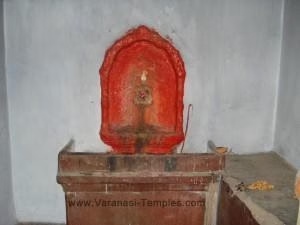
Vriddh-Outer2-300×225, Vriddh Aditya Temple, Varanasi
Vriddh-Inner2-300×225, Vriddh Aditya Temple, Varanasi
Contact Details
Address: D-3/15, South of Bare Hanumanji, Mir Ghat, Varanasi, Uttar Pradesh 221001
Phone: (Note: As this is an ancient shrine managed by local trust, a direct dedicated phone line is often unavailable. Please contact the Shri Kashi Vishwanath Temple Trust for inquiries.)