
Contents
Introduction & Spiritual Essence
Nestled near Trilochan in the sacred city of Varanasi (Kashi), the Kameshwar Temple stands as a testament to the transformative power of devotion and the deep-rooted mythology of the Kashi Khand. This ancient shrine is dedicated to Lord Shiva, revered here in the form of the Kameshwar Linga.
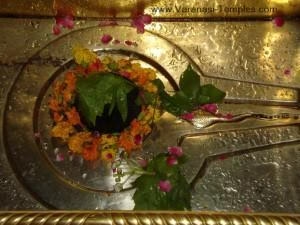
Deity & Form: The temple houses two primary Shiv Lingas. The larger one is known as the Durvaseshwar Linga, representing pure Bhakti (devotion), while the smaller, potent linga is the Kameshwar Linga (also called Man Kameshwar), representing Shakti (power). While Lord Shiva is the primary deity, the presiding form of Kameshwar is specifically associated with the fulfillment of wishes.
Phalaśruti (Spiritual Benefits):
According to the Kashi Khand, Chapter 85, the spiritual merit (Phalaśruti) of visiting this temple is unparalleled. The legend suggests that Lord Shiva granted a boon that when Saturday coincides with Trayodashi (the 13th day of the lunar fortnight) and Pradosha (the twilight period), devotees who take a bath in the now-dried Kamkund and worship Kameshwar are:
- Cleansed of all sins: Liberation from past karma.
- Granted Wish Fulfillment: Specific desires are realized through sincere prayer.
- Assured Moksha: Attaining heaven or liberation after death.
Historical Origins & Scriptural Legend
The history of Kameshwar Temple is deeply intertwined with the temper and devotion of the sage Durvasa Rishi.
The Legend of Sage Durvasa
Tradition holds that while describing the Kashi Mahatmya to Agastya Rishi, Lord Skanda narrated the story of Durvasa. The hot-tempered sage traveled the world and eventually reached Kashi. There, he dug a pond (a Kund) for bathing and installed a Shiv Ling nearby to perform Pooja and Archana.
On a specific occasion, Sage Durvasa became enraged and was about to curse Kashi and its inhabitants. At that critical moment, Lord Shiva appeared before him, pacifying his anger. Pleased, Durvasa requested a divine boon: that the Kund he dug be named Kamkund and the Ling be called Kameshwar Ling. Lord Shiva granted this wish immediately.
Scriptural References
The primary textual authority is the Kashi Khand (Chapter 85) of the Skanda Purana. Inscriptions and temple records highlight the spiritual geography of this area, though the exact century of construction is obscured by centuries of reconstruction. The presence of two distinct lingas suggests a layered history, possibly dating back to early medieval periods, though the current structure reflects later Maratha and traditional North Indian architectural influences.
Architectural Marvels
While the exterior of Kameshwar Temple is modest compared to the grand monolithic structures of the South, its architectural significance lies in its adherence to the Nagara style prevalent in North India, fused with the spiritual geometry of Vastu Shastra.
Sanctum and Mandapas
The Garbhagriha (sanctum sanctorum) is designed to house the Shiv Linga at a subterranean or slightly lowered level, symbolizing the connection to the underworld (Patala) and the Kamkund itself. The Mandapa (hall) allows for circumambulation (Pradakshina). Unlike massive temples, the structure focuses on intimacy and energy concentration.
Sculptural Details
Though the temple is compact, the stone carvings around the sanctum often depict motifs associated with Kamadeva (the God of Love) and Parvati (symbolizing Shakti). The interplay of the Durvaseshwar and Kameshwar lingas represents the balance of devotion and power, a core architectural theme in Kashi temple layouts.
Note: Unlike major heritage sites, this temple is not under ASI protection but is maintained by local trusts, preserving its organic, living heritage status.
Darshan & Ritual Logistics
Devotees visit Kameshwar Temple primarily for Shiv Puja and Abhishekam. The energy is most potent during the twilight hours.
Daily Timings
The temple generally follows the standard Kashi puja schedule. The Pradosha Kaal (twilight) is considered the best time for darshan.
| Session | Timing | Rituals |
|---|---|---|
| Morning Darshan | 5:00 AM – 12:00 PM | Mangala Aarti, Abhishekam |
| Afternoon Closure | 12:00 PM – 3:00 PM | Sanctum cleaning and rest |
| Evening Darshan | 4:00 PM – 9:00 PM | Shringar Aarti, Shayan Aarti |
| Pradosha Kaal | 6:00 PM – 7:30 PM | Special Puja (Best time for wish fulfillment) |
Key Sevas and Online Booking
While online infrastructure varies for smaller heritage temples in Varanasi, standard Sevas performed here include:
- Abhishekam: Ritual bathing of the Linga (Milk, Honey, Ghee, Water).
- Archana: Recitation of names (Namaskara).
- Special Pradosha Puja: Highly recommended on the Trayodashi days.
Booking: For general darshan, no tickets are required. For special rituals, it is advisable to consult the temple priest on-site. For Varanasi-wide temple bookings, devotees often use the official Kashi Vishwanath apps, but specific seva for Kameshwar is typically arranged locally to respect the intimate nature of the shrine.
2026 Major Festival Dates
- Maha Shivaratri: February 26, 2026 (Major celebrations, night-long darshan).
- Shravan Month: July 14, 2026 – August 11, 2026 (Peak attendance, Mondays are auspicious).
- Pradosh Vrat: Observed on the 13th day of every lunar fortnight (Check local Panchangam for exact dates).
Practical Visitor Guidance
Visiting Kameshwar Temple requires adherence to local customs and logistical preparedness.
Dress Code and Etiquette
Traditional attire is recommended. Men should wear Dhoti or trousers with a bare torso or shirt, while women should wear Saree or Salwar Kameez. Modest clothing is appreciated. Footwear must be removed at the designated stands outside the temple.
Photography and Electronics
Photography inside the sanctum sanctorum is strictly prohibited to maintain the sanctity of the rituals. Mobile phones should be kept on silent mode. Many small temples in Varanasi request phones be kept in bags rather than used during Darshan.
Accessibility and Crowd Management
The temple is located in a narrow lane near Prahlad Ghat.
- Footwear: Be mindful of the heat; carry a pair of thick socks if walking barefoot on stone paths.
- Best Hours: Visit between 5:00 AM – 7:00 AM or 8:00 PM – 9:00 PM to avoid the midday rush and heat.
- Summer Advice: May and June temperatures in Varanasi can exceed 40°C; carry water and cover your head.
- Monsoon: July-September brings humidity and rain; waterproof footwear is recommended.
Pilgrimage Connectivity
Kameshwar Temple is located in the heart of the old city, making it accessible via various modes of transport.
How to Reach
- By Air (Flight): The nearest airport is Lal Bahadur Shastri International Airport (VNS), approximately 25 km away. From there, take a taxi to Dashashwamedh Ghat or Godaulia.
- By Train (Rail): The closest railway station is Varanasi Junction (BSB) (approx. 5 km) or Manduadih Railway Station (approx. 4 km). From there, hire an auto-rickshaw or e-rickshaw.
- By Road: The temple is approachable via the Varanasi-Prayagraj Highway (NH 19) and is located just off the ghats.
Nearby Sacred Sites
To maximize your spiritual itinerary, consider visiting these nearby locations which form a pilgrimage circuit:
- Trilochan Mahadev Temple: Located very close to Kameshwar, known for its three eyes (Trilochan) representation of Lord Shiva.
- Prahlad Ghat: A historic ghat built by Raja Pratap Singh. It is named after the demon-king Hiranyakashipu’s son, Prahlad, a great devotee of Vishnu.
- Kashi Vishwanath Temple (Main Shrine): Located approximately 2-3 km away, accessible by boat or walking.
Frequently Asked Questions (FAQ)
1. Is there a VIP or special entry for darshan?
Kameshwar Temple is a smaller heritage shrine and generally does not have a formal VIP entry system like larger temples. However, approaching during non-peak hours (early morning) allows for a quick and peaceful darshan.
2. Why is Kamkund important if it is dried up?
Even though the physical water of Kamkund has dried up due to urbanization, the site holds immense Tejas (spiritual energy). Devotees believe that circumambulating the temple and praying at the Kameshwar Ling has the same merit as taking a dip in the ancient Kund, as the energy vortex remains active.
3. Can I perform Rudrabhishek at Kameshwar Temple?
Yes, Rudrabhishek can be performed, though it requires prior coordination with the local priests. The temple space is compact, so smaller groups or individual pujas are ideal.
4. Is the temple open during monsoon rains?
Yes, the temple remains open year-round. However, during heavy downpours, visiting by foot near the ghats requires caution due to slippery steps.
5. Are there accommodation facilities nearby?
While there are no hotels directly adjacent to the temple, the surrounding areas of Godaulia, Dashashwamedh, and Lanka offer a wide range of hotels and Dharamshalas within a 3 km radius.
Photo Gallery
Contact Details
Since Kameshwar is a traditional neighborhood temple, it does not have a dedicated official phone line. For inquiries, it is best to visit the temple office or contact local guides at Prahlad Ghat.
Official Address
Kameshwar Temple
Trilochan Area, Near Prahlad Ghat
Varanasi, Uttar Pradesh 221001
India
Recent Posts

Shri Kaamkoteeshwar Mandir, Varanasi – History & Significance
In the heart of Kashi, the eternal city of Lord Shiva, where the Ganges flows with celestial grace, stands the Shri Kaamkoteeshwar Mandir. This sacred Sannidhi is not merely a temple but a profound spiritual bridge between the Northern…

ओ सांवरे तूने ही मुझको संभाला – Lyrics & Meaning
ओ सांवरे तूने ही मुझको संभाला – A Prayer to Shyam Origin & Spiritual Essence Why This Bhajan Resonates Devotees chant this when overwhelmed by life’s storms—the refrain ‘तूने ही मुझको संभाला’ is the soul’s sigh of relief: “You…

कथा ये है महाराज मेरे की – Lyrics & Meaning
कथा ये है महाराज मेरे की छत्रपति संभाजी महाराज – A Prayer to Chhatrapati Sambhaji Maharaj Origin & Spiritual Essence Why This Bhajan Resonates Devotees chant this when their spirit feels tested—its powerful refrain “महाराज मेरे” is a soul’s…

Rigveda Samhita Yathartha Anuvada (ऋग्वेद संहिता यथार्थ अनुवाद) – Complete Set with Anvayartha & Hindi/English Translation
The Rigveda is the oldest surviving scripture of humanity and the foundational text of Sanātana Dharma. For serious students, scholars, UPSC aspirants studying ancient Indian history, Sanskrit learners, and spiritual seekers, a precise and grammatically structured translation is indispensable.…

आना भी अकेला है जाना भी अकेला है – Lyrics & Meaning | BharatTemples
आना भी अकेला है जाना भी अकेला है – A Prayer to the Divine Witness Origin & Spiritual Essence Why This Bhajan Resonates Devotees turn to this bhajan in moments of deep reflection—when life’s attachments begin to ache. The…

माता शेरावाली के द्वार जो भी जाता है – Lyrics & Meaning
माता शेरावाली के द्वार जो भी जाता है – A Prayer to Maa Sherawali Origin & Spiritual Essence Why This Bhajan Resonates Devotees turn to this bhajan in times of fear or uncertainty—its promise that no one leaves Maa’s…

मार लेना सपणी उबार लेणा भवरा – Lyrics & Meaning
मार लेना सपणी उबार लेणा भवरा – A Prayer to the Divine Beloved Origin & Spiritual Essence Why This Bhajan Resonates Devotees chant this in moments of deep vulnerability—its cry of “मार लेना सपणी, उबार लेणा भवरा” is the…

हमें श्याम सुंदर भरोसा तुम्हारा – Lyrics & Meaning
हमें श्याम सुंदर भरोसा तुम्हारा – A Prayer to Shyam Sundar Origin & Spiritual Essence Why This Bhajan Resonates Devotees chant this when feeling alone—its refrain ‘de do sahara’ is the soul’s cry for divine support. Lyrics in Hindi…

Mere Satguru Ne Di Thi Davai Lyrics in Hindi & Meaning
Mere Satguru Ne Di Thi Davai: Invoking the Guru’s Liberating Wisdom This soul-stirring bhajan venerates the Satguru (True Spiritual Master) as the divine physician who dispenses the only remedy for life’s deepest sufferings. Composed by Sant Karmaveer Tufani, it…

Janm Diyo Thari Maa Dukh Dekhiyo Lyrics in Hindi & Meaning
जन्म दियो थारी माँ दुख देखियो (Maa’s Grief Upon Birthing You) This soul-stirring Chetavani Bhajan (admonitory hymn) is addressed to the Divine Mother (Maa) – a call for repentance when children forget their filial duties in the dark age…