
Contents
| Date built: | – |
|---|---|
| Deity: | Shatkaleshwar |
| Architectural style: | Hindu Temple architecture |
| Major festivals | – |
| Locale: | Varanasi |
| District:: | Varanasi |
| Address: | – |
| Phone | – |
Introduction & Spiritual Essence
Nestled in the labyrinthine lanes of the ancient city, the Shatkaleshwar Temple, Varanasi stands as a testament to the unwavering faith that permeates Kashi. While the bustling ghats attract millions, the true spiritual essence of Varanasi lies in its hidden Mandirs. Here, the presiding deity is Shatkaleshwar, a form of Lord Shiva, established as a Swayambhu (self-manifested) Lingam.
Kashi Khand mentions one Shatkaleshwar Ling among various other Shiv Lings. It is stated in this epic that Lord Shiva stayed in Kashi to bring out this Ling for the benefit of easy darshan to the devotees.
A devotee who worships Shatkaleshwar Ling, will live happily for hundred years.
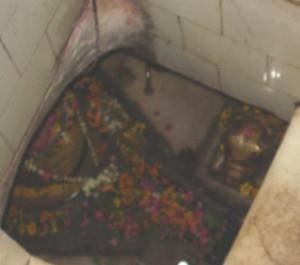
This temple is unique not only for its spiritual lore but for its physical location—underground. Known locally as Peetal Shivala or the “Brass Temple,” it is a silent sanctuary of peace. The primary Phalaśruti (spiritual benefit) of visiting this temple, as derived from the Kashi Khand, is the granting of longevity. Devotees believe that worshiping here ensures a life span of one hundred years, filled with health and prosperity, effectively cleansing the ancestral karma and bestowing blessings of vitality.
Historical Origins & Scriptural Legend
The Kashi Khand Connection
The origin of Shatkaleshwar is deeply rooted in the Kashi Khand of the Skanda Purana. According to the scripture, Goddess Parvati requested Lord Shiva to reveal all the sacred Teerths and Shiv Lings present within the boundaries of Kashi. To fulfill her wish, Lord Shiva manifested six distinct forms of his energy in Kashi, one of which is Shatkaleshwar (Shatka = Six; Ishwar = Lord).
Archaeological and Local History
While the exact century of construction is not explicitly recorded in ASI (Archaeological Survey of India) documents due to the temple’s submerged nature, local tradition holds that the structure dates back several centuries. The temple is located at Ck.17/24, Thatheri Bazar, a commercial hub known for brassware. Historically, Varanasi’s temples often featured underground sanctums to protect the deities during invasions and to maintain the natural coolness required for Shiva worship.
Architectural Marvels
Shatkaleshwar Temple is a remarkable example of subterranean architecture within the urban fabric of Varanasi. Unlike the towering Shikharas of North Indian temples, this shrine sinks deep into the earth, creating a mystical atmosphere.
Style and Layout
The architecture follows a simplified Nagara style adapted for an underground setting. The entrance is narrow, leading to a staircase that descends to the sanctum sanctorum. The walls are constructed of stone and brick, thick and sturdy to support the earth above.
The Brass (Peetal) Connection
The local name “Peetal Shivala” is derived from the extensive use of brass (Tamba) in the temple’s fittings and the main door. The most striking feature is the heavy iron grill or gate that separates the devotees from the inner sanctum. This gate allows for Darshan but prevents physical entry, emphasizing the temple’s reputation for housing a “very powerful” Lingam that requires distance for safety and sanctity.
Darshan & Ritual Logistics
As a site managed by local priests and trust, the atmosphere is less commercial and more devotional. However, maintaining a schedule is essential for visitors.
Daily Timings
| Session | Timings |
|---|---|
| Morning Darshan | 06:00 AM – 12:00 PM |
| Afternoon Break | 12:00 PM – 04:00 PM |
| Evening Darshan | 04:00 PM – 09:00 PM |
| Key Note | Timings may vary slightly during festivals. |
Sevas and Booking
Since the Lingam is accessed through a grill, physical Abhishekam (ritual bathing) by devotees is generally not permitted inside the sanctum. However, rituals are performed by the head priest.
- Archana: Can be requested at the entrance desk. The priest will perform the chanting on your behalf.
- Online Seva Booking: While this specific shrine does not have a dedicated large-scale online portal like major temples, devotees can book general Kashi darshan packages through the Kashi Vishwanath Temple Trust website, which covers the broader spiritual circuit.
2026 Major Festival Dates
- Maha Shivaratri: February 26, 2026 (Extremely crowded; extended hours).
- Shravan Mondays: July 6, 13, 20, 27, 2026 (Monsoon peak; temple remains open longer).
- Kartik Purnima: November 5, 2026.
Practical Visitor Guidance
Visiting Shatkaleshwar requires navigating the narrow, bustling lanes of Thatheri Bazar.
Rules and Etiquette
- Footwear: There is a shoe keeper at the top of the stairs leading underground. A small fee is standard.
- Photography: Strictly prohibited inside the underground chamber to respect the sanctity of the powerful Lingam.
- Mobile Phones: Must be switched to silent mode. Lockers are not available in this small shrine; it is advisable to travel light.
- Accessibility: The descent involves steep stairs. This site is not wheelchair accessible. Elderly visitors should take extra care.
Crowd Management
Unlike the main Kashi Vishwanath Temple, crowds here are manageable. However, during Shravan (July-August) and Maha Shivaratri, the area gets congested.
- Best Time to Visit: Early morning (6:00 AM – 7:30 AM) is ideal for a peaceful darshan.
- Seasonal Advice: In May and June, the underground chamber remains cool, offering relief from the intense heat. In winter, it can feel damp, so wear layers.
Pilgrimage Connectivity
How to Reach
Address: Ck.17/24, Thatheri Bazar, Opp. Dashrath Kala Kendra, Varanasi, Uttar Pradesh 221001.
- Nearest Airport: Lal Bahadur Shastri International Airport (LBS) is approximately 25 km away. A taxi to Godaulia (approx. 45 mins) followed by an auto-rickshaw is the most efficient route.
- Nearest Railway Station: Varanasi Junction (VNS) is 4 km away. Direct autos are available to Godaulia or Vishwanath Gali.
- By Road: Located on the Varanasi-Allahabad section of NH 19. Access is strictly via two-wheelers or auto-rickshaws; cars cannot enter the congested Thatheri market lanes.
Nearby Sacred Sites
To complete your spiritual journey, visit these nearby temples within walking distance:
- Kashi Vishwanath Jyotirlinga (New Temple): 500 meters away via Vishwanath Gali.
- Sankat Mochan Hanuman Temple: 2.5 km away (famous for the healing power of the “Sankat Mochan” recitation).
- Tulsi Manas Temple: 2 km away, a serene white marble temple marking the composition site of the Ramcharitmanas.
Frequently Asked Questions (FAQs)
Is there a VIP darshan entry at Shatkaleshwar Temple?
Due to the small size of the underground sanctum, there is no separate VIP entry. Darshan is general, and the queue moves quickly as devotees view the Lingam through the grill.
Why is the Lingam kept behind a grill?
The Lingam is considered highly potent and ancient. Local tradition dictates that it should not be touched frequently or physically handled. The grill preserves the energy of the deity and prevents misuse.
What is the best time to visit to avoid the Varanasi heat?
Since Shatkaleshwar is an underground temple, the internal temperature remains lower than the outside. However, the best months for a comfortable visit are October to March.
Is there any entry fee?
General entry is free. However, offerings (flowers, milk) can be purchased from vendors outside the temple.
Can tourists visit Shatkaleshwar?
Yes, tourists are welcome. However, as the space is tight, large groups should send members in small batches to avoid congestion in the narrow lanes.
Recent Posts

Shri Kaamkoteeshwar Mandir, Varanasi – History & Significance
In the heart of Kashi, the eternal city of Lord Shiva, where the Ganges flows with celestial grace, stands the Shri Kaamkoteeshwar Mandir. This sacred Sannidhi is not merely a temple but a profound spiritual bridge between the Northern…

ओ सांवरे तूने ही मुझको संभाला – Lyrics & Meaning
ओ सांवरे तूने ही मुझको संभाला – A Prayer to Shyam Origin & Spiritual Essence Why This Bhajan Resonates Devotees chant this when overwhelmed by life’s storms—the refrain ‘तूने ही मुझको संभाला’ is the soul’s sigh of relief: “You…

कथा ये है महाराज मेरे की – Lyrics & Meaning
कथा ये है महाराज मेरे की छत्रपति संभाजी महाराज – A Prayer to Chhatrapati Sambhaji Maharaj Origin & Spiritual Essence Why This Bhajan Resonates Devotees chant this when their spirit feels tested—its powerful refrain “महाराज मेरे” is a soul’s…

Rigveda Samhita Yathartha Anuvada (ऋग्वेद संहिता यथार्थ अनुवाद) – Complete Set with Anvayartha & Hindi/English Translation
The Rigveda is the oldest surviving scripture of humanity and the foundational text of Sanātana Dharma. For serious students, scholars, UPSC aspirants studying ancient Indian history, Sanskrit learners, and spiritual seekers, a precise and grammatically structured translation is indispensable.…

आना भी अकेला है जाना भी अकेला है – Lyrics & Meaning | BharatTemples
आना भी अकेला है जाना भी अकेला है – A Prayer to the Divine Witness Origin & Spiritual Essence Why This Bhajan Resonates Devotees turn to this bhajan in moments of deep reflection—when life’s attachments begin to ache. The…

माता शेरावाली के द्वार जो भी जाता है – Lyrics & Meaning
माता शेरावाली के द्वार जो भी जाता है – A Prayer to Maa Sherawali Origin & Spiritual Essence Why This Bhajan Resonates Devotees turn to this bhajan in times of fear or uncertainty—its promise that no one leaves Maa’s…

मार लेना सपणी उबार लेणा भवरा – Lyrics & Meaning
मार लेना सपणी उबार लेणा भवरा – A Prayer to the Divine Beloved Origin & Spiritual Essence Why This Bhajan Resonates Devotees chant this in moments of deep vulnerability—its cry of “मार लेना सपणी, उबार लेणा भवरा” is the…

हमें श्याम सुंदर भरोसा तुम्हारा – Lyrics & Meaning
हमें श्याम सुंदर भरोसा तुम्हारा – A Prayer to Shyam Sundar Origin & Spiritual Essence Why This Bhajan Resonates Devotees chant this when feeling alone—its refrain ‘de do sahara’ is the soul’s cry for divine support. Lyrics in Hindi…

Mere Satguru Ne Di Thi Davai Lyrics in Hindi & Meaning
Mere Satguru Ne Di Thi Davai: Invoking the Guru’s Liberating Wisdom This soul-stirring bhajan venerates the Satguru (True Spiritual Master) as the divine physician who dispenses the only remedy for life’s deepest sufferings. Composed by Sant Karmaveer Tufani, it…

Janm Diyo Thari Maa Dukh Dekhiyo Lyrics in Hindi & Meaning
जन्म दियो थारी माँ दुख देखियो (Maa’s Grief Upon Birthing You) This soul-stirring Chetavani Bhajan (admonitory hymn) is addressed to the Divine Mother (Maa) – a call for repentance when children forget their filial duties in the dark age…