
Contents
Introduction & Spiritual Essence
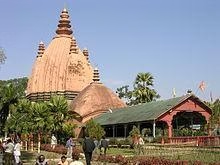
In the heart of Assam’s historic city lies the Sivasagar Sivadol, a monumental testament to faith, architectural grandeur, and the syncretic history of the Ahom dynasty. Officially known as the ‘Group of Monuments,’ this complex is centered around the Sivadol (Temple of Lord Shiva), alongside the Vishnudol (Vishnu Temple) and Devidol (Durga Temple). Rising majestically from the banks of the Sivasagar tank (Borpukhuri), the Sivadol stands as one of the tallest Shiva temples in India, reaching for the heavens at 104 feet.
Deity and Form: The central deity is a Swayambhu (self-manifested) Shiva Linga, known as Bholoknath. Unlike many ancient sites where the original form is lost to time, the Linga here remains a potent center of energy, representing the formless Absolute (Nirguna) with a concrete form (Saguna) for the devotee’s focus.
Phalaśruti (Spiritual Benefits): According to temple records and Puranic legends, a circumambulation (Pradakshina) of the Sivadol is believed to wash away the sins of a lifetime. Devotees flock here specifically for the cleansing of ancestral karma (Pitra Dosha Nivaran). It is said that offering a single sesame oil lamp (deepa) within the sanctum grants longevity and prosperity. The tank itself, filled with 365 sacred theerthas (water sources), is considered as holy as the river Ganges, making it a vital stop for the Panchakroshi Parikrama.
Historical Origins & Scriptural Legend
The history of Sivasagar is intrinsically linked to the rise and spiritual evolution of the Ahom Kingdom. While the Ahoms migrated from South China in 1228 AD and originally practiced Buddhism, the dynasty gradually embraced Hinduism, synthesizing it with their Tai traditions.
Builders and Timeline:
According to historical inscriptions and the Buranjis (Ahom chronicles), the massive tank (Borpukhuri) was excavated between 1731 and 1738 AD. The Sivadol complex was completed in 1734 AD under the patronage of Bar Raja Ambika, the queen of Swargadeo Siba Singha (1714–1744). Unlike typical temple construction involving thousands of laborers, the excavated earth from the tank was used to build the temple foundations, creating a harmonious landscape engineering marvel.
Scriptural & Sthala Purana:
While the Shiva Purana details the glory of Shiva Lingas across India, the Sthala Purana (local oral legend) of Sivasagar offers a unique narrative. Legend holds that Queen Ambika, an ardent devotee of Shiva, yearned to construct a temple that would rival the grandeur of the Kailash mountain.
“Tradition holds that the Queen dreamt of the Linga surfacing in the Borpukhuri tank. Upon waking, she ordered the tank’s excavation and discovered the Swayambhu Linga, which was subsequently enshrined in the sanctum.”
The complex reflects the Saktism and Visnuism alongside Saivism, symbolizing the Ahom kings’ acceptance of the Trimurti. The inscriptions on the temple walls, some still legible in Assamese and Tai-Ahom scripts, narrate the glorious reign of Siba Singha and the devotion of Ambika.
Architectural Marvels
The architecture of Sivasagar Sivadol is a rare example of the Ahom Style, which fuses indigenous Assamese, Mughal, and traditional Hindu temple architecture (predominantly Nagara style influences with distinct regional modifications).
- The Shikhara (Tower): The Sivadol features a bell-shaped Shikhara that rises 104 feet to the base of the Golden Dome. The dome, added later to protect the structure from heavy monsoon rains, is an 8-foot high conical pinnacle covered in gold, gleaming under the Assamese sun.
- The Mandapa: The temple has a rectangular Mandapa (hall) with towering pillars. The roof is flat, supported by intricate iron columns, a hallmark of Ahom metallurgy.
- Sculptures and Vastu: While the exterior lacks the profuse carvings of South Indian temples (due to the soft alluvial soil of the Brahmaputra valley), the inner sanctum is a study in Vastu Shastra. The layout aligns perfectly with the cardinal directions, ensuring the first rays of the sun fall directly on the Linga during the equinoxes.
- Protection Status: The Sivasagar Sivadol is not a UNESCO World Heritage site but is a protected Monument of National Importance under the Archaeological Survey of India (ASI).
Darshan & Ritual Logistics
The rituals at Sivasagar follow the Agamic traditions. The priests (usually Brahmins of the Assamese community) perform daily offerings with a mix of Ahom rituals and Vedic rites.
Daily Darshan Timings (2026 Schedule)
Assuming the current year is 2026, the following timings apply. Note that timings may vary slightly during festivals.
| Session | Timings | Activity |
|---|---|---|
| Morning | 5:00 AM – 12:00 PM | Mangala Arati, Abhishekam, Pushpa Samput |
| Afternoon | 12:00 PM – 3:00 PM | Sanctum Rest (Cleaning) |
| Evening | 3:00 PM – 8:30 PM | Sandhya Arati, Shayan Darshan |
Key Sevas & Online Booking
To facilitate pilgrims, the Sivasagar Sivadol management has digitized several services for the 2026 season.
- Abhishekam (Ritual Bathing): Performed with Panchamrit (milk, honey, ghee, yogurt, sugar) and holy water. Booking slots open at 5:00 AM IST daily on the official portal.
- Maha Shiva Puja (Archana): Personalized chanting of the 108 names of Shiva. This can be booked for specific durations (11, 21, or 108 minutes).
- Special 2026 Festivals:
- January 28, 2026 (Phalguna Krishna Chaturdashi): Mahashivaratri. The grandest event of the year. Expect millions of pilgrims. An estimated 150 quintals of Belpatra (leaves) and Ganga water are used.
- July 6, 2026 (Ashadha Shukla Pratipada): Opening of the Charak Mela (traditional folk festival).
- October 2, 2026: Durga Puja (Vijaya Dashami) – Special Maha Aarti at Devidol.
How to Book Online: Visit the official Sivasagar Sivadol website or use the ‘Sivasagar Sivadol’ mobile app (launched by Assam Tourism). Navigate to “Seva Services,” select the date, and pay via UPI/Net Banking.
Practical Visitor Guidance
Ensuring a smooth darshan experience requires preparation. Here are essential guidelines:
- Dress Code: Traditional attire is mandatory. Men must wear Dhoti and Angavastram (upper cloth), or full-length trousers with a shirt. Women must wear Saree, Salwar Kameez, or Mekhela Chador. Synthetic shorts and t-shirts are strictly prohibited.
- Photography & Mobiles: Photography is strictly prohibited inside the inner sanctum (Garbhagriha). Mobile phones are allowed in the outer premises but must be silenced. Videography requires prior permission from the ASI office.
- Lockers: Free mobile lockers and shoe storage facilities are available at the main entrance gate. It is advisable to carry minimal cash.
- Accessibility: The temple complex has stone steps. While there is no elevator to the sanctum, wheelchairs are available at the entrance for the mandapa area upon request.
- Crowd Management:
- Best Hours: 8:00 AM to 10:00 AM (post-Mangala Arati) and 4:00 PM (pre-Sandhya Arati).
- Seasonal Advice: Assam winters (Nov-Feb) are pleasant, while summers (April-June) are humid. Carry water and an umbrella during May as temperatures can rise, and the stone flooring reflects heat.
Pilgrimage Connectivity
Sivasagar serves as the anchor for the Upper Assam pilgrimage circuit.
How to Reach
- By Air: The nearest airport is Jorhat Airport (JRH), approximately 55 km away (1.5 hours by taxi). The international airport is Guwahati (GAU), 370 km away.
- By Rail: Sivasagar Railway Station connects to Guwahati and Dibrugarh. Trains like the Kamrup Express and Dibrugarh Rajdhani halt here.
- By Road: Located on the Assam Trunk (AT) Road (National Highway 27). Regular deluxe buses ply from Guwahati (approx. 7-8 hours) and Dibrugarh (approx. 2 hours).
Nearby Sacred Sites
Extend your pilgrimage to these nearby monuments (all within 20 km of Sivasagar):
- Rang Ghar: The “Colosseum of the East,” an Ahom amphitheater located just 2 km from Sivadol.
- Talatal Ghar & Kareng Ghar: The palatial abodes of the Ahom kings in Rangpur, 6 km away.
- Charaideo: The first capital of the Ahoms, located 28 km away, famous for its Maidams (vaulted tombs), often compared to the pyramids of Egypt.
Photo Gallery
Frequently Asked Questions (FAQ)
1. Is there a VIP Darshan entry at Sivasagar Sivadol?
Yes, the temple management offers a “Priority Darshan” pass for senior citizens and specially-abled pilgrims. This can be obtained at the administrative office near the main gate. However, unlike Tirupati, there is no paid VIP entry; all darshans are spiritually equal.
2. What is the significance of the Borpukhuri tank?
The Borpukhuri tank is an artificial reservoir constructed by King Siba Singha. It represents the cosmic ocean. Legend says the tank never overflows or dries up, regardless of the monsoon intensity. Taking a dip in the tank before entering the temple is considered auspicious.
3. Are non-Hindus allowed inside the temple?
Historically, entry was restricted to Hindus. However, due to its status as a protected monument under the ASI, visitors of all faiths can enter the outer premises and view the architecture. Access to the inner sanctum (Garbhagriha) is generally permitted only for Hindus, though this is subject to the prevailing sentiment of the priests on duty.
4. What are the accommodation options in Sivasagar?
There are several government and private lodges. The Assam Tourism Development Corporation (ATDC) runs the Bhorali Stay near the tank. Several private hotels in Sivasagar town offer budget to mid-range facilities. It is advisable to book during Mahashivaratri.
5. Can we perform rituals for deceased ancestors?
Yes, the Sivadol is a powerful site for Shraddha and Pitra Tarpan. Priests located near the northern gate of the tank specialize in these Vedic rituals. Offerings include black sesame seeds (til), water, and pinda.
Contact Details
Official Address:
Sivasagar Sivadol Trust Board,Borpukhuri Tank Area,Sivasagar, Assam 785640, India.
Recent Posts

Shri Kaamkoteeshwar Mandir, Varanasi – History & Significance
In the heart of Kashi, the eternal city of Lord Shiva, where the Ganges flows with celestial grace, stands the Shri Kaamkoteeshwar Mandir. This sacred Sannidhi is not merely a temple but a profound spiritual bridge between the Northern…

ओ सांवरे तूने ही मुझको संभाला – Lyrics & Meaning
ओ सांवरे तूने ही मुझको संभाला – A Prayer to Shyam Origin & Spiritual Essence Why This Bhajan Resonates Devotees chant this when overwhelmed by life’s storms—the refrain ‘तूने ही मुझको संभाला’ is the soul’s sigh of relief: “You…

कथा ये है महाराज मेरे की – Lyrics & Meaning
कथा ये है महाराज मेरे की छत्रपति संभाजी महाराज – A Prayer to Chhatrapati Sambhaji Maharaj Origin & Spiritual Essence Why This Bhajan Resonates Devotees chant this when their spirit feels tested—its powerful refrain “महाराज मेरे” is a soul’s…

Rigveda Samhita Yathartha Anuvada (ऋग्वेद संहिता यथार्थ अनुवाद) – Complete Set with Anvayartha & Hindi/English Translation
The Rigveda is the oldest surviving scripture of humanity and the foundational text of Sanātana Dharma. For serious students, scholars, UPSC aspirants studying ancient Indian history, Sanskrit learners, and spiritual seekers, a precise and grammatically structured translation is indispensable.…

आना भी अकेला है जाना भी अकेला है – Lyrics & Meaning | BharatTemples
आना भी अकेला है जाना भी अकेला है – A Prayer to the Divine Witness Origin & Spiritual Essence Why This Bhajan Resonates Devotees turn to this bhajan in moments of deep reflection—when life’s attachments begin to ache. The…

माता शेरावाली के द्वार जो भी जाता है – Lyrics & Meaning
माता शेरावाली के द्वार जो भी जाता है – A Prayer to Maa Sherawali Origin & Spiritual Essence Why This Bhajan Resonates Devotees turn to this bhajan in times of fear or uncertainty—its promise that no one leaves Maa’s…

मार लेना सपणी उबार लेणा भवरा – Lyrics & Meaning
मार लेना सपणी उबार लेणा भवरा – A Prayer to the Divine Beloved Origin & Spiritual Essence Why This Bhajan Resonates Devotees chant this in moments of deep vulnerability—its cry of “मार लेना सपणी, उबार लेणा भवरा” is the…

हमें श्याम सुंदर भरोसा तुम्हारा – Lyrics & Meaning
हमें श्याम सुंदर भरोसा तुम्हारा – A Prayer to Shyam Sundar Origin & Spiritual Essence Why This Bhajan Resonates Devotees chant this when feeling alone—its refrain ‘de do sahara’ is the soul’s cry for divine support. Lyrics in Hindi…

Mere Satguru Ne Di Thi Davai Lyrics in Hindi & Meaning
Mere Satguru Ne Di Thi Davai: Invoking the Guru’s Liberating Wisdom This soul-stirring bhajan venerates the Satguru (True Spiritual Master) as the divine physician who dispenses the only remedy for life’s deepest sufferings. Composed by Sant Karmaveer Tufani, it…

Janm Diyo Thari Maa Dukh Dekhiyo Lyrics in Hindi & Meaning
जन्म दियो थारी माँ दुख देखियो (Maa’s Grief Upon Birthing You) This soul-stirring Chetavani Bhajan (admonitory hymn) is addressed to the Divine Mother (Maa) – a call for repentance when children forget their filial duties in the dark age…